BEIJING, China — October 31, 2026
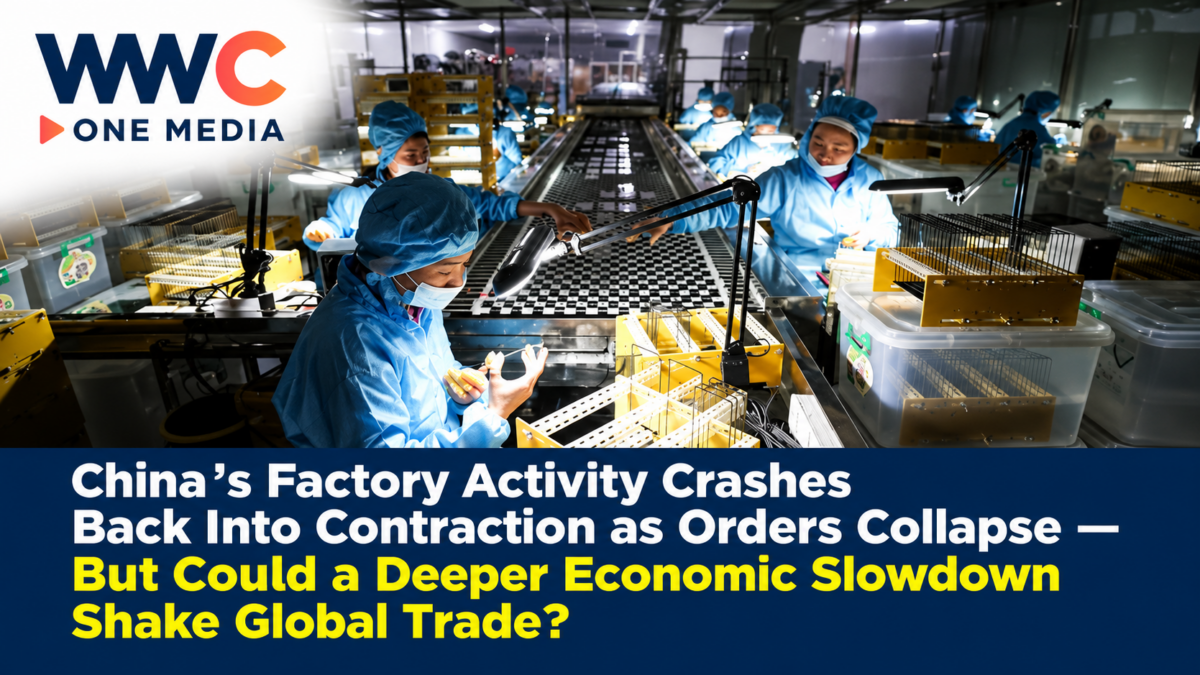
China’s manufacturing sector unexpectedly slipped back into contraction in October, delivering another warning that the world’s second-largest economy is struggling to sustain its recovery despite strong exports, technology investment and government support.
Official figures released Saturday showed that China’s manufacturing purchasing managers’ index (PMI) declined to 49.3 in October from 50.1 in September, its weakest reading in three months.
The result was below the 50-point threshold separating expansion from contraction and weaker than the approximately 50.0 reading forecast by economists surveyed by Reuters.
But the deterioration extended well beyond factories.
China’s non-manufacturing PMI, covering services and construction, dropped to 49.7 from 50.2, while construction activity plunged to 48.0 and services slipped to 50.0, signaling stagnation.
The composite PMI output index also fell to 49.7 from 50.7, indicating broader weakening across the country’s business sectors.
The latest National Bureau of Statistics data, corroborated by Reuters and The Wall Street Journal, show that September’s tentative improvement has given way to renewed pressure on production, orders and investment-related activity.
For Beijing, the challenge is becoming increasingly difficult: Can China’s export-oriented manufacturing industry sustain growth when domestic consumers remain cautious, construction is weakening and international trade tensions continue to intensify?
China’s Manufacturing PMI Falls to 49.3
China’s official manufacturing PMI declined by 0.8 point in October, reversing the previous month’s return to expansion.
In September, the index had climbed to 50.1, offering optimism that industrial conditions were improving after weakness during July and August.
The latest reversal suggests that recovery has yet to establish sustained momentum.
The manufacturing PMI is compiled using monthly surveys of purchasing managers and measures changes in business conditions, including production, new orders, inventories, employment and supplier deliveries.
A reading above 50 generally signals expansion from the previous month.
A reading below 50 indicates contraction.
The October figure therefore suggests that manufacturing conditions deteriorated compared with September.
It does not mean China’s factories collectively lost 0.7% of their output or that the country’s industrial sector has contracted by that amount.
The index is a survey-based indicator rather than a direct measure of total industrial production.
September’s Factory Recovery Has Already Reversed
Just one month earlier, the economic picture appeared more encouraging.
WWC ONE MEDIA reported on the recovery in China’s Factory Activity Returns to Growth as Global AI Boom Boosts Demand.
That report examined September’s rise in the official manufacturing PMI to 50.1, supported by improved production and demand related to technology manufacturing.
The October figures now show how fragile the rebound was.
Factory activity had already contracted during July and August.
The return to expansion in September lasted only one month before the index dropped again.
This pattern suggests that China’s manufacturing sector is experiencing uneven demand rather than a consistent improvement.
It also highlights why economists track several months of PMI readings alongside industrial production, investment and trade data.
A single positive month is insufficient to establish a lasting economic recovery.
New Orders Drop as Domestic Demand Weakens
One of the most concerning components of October’s report was the decline in new factory orders.
China’s manufacturing new orders index fell to 49.4 from 50.5 in September.
The movement returned new orders to contraction territory.
Manufacturers depend on incoming orders to determine production schedules, inventory requirements and hiring decisions.
When new orders weaken, companies may reduce output, postpone investment or become more cautious about purchasing raw materials.
The production index also declined sharply.
It fell to 49.8 from 51.7, suggesting that factory output conditions weakened from the previous month.
The two figures point toward the same underlying problem.
Businesses are receiving less favorable demand signals, and production is adjusting accordingly.
China’s domestic economy has struggled with subdued household confidence and prolonged property-sector weakness.
These conditions can limit consumer purchases and business investment.
However, the PMI alone cannot determine precisely how much of October’s slowdown resulted from domestic demand compared with external trade pressures.
Both appear relevant.
Export Orders Fall Below the Expansion Threshold
China’s manufacturing sector has relied heavily on foreign demand as domestic spending has disappointed.
But October’s official data suggest that even overseas orders are becoming less supportive.
The manufacturing new export orders index declined to 48.7 from 50.0.
That placed the indicator below the expansion threshold.
China remains a dominant supplier of machinery, electronics, electric vehicles, industrial equipment and other manufactured products.
Its export performance is important not only to Chinese companies but also to international supply chains.
Weakening export orders could become a problem if the decline persists.
However, a PMI reading below 50 is not equivalent to a confirmed year-on-year fall in the total value of exports.
Official merchandise trade data are needed to determine actual export shipments and their monetary value.
The October survey instead provides an early warning about manufacturers’ order conditions.
China’s Small Manufacturers Are Feeling Greater Pressure
The latest figures also revealed significant differences between large and smaller manufacturers.
Large enterprises recorded a manufacturing PMI of 50.2, remaining slightly above the expansion threshold.
Medium-sized businesses reported 48.4.
Small enterprises registered just 47.5.
Both medium and small manufacturers remained in contraction territory.
That gap is important because smaller businesses may have fewer resources to withstand weak demand or rising costs.
Large manufacturers can sometimes rely on established financing arrangements, diversified customers and greater economies of scale.
Smaller companies may face more difficulty absorbing changes in input prices or delayed customer orders.
The figures do not mean every small manufacturer is struggling.
They indicate that overall business conditions were weaker among surveyed smaller enterprises than among large companies.
For policymakers, the gap raises questions about whether economic support is reaching businesses across the industrial sector.
Construction Activity Plunges to 48.0
Manufacturing was not China’s only source of weakness.
The official construction business activity index fell sharply to 48.0 from 50.3 in September.
The decline of 2.3 points placed construction firmly in contraction territory.
China’s property market has faced years of pressure involving developer debt, unfinished projects, weaker homebuyer confidence and subdued investment.
Construction activity is also influenced by infrastructure spending and public investment.
Weakness in these industries can affect demand for steel, cement, copper, machinery and other materials.
That creates consequences for suppliers inside and outside China.
Economists have also pointed to weak infrastructure investment as a problem for the broader economy.
Reuters reported ahead of the October release that infrastructure investment had declined 4.2% during the first nine months of 2026.
The construction PMI adds to concerns that investment-related activity has not yet recovered.
Services Stall as Broader Business Conditions Deteriorate
China’s services sector also lost momentum.
Its services business activity index declined to 50.0 from 50.2.
At exactly 50, the indicator sits on the boundary between expansion and contraction.
This suggests that the sector was broadly stagnant rather than clearly expanding or contracting.
The headline non-manufacturing PMI, which combines services and construction, fell to 49.7.
New orders in the broader non-manufacturing sector also weakened, falling to 44.4 from 46.5.
The construction new orders index was particularly weak at 40.0.
These figures indicate a significant deterioration in business demand, even though some individual service industries continued growing.
China’s statistics agency identified areas such as internet software, information technology and transport-related services among the relatively stronger performers.
The mixed results show that China’s economy is not weakening uniformly.
Technology and selected services continue demonstrating resilience while construction and other activities face substantial pressure.
Why China Is Struggling Despite Its Manufacturing Power
China possesses an industrial production system with few global equivalents.
It produces large quantities of vehicles, batteries, electronics, solar equipment, industrial machinery and consumer goods.
But the country’s enormous manufacturing capabilities have also generated international debate over excess capacity.
WWC ONE MEDIA previously examined this issue in China Is Producing More Cars, Batteries and Goods Than Ever — But the Numbers Reveal Why the West’s ‘Overcapacity’ Case Isn’t So Simple.
That report explored competing views about China’s industrial expansion.
Western policymakers have argued that government support and excess production capacity can distort international markets.
Beijing maintains that its manufacturers have developed legitimate competitive advantages through innovation, scale and efficient supply chains.
The October PMI figures do not resolve that debate.
But they demonstrate that significant production capacity does not guarantee strong factory demand.
When domestic and international orders weaken, manufacturers can face underutilized facilities and pressure on profitability.
China’s Automotive Industry Reveals a Bigger Demand Problem
The automobile industry provides one example of the gap between production capacity and consumer demand.
Chinese automakers have expanded aggressively into overseas markets as competition at home has intensified.
WWC ONE MEDIA examined this trend in China Exports Over 7 Million Cars as Domestic Sales Plunge 22% — But Is Its Auto Industry Heading for a Global Trade War?.
The article discussed strong overseas vehicle shipments alongside weakness in China’s domestic passenger-car market.
The contrast illustrates how export growth can support factories when local buyers are spending less.
But reliance on foreign markets introduces additional risks.
Governments may impose tariffs or other trade restrictions.
Foreign competitors may challenge pricing practices.
And manufacturers must invest in overseas dealerships, distribution networks and customer support.
If export orders weaken while domestic demand remains sluggish, Chinese manufacturers could face pressure from both directions.
Trade Disputes With Europe Add to Manufacturing Uncertainty
China’s export strategy has attracted increasing scrutiny in Europe.
Governments are examining the effect of Chinese vehicle imports and industrial competition on domestic manufacturers.
WWC ONE MEDIA previously reported on the tensions in China Rejects EU Demand to Cap Hybrid Car Exports — Is a New Trade War About to Explode?.
The report explored differences between Beijing and Brussels over vehicle trade and the wider European trade deficit with China.
For Chinese manufacturers, international market access is particularly important when domestic demand slows.
But trade barriers can reduce the profitability of overseas sales or force companies to change their distribution strategies.
For foreign economies, the debate involves protecting industrial employment while maintaining competition and access to affordable products.
The October factory slowdown increases the importance of these trade relationships for Beijing.
However, the official PMI release does not establish that any particular European trade dispute directly caused the October decline.
AI Manufacturing Remains a Bright Spot, but Risks Are Growing
China’s economy has also benefited from international demand associated with artificial intelligence.
High-performance electronics, computing infrastructure and related industrial equipment have supported activity in some technology segments.
However, the global AI investment cycle is facing financial questions.
WWC ONE MEDIA reported on those concerns in Asian Chip Stocks Plunge as Amazon’s AI Spending Sparks Funding Fears — But Could the $2.1-Trillion Data Center Boom Be at Risk?.
The article examined investor concerns about the enormous spending commitments of technology companies.
China’s AI-related manufacturing industries are not identical to the semiconductor businesses discussed in that report.
Nevertheless, both operate within a technology supply chain influenced by investment decisions from major customers.
If global companies reduce or delay infrastructure spending, some technology suppliers could eventually face weaker orders.
Conversely, sustained demand could continue supporting parts of China’s high-tech manufacturing sector.
For now, China’s PMI data suggest that strength in selected industries has not prevented broader industrial weakness.
Rising Energy Costs Add Another Challenge
October’s survey also highlighted pressure from international energy prices.
China’s statistics agency noted elevated price indicators in industries such as petroleum processing, chemical fibers and rubber and plastic products.
Higher input costs can reduce profit margins if manufacturers cannot raise their selling prices.
Alternatively, businesses may pass increased costs to buyers, depending on competitive conditions.
This creates another challenge for manufacturers already facing weaker demand.
The combination of rising production expenses and fewer orders can make expansion less attractive.
Energy-price volatility may also affect global supply chains, particularly for industries that depend on fuel-intensive transportation or processing.
But the extent to which increased energy costs contributed to October’s overall PMI decline cannot be precisely determined from the headline index alone.
Beijing Faces Growing Pressure to Support the Economy
China’s policymakers have already introduced measures intended to support investment and business activity.
Authorities have directed credit toward selected sectors and made additional financing resources available to local governments.
Reuters reported that Beijing allocated approximately 550 billion yuan in unused government debt quotas to support local finances and investment.
Officials are also developing longer-term policies to encourage domestic demand.
The latest PMI figures may intensify discussion about whether additional support is required.
Possible policy approaches include measures affecting infrastructure investment, household consumption, property-market conditions and financing availability.
However, the Chinese government has not automatically committed to a new stimulus package simply because the October PMI fell.
Any additional measures would require official announcements.
The effectiveness of policy support will also depend on whether it generates sustainable demand rather than merely adding production capacity.
What China’s Slowdown Means for the Philippines
China’s economic conditions matter to the Philippines through trade, imports, investment and commodity markets.
China is a major supplier of manufactured products used by Philippine businesses and consumers.
It is also an important market for regional exporters and a significant participant in Asian supply chains.
If Chinese manufacturing weakens, demand for some imported materials and components could slow.
This may affect regional trade and businesses connected to industrial production.
At the same time, weaker Chinese domestic demand could influence commodity prices and competition among exporters.
For Filipino consumers, lower export prices for some manufactured goods might eventually support affordability.
But exchange rates, logistics costs, tariffs and local distribution expenses could offset those benefits.
A weak Chinese PMI does not automatically mean Philippine consumer prices will decline.
The actual effects depend on the products involved and broader market conditions.
Global Markets Will Watch China’s November Data
October’s economic results raise several questions for investors.
Will factory new orders recover?
Can construction activity stabilize?
Will Chinese consumers increase spending?
Can exports remain strong despite weaker new export orders?
And will policymakers announce additional support?
The next official PMI survey, industrial production reports, retail sales data and trade figures will provide further evidence.
It will also be important to distinguish China’s official PMI from private-sector surveys, which can cover different groups of manufacturers and sometimes produce different readings.
One survey should not be treated as a complete measure of the country’s economic output.
But when manufacturing, construction, services and new orders all weaken simultaneously, the combined signal deserves attention.
The Bigger Question: Is China’s Recovery Losing Momentum?
October’s results reveal a difficult economic picture.
Manufacturing has returned to contraction.
Production and new orders are weakening.
Construction has fallen sharply.
Services are stagnating.
And the broader composite output index is below 50.
China remains a major industrial power with strong capabilities in electric vehicles, renewable energy, advanced manufacturing and technology.
Those strengths could help support future growth.
But they do not eliminate challenges involving domestic consumption, property investment and external demand.
The country must find a way to sustain production while creating sufficient demand for the goods and services its businesses provide.
The Bottom Line
China’s official manufacturing PMI fell to 49.3 in October 2026, down from 50.1 in September and below economists’ expectations.
The production index dropped to 49.8, new orders declined to 49.4 and new export orders weakened to 48.7.
Non-manufacturing activity slipped to 49.7, with construction falling to 48.0 and services easing to 50.0.
The composite PMI output index declined to 49.7.
These figures suggest that September’s economic recovery lost momentum as weakness spread across manufacturing and other business activities.
But they do not establish that China is in a recession or that its annual economic output has declined.
As Beijing confronts weakening factories, falling orders and an increasingly fragile construction sector, one question could shape the next chapter of the world’s second-largest economy: Can China revive domestic demand before the industrial slowdown spreads further—or will its massive manufacturing machine become increasingly dependent on overseas buyers just as global trade tensions intensify?