
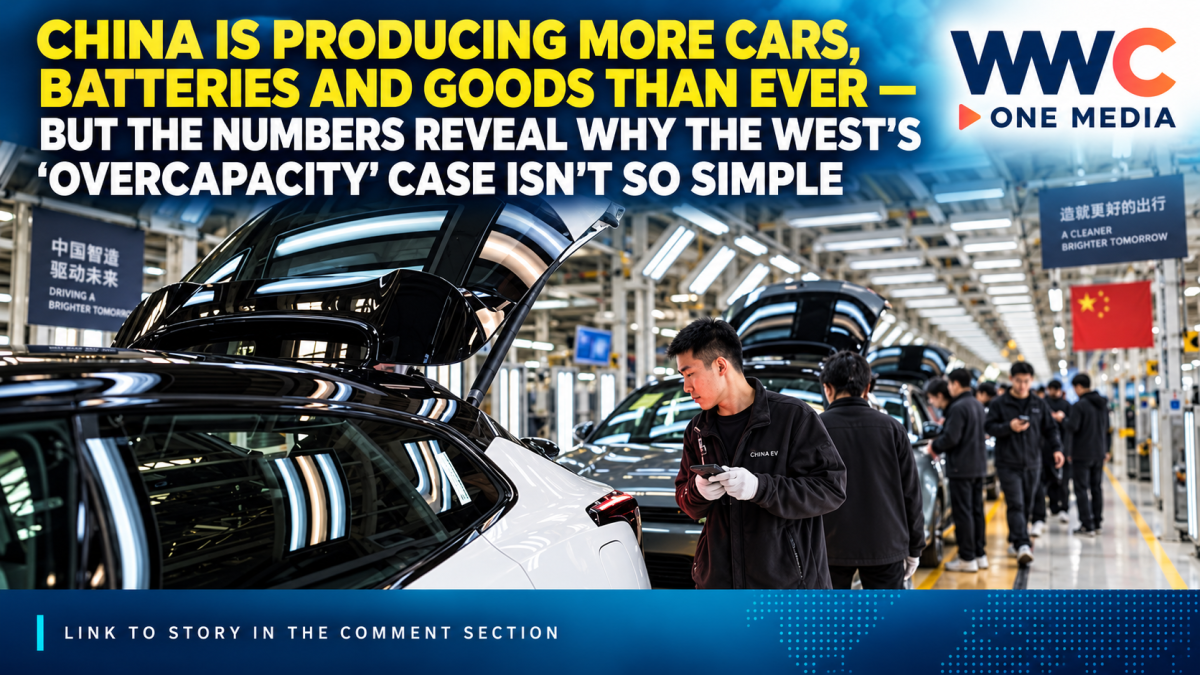
BEIJING/WASHINGTON/BRUSSELS — A battle over Chinese factories has rapidly become one of the biggest economic confrontations of 2026.
Washington says China is producing too much.
Europe says a flood of subsidized Chinese goods threatens its industrial base.
Beijing says Western governments are using the language of “overcapacity” to disguise protectionism against increasingly competitive Chinese companies.
And the numbers suggest an uncomfortable conclusion: there is evidence supporting parts of all three arguments.
The dispute has moved well beyond electric cars and solar panels. It now sits at the heart of negotiations among the world’s largest economies as governments struggle with China’s enormous trade surplus, weak domestic consumption and manufacturing system capable of producing goods at a scale few competitors can match.
At a G20 finance gathering in the United States this week, every participant except China backed language aimed at confronting non-market policies and excessive reliance on exports, according to Reuters. U.S. Treasury Secretary Scott Bessent has argued that China’s enormous export surplus is unsustainable and risks redirecting increasingly cheap Chinese products into markets around the world.
China rejects that characterization. Its central bank governor said Beijing does not deliberately pursue a trade surplus and is working to strengthen domestic demand.
Behind the rhetoric is a question with enormous consequences:
Is China unfairly producing far more than its economy can consume—or has it simply become better at manufacturing many of the products the rest of the world wants to buy?
China’s $1.2 trillion surplus has changed the debate
The argument has become harder to ignore because of the sheer scale of China’s export machine.
China ended 2025 with a goods trade surplus approaching $1.2 trillion, a record, even as exports to the United States weakened under trade restrictions. Chinese companies compensated by selling more aggressively into Europe, Southeast Asia, Africa and Latin America.
The European Union has become particularly alarmed.
China’s goods surplus with the EU reached €360.6 billion in 2025, up roughly 15% from the previous year, and continued expanding during the opening months of 2026.
EU Trade Commissioner Maroš Šefčovič has now demanded tangible progress from Beijing by October and warned that a failure to rebalance the relationship could produce “harsher measures.”
That makes this much bigger than a theoretical argument among economists.
A new round of trade barriers may be coming.
Washington is considering another China tariff—but 7.5% is not yet in force
The United States is also moving toward another trade action.
President Donald Trump’s administration has been considering an additional 7.5% tariff on Chinese imports tied to an investigation into alleged industrial excess capacity.
But there is an important accuracy point: the 7.5% tariff has been discussed and reported as a proposed measure, not a tariff already imposed.
AP reported in late August that administration officials were considering the rate as Washington attempts to address what it views as China’s dumping of underpriced manufactured goods into world markets.
The distinction matters because trade policy remains part of wider negotiations ahead of expected meetings between Trump and Chinese President Xi Jinping.
Washington’s argument is straightforward: America’s tariff wall has already reduced direct Chinese access to the U.S. market, but that can push Chinese factories to redirect output toward Europe, Latin America and Asia instead.
Bessent has therefore urged other economies to consider their own responses rather than allowing displaced Chinese exports simply to move elsewhere.
Electric vehicles provide the strongest evidence for both sides
Nowhere is the dispute clearer than in electric cars.
China produced about 16 million electric cars in 2025, representing nearly three-quarters of global EV production, according to the International Energy Agency.
That alone does not prove overcapacity.
But another IEA number gets closer to the heart of the argument: Chinese EV output in 2025 exceeded domestic demand by about 20%.
Chinese electric-car exports consequently doubled to more than 2.5 million vehicles.
And the trend became even stronger in 2026.
During the first half of this year, overall Chinese car sales fell more than 20% from a year earlier, while exports jumped roughly 65%. Electric-car exports increased by more than 120%, according to IEA analysis.
For Western governments, that looks like textbook evidence of factories relying increasingly on foreign markets because China’s domestic economy cannot absorb everything they produce.
There is another warning sign.
The IEA estimates that Chinese EV exports in 2025 exceeded actual overseas sales by more than 25%, suggesting inventories were accumulating outside China.
That provides substantially stronger evidence for the overcapacity argument than simply pointing to China’s market share.
But huge exports can also mean huge competitive advantage
There is another side to those same figures.
People around the world are actually buying Chinese electric cars.
China has built enormous advantages in batteries, power electronics, electric drivetrains, mineral processing and integrated supply chains.
The country produced more than 80% of the world’s battery cells in 2025 and even larger shares of some battery materials.
Its factories operate on a scale many Western automakers cannot easily reproduce.
So high output does not automatically mean economically irrational output.
If Chinese companies can manufacture an electric vehicle for less money and consumers in Southeast Asia, Europe or Latin America choose to buy it, that is also simply international competition.
More than half of electric cars sold in Southeast Asia in 2025 came from Chinese brands, according to the IEA.
The difficult policy question is determining how much of China’s price advantage comes from better technology and scale—and how much comes from state support unavailable to foreign rivals.
The IMF says the subsidies are real—and enormous
Here Western governments have stronger evidence.
The International Monetary Fund says China continues to use industrial policy extensively across strategic sectors.
IMF staff estimated that grants, tax benefits, subsidized credit, inexpensive land and related support for priority industries carried an equivalent fiscal cost of around 4% of Chinese GDP as of 2023.
The IMF warned that those policies can encourage excessive production, duplicate investment and economic distortions.
Its 2026 assessment was particularly clear: industrial support combined with weak Chinese domestic demand has accelerated manufacturing production, pushed export prices lower and increased China’s dependence on exports for growth.
That does not mean every low-priced Chinese product is subsidized.
But it makes it difficult to dismiss Western concerns as nothing more than fear of competition.
Europe already found subsidies in Chinese EVs
The European Union went further by conducting a formal anti-subsidy investigation.
The European Commission concluded in 2024 that China’s battery-electric vehicle supply chain benefited from unfair state support that threatened economic injury to European manufacturers.
It subsequently imposed additional countervailing duties of:
- 17% on BYD
- 18.8% on Geely
- 35.3% on SAIC
- 7.8% on Tesla’s China-made vehicles, under its individual rate
Those duties were placed on top of the EU’s standard car import tariff, although Brussels has since allowed some manufacturers to negotiate alternative minimum-price arrangements.
That is important because even Western companies are caught inside the dispute.
Tesla exports cars from Shanghai. BMW manufactures some models in China. Volkswagen’s Cupra has also shipped Chinese-built vehicles into Europe.
In other words, “Made in China” does not necessarily mean “Chinese-owned.”
One Asia Times number needs correcting
The Asia Times commentary makes an important point about foreign companies’ role in China’s manufacturing system, but one of its headline trade figures needs qualification.
The article states that China’s 2025 goods trade totaled approximately $6.8 trillion.
Official Chinese statistics put the value at 45.47 trillion yuan, or about $6.48 trillion using the conversion cited by the Chinese government.
Foreign-invested enterprises conducted 13.27 trillion yuan of imports and exports during the year—roughly 29% of China’s total merchandise trade.
That remains a major share.
But it has fallen substantially over time as Chinese private companies have become more dominant.
Private Chinese enterprises represented 57.3% of China’s total merchandise trade in 2025, according to official statistics.
So foreign companies remain deeply embedded in China’s industrial ecosystem, but they no longer provide a complete explanation for China’s export boom.
Private company does not necessarily mean unsubsidized company
This is another crucial distinction.
Arguments against the overcapacity narrative sometimes contrast privately owned Chinese companies with state-owned enterprises.
But ownership alone does not settle the subsidy question.
A privately owned EV or battery company may still receive tax incentives, inexpensive industrial land, policy-bank financing, local-government grants or other state-supported benefits.
That is why the real economic debate is not simply:
state-owned versus private.
It is:
how much government policy changed the amount of production that would otherwise have existed—and whether that production is damaging foreign industries unfairly.
Those questions are considerably more difficult to answer.
Europe itself cannot agree on how aggressive to become
Even inside the EU, there is no unified appetite for a full-scale trade confrontation.
France and some other governments have pressed for tougher defensive measures.
Germany and Spain have been more cautious because of the depth of their commercial exposure to China.
German industry illustrates the dilemma.
A recent survey found 83% of German industrial companies reporting stronger competitive pressure from Chinese rivals. Yet most did not intend to abandon their sectors. Instead, companies said they planned to innovate, reduce costs and seek new markets.
At the same time, 55% supported stronger EU measures against market distortions.
That is perhaps the most revealing response to the China challenge.
Businesses themselves appear to believe that both things can be true: Chinese competitors may be benefiting from distortions, while also genuinely becoming better competitors.
So is it overcapacity or protectionism?
The answer depends partly on the industry.
In some sectors, the evidence of excess production is difficult to dismiss.
Chinese EV production exceeded domestic demand. Export volumes exploded as domestic sales weakened. Inventories accumulated overseas. Subsidies and industrial-policy support remain substantial.
Those are legitimate warning signals.
But equating every Chinese export advantage with “overcapacity” goes too far.
China has also created real technological, logistical and cost advantages that allow its companies to make products more efficiently than many competitors.
And tariffs do more than correct subsidies.
They also protect domestic manufacturers from cheaper foreign products—even when part of the price advantage comes from genuine efficiency.
That is where the line between trade defense and protectionism begins to blur.
The next phase could reshape global manufacturing
The stakes are enormous because this dispute extends beyond cars.
Steel, solar panels, batteries, machinery, electronics, chemicals and critical minerals are all increasingly part of the conversation.
And emerging economies could become the next battleground.
If the United States and Europe erect stronger barriers, Chinese manufacturers will have an even greater incentive to sell—and increasingly manufacture—in Southeast Asia, Latin America, the Middle East and other fast-growing regions.
The IEA already estimates that Southeast Asia hosts more than half of Chinese automakers’ overseas vehicle-production capacity, with Thailand and Indonesia among the most important locations.
What begins as a U.S.-China or EU-China dispute could therefore reorganize factories, investment and supply chains across the developing world.
The argument over one word—“overcapacity”—is ultimately an argument over something much larger:
Who gets to manufacture the technologies that will dominate the next generation of the global economy?
And with Washington considering another tariff, Brussels demanding concessions by October and China refusing to accept the West’s diagnosis, that fight is only getting started.
WWC ONE MEDIA M.J.E




Leave a Reply