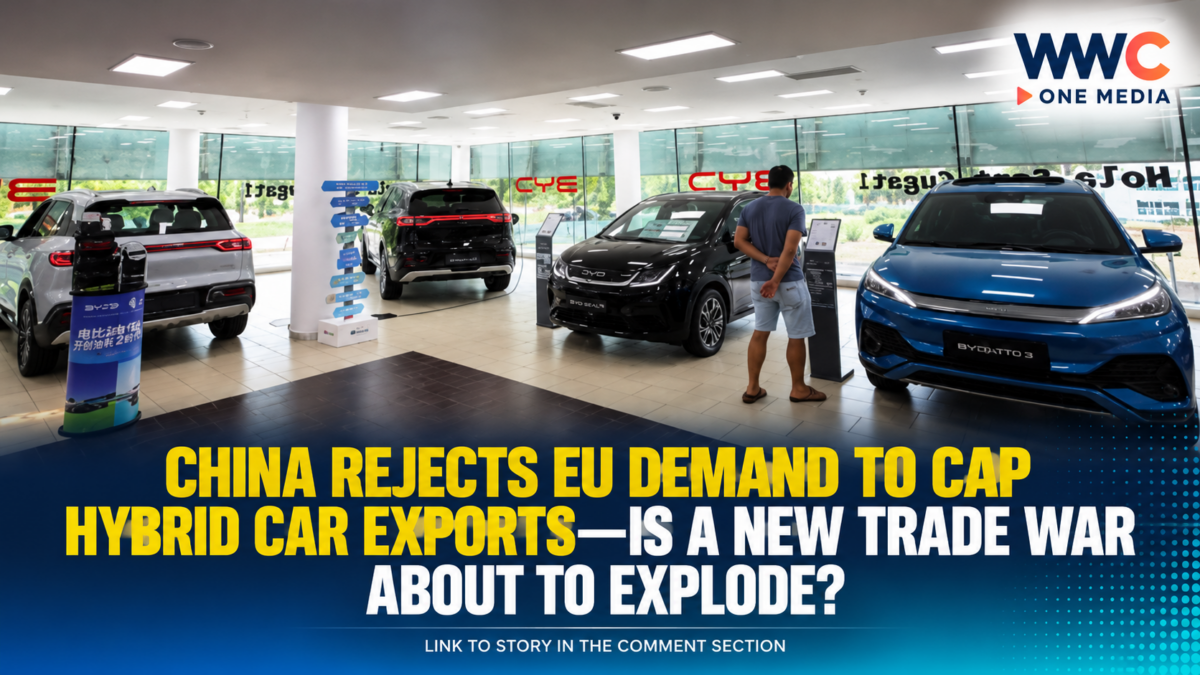
BEIJING — A potentially explosive new front has opened in the European Union’s trade battle with China after Beijing rejected a European request to voluntarily restrict exports of hybrid vehicles to the bloc.
The rejection comes as EU Trade Commissioner Maroš Šefčovič heads to Beijing for critical negotiations aimed at reducing Europe’s enormous trade deficit with China and preventing a broader confrontation.
The stakes are unusually high.
The EU’s goods trade deficit with China has surpassed €1 billion ($1.12 billion) a day, according to Reuters, while Chinese vehicle exports to Europe have surged despite Brussels imposing additional duties on Chinese battery-electric vehicles.
Now Brussels is considering whether to impose its own restrictions on Chinese hybrid imports.
That could turn a dispute over cars into a much wider fight over trade, industrial policy, market access and Europe’s future as a global manufacturing power.
Beijing Says No to Voluntary Export Limits
The Financial Times reported that China rejected the EU’s proposal to voluntarily limit hybrid vehicle exports to Europe.
According to the FT, Brussels had been seeking a ceiling equivalent to roughly 15% of the EU hybrid market, compared with more than one-third of the market currently supplied by Chinese manufacturers.
Beijing had already made clear that it opposed the concept.
China’s Commerce Ministry said in September that so-called voluntary export restrictions violate World Trade Organization rules and conflict with the principles of market competition. Reuters also reported that Beijing warned it would take measures to safeguard the interests of Chinese companies if the EU moved against them.
The latest rejection therefore comes as little surprise.
But the timing makes it much more dangerous.
Brussels Is Running Out of Patience
European officials have spent months trying to find a negotiated solution to the widening trade imbalance.
Šefčovič is scheduled to meet Chinese Commerce Minister Wang Wentao in Beijing as the two sides search for what Brussels calls tangible progress before EU leaders meet in Brussels on October 15-16.
The European Commission’s concern extends far beyond cars.
Chinese exports of machinery, textiles, chemicals and other manufactured products have increased, while European companies continue to face difficulties expanding their sales in China.
Reuters reported that imports of Chinese plug-in hybrid vehicles increased 86% over the previous year, while battery-electric vehicle imports rose 40%.
For European policymakers, the problem is becoming increasingly difficult to ignore.
The EU does not simply see an influx of inexpensive cars.
It sees a potential threat to one of the continent’s most important industrial sectors.
Why Hybrids Have Become the New Flashpoint
The hybrid-car dispute is partly a consequence of Europe’s earlier attempt to protect its electric-vehicle industry.
The EU imposed additional anti-subsidy duties on Chinese battery-electric vehicles in 2024, with rates reaching as high as 35% on top of the bloc’s standard 10% automobile tariff, according to the FT.
But those measures did not cover hybrid vehicles.
Chinese manufacturers subsequently expanded their hybrid exports into Europe.
That has created what European policymakers increasingly regard as a major loophole.
The EU’s own research has documented the rapid rise of Chinese vehicles in the European market. A European Commission Joint Research Centre report found that China’s share of vehicle imports has grown significantly, while Chinese manufacturers have become increasingly competitive on cost and technology.
The shift has been particularly important for companies such as BYD, which has expanded its international presence by selling a mix of battery-electric and plug-in hybrid vehicles.
For European automakers already struggling with high production costs and the transition toward electrification, the surge represents another challenge.
The EU Could Impose a Safeguard Instead
China’s refusal leaves Brussels with a difficult choice.
According to the FT, European officials are now considering a temporary “safeguard” measure that could restrict the number of Chinese-made hybrids entering the EU.
Under the approach being discussed, a limited quantity of vehicles could enter at normal conditions, while imports above an agreed threshold could face an additional tariff.
That would effectively create a tariff-rate quota.
The mechanism would be politically explosive because it could be imposed even without proving that Chinese companies engaged in unfair trade practices in the traditional anti-dumping or anti-subsidy sense.
And there is another complication.
Such a safeguard could also affect hybrid vehicles manufactured in countries such as Japan, South Korea and the United Kingdom, depending on how Brussels designs the measure.
That could make the policy considerably more complicated than simply targeting China.
Beijing Has Already Warned Europe
China’s response has been unusually firm.
Its Commerce Ministry has argued that voluntary export restrictions would undermine fair competition and violate WTO principles. Beijing has also called on Europe to maintain an open and non-discriminatory market for companies from all countries.
That puts Brussels in a difficult position.
The EU wants to reduce Chinese industrial pressure without triggering retaliation.
China, meanwhile, has little incentive to voluntarily restrict exports from one of its fastest-growing industries.
And the European automotive industry is under increasing pressure.
The result is a classic trade-policy dilemma:
Europe wants fewer Chinese cars without starting a trade war over Chinese cars.
Europe’s Trade Deficit Has Become the Bigger Story
The hybrid dispute cannot be separated from the broader EU-China trade imbalance.
The European Union’s goods deficit with China has grown to more than €1 billion every day, according to Reuters. European Commission President Ursula von der Leyen has described the imbalance as reaching a tipping point and has warned that the bloc needs to rebalance its economic relationship with Beijing.
For Brussels, this is no longer simply about individual products.
It is about whether European manufacturing can remain globally competitive.
Germany and France have become particularly vocal.
The two countries recently urged the EU to develop a stronger mechanism capable of responding rapidly when foreign governments or companies threaten European industries or restrict access to critical supplies.
That represents an important political shift.
Germany has traditionally been one of Europe’s strongest advocates of maintaining deep economic ties with China.
Now Berlin is increasingly concerned that Chinese industrial competition could weaken the foundations of Germany’s manufacturing economy.
Germany and France Want a New “Kill Switch”
Germany and France have proposed a new trade instrument that could give Brussels much faster powers to respond to economic pressure.
The proposal is designed to complement existing EU trade-defense tools and could, in extreme circumstances, allow the bloc to restrict access to its single market.
The measure is officially framed as country-neutral rather than specifically anti-China.
But the political context is unmistakable.
European leaders are increasingly worried about Chinese industrial overcapacity, critical-mineral restrictions and the growing dependence of European supply chains on China.
The hybrid-car dispute is therefore becoming a test case for whether Europe is prepared to use its enormous consumer market as leverage.
China’s Counterattack Could Come Elsewhere
A European decision to restrict Chinese hybrids could invite retaliation.
Beijing has already demonstrated its willingness to respond to European trade measures.
The FT reported that China has imposed anti-dumping measures affecting EU products including cognac, pork and dairy goods.
China also controls important parts of the global supply chain for rare earths and critical minerals.
Those materials are crucial to industries ranging from automobiles and renewable energy to electronics and defense.
Reuters reported that EU-China negotiations are also dealing with Chinese restrictions on exports of rare-earth magnets and other critical materials.
That means the dispute could quickly expand beyond automobiles.
A fight over hybrids could eventually become a fight over technology, minerals, industrial machinery and market access.
Europe Has a Problem China Cannot Easily Solve for It
The deeper issue is competitiveness.
Chinese automakers have invested heavily in batteries, electric drivetrains, software and manufacturing efficiency.
The European Commission’s Joint Research Centre has found that Chinese vehicles are increasingly competitive because of lower costs, while European manufacturers retain advantages in some areas of performance and technology.
That leaves European policymakers facing an uncomfortable question:
How much protection can Europe provide before protection itself becomes a substitute for competitiveness?
Tariffs and quotas can slow imports.
They cannot automatically make European cars cheaper.
They cannot instantly create cheaper batteries.
And they cannot guarantee that consumers will prefer European vehicles if Chinese manufacturers offer better prices or technology.
Chinese Automakers Are Adapting Fast
There is another reason Brussels is nervous.
Chinese automakers have repeatedly demonstrated an ability to adapt when trade barriers change.
After the EU introduced additional duties on Chinese battery-electric vehicles, Chinese manufacturers increased their focus on hybrids, which were outside the scope of those measures.
That experience has changed the way European officials think about trade restrictions.
If Brussels closes one route into the market, manufacturers may simply redirect investment, alter product mixes or build factories inside Europe.
The UK is facing a similar dilemma.
The Guardian reported that Chinese automakers including BYD, Omoda and Jaecoo have rapidly expanded their presence in Britain, creating a difficult policy choice for London between protecting domestic manufacturers and maintaining access to affordable vehicles and Chinese investment.
Europe May Be Entering a New China Policy Era
The most significant development may therefore be political rather than automotive.
Europe’s approach toward China is hardening.
For years, many European governments tried to balance economic cooperation with concerns about strategic dependence.
Now the emphasis is shifting toward economic security.
Germany’s willingness to consider stronger trade-defense measures is particularly important because German companies have historically depended heavily on the Chinese market.
France has also pushed for stronger European industrial defenses.
Together, the two countries are signaling that Brussels may be entering a more confrontational phase of its China policy.
The October Talks Could Decide What Comes Next
The immediate test is the Beijing negotiations.
Šefčovič wants tangible progress that can be presented to EU leaders later this month.
But China’s rejection of voluntary hybrid export limits suggests that compromise may be difficult.
If Beijing refuses to limit shipments, Brussels could move toward a safeguard mechanism.
If Europe imposes quotas or additional tariffs, China could retaliate.
And if retaliation spreads to other European industries, the dispute could become much larger than the original disagreement over cars.
That is why the current talks matter.
They are not simply another round of negotiations over vehicle exports.
They could determine whether EU-China relations move toward managed competition—or a new cycle of escalating trade barriers.
The Bottom Line
China has rejected the European Union’s request to voluntarily limit hybrid-car exports, leaving Brussels to consider imposing its own restrictions as the two sides attempt to prevent a wider trade confrontation.
The immediate issue is automobiles.
The underlying battle is much bigger.
Europe is struggling with a trade deficit exceeding €1 billion a day, Chinese manufacturers are rapidly gaining ground in European markets, and governments in Berlin and Paris are demanding stronger tools to protect strategic industries.
China, meanwhile, argues that voluntary export restrictions violate the principles of fair competition and WTO rules.
The next move now belongs to Brussels.
If the EU imposes a cap, Beijing could retaliate.
If Brussels backs down, European manufacturers may face even greater Chinese competition.
And that leaves Europe facing the question it has tried to avoid for years: Can it protect its industrial base without turning its biggest trading relationship into an all-out trade war?