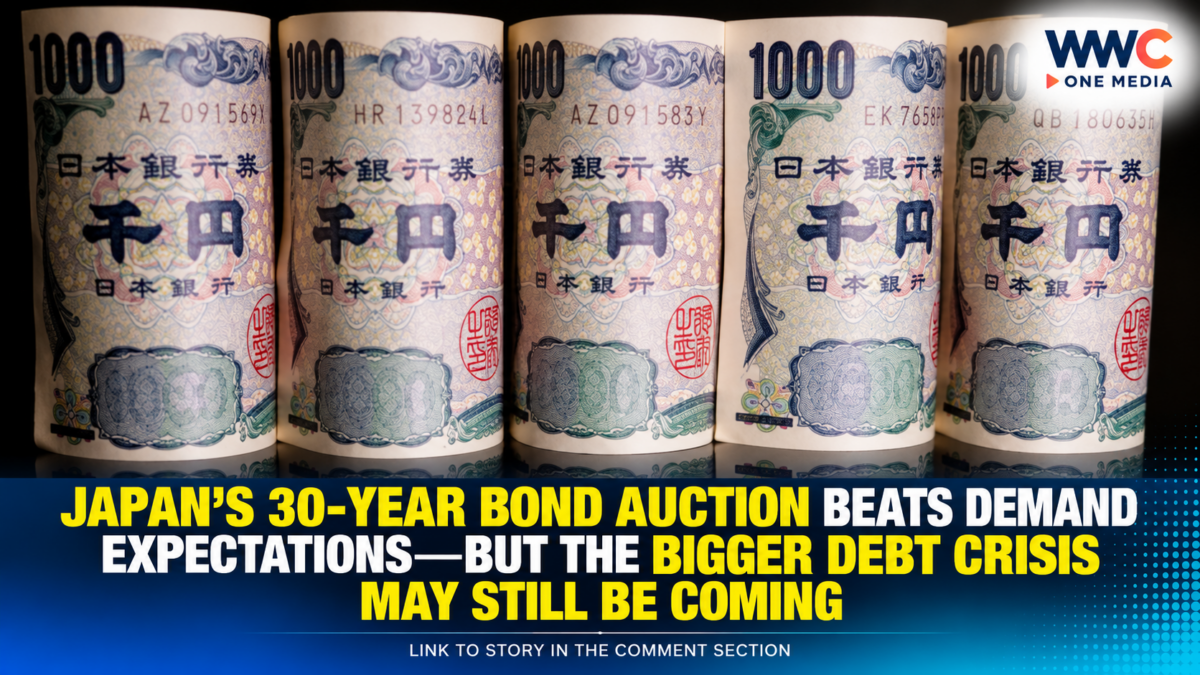
TOKYO — Japan’s bond market just passed one of its most closely watched tests—but investors are not yet convinced the country’s long-term debt problems are under control.
Japan’s Ministry of Finance sold about ¥600 billion ($3.8 billion) of 30-year Japanese government bonds (JGBs) on Thursday, with demand coming in firmer than the market’s recent average despite yields remaining near record levels.
The auction drew ¥1.747 trillion in competitive bids against ¥450.7 billion accepted, equivalent to roughly 3.88 times coverage. That was above the recent 12-month average and slightly stronger than the previous 30-year sale. The weighted-average yield was 4.109%, while the lowest accepted price implied a yield of 4.121%.
The result gave Japan’s battered long-end bond market a temporary boost.
But it also exposed the central dilemma facing Prime Minister Sanae Takaichi’s government and the Bank of Japan:
Investors are still willing to lend to Japan—but they are demanding much higher returns to do it.
A surprisingly strong auction
The 30-year JGB sale had become a major market test after Japanese long-term yields surged to unprecedented levels.
Instead of showing signs of a buyers’ strike, the auction attracted substantial demand.
The roughly 3.88-times bid-to-cover ratio means investors submitted almost four times as many bids as the amount ultimately allocated through the competitive auction.
Japan’s previous 30-year auction on September 3 generated a 3.79 bid-to-cover ratio, with the weighted-average yield at 4.079%.
The latest result therefore suggests that higher yields are beginning to attract buyers who had previously been reluctant to commit to ultra-long Japanese debt.
That is important.
But it does not mean investors have suddenly become comfortable with Japan’s fiscal outlook.
The yield is the warning sign
The most striking number from Thursday’s auction may not be the demand ratio.
It is the 4.109% average yield.
Japan spent decades with government borrowing costs close to zero. The 30-year JGB now offers investors a yield above 4%, reflecting a radically different interest-rate environment.
The 30-year yield had already reached a record 4.235% on October 5, according to Reuters, amid concerns about increased government borrowing and inflation.
The yield subsequently moved back from that peak as the market approached the auction.
That decline matters because bond prices and yields move in opposite directions: when investors buy more aggressively, prices rise and yields fall.
Thursday’s auction therefore delivered a short-term message of reassurance.
There are buyers at these levels.
Japan’s 10-year bond market is sending the same message
The stronger demand was not limited to the 30-year maturity.
On October 6, Japan sold 10-year JGBs in an auction that also showed robust demand.
The Ministry of Finance reported ¥7.401 trillion in competitive bids against ¥1.966 trillion accepted, producing a bid-to-cover ratio of roughly 3.76. The weighted-average yield was 3.101%.
Reuters reported that demand at that sale was the strongest since May, helping Japanese government bonds recover some ground despite continued concerns about fiscal policy.
That combination is significant.
It suggests that investors are not abandoning Japanese government bonds altogether.
Instead, they appear to be saying:
Give us enough yield, and we’ll buy.
That is a much more complicated signal than a simple “strong demand” headline suggests.
Why are Japanese yields rising so sharply?
Several forces are colliding.
1. The Bank of Japan is no longer suppressing borrowing costs the way it once did
Japan’s monetary regime has changed dramatically.
The Bank of Japan’s current policy guideline calls for the overnight call rate to remain around 1.25%, following the September 2026 policy change. The central bank’s next scheduled monetary policy meeting is October 29–30.
That is a completely different environment from the years when negative interest rates and enormous JGB purchases kept yields extraordinarily low.
The BOJ is also gradually reducing its purchases of Japanese government bonds.
That means the private market has to absorb a greater share of Japan’s debt without relying on the central bank to be the dominant buyer.
As a result, yields have become a much more important mechanism for balancing supply and demand.
2. Inflation has changed the investment equation
Japan is also dealing with a more persistent inflation environment than investors became accustomed to during the country’s deflationary era.
Higher inflation means investors demand higher nominal yields to preserve the real value of their money.
That is especially important for 30-year bonds.
Someone buying a Japanese government bond that matures three decades from now faces considerably more uncertainty over future inflation than someone buying a two-year security.
The longer the maturity, the greater the compensation investors can demand.
3. Japan’s government is under pressure to spend
Fiscal policy has become another major source of concern.
Prime Minister Sanae Takaichi has pushed an investment-led economic strategy while also promising to protect households from rising living costs.
But more spending can mean more borrowing.
Reuters reported that Takaichi pledged on October 5 to control bond issuance and respond quickly to market turbulence, attempting to reassure investors worried about Japan’s public finances.
Her comments came after the 30-year JGB yield reached its record high.
That timing was no coincidence.
The bond market is effectively forcing the government to demonstrate that its growth strategy will not translate into uncontrolled debt issuance.
The fiscal math is becoming harder
Japan already carries one of the world’s largest government-debt burdens relative to economic output.
That makes rising interest rates particularly uncomfortable.
When borrowing costs increase, refinancing existing debt becomes more expensive. The effect does not appear immediately across the entire debt stock because much of it has been issued at older, lower rates.
But over time, as bonds mature and are replaced with new securities carrying higher coupons, the government’s interest bill can rise.
That creates a potential feedback loop:
Higher yields → higher debt-service costs → greater fiscal pressure → greater investor concern → potentially even higher yields.
Japan’s policymakers are trying to prevent that loop from becoming self-reinforcing.
Why Thursday’s auction matters beyond Japan
The JGB market is not an isolated corner of global finance.
Japan is one of the world’s largest pools of institutional capital, with banks, insurers, pension funds and other investors holding enormous amounts of domestic and foreign bonds.
When Japanese yields rise, the relative attractiveness of domestic assets changes.
That can influence decisions about whether Japanese investors keep money at home or allocate capital to U.S. Treasuries, European government bonds and other international assets.
The shift is particularly important for global bond markets because Japan has historically been a major source of overseas investment.
If Japanese yields continue rising, some investors may decide that they no longer need to accept the currency and interest-rate risks associated with foreign bonds to obtain attractive returns.
That could potentially reduce demand for overseas debt.
And then there is the yen
Japan’s bond market and currency market are closely connected.
Higher Japanese yields can make yen-denominated assets more attractive, potentially supporting the yen.
But if investors believe higher yields are primarily a consequence of deteriorating fiscal conditions, the effect can be much more complicated.
A country can offer higher yields because its economy is strengthening.
Or it can offer higher yields because investors are demanding additional compensation for risk.
The distinction is critical.
Japan wants the first scenario—not the second.
The BOJ now faces a delicate balancing act
The Bank of Japan has to navigate between two opposing risks.
If it raises rates too slowly, inflation and yen weakness could remain problematic.
If it raises rates too aggressively, borrowing costs could rise sharply for households, businesses and the government.
The bond market adds another layer of pressure.
The BOJ is simultaneously trying to normalize monetary policy while reducing its role as a massive buyer of Japanese government bonds.
That means policymakers have to watch not only inflation and economic growth, but also the functioning of the JGB market itself.
The central bank’s own data show that it continues to operate in the JGB market, even as the overall framework moves away from the extraordinary monetary easing of previous years.
Thursday’s auction is a reprieve—not a victory
The strongest interpretation of the auction is therefore not that Japan’s debt problem has disappeared.
It is that investors are willing to absorb long-term Japanese government debt when yields are sufficiently attractive.
That is encouraging.
But it also means Japan is paying substantially more to secure that demand.
The 30-year bond’s average auction yield of 4.109% is dramatically higher than the levels that prevailed during much of Japan’s ultra-loose monetary-policy era.
In effect, the market has delivered two messages simultaneously:
“We will buy.”
And:
“But you will have to pay us.”
The next danger is what happens after the auction
A successful auction can stabilize sentiment for a day.
It cannot determine where yields will be six months or three years from now.
Investors will continue watching:
- BOJ rate decisions, particularly the October 29–30 meeting;
- Japan’s inflation data;
- government spending and bond issuance plans;
- yen movements;
- demand at future 20-, 30- and 40-year JGB auctions;
- and the behavior of Japanese institutional investors.
The long end of Japan’s yield curve will be especially important.
If demand remains healthy while yields stabilize or fall, Thursday’s auction could prove to be an early sign that the market is finding a new equilibrium.
If yields continue climbing despite strong auctions, however, it could indicate that investors are simply demanding more compensation as Japan’s fiscal and monetary regime changes.
A bigger global bond story is unfolding
Japan’s bond-market stress is also arriving at a difficult moment for global fixed income.
U.S. Treasury yields have recently climbed to multi-decade highs, while European government bonds have also faced pressure from inflation and fiscal concerns. Reuters reported this week that sovereign debt markets globally are being challenged by rising government borrowing needs and renewed inflation risks.
That makes Japan’s auction particularly important.
If investors simultaneously demand higher yields from the United States, Japan and European governments, the global cost of capital rises.
And when the world’s biggest bond markets reprice at the same time, the consequences can spread into:
mortgages, corporate borrowing, equities, currencies and emerging-market capital flows.
Japan may therefore be one of the most important places to watch for the next phase of the global bond-market adjustment.
The Bottom Line
Japan’s 30-year JGB auction delivered exactly what policymakers needed: buyers showed up.
The Ministry of Finance sold ¥450.7 billion through the competitive auction from ¥1.747 trillion of bids, producing roughly 3.88-times coverage, while the average yield settled at 4.109%.
That is a considerably better outcome than a weak auction would have been.
But the victory is incomplete.
Japan’s 30-year yield had just reached a record 4.235%, the BOJ is operating with a policy rate around 1.25%, and the government is facing growing pressure to demonstrate fiscal discipline as it pursues a more expansionary economic agenda.
The auction shows that Japan can still borrow.
The unanswered question is how expensive that borrowing will become.
And that is where the next chapter of Japan’s bond-market story could get much more dangerous.