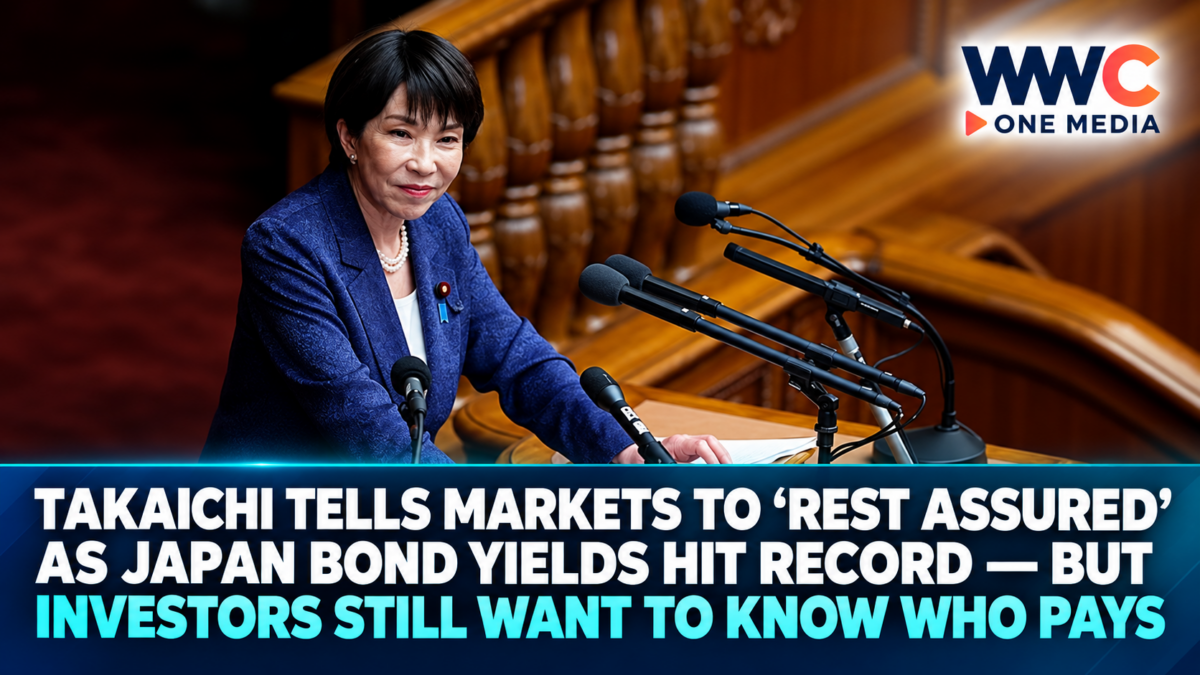
TOKYO — Japanese Prime Minister Sanae Takaichi is trying to convince investors that Japan can spend aggressively, cut taxes and still keep its enormous public debt under control — but the bond market is not fully convinced.
Speaking at the opening of an extraordinary Diet session, Takaichi pledged to manage government finances responsibly, control new bond issuance and respond quickly if financial markets become unstable.
Her message to investors was essentially simple:
Japan can pursue stronger economic growth without triggering a debt crisis.
But markets are demanding proof.
Japan’s 30-year government bond yield surged to a record 4.235%, while the benchmark 10-year yield remained near its highest level in 31 years.
That rise reflects growing concern that Takaichi’s combination of tax cuts, defense spending and large-scale public investment could force Tokyo to issue more debt just as borrowing costs are becoming much more expensive.
Takaichi says investors should not panic
Takaichi told parliament that her government would examine:
inflation;
tax revenues;
interest rates;
debt-servicing costs;
and overall economic conditions
before determining how much new government debt to issue.
She also promised action if unusual financial-market movements emerge.
The prime minister described her approach as “responsible and proactive” fiscal policy, arguing that government spending should generate economic growth strong enough to raise employment, incomes and ultimately tax revenue.
That is the foundation of what markets have increasingly called “Takaichinomics.”
The theory is that Japan should invest more aggressively in strategic sectors rather than focusing primarily on reducing government debt.
Japan wants to spend its way into stronger growth
Takaichi has made economic expansion her government’s top priority.
Her administration wants large public and private investment in areas such as:
artificial intelligence;
semiconductors;
shipbuilding;
defense;
energy security;
green technology;
and other strategic industries.
Japan earlier unveiled a long-term economic development strategy involving trillions of dollars of public and private investment over the coming years.
Takaichi’s argument is that Japan cannot solve its fiscal problems through austerity alone.
Instead, the country must expand the economy.
If nominal GDP rises and corporate profits increase, the government can collect more tax revenue even without raising tax rates.
That, in theory, makes Japan’s debt burden easier to manage over time.
But Japan already carries one of the world’s biggest debt loads
That is where investors become nervous.
Japan’s public debt is roughly twice the size of its economy, making it one of the most indebted developed countries in the world.
For decades, that burden remained manageable because interest rates were extremely low.
The Bank of Japan kept monetary policy loose.
Government borrowing costs remained near zero.
And domestic institutions absorbed enormous quantities of government bonds.
That environment is disappearing.
The Bank of Japan has now pushed interest rates to their highest level in decades.
Long-term bond yields have risen sharply.
And the BOJ is buying fewer government bonds than it once did.
That means Tokyo increasingly has to pay market rates to finance its debt.
Japan’s 30-year yield has become the warning signal
The record rise in long-dated Japanese government bond yields is particularly important.
Long-term yields represent investors’ expectations about:
inflation;
future interest rates;
government borrowing;
and fiscal credibility.
A 30-year yield above 4% would once have been almost unimaginable in Japan.
Now it is reality.
The move suggests investors increasingly want greater compensation for lending to the Japanese government over long periods.
And the higher yields climb, the more expensive future government borrowing becomes.
That creates a dangerous feedback loop.
More debt means higher interest costs.
Higher interest costs require more government revenue.
And if those costs are financed with still more debt, investors may demand even higher yields.
Takaichi wants to cut the food tax dramatically
One of the most politically popular parts of Takaichi’s economic program is a temporary reduction in the consumption tax on food.
The current rate is 8%.
Her government wants to reduce it to 1% for two years beginning next April.
The measure is designed to provide relief to households struggling with high food prices.
Politically, the proposal is easy to understand.
Food inflation directly affects nearly every household.
Cutting the tax provides immediate visible relief.
Financially, however, the question becomes much more difficult:
How will the government replace the lost revenue?
Takaichi says no deficit bonds will be needed
Takaichi has repeatedly said the government will finance the food-tax reduction without relying on new deficit-covering bonds.
At a September press conference, she said Japan had a “solid outlook” for securing the necessary funding and told investors there was no reason for concern.
That is an important commitment.
If fulfilled, it would reduce the risk that the tax cut simply adds directly to government debt.
But markets still want details.
The government has not yet provided a complete public explanation of how the revenue gap will be filled.
That lack of clarity is contributing to bond-market anxiety.
The budget is already getting enormous
Japan’s ministries have submitted spending requests totaling about ¥143 trillion, or roughly $903 billion, for the next fiscal year.
That approaches levels last seen during the pandemic.
Those requests do not mean the final budget will be that large.
Japan’s Ministry of Finance will negotiate and reduce many of them before a final spending plan is approved.
But the starting point illustrates the scale of pressure on public finances.
Tokyo is simultaneously trying to fund:
social security;
defense;
industrial policy;
energy security;
AI;
infrastructure;
and household support.
At the same time, rising rates are increasing the cost of servicing existing debt.
Something eventually has to give.
Defense is another major spending pressure
Japan is also undertaking one of the largest military buildups in its postwar history.
Defense spending has risen rapidly as Tokyo responds to:
China’s military expansion;
North Korea’s missile program;
Russia’s war in Ukraine;
and U.S. demands that allies carry more of the security burden.
The government has committed to spending around 2% of GDP on defense.
That creates another long-term fiscal obligation.
Unlike a temporary food-tax cut, defense spending is unlikely to disappear after two years.
It becomes part of the government’s permanent cost base.
AI and industrial policy add another layer
Takaichi also wants Japan to compete more aggressively in strategic technology.
Her government has emphasized investment in:
artificial intelligence;
semiconductor fabrication;
advanced manufacturing;
energy;
robotics;
and shipbuilding.
Those sectors are increasingly treated as national-security priorities rather than ordinary commercial industries.
The logic is understandable.
Japan wants to avoid dependence on China.
It wants stronger domestic supply chains.
And it wants to regain technological leadership in areas where it has lost ground.
But strategic investment still costs money.
And investors are asking whether Tokyo can pursue every priority simultaneously without creating unsustainable borrowing.
The yen complicates everything
Japan’s fiscal challenge is linked closely to the yen.
The currency has been trading near ¥158 to the dollar, remaining weak despite the Bank of Japan’s shift toward higher interest rates.
A weak yen helps exporters.
But it also makes imports more expensive.
Japan imports large quantities of:
oil;
gas;
food;
and raw materials.
That can increase inflation.
Higher inflation can push the Bank of Japan toward more rate hikes.
And higher rates raise the government’s debt-servicing costs.
That is why fiscal, monetary and currency policy have become tightly interconnected.
Takaichi says growth will ultimately strengthen the yen
The prime minister argues that the best long-term solution is stronger economic competitiveness.
If Japan becomes more productive, attracts investment and expands its growth industries, confidence in the economy should eventually support the currency.
That is a more structural approach than direct currency intervention.
Instead of simply buying yen in foreign-exchange markets, the government wants to make Japan itself more attractive to capital.
The problem is timing.
Structural reforms can take years.
Currency markets move every second.
The Bank of Japan is becoming part of the political tension
The BOJ has already raised its policy rate to 1.25%, the highest level in 31 years.
Minutes from its September meeting show some policymakers considered moving rates even higher to prevent inflation from becoming entrenched.
But government officials expressed caution.
Takaichi’s administration worries that raising rates too aggressively could weaken economic growth and increase fiscal pressure.
That creates an uncomfortable situation.
The BOJ may need higher rates to contain inflation.
The government would prefer lower borrowing costs while it increases investment.
Those two goals are not always compatible.
This is why investors worry about “fiscal dominance”
Markets become nervous when they think monetary policy could be influenced by government debt concerns.
If the central bank keeps rates artificially low because the government cannot afford higher borrowing costs, inflation risks can increase.
Japan is not necessarily at that point.
The BOJ remains institutionally independent.
But investors watch closely for signs that fiscal concerns are influencing monetary policy.
The debate over whether rates should rise faster has therefore become highly sensitive.
Takaichi’s government is changing its language
Finance Minister Satsuki Katayama acknowledged that the government has deliberately adjusted its communication strategy because markets were increasingly interpreting Takaichi’s agenda as aggressively reflationary.
Katayama said officials wanted to make clearer that the government remains committed to fiscal responsibility.
That itself is revealing.
Governments generally change their messaging when they believe markets are misreading policy—or when market movements become uncomfortable.
Tokyo clearly believes bond investors have become too nervous about Takaichinomics.
The question is whether rhetoric will be enough.
Nomura warns words are not policy
Economists cited by the FT and Semafor cautioned that reassuring language does not necessarily mean the government will actually scale back spending.
Nomura noted that Takaichi’s speech contained multiple references designed to preserve market confidence, but that does not guarantee policy will be adjusted if investors continue demanding higher yields.
That distinction matters.
Investors can be reassured temporarily by speeches.
Ultimately they respond to:
budgets;
bond issuance;
tax revenues;
inflation;
and interest rates.
Japan now has to demonstrate that the numbers match the rhetoric.
Washington is watching too
Pressure is not coming only from domestic investors.
U.S. officials have also been paying close attention to Japan’s fiscal and currency policies.
Treasury Secretary Scott Bessent has discussed Japan’s policy mix with Tokyo and has encouraged clearer communication around fiscal management and the yen.
That matters because Japan is one of the world’s largest holders of U.S. Treasury securities and a critical financial ally of Washington.
Instability in Japanese bond markets can have global consequences.
Why Japanese bonds matter to the rest of the world
For years, Japanese investors searched overseas for higher yields because returns at home were extremely low.
That sent Japanese money into:
U.S. Treasuries;
European bonds;
Australian debt;
and global credit markets.
As Japanese yields rise, some of that capital may stay home—or return home.
That can push borrowing costs higher elsewhere.
So when Japan’s 30-year yield hits a record, the story is not confined to Tokyo.
It can affect bond markets from New York to Frankfurt.
The global bond market is already under pressure
Japan’s bond selloff is occurring alongside rising yields in the United States and Europe.
The U.S. 10-year Treasury yield has recently climbed above 5.3%, its highest level since 2002.
The 30-year Treasury yield is above 5.6%.
France is also facing rising borrowing costs because of fiscal and political concerns.
That means investors are becoming less tolerant of governments with large deficits and uncertain funding plans.
Japan can no longer assume it is insulated from that global shift.
Japan used to be the exception
For decades, economists worried about Japan’s debt without seeing the crisis many expected.
The country repeatedly proved skeptics wrong.
Interest rates stayed low.
Inflation remained weak.
Japanese households and institutions continued holding domestic debt.
That allowed the government to borrow cheaply despite enormous liabilities.
But the environment is changing.
Inflation has returned.
Interest rates are rising.
The Bank of Japan is normalizing policy.
And investors now have more attractive alternatives elsewhere.
The assumptions supporting Japan’s old debt model are becoming less reliable.
Takaichi is betting growth can outrun the problem
That is ultimately the prime minister’s gamble.
She does not believe Japan should respond to rising debt by dramatically cutting investment.
She believes the country should invest now to create a larger economy later.
If that works, the debt-to-GDP ratio could improve because GDP grows faster than debt.
If it fails, Japan could end up with:
more debt;
higher interest costs;
and insufficient economic growth to pay for either.
That is why markets are so focused on execution.
The stock market sees the opportunity
Interestingly, Japanese equities have remained strong even as bond investors become more cautious.
The Nikkei has surged dramatically over the past year, supported by:
corporate governance reforms;
a weak yen;
AI investment;
defense spending;
and improved shareholder returns.
That creates an unusual divergence.
Stock investors see growth.
Bond investors see risk.
Both could be right.
Expansionary fiscal policy can boost corporate profits in the short term while worsening government finances over the longer term.
Japan Inc. also faces higher borrowing costs
Rising government yields eventually filter into corporate finance.
Companies issuing bonds must compete with safer government securities.
If JGBs offer higher returns, investors demand more yield from corporate debt too.
That means Takaichi’s investment boom could unintentionally make private investment more expensive.
This is one of the paradoxes of aggressive fiscal spending.
Government stimulus is intended to crowd in private investment.
But too much borrowing can sometimes crowd it out.
The food-tax cut is politically powerful but economically complicated
Reducing the tax on food from 8% to 1% would provide immediate household relief.
That could boost consumption.
It could also reduce measured inflation temporarily.
But consumption taxes are a major source of government revenue.
Japan needs that revenue partly because of its aging population.
The country already faces rising spending on:
pensions;
healthcare;
and elder care.
A temporary tax cut therefore creates a difficult balancing act.
The government has to replace the revenue without undermining its fiscal credibility.
Japan’s aging population makes fiscal math harder
Japan’s demographic challenge remains severe.
The working-age population has been shrinking for years.
The elderly share continues rising.
That means fewer workers support more retirees.
Even strong productivity growth may struggle to completely offset that trend.
This is one reason investors care so much about long-term fiscal sustainability.
Japan’s debt problem is not simply about one budget.
It is connected to decades of demographic pressure.
Takaichi still has strong political support
One advantage for the prime minister is political capital.
Her government continues to enjoy relatively strong approval after a historic election victory earlier this year.
That gives her more room to pursue reforms and spending plans than many Japanese prime ministers have had.
But markets operate independently of elections.
A parliamentary majority cannot force investors to accept low yields.
That may be the biggest constraint on her agenda.
The bond market may become Takaichi’s real opposition
Politically, Takaichi is powerful.
Financially, she still answers to investors.
If bond yields keep rising, the government may have to:
reduce spending;
change tax plans;
issue fewer bonds;
or tolerate higher financing costs.
That is why analysts increasingly say the bond market may impose more discipline on Japan than parliament does.
Investors can effectively vote every day.
They vote by deciding what yield they require to buy government debt.
“Rest assured” is therefore only the beginning
Takaichi has now told markets what they wanted to hear:
bond issuance will be controlled;
fiscal discipline still matters;
unexpected market moves will be addressed;
and the food-tax cut will not rely on deficit-financing bonds.
Those commitments are meaningful.
But Japan still has to demonstrate how they fit together with:
record budget requests;
higher defense spending;
large industrial investment;
a weaker yen;
rising interest rates;
and one of the developed world’s largest public debt burdens.
Takaichi wants investors to believe Japan can spend more today without sacrificing fiscal credibility tomorrow.
The bond market is effectively saying:
show us the numbers.
And with the 30-year yield already at a record high, the cost of failing that test is getting more expensive by the day.