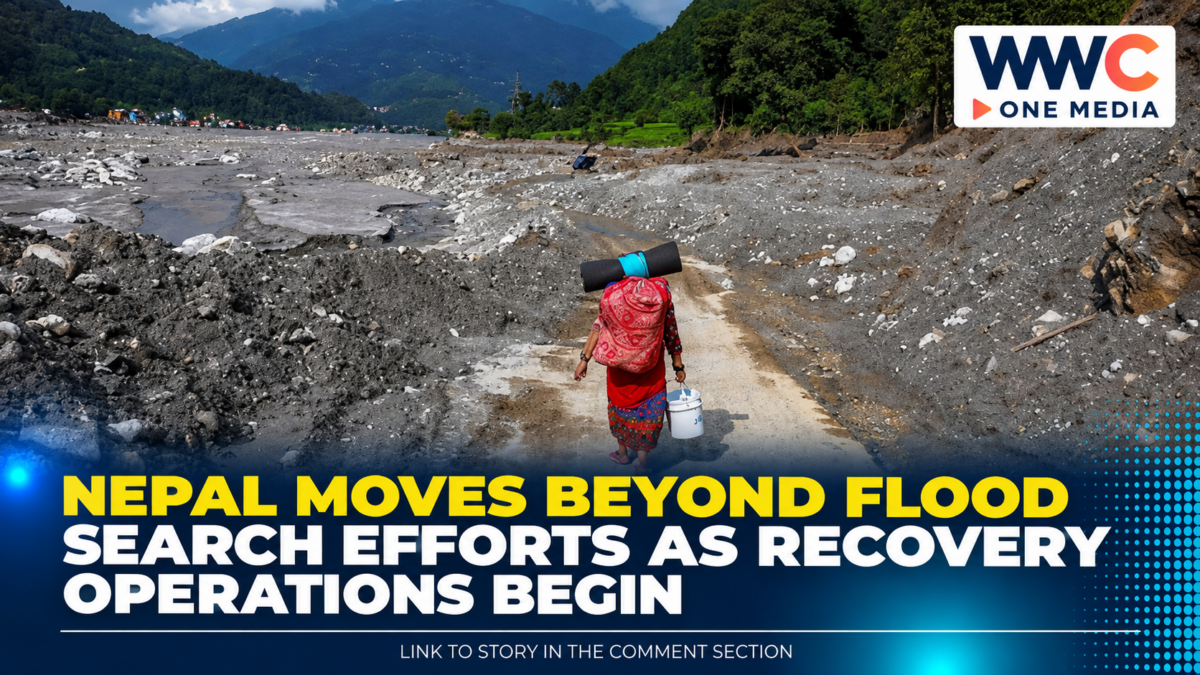
Nepal has ended its large-scale search-and-rescue operation for people still missing after devastating floods and landslides killed at least 1,455 people, with authorities now shifting their focus toward rehabilitation, reconstruction and support for affected families.
At least 5,285 people remain missing, while 13,795 people were rescued during the emergency response following the disaster on Aug. 26.
The disaster, which struck areas near Nepal’s border with China’s Tibet region, caused widespread destruction and left communities facing months or even years of recovery. Roads, bridges, farmland, settlements and major infrastructure were damaged or destroyed, while thousands of families were displaced.
Nepal moves from search and rescue to rehabilitation
Phanindra Paudel, chief of Nepal’s National Emergency Operation Centre, said authorities were moving from the emergency search-and-rescue phase into what officials described as a search-and-rehabilitation phase.
The change reflects the difficulty of continuing a large-scale operation weeks after the disaster, particularly in areas where floodwaters, mud and debris have transformed the landscape.
Authorities are also preparing to begin legal procedures for people who remain missing to be formally declared dead.
Such declarations can be important for families who need to settle inheritance matters, access insurance payments, close bank accounts or complete other legal and administrative procedures following a death.
However, officials stressed that the end of the formal search operation does not mean all recovery work has stopped.
Dharam Raj Uprety, chief of Nepal’s National Disaster Risk Reduction and Management Authority, said authorities would continue to recover bodies, personal belongings and other valuables if they are discovered during rehabilitation and reconstruction work.
Emergency rescue operations can also still be launched if new situations arise.
Thousands remain unaccounted for
The number of people still listed as missing highlights the enormous scale of the disaster.
For thousands of families, the end of the active search brings an uncertain and painful transition. Many have spent weeks waiting for information about relatives who disappeared when floodwaters swept through communities or destroyed infrastructure.
Authorities have also faced challenges identifying recovered bodies, particularly because of the scale of destruction and difficult terrain.
DNA samples have been collected from recovered remains and relatives of missing people as officials work to establish identities and provide families with answers.
The identification process is expected to remain an important part of the recovery effort even after the large-scale search operation has ended.
Hydropower projects among major losses
Nepal’s infrastructure suffered extensive damage in the disaster.
Officials said 12 hydroelectric projects were destroyed, while roads, bridges, farms and settlements were also severely affected.
The damage to hydropower facilities is particularly significant for Nepal, which relies heavily on the sector for electricity generation and economic activity.
Some workers at hydropower projects were also among those reported missing after facilities were inundated or buried by floodwaters and debris.
Rescue teams previously carried out difficult operations around damaged infrastructure, including searches of tunnels and other confined areas where workers could potentially have survived.
The disaster demonstrated the vulnerability of critical infrastructure in Nepal’s mountainous regions, where access can become extremely difficult after landslides and flooding.
Communities face a long road to recovery
For survivors, the immediate emergency has given way to the more complicated task of rebuilding.
Families who lost homes must find longer-term accommodation, while farmers face the loss of land, crops and livestock.
Communities also need roads and bridges restored to reconnect isolated areas and allow food, medicine and other supplies to reach residents.
The destruction of infrastructure has made recovery more difficult in areas that were already geographically challenging to reach.
The government is therefore expected to face significant logistical and financial challenges as it moves from emergency relief toward longer-term reconstruction.
Nearly US$5 billion needed
Nepal’s government has estimated that nearly US$5 billion will be required for early recovery and rehabilitation following the disaster.
The figure reflects the scale of the work ahead, including restoring infrastructure and helping affected communities rebuild their livelihoods.
The financial burden comes at a time when authorities must also address the immediate needs of people who remain displaced or have lost their primary sources of income.
International assistance is expected to remain important as Nepal moves through the recovery phase.
A painful turning point for families
The decision to end the active search marks a major turning point in Nepal’s response to the disaster.
For rescue teams, it represents a shift away from large-scale operations aimed at finding survivors and toward rebuilding communities and restoring essential services.
For families of those still missing, however, the transition may be far more difficult.
With thousands of people still unaccounted for, families will have to navigate a period of uncertainty while authorities work through identification procedures and the legal process surrounding missing persons.
The government has stressed that recovery efforts will continue, including the recovery of remains and belongings found during reconstruction.
But the focus is now firmly moving toward rebuilding what the floods destroyed.
From rescue to rebuilding
More than six weeks after the disaster, Nepal is entering a new phase of the crisis.
The search for survivors may have officially ended, but the consequences of the floods will continue to be felt for years.
With 1,455 confirmed deaths, 5,285 people still missing and thousands of survivors facing damaged homes and livelihoods, the country’s challenge is no longer only finding those who were lost.
It is rebuilding communities, restoring critical infrastructure and helping survivors begin again.