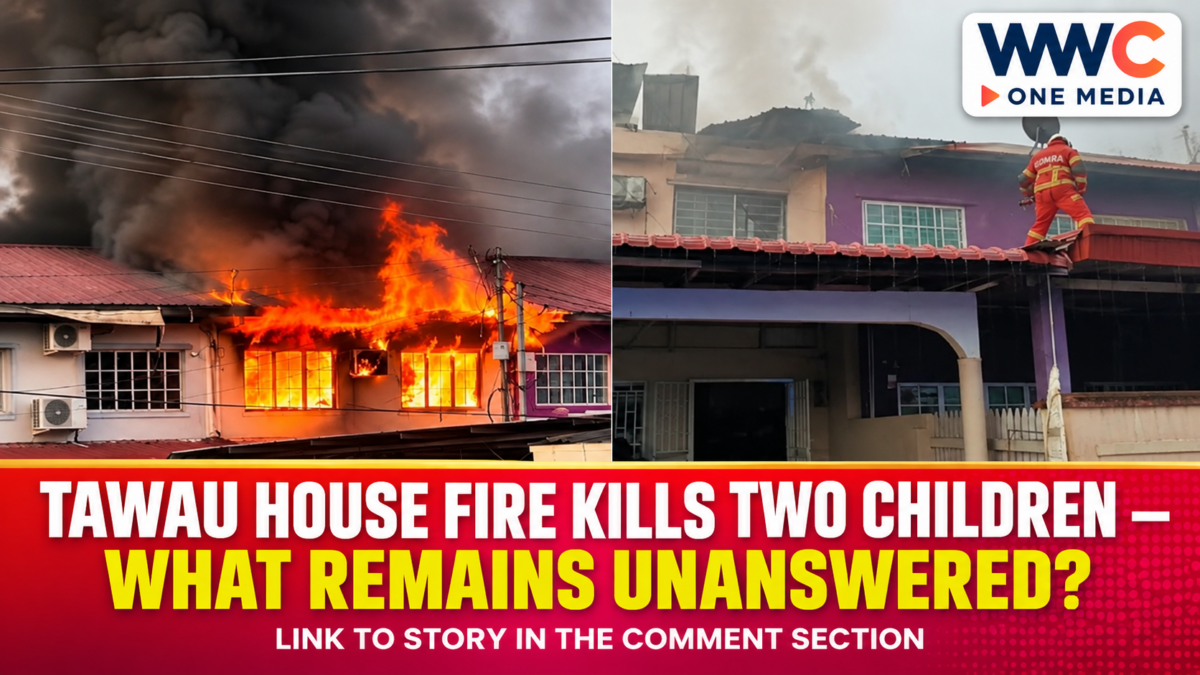
TAWAU, Malaysia — Two children died in a house fire in Tawau, Sabah, on Friday, Nov. 20, 2026. A government-published account of the fire-service response identifies the victims as a 13-year-old boy and a 10-year-old girl, while four other occupants escaped.
The Tawau house fire is both a family tragedy and a reason to examine what the public record can — and cannot — establish about household escape planning. Malaysia’s existing safety guidance offers practical advice, but it does not prove why these particular children could not get out. That distinction matters when the cause and detailed circumstances have not been independently established in a publicly accessible fire-investigation report.
Tawau house fire: what the official account establishes
Malaysia’s public broadcaster published an incident account on Nov. 20 identifying Tawau Fire and Rescue Station chief Jemishin Ujin as the official explaining the response. The account places the emergency call at 6:13 a.m. and says firefighters arrived nine minutes later.
It identifies six occupants: four who got out and two children who did not. It also says the firefighting response prevented the fire from spreading to two adjacent houses. These details describe the immediate response; they do not, on their own, establish the ignition source or the sequence of events inside the home.
The publicly accessible accounts reviewed for this story do not agree on the precise time when the children were found. WWC therefore does not publish a discovery time. An original, publicly accessible operational log or a clarified fire-service statement would be needed to resolve that difference.
Nothing in the verified public-safety material supports assigning fault to an occupant, a family member, a building owner or an electrical installation. Equally, a reported response time cannot explain what opportunities for escape existed before the emergency call.
Why an upstairs escape plan matters
In a multi-level home, residents need to know more than the location of the front door. They need a workable route from wherever they sleep, a way to recognise danger and an agreed response if a usual route is no longer safe.
Malaysia’s National Security Council publishes fire-prevention guidance drawn from the Fire and Rescue Department. It recommends smoke detectors on every floor, including suitable positions near bedrooms and staircases. It also recommends identifying two emergency escape routes from each room and ensuring occupants know and practise using them.
These are general recommendations, not findings about the Tawau property. There is no verified incident record in the material reviewed confirming whether the home had smoke alarms, whether any exit was obstructed or whether any specific measure might have changed the outcome.
The distinction also applies elsewhere. WWC’s report on a two-storey house fire in Singapore discussed evacuation and the threat posed to neighbouring homes. Different buildings and incidents require different investigations, even when the broader need for clear escape arrangements is similar.
Preparation should include everyone living in the home
A household plan is useful only if the people expected to follow it can do so. That means thinking about children’s ages, how residents communicate an alarm, whether someone requires assistance and whether adults know how to respond without creating further danger.
The fire service’s public education work recognises that fire safety includes teaching building occupants and members of the public, not merely training professional responders. Its academy describes courses, seminars and workshops as part of building a wider culture of prevention.
For families, a practical discussion can begin with the sleeping arrangements, which exit each person can reach, and where everyone would meet after leaving. An evacuation practice should reflect the home’s actual layout and the abilities of its occupants. Any specialised accessibility needs warrant appropriately tailored guidance rather than assumptions about an individual.
This is not an invitation to judge the family affected in Tawau. The public record reviewed does not establish their preparations, the conditions they faced or the decisions available to them during the fire.
Smoke warnings and safe routes are separate safeguards
An alarm is intended to provide a warning. An escape route provides a way to act on that warning. One cannot automatically substitute for the other, and neither is proof that everyone can leave safely under all conditions.
Malaysia’s National Disaster Management Agency also hosts safety guidance covering fire alarms, movement away from smoke and the importance of keeping emergency routes clear. The National Security Council’s advice adds precautions against overloading electrical circuits and recommends keeping flammable materials away from ignition sources and children.
Those recommendations are preventive measures for households generally. They must not be read as clues to the cause of the Tawau incident. Until investigators identify a cause, electrical faults, open flames and other explanations remain unverified possibilities rather than facts to publish.
WWC’s earlier Malaysia fire-safety explainer examined how training, building arrangements and emergency readiness fit together. Its coverage of a Johor Bahru carpark fire likewise illustrates why reporting must distinguish a response from a confirmed technical cause.
What the incident record still needs to answer
A complete public account would ideally establish the fire’s origin, its progression through the building, the condition of exits and warning devices, and the chronology recorded by responders. Those are questions for competent investigators, not conclusions that can be drawn from the children’s location or the scale of the response.
The initial official account is useful for identifying the reported loss of life and the emergency response. It is not a substitute for a forensic conclusion. Nor should comparisons with unrelated fires be treated as evidence about this home.
Careful reporting protects both public understanding and the people affected. It allows the urgent lesson — prepare practical escape arrangements — to stand without inventing a story about how a family behaved in a crisis.
What happens next
The responsible authorities may clarify the timeline and release findings about how the Tawau fire began and spread. As of Nov. 21, 2026, WWC has not independently located a publicly accessible original fire-service incident report or final investigation finding for this event.
Until that changes, the soundest public takeaway is limited but important: two children were reported to have died, four occupants escaped, and the circumstances require evidence rather than speculation. Households can review official precautions now, while investigators determine what happened in this particular case.