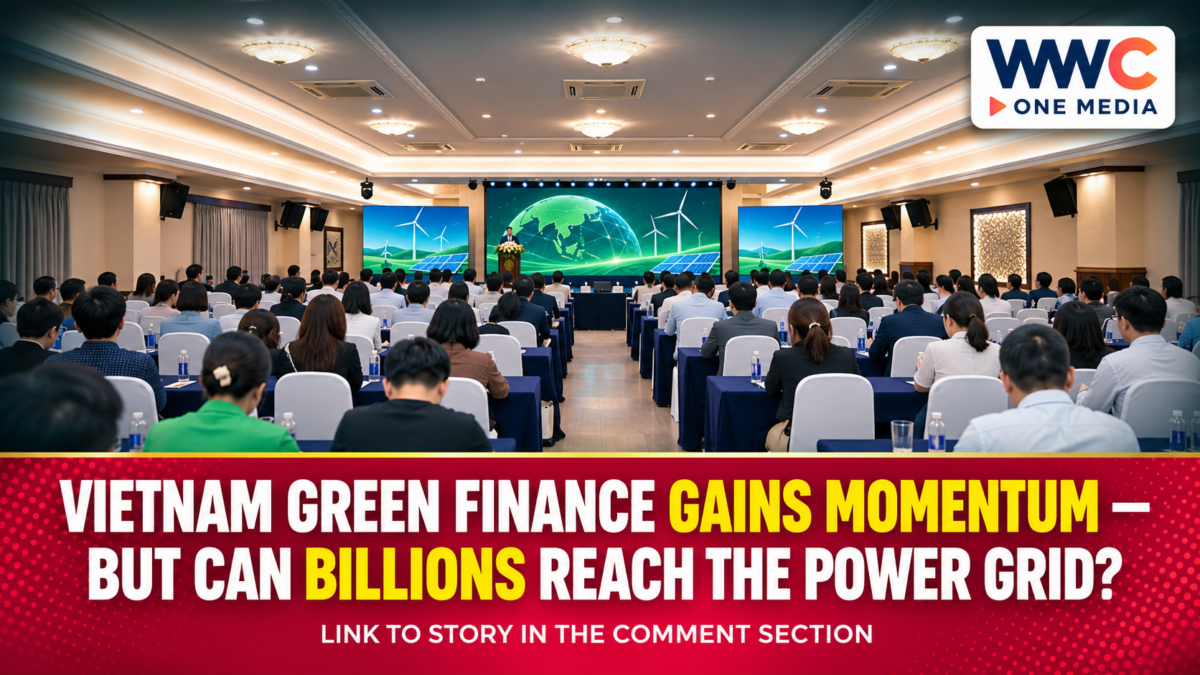
MANILA, Philippines, Nov. 21, 2026 — Vietnam is expanding its green-finance market while pursuing one of Southeast Asia’s most ambitious electricity-development programmes. Government power plans and international development-finance disclosures show substantial demand for new generation, storage and transmission infrastructure, alongside emerging financing channels for climate-related investments.
The central question is no longer whether Vietnam has renewable-energy ambitions. It is whether green capital, bankable electricity contracts and grid construction can advance together quickly enough to turn planned capacity into reliable power.
Vietnam green finance meets a demanding electricity plan
Vietnam’s Ministry of Industry and Trade approved an implementation plan for its revised Power Development Plan VIII on May 30, 2025, following the government’s approval of the revised national power plan on April 15, 2025. The framework sets targets for electricity supply through 2030, with a longer-term vision to 2050.
Under that implementation plan, solar capacity is targeted at 46,459–73,416 megawatts by 2030, with onshore wind at 26,066–38,029 MW. The plan also calls for 6,000 MW of offshore wind serving domestic demand by 2030 and around 10,000–16,300 MW of battery-storage capacity.
These are planning targets, not a tally of plants already commissioned. They describe the scale of investment that developers, network operators and lenders must support if Vietnam is to expand its electricity system as envisaged.
A later ministry review put the revised plan’s total installed-capacity objective for 2030 at 183,291–236,363 MW. Delivery depends on project readiness.
Green bonds show capital can be mobilised
Vietnam already has documented examples of sustainable financing reaching domestic banks. In June 2024, the International Finance Corporation announced a US$150-million financing package for SeABank, including its subscription to a US$50-million green bond and a US$25-million blue bond. The green-bond funding was intended to support qualifying activities such as renewable energy, energy efficiency and green buildings.
In September 2025, IFC announced a US$200-million investment in VPBank’s five-year, US$300-million sustainability bond, issued privately with French development finance institution Proparco as a parallel investor. IFC stated that 40% of its own investment would support eligible climate projects, while the remainder would finance specified small-business lending.
These transactions show capital reaching banks, not necessarily completed power plants or transmission lines.
That distinction matters to Philippine readers as well. WWC ONE MEDIA’s Alternergy green-bond financing coverage similarly examines the difference between raising investment funds and delivering operational renewable-energy assets.
The power grid is as important as new generation
A renewable-energy plant only creates usable electricity for customers when it can connect to a functioning network and deliver power when required. As wind and solar capacity expands, transmission access, storage and system flexibility can become just as important as construction of the generating facilities themselves.
Vietnam’s implementation plan explicitly includes transmission development and battery-storage targets. It also envisages electricity imports and exports, showing that the country’s power strategy extends beyond individual domestic projects.
The World Bank Group’s July 2025 framework for offshore wind identified grid and port planning, clearer project-award processes and more bankable power-purchase agreements among the measures needed to attract private developers. A large resource opportunity does not automatically create an investable project.
The same separation between a project pipeline and actual grid readiness appears in WWC ONE MEDIA’s analysis of Philippine renewable-energy expansion and grid constraints. Both markets face a practical question: can essential network investments keep pace with planned renewable generation?
Financing depends on contracts and regulatory certainty
Banks and bond investors generally need to assess how a project will earn revenue, who will purchase the electricity, which party bears delays or cost overruns, and how contractual disputes will be resolved. A green label cannot replace those commercial fundamentals.
In November 2026, Vietnam’s Ministry of Industry and Trade discussed proposed amendments to electricity legislation covering investment-risk allocation, capacity pricing and negotiation of power-purchase agreements. These were presented as proposed reforms addressing obstacles encountered in implementing large power projects; they should not be mistaken for fully enacted measures.
The World Bank’s offshore wind work likewise identified improvements to power-purchase-agreement bankability, permitting and price-adjustment mechanisms as priorities. For financiers, such details influence whether anticipated revenue is sufficiently predictable to support long-term lending.
On the banking side, an IFC advisory disclosure dated June 29, 2026 described a green-finance initiative intended to help selected Vietnamese financial institutions develop green credit lines, bonds, risk management and disclosure practices. Its published record did not establish a completed portfolio of investments arising from that initiative.
Why Vietnam’s transition matters to ASEAN
Vietnam’s investment choices affect a region examining how cleaner electricity can travel across national borders. The World Bank’s ASEAN Power Grid Financing initiative, described in October 2025, seeks to support interconnection, regional power trade and financing arrangements for renewable-energy development.
The initiative estimated US$800 billion in generation and transmission investment for the wider ASEAN Power Grid vision through 2045. That regional estimate must not be misrepresented as the financing requirement for Vietnam alone.
WWC ONE MEDIA has separately examined Philippine participation in ASEAN energy-security cooperation, illustrating why grid interconnection and energy planning have become regional policy questions rather than purely domestic concerns.
In the Philippines, efforts to give eligible public institutions more electricity-supply choices also demonstrate how market rules influence whether demand for cleaner electricity can turn into bankable investment.
Regional cooperation still depends on contracts, infrastructure and actual demand.
What happens next
The next meaningful tests are whether Vietnamese authorities advance grid projects and permitting, whether developers secure financially viable power-purchase agreements, and whether banks can document how green funding is allocated. Progress should be measured through approvals, financial close, completed facilities and electricity actually supplied.
WWC analysis: The official record supports a cautiously positive picture. Financing instruments exist, and government targets establish a substantial market for electricity investment. But the evidence does not support treating every target as a funded project or every sustainable bond as a completed power station. Vietnam’s energy transition will be judged by execution as much as ambition.