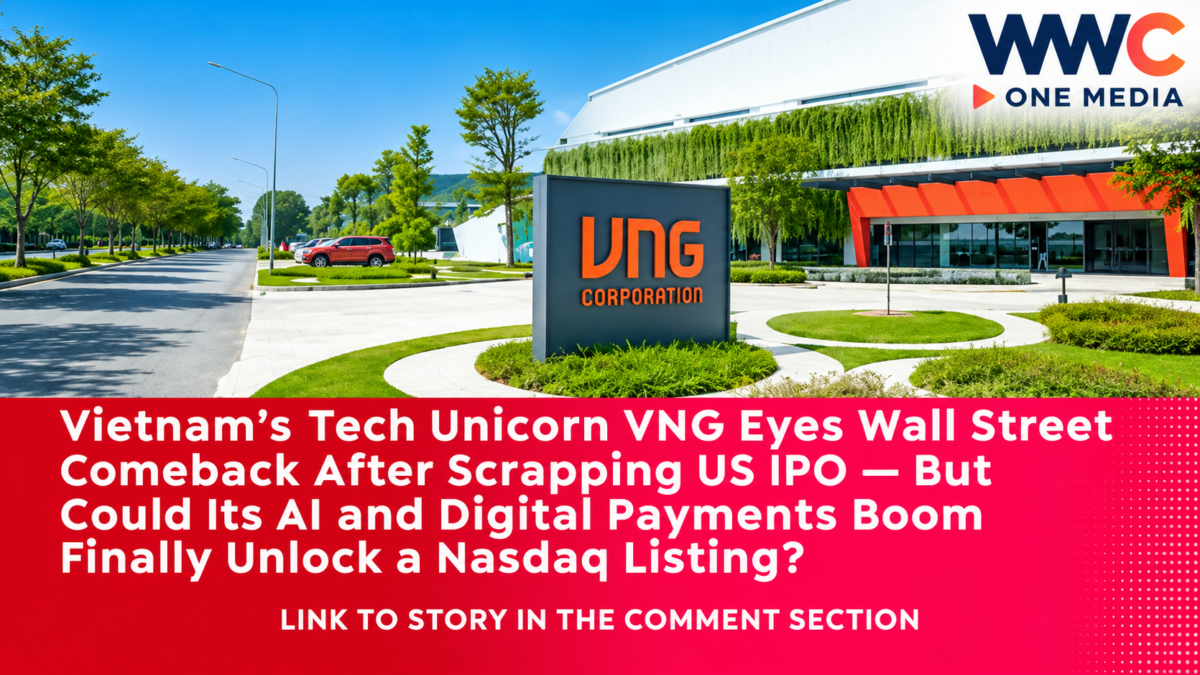
HO CHI MINH CITY / NEW YORK / MANILA — Vietnam’s homegrown technology powerhouse VNG Group is reportedly considering reviving its long-delayed plan to list shares in the United States, raising the possibility of a major Wall Street debut as the company reports stronger earnings and rapid expansion in artificial intelligence, digital payments and online services.
According to Bloomberg’s November 4 report, the Vietnamese technology company is exploring a return to the US listing market after withdrawing its previous initial public offering registration in January 2024.
The development comes as VNG reports a striking financial turnaround.
In its latest quarterly results, the company announced ₫3.36 trillion in revenue, up 22% year over year, and ₫420 billion in net profit, compared with a loss in the corresponding period last year.
Its Zalo messaging platform has reached 82.6 million monthly active users, while Zalopay’s revenue surged 89%.
The numbers strengthen the company’s potential investment case, but they do not guarantee a successful public offering.
VNG has spent years exploring an overseas listing, and previous attempts were delayed or abandoned because of market conditions and other execution challenges.
Now the company faces a difficult question: Can stronger earnings and expanding AI businesses persuade Wall Street investors to back one of Southeast Asia’s best-known technology firms?
VNG May Revive Its US IPO After Years of Delays
VNG’s ambitions to trade on an American stock exchange stretch back nearly a decade.
In 2017, the company signed a memorandum of understanding relating to a potential Nasdaq listing.
The proposal reflected VNG’s ambition to become a globally recognized Vietnamese technology business.
However, the planned offering did not materialize.
The company subsequently considered other fundraising routes, including a possible merger with a special purpose acquisition company, or SPAC.
In 2021, Bloomberg reported that VNG was exploring a transaction that could have valued it at approximately $2 billion to $3 billion.
Those were historical estimates associated with a possible transaction, not a verified valuation for November 2026.
VNG eventually pursued a conventional IPO registration.
In August 2023, VNG Ltd. filed documents with the US Securities and Exchange Commission for a proposed Nasdaq Global Select Market listing.
The offering initially involved plans to sell approximately 21.7 million shares.
Reuters reported that the transaction could have raised roughly $150 million.
However, the company postponed the offering in September 2023 amid volatile market conditions.
On January 19, 2024, VNG filed to withdraw its registration.
The company indicated that it intended to pursue another registration in the future.
Bloomberg’s latest report suggests that the long-standing ambition may now be returning to the company’s agenda.
Nevertheless, no completed IPO registration, final fundraising target, share price or trading date has been independently established for a new offering.
VNG’s Third-Quarter Earnings Could Strengthen Its Investment Case
VNG’s latest financial performance provides an important reason why the possibility of a listing revival is attracting attention.
According to its official third-quarter results, released at the end of October and published through investor relations on November 2, consolidated revenue reached ₫3.361 trillion, increasing 22% from a year earlier.
Adjusted operating profit climbed 148% to ₫652 billion.
The company reported ₫420 billion in net profit, reversing a small loss in the third quarter of 2025.
The improvement extended across its major business divisions.
For the first nine months of 2026, VNG recorded consolidated revenue of approximately ₫9.233 trillion and adjusted operating profit of ₫1.589 trillion.
Nine-month net profit reached ₫1.013 trillion.
The company said it was working toward its first full year of positive net profit since its shares began trading on Vietnam’s UPCoM market in January 2023.
These results may help demonstrate that its growth strategy is becoming more financially sustainable.
But investors must distinguish adjusted operating profit from net profit.
Adjusted figures exclude certain items and are not interchangeable with statutory earnings.
A potential IPO prospectus would also need to provide sufficient financial disclosures for investors to evaluate the business.
Zalo’s 82.6 Million Users Give VNG a Major Competitive Advantage
One of VNG’s most recognizable businesses is Zalo, the messaging platform widely used across Vietnam.
According to its third-quarter disclosure, Zalo reached 82.6 million monthly active users, an increase of 4% from the previous year.
The service processes approximately 2.2 billion messages daily.
VNG has been expanding Zalo beyond conventional messaging by integrating artificial intelligence tools into the platform.
Around 41% of Zalo’s monthly users accessed integrated AI functions, according to the company.
These include voice-to-text conversion, dictation and translation.
Zalo’s large domestic audience provides VNG with an established platform for introducing additional digital products.
However, user numbers alone do not guarantee profitability.
Investors will assess how effectively VNG converts engagement into revenue while maintaining customer trust, privacy and operating efficiency.
Zalopay Revenue Surges 89% as Digital Payments Expand
VNG’s financial technology business is another important growth engine.
Zalopay generated approximately ₫291 billion in third-quarter revenue, an 89% increase from the corresponding period in 2025.
The company reported 44% growth in active users and a 68% increase in total payment value.
Financial-services revenue expanded particularly strongly, increasing 379% year over year.
VNG is also pursuing cross-border payment opportunities.
Zalopay has expanded international QR-code payment capabilities in markets including China, South Korea, Thailand, Singapore and Japan.
Management is targeting coverage across 60 countries by the end of 2026.
That target remains a company objective rather than a completed expansion.
The strategy could make Zalopay increasingly relevant to Southeast Asian consumers and international travelers.
But digital payments remain highly competitive, and VNG must continue investing in technology, partnerships and fraud prevention.
How VNG’s Ambitions Compare With the Philippines’ Fintech Boom
The renewed interest in a possible VNG listing comes as Southeast Asian technology businesses explore different ways to access international capital.
In the Philippines, GCash operator Mynt completed its landmark public offering in October 2026.
WWC ONE MEDIA reported the transaction in GCash’s Record ₱60.9-Billion IPO Draws BlackRock, Citadel and Global Investors — But the Real Test for Philippine Tech Begins Now.
That offering demonstrated international investor interest in established Southeast Asian fintech platforms.
However, VNG and Mynt are different businesses with different ownership structures, growth strategies and financial characteristics.
VNG combines gaming, messaging, financial technology and cloud services, while Mynt’s operations are centered on financial services.
The comparison is relevant because both businesses illustrate how digital consumer platforms can reach enormous scale within their domestic markets.
For VNG, a successful overseas offering could provide access to an additional pool of institutional investors.
But its valuation would depend on the company’s earnings quality, expected growth and the terms of the proposed listing.
VNG’s Artificial Intelligence Strategy Expands Beyond Messaging
Artificial intelligence is becoming an increasingly important part of VNG’s business.
The company operates GreenNode, a cloud and AI infrastructure division.
GreenNode generated ₫164 billion in third-quarter revenue, increasing 4% from a year earlier.
Within that division, AI cloud revenue grew 160%.
VNG has also been developing enterprise AI services, including tools for deploying and managing AI models.
Its investments reflect a wider regional trend in which technology companies are seeking to build infrastructure and software for increasingly sophisticated digital services.
The company’s AI strategy may appeal to investors interested in exposure to Vietnam’s expanding technology sector.
However, rapid AI revenue growth from a relatively small base does not necessarily indicate that the entire business is growing at the same rate.
Investors will need to evaluate the division’s profitability, spending requirements and long-term customer demand.
Online Gaming Remains an Important Revenue Engine
Despite VNG’s increasing focus on artificial intelligence and digital payments, online gaming remains central to its operations.
The company began in 2004 as a gaming publisher under the name Vinagame.
It subsequently expanded into messaging, digital payments, entertainment and cloud services.
In the third quarter of 2026, VNG’s gaming business generated approximately ₫2.138 trillion in revenue, up 12% year over year.
Gaming bookings rose 10% to ₫2.55 trillion.
The division recorded 57.3 million quarterly active users.
VNG publishes titles such as PUBG Mobile and Play Together in selected markets.
It has also been developing and distributing additional games internationally, including in Thailand, Indonesia and the Philippines.
Gaming provides a substantial revenue base but carries risks involving customer retention, licensing arrangements, development costs and changing consumer preferences.
A potential IPO investor would need to assess the profitability and sustainability of each of VNG’s business segments rather than focusing only on its AI ambitions.
Why VNG’s 2024 IPO Withdrawal Still Matters
VNG’s previous attempt to list in the United States provides important context for the latest report.
In August 2023, the company formally pursued a Nasdaq listing.
But the offering was postponed and ultimately withdrawn in January 2024.
Reuters reported that the withdrawal followed difficulties meeting certain registration deadlines, according to a person familiar with the matter.
VNG itself did not publicly provide a detailed explanation in the withdrawal request.
The company stated that it intended to file another registration in the future.
In June 2025, VNG CEO Kelly Wong said the company’s ambitions for a US listing remained alive, although timing would depend on financial-market conditions.
That uncertainty has not disappeared.
International technology IPOs can be affected by interest rates, investor sentiment, exchange valuations and regulatory requirements.
A company may have a strong business and still choose to delay an IPO if the valuation investors are willing to pay does not meet shareholder expectations.
Hong Kong’s IPO Troubles Show Why Timing Matters
VNG’s possible return to Wall Street coincides with uncertainty across Asian capital markets.
In Hong Kong, Bloomberg reported that the rate of abandoned IPO transactions in 2026 had climbed to its highest level since the 2008 financial crisis.
WWC ONE MEDIA examined that development in Hong Kong IPO Crisis Deepens as 1 in 4 Deals Collapse in Worst Withdrawal Wave Since 2008 — But Is Asia’s Biggest Fundraising Boom About to End?.
The report highlighted the growing difficulty some businesses face in completing public offerings when investors demand more conservative valuations.
Yet other companies continue pursuing listings.
WWC ONE MEDIA also covered Hong Kong’s $765-Million IPO Rush as Chinese Chip Suppliers Race to Raise Cash.
Together, these developments demonstrate that access to capital remains available, but the conditions can vary significantly by industry, timing and company fundamentals.
For VNG, a strong earnings report may improve the investment story, but it cannot eliminate uncertainty about demand for a new offering.
Maya’s IPO Plans Highlight Southeast Asia’s Competition for Capital
VNG is not the only Southeast Asian technology business reconsidering its listing timetable.
Philippine digital financial services company Maya has also been evaluating a possible public offering.
WWC ONE MEDIA examined those ambitions in After GCash’s ₱60.9-Billion IPO, Pangilinan Eyes Maya Listing in 2027 — But Will Wall Street or Filipino Investors Get the Bigger Opportunity?.
The report noted that Maya’s leadership was considering a 2027 listing, with the choice of venue still subject to further decisions.
This reflects a broader challenge for technology companies in the region.
A US IPO can provide access to a large investor base and international visibility.
However, Asian exchanges may offer advantages involving geographical proximity, regional investors and different regulatory conditions.
The best choice depends on the business, shareholders and market environment.
VNG’s renewed consideration of a US listing does not establish that Wall Street will necessarily be more attractive than other fundraising alternatives.
A Nasdaq Listing Could Be a Landmark for Vietnamese Technology
Vietnam has become an increasingly important center for technology investment and manufacturing.
The country’s digital economy includes online gaming, e-commerce, financial technology, software and cloud services.
A conventional US IPO by VNG would represent a significant milestone for Vietnam’s technology industry.
It could increase international awareness of Vietnamese technology businesses and potentially encourage other companies to explore overseas capital markets.
However, VNG would not be the first Vietnamese company to trade in the United States.
Electric-vehicle manufacturer VinFast entered Nasdaq in 2023 through a merger with a special purpose acquisition company.
That distinction is important when describing the potential historical significance of VNG’s plans.
A successful conventional IPO would differ structurally from VinFast’s SPAC transaction.
The final significance would depend on the offering’s structure and completion.
The Biggest Challenge: Can VNG Turn Growth Into a Wall Street-Ready Business?
The company’s improving earnings provide evidence that its strategy is making financial progress.
Revenue is increasing across its main divisions.
Zalo maintains a large domestic user base.
Zalopay is growing rapidly.
AI cloud services are expanding.
And quarterly net profit has recovered from the loss reported a year earlier.
Nevertheless, investors considering a potential IPO would examine more than revenue growth.
They would evaluate cash generation, profitability, shareholder rights, regulatory exposure and the sustainability of the company’s business model.
They would also assess its legal and corporate structure, including the relationship between Vietnamese operating entities and any overseas listing vehicle.
Any new US offering would be subject to applicable securities requirements.
At present, the reported revival remains a potential transaction rather than a completed capital-raising event.
What Happens Next? Three Signals to Watch
First, a new US securities filing.
An updated registration statement would provide a stronger indication that VNG is formally progressing toward an IPO.
Second, financial performance in the fourth quarter and full year.
Continued revenue growth and profitability would strengthen the company’s investment case.
Third, confirmation of the offering structure and valuation.
Investors will need to know which entity would list, how many shares would be sold and how the proceeds would be used.
Until those details are disclosed, precise estimates of a new IPO valuation or fundraising size would be speculative.
The Bigger Picture: Could VNG Open Another Door for Southeast Asian Tech?
VNG’s potential Wall Street comeback comes at an important moment for Southeast Asia’s digital economy.
The Vietnamese company has spent more than two decades expanding from online gaming into messaging, payments, cloud infrastructure and artificial intelligence.
Its latest financial results show that the strategy is producing substantial revenue growth and improving profits.
But a successful US IPO would present a different test.
Public-market investors would need to be convinced that VNG can sustain growth, manage costs, compete effectively and meet the expectations attached to an internationally listed company.
The company’s earlier withdrawal shows that a listing ambition is not the same as a completed deal.
Its latest earnings may strengthen the case for returning to the market.
But the final decision will depend on financial conditions, shareholder priorities and regulatory approvals.
As Vietnam’s VNG explores another attempt to reach Wall Street, backed by 82.6 million Zalo users, surging digital-payment revenue and improving profitability, can the tech pioneer finally achieve its long-awaited US listing—or will volatile capital markets force Southeast Asia’s rising technology giant to postpone its American dream once again?