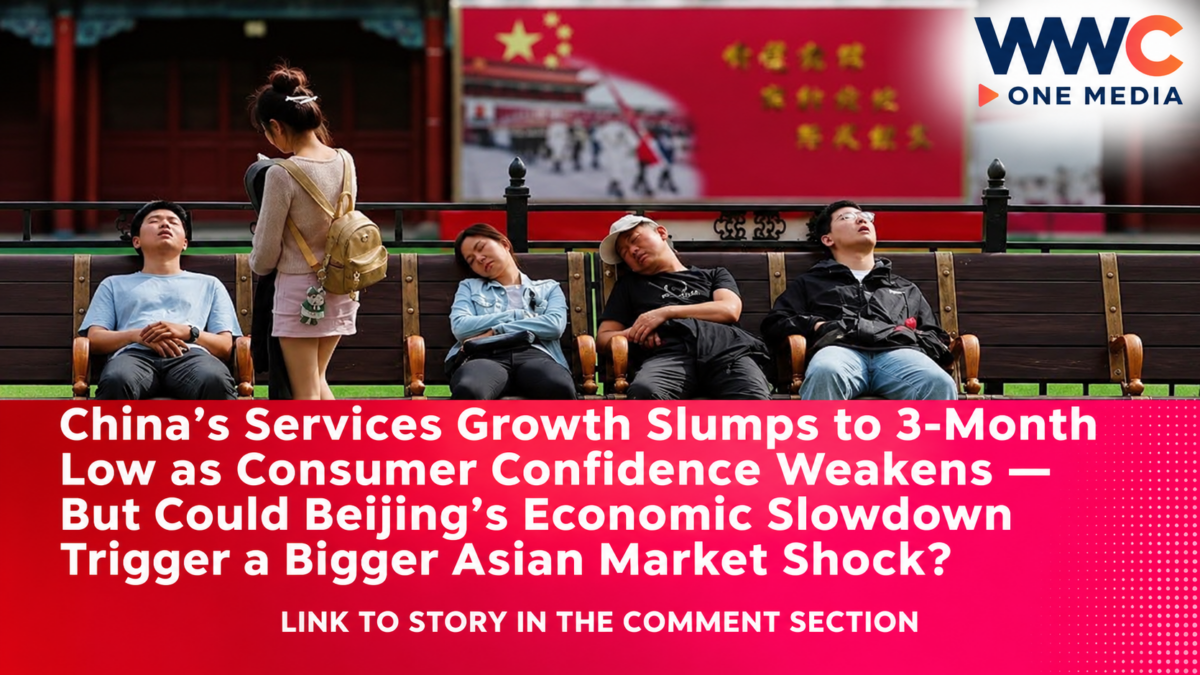
BEIJING / HONG KONG / MANILA — China’s economic recovery is facing another warning sign after a closely watched private-sector survey showed services activity slowing to its weakest pace in three months, raising fresh concerns about consumer spending, business profitability and the outlook for Asia’s largest economy.
The RatingDog China General Services Purchasing Managers’ Index (PMI) fell to 50.8 in October from 51.6 in September, according to figures released Wednesday, November 4.
The result missed economists’ expectations of approximately 51.5 and marked the weakest reading since July.
According to Bloomberg and Reuters, businesses reported intensifying competition, higher operating costs and weaker expectations about future activity.
Even China’s weeklong Golden Week holiday failed to provide enough of a boost to prevent the slowdown.
The latest figures come just days after official data showed manufacturing activity slipping back into contraction, adding to concerns that the world’s second-largest economy is losing momentum as 2026 approaches its final months.
However, China’s services industry is still expanding. A PMI reading above 50 signals growth, while a reading below 50 indicates contraction.
The danger is not that services have collapsed, but that growth is becoming increasingly fragile while businesses struggle to maintain profitability.
With factories under pressure, consumers remaining cautious and service providers cutting prices despite rising costs, can Beijing revive domestic demand before weakness spreads further across the economy?
China’s Services PMI Falls to 50.8, Missing Economists’ Forecasts
The latest RatingDog survey delivered a disappointing result for investors expecting stronger economic momentum.
September’s services PMI of 51.6 had suggested a relatively healthy expansion.
But the decline to 50.8 in October revealed that activity was growing at a substantially slower pace.
The survey tracks changes in business activity, new orders, employment, costs and confidence among service providers.
Industries covered include consumer-facing businesses and other private service activities.
A reading of 50.8 indicates modest expansion compared with the previous month.
It does not mean that services output fell by 0.8%, nor does it establish that China’s overall economy contracted.
The concern is that the index is approaching the 50-point threshold separating expansion from contraction.
At the same time, the RatingDog composite PMI, which combines manufacturing and services activity, declined to 52.0 from 52.4.
That suggests China’s private-sector economy continued growing, but at a slower pace overall.
Businesses Face Rising Costs but Cannot Raise Prices
One of the most troubling findings concerns the relationship between business expenses and selling prices.
According to Reuters, input costs increased at their fastest pace in five months.
Companies faced higher prices for materials, fuel and labor.
Normally, businesses may attempt to pass additional expenses on to customers by increasing their selling prices.
But China’s service providers reported the opposite trend.
Average selling prices declined for the second consecutive month.
The combination suggests that businesses are finding it difficult to protect profit margins in a highly competitive environment.
Companies may be cutting prices or offering discounts to attract customers, even as operating expenses rise.
That can create a difficult cycle.
Lower prices may temporarily support demand, but they can also reduce profitability.
Weaker profits can limit hiring, investment and future business expansion.
The latest survey does not quantify a nationwide fall in service-sector profits, but it identifies conditions that could place further pressure on businesses.
Golden Week Travel Fails to Deliver a Stronger Economic Boost
October included China’s important Golden Week holiday, traditionally one of the country’s busiest periods for tourism, restaurants, shopping and entertainment.
Millions of people travel domestically and internationally during the holiday period.
Businesses often anticipate stronger spending as consumers book accommodation, visit attractions and purchase goods and services.
Yet the RatingDog survey found that the holiday provided limited support to overall services momentum.
This does not mean Golden Week tourism collapsed.
Travel volumes and total spending must be assessed using their own official statistics.
However, strong passenger numbers do not necessarily guarantee equally strong business revenue or profits.
Consumers may travel more frequently while choosing cheaper hotels, discounted transport and lower-cost activities.
WWC ONE MEDIA previously examined this distinction in China Braces for Record 2.13 Billion Trips as Golden Week Travel Rush Reaches Historic Scale.
The report highlighted how travel activity can remain substantial even when consumers are becoming more cautious about individual purchases.
October’s services PMI suggests that holiday demand was insufficient to offset the wider pressures facing businesses.
China’s Service Providers Continue Hiring Despite Slower Growth
The report was not entirely negative.
Reuters said service-sector companies continued adding both full-time and part-time employees to manage existing workloads.
New business also increased at a pace broadly similar to September.
Meanwhile, new export business grew for a sixth consecutive month, extending the longest expansion streak in that indicator since 2024.
These developments suggest that demand has not disappeared.
Some service providers continue attracting customers and expanding operations.
However, business confidence declined to its lowest level since July.
That difference between current activity and future expectations is important.
Companies may continue hiring to fulfill existing orders while becoming less optimistic about demand in the months ahead.
If expectations deteriorate further, businesses could eventually reconsider recruitment and investment plans.
For now, the survey shows weaker confidence rather than a confirmed nationwide collapse in service-sector employment.
Factory Activity Contracts as China’s Economic Problems Spread
The services slowdown follows another disappointing economic report.
On October 31, China’s official manufacturing PMI declined to 49.3 from 50.1, returning to contraction territory.
The official non-manufacturing PMI, which covers services and construction, also slipped to 49.7.
Within that survey, the services index stood at 50.0, indicating broadly unchanged activity, while construction weakened sharply.
WWC ONE MEDIA covered the deterioration in China’s Factory Activity Crashes Back Into Contraction as Orders Collapse — But Could a Deeper Economic Slowdown Shake Global Trade?.
That report examined falling factory orders, weaker construction activity and mounting concerns about domestic demand.
There is an important distinction between the two sets of figures.
China’s official services index and the private RatingDog services PMI use different survey panels and methodologies.
One can indicate stagnation while the other shows modest growth without necessarily being contradictory.
Taken together, however, they suggest that the wider economy is not experiencing a strong, broad-based acceleration.
Consumers Remain Cautious as Property Troubles Continue
Weak consumer confidence remains one of China’s most persistent economic challenges.
Households have faced uncertainty involving employment, income growth and property values.
The prolonged real estate downturn has weakened an important source of household wealth.
When homeowners become concerned about property values or future earnings, they may postpone major purchases and increase precautionary savings.
That can affect restaurants, retailers, travel operators and other service providers.
WWC ONE MEDIA previously explored the problem in China’s Factory Boom Masks Growing Strain as Consumer Spending Slows.
The article examined the growing imbalance between China’s industrial production capacity and domestic spending.
China’s manufacturers have expanded strongly in advanced industries such as electric vehicles, batteries and renewable-energy equipment.
But strong production does not automatically create equally strong household consumption.
The latest services PMI suggests that businesses continue operating in an environment where customers are sensitive to price increases.
China’s Price Wars Are Becoming a Bigger Economic Threat
The pressure to reduce selling prices is part of a broader challenge facing Chinese businesses.
Intense competition has encouraged aggressive discounts across several industries.
Chinese policymakers have increasingly criticized what they describe as destructive or excessive competition.
The problem is sometimes referred to as involution, a situation in which businesses compete more intensely without achieving corresponding improvements in profits or productivity.
WWC ONE MEDIA examined the issue in China Moves to Crush “Malicious” Price Competition — And Businesses Are About to Face Tougher Scrutiny.
The report described Beijing’s efforts to increase scrutiny of pricing practices that authorities consider unsustainable or disorderly.
However, low prices are not inherently harmful.
They can benefit consumers and reflect legitimate improvements in efficiency.
The concern arises when businesses repeatedly sacrifice margins because demand is insufficient to support their production and service capacity.
October’s survey adds another indication that competition is becoming a serious challenge to profitability.
Beijing Faces Renewed Pressure to Stimulate Domestic Demand
The latest slowdown may increase expectations that Chinese policymakers will introduce additional economic support.
Beijing has already implemented measures aimed at supporting investment, financing conditions and selected consumer activities.
These have included targeted credit measures and efforts to improve local government finances.
WWC ONE MEDIA previously reported on those policies in China’s Q3 Economic Growth Set to Rebound as Export Boom Drives Manufacturing, but Weak Consumer Spending Raises Concerns.
The report examined how exports and high-tech production have supported economic activity while consumer spending and property investment remain weak.
The challenge for Beijing is finding policies that generate sustainable household demand.
Infrastructure spending can support employment and industrial activity, but it does not necessarily encourage families to increase everyday consumption.
Likewise, cheaper credit may have limited effects if households and businesses remain reluctant to borrow.
Economists will therefore watch whether authorities introduce stronger measures to improve household confidence and encourage spending.
No additional stimulus package should be treated as confirmed without an official announcement.
China’s Manufacturing Strength Offers Some Protection
Despite the softer services reading, China retains important economic strengths.
The private RatingDog manufacturing PMI remained at 52.0 in October, indicating continued expansion among businesses covered by that survey.
The figure contrasted with the weaker official manufacturing index.
Exports, high-tech manufacturing and investment in advanced industries continue supporting parts of the economy.
However, the different survey readings also illustrate how uneven growth has become.
Some export-oriented manufacturers may perform relatively well while companies dependent on domestic demand struggle.
The sustainability of this model depends partly on overseas demand remaining strong.
Trade barriers, geopolitical uncertainty and weaker international orders could create additional challenges.
A stronger domestic consumer economy would make China less dependent on external demand to sustain growth.
What the Slowdown Means for the Philippines and Asian Markets
China is a major trading partner for economies across Asia, including the Philippines.
Changes in Chinese demand can influence regional exports, industrial supply chains, tourism and commodity prices.
A prolonged slowdown in Chinese consumer spending could reduce demand for certain imported products and services.
Weaker construction and manufacturing activity could also affect demand for industrial materials.
However, slower Chinese growth can have mixed effects.
Lower demand for some commodities may ease international prices, potentially benefiting importing countries.
At the same time, weaker Chinese demand could hurt exporters that depend on sales to the mainland.
For Philippine businesses, the impact would vary by industry.
Electronics suppliers, manufacturers, tourism operators and agricultural exporters face different exposures.
The October services PMI does not establish that Philippine exports or employment will decline.
It is an early economic indicator that warrants monitoring alongside actual trade and investment data.
What Happens Next? Three Critical Indicators to Watch
First, China’s next services PMI.
A recovery above October’s 50.8 reading would suggest improving momentum.
A decline below 50 would indicate contraction among businesses covered by the private survey.
Second, consumer spending and retail sales.
Official retail-sales data will help determine whether households are becoming more willing to spend.
Stronger consumption would provide support for restaurants, retailers and other service providers.
Third, government stimulus and property-market developments.
Investors will assess whether Beijing introduces additional support and whether existing policies improve confidence.
Stabilization in property conditions could help strengthen household sentiment.
However, economic recovery would require sustained improvement across multiple indicators, not simply one stronger monthly survey.
The Bigger Picture: Is China’s Recovery Running Out of Momentum?
China’s October services PMI delivers another warning about the uneven condition of the world’s second-largest economy.
The sector is still expanding, but growth has slowed to its weakest pace since July.
Input costs are increasing.
Businesses are cutting selling prices.
Confidence is weakening.
And the Golden Week holiday failed to produce a decisive acceleration in service-sector activity.
At the same time, the official manufacturing PMI has returned to contraction and the property sector remains under pressure.
There are still positive indicators.
New business continues growing, overseas service demand remains resilient and companies are adding workers.
The evidence therefore points to an uneven slowdown rather than a complete economic breakdown.
But Beijing faces increasing pressure to develop a more durable recovery driven by household spending and sustainable business profitability.
As China’s services PMI slips to 50.8 and companies struggle with rising costs, aggressive price competition and cautious consumers, can Beijing restore confidence before the slowdown spreads further—or could weakening domestic demand become the next major threat to Asian economic growth?