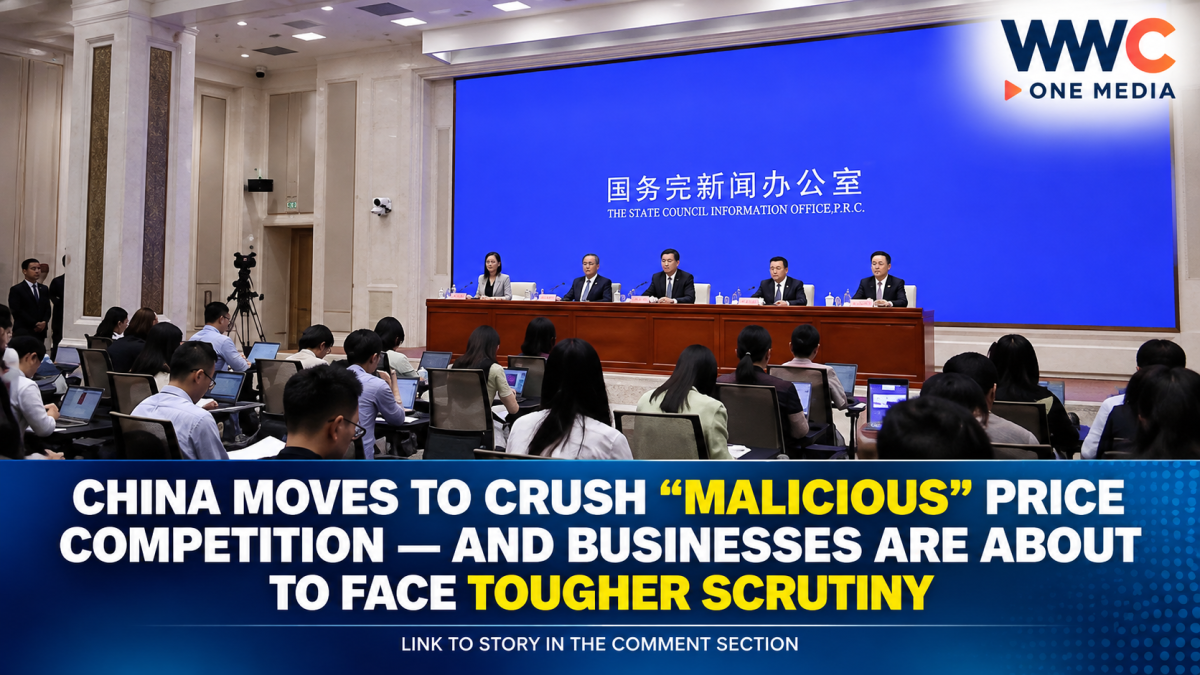
China is escalating its campaign against aggressive price-cutting, signaling tougher enforcement against companies that regulators say use unsustainable or disorderly low prices to win market share.
The State Administration for Market Regulation (SAMR) said Sunday that it will strengthen price enforcement, conduct cost investigations and price inspections of companies leading what it describes as malicious low-price competition, and push businesses toward competing on quality rather than simply offering the lowest price.
The move is the latest escalation in Beijing’s broader effort to curb what Chinese authorities have described as “involution” — excessive, destructive competition that can squeeze corporate profits, undermine product quality and contribute to deflationary pressure.
And this time, regulators are putting more emphasis on determining whether prices are supported by actual costs.
China is targeting the race to the bottom
At a State Council Information Office briefing on September 20, SAMR Vice Minister Shu Wei said regulators would accelerate work to shift competition from “competing on price” toward “competing on quality.”
The regulator plans to strengthen price enforcement in several ways.
Among them:
- Accelerating revisions to China’s Price Law
- Studying revisions to rules governing low-price dumping
- Working with industry associations to establish cost-calculation standards
- Conducting cost investigations and price inspections of companies engaging in malicious low-price competition
- Implementing rules governing pricing behavior on internet platforms
- Increasing corporate responsibility for price compliance
That represents a potentially significant change for industries where companies have relied heavily on discounts, subsidies and aggressive pricing to attract customers.
Nearly 29,000 cases have already been investigated
China’s campaign is not starting from scratch.
SAMR said that, as of the end of August, authorities had investigated 29,000 cases involving illegal inferior-quality, low-price competition, using price enforcement, quality supervision and standards-related measures. Authorities had imposed or confiscated 280 million yuan, equivalent to roughly $39 million, in those cases and returned more than 16 million yuan to consumers, according to the regulator.
The regulator says the campaign is intended to discourage companies from competing by selling products at exceptionally low prices while potentially sacrificing quality or disrupting normal market operations.
The distinction matters.
China is not announcing a blanket ban on low prices.
Rather, authorities are targeting forms of competition they determine to be illegal, malicious, disorderly or inconsistent with cost and fair-market rules.
The cost of making a product is becoming more important
One of the most significant developments came earlier this month.
China’s National Development and Reform Commission (NDRC) and SAMR jointly issued guidance on how authorities should calculate production costs when investigating disorderly low-price competition involving important industrial products.
Under the September 10 guidance, cost calculations will generally be based on an individual producer’s costs.
Where an individual cost cannot be established, regulators can refer to industry-average costs while taking into account an appropriate downward adjustment, with industry associations helping calculate those benchmarks under government supervision.
That gives regulators a more structured framework for determining whether a company’s pricing behavior could amount to prohibited low-price competition.
China’s steel industry is already feeling the pressure
The crackdown is particularly significant for heavy industries struggling with excess capacity and weak pricing.
China’s steel sector has been under pressure from oversupply and falling margins, and industry groups are now encouraging producers to exercise greater self-discipline.
The China Iron and Steel Association recently called for production controls, inventory reductions and stronger resistance to below-cost sales, according to Fastmarkets.
The development is consistent with Beijing’s broader effort to reduce destructive price competition rather than simply allowing companies to chase market share regardless of profitability.
For manufacturers, that could mean a greater focus on capacity discipline, product quality and sustainable margins.
The crackdown is moving into China’s internet economy
Online platforms are another major focus.
Earlier this year, Chinese regulators proposed rules governing subsidies offered by food-delivery platforms, following a fierce price war involving companies including Meituan, Alibaba and JD.com.
The draft rules would restrict platforms from forcing merchants to participate in subsidy campaigns or bear subsidy costs, while also targeting the use of financial strength for monopolistic or unfair competition and sales below cost.
The intervention came after a period in which platforms spent heavily on coupons, free delivery and merchant incentives to attract customers.
Reuters reported that the resulting competition reshaped consumer behavior and accelerated the growth of China’s instant-retail market, in which products ranging from groceries and electronics to medicines can be delivered extremely quickly.
But the financial cost was substantial.
Companies faced pressure on profitability as they competed aggressively for users and merchants.
The price war is changing — but competition isn’t disappearing
The government’s intervention does not necessarily mean Chinese technology companies are abandoning competition.
Instead, the battleground appears to be changing.
Reuters reported earlier this month that Meituan, Alibaba and JD.com are increasingly focusing on infrastructure, logistics networks and instant retail after a year of intense subsidy-driven competition.
Companies are investing in supermarkets, warehouses and delivery infrastructure rather than relying exclusively on increasingly expensive discounts.
That could represent the next phase of China’s e-commerce competition:
less money burned on coupons, more money spent building distribution networks and attracting higher-margin purchases.
Regulators are also targeting unfair competition
The enforcement campaign extends beyond pricing.
China’s revised Anti-Unfair Competition Law is being incorporated into broader enforcement efforts targeting practices such as false advertising, commercial disparagement, bribery and other forms of unfair competition.
Authorities also intend to strengthen protection of trade secrets and increase enforcement against problematic online product sales.
That means companies could face scrutiny on multiple fronts rather than simply being asked to raise prices.
A fresh investigation shows how broad the campaign is becoming
The tougher environment was underscored on September 19 when China’s market regulator began investigations into several online travel and hotel-booking companies over suspected unfair competition.
Reuters reported that the companies included units of Meituan and Alibaba, as well as Tongcheng and Tujia. The investigations followed preliminary findings by regulators.
The companies said their operations were continuing normally and that they would cooperate with authorities.
The investigations came after Beijing had already imposed a major penalty on Trip.com.
In July, SAMR said it had fined and confiscated a combined 5.2 billion yuan ($770 million) from Trip.com over what it described as abuse of a dominant position in China’s online hotel-booking market.
Why Beijing is doing this now
The timing matters.
China has been trying to support domestic consumption while dealing with weak pricing power in parts of the economy, excess industrial capacity and intense competition between companies.
Aggressive discounting can help consumers in the short term, but persistent price wars can also compress corporate margins, discourage investment and make it harder for companies to maintain product quality.
Regulators’ language increasingly reflects that concern.
Instead of encouraging companies simply to sell more cheaply, Beijing is pushing them toward “quality competition” and “value competition.”
That is particularly important for China’s manufacturing sector, where excess capacity in several industries has contributed to intense competition.
What businesses should watch next
The latest announcement suggests that enforcement is likely to become more systematic.
Companies operating in China will need to pay attention to:
Cost documentation. Businesses may need stronger evidence showing how their prices relate to production costs.
Online-platform pricing. Internet companies face increasing scrutiny over subsidies, exclusivity and other competitive practices.
Product quality. Regulators say products sold at unusually low prices will receive greater attention when there are safety concerns or a history of quality problems.
Competition law. Companies could face scrutiny not only for pricing but also for practices such as false promotion, commercial attacks and other forms of unfair competition.
Industry standards. Sector associations are being drawn into the process of establishing cost benchmarks and promoting greater self-regulation.
The bigger economic shift
China’s latest move could have consequences far beyond individual companies.
For years, aggressive price competition has been one of the defining characteristics of several Chinese industries, from electric vehicles and consumer electronics to e-commerce, food delivery and manufacturing.
Now Beijing is signaling that winning market share at any price is no longer necessarily the model it wants to encourage.
The government is attempting to move businesses toward a system in which companies compete through product quality, technology, efficiency and value rather than simply cutting prices again and again.
Whether that succeeds will depend partly on whether companies can reduce excess capacity and improve profitability without weakening consumer demand.
But one thing is becoming increasingly clear:
China’s price-war era is facing a much tougher regulator — and companies that built their strategies around relentless discounting may soon have to find a very different way to compete.