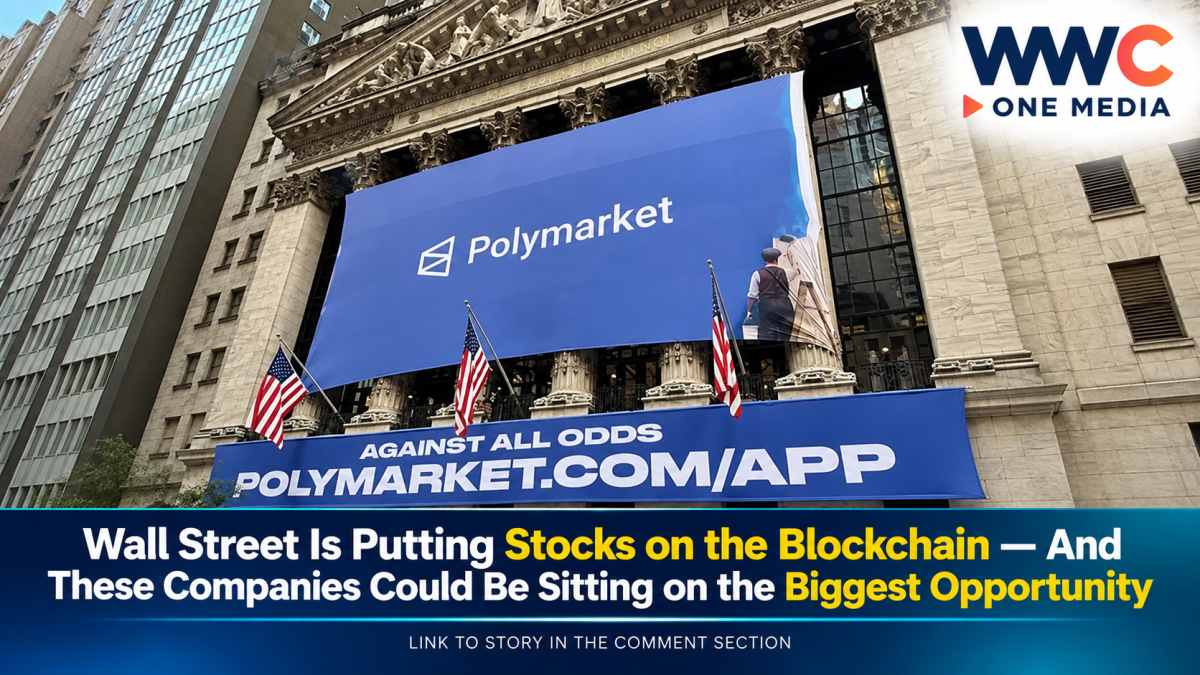
The stock market may be entering one of its biggest structural changes in decades.
The catalyst is not a new exchange or a breakthrough trading app.
It is blockchain technology.
On September 17, the U.S. Securities and Exchange Commission created a temporary regulatory pathway for certain platforms to trade tokenized U.S. stocks — digital representations of traditional shares that can be transferred and traded using blockchain infrastructure.
The move could bring elements of the crypto market — including potentially longer trading hours, programmable transactions and blockchain-based settlement — closer to traditional equities.
And it has immediately put a handful of financial and crypto companies in the spotlight.
Among them are Robinhood and Coinbase, two companies already positioning themselves at the intersection of traditional finance and digital assets.
But the bigger story may be what happens if tokenized equities move from an experimental product into mainstream market infrastructure.
What exactly is a tokenized stock?
Tokenization essentially means creating a blockchain-based representation of an existing financial asset.
Instead of ownership being recorded solely through conventional financial-market infrastructure, a token can represent the underlying security on a blockchain.
That doesn’t necessarily mean the investor is buying a cryptocurrency that merely tracks a company’s share price.
Under the SEC’s new framework, eligible tokenized stocks must provide the same fundamental shareholder rights as the underlying securities, including dividend and voting rights.
That distinction is critical.
The market already contains products marketed as “tokenized stocks” that may not provide the same legal ownership rights as conventional shares.
The SEC’s new framework is specifically aimed at tokenized securities that meet its requirements.
The SEC just opened the door
The SEC’s September 17 order provides temporary, conditional exemptions for qualifying tokenized securities venues and liquidity providers.
The exemption lasts five years.
The agency says the initiative is intended to allow on-chain trading experiments while it considers whether additional regulatory action is needed.
SEC Chairman Paul Atkins described the initiative as a step toward bringing U.S. capital markets into the digital era.
The regulator’s move is significant because one of the biggest obstacles to tokenized equities has been uncertainty over how blockchain-based trading fits within existing securities rules.
Now, at least for qualifying platforms, there is a defined regulatory pathway.
Why Robinhood suddenly matters
Robinhood is one of the companies most directly connected to the tokenization trend.
The trading platform has already been experimenting with tokenized assets outside the United States and has been expanding its cryptocurrency infrastructure.
The SEC’s new framework could give companies like Robinhood a clearer route toward offering tokenized U.S. securities domestically.
The potential attraction is obvious.
Blockchain-based securities could theoretically allow trading and settlement to operate outside the traditional timetable and infrastructure of stock exchanges.
Instead of treating stocks as assets that only move through conventional brokerage and clearing systems, tokenization could make them more portable across blockchain-based financial platforms.
But the transition will not happen overnight.
Regulatory approval does not automatically mean that every publicly traded company can immediately have its shares converted into tokens.
The SEC’s framework contains conditions, and issuers have an important role.
Coinbase wants a piece of the stock market too
Coinbase is another major potential beneficiary.
The cryptocurrency exchange has been pushing beyond traditional crypto trading as the digital-asset industry moves toward tokenizing real-world assets.
Tokenized stocks could give Coinbase another product category while bringing traditional securities closer to the infrastructure that crypto exchanges already use.
The market reaction showed how closely investors are watching the development.
Reports following the SEC announcement showed substantial moves in crypto-linked stocks, including Robinhood and Coinbase.
But a stock-price reaction should not be confused with proof that tokenization will generate a specific amount of future revenue.
The business opportunity remains dependent on adoption, regulation, liquidity, issuer participation and the economics of operating these markets.
Nasdaq is moving in the same direction
Perhaps the most important sign that tokenized equities are moving beyond the crypto world is the involvement of Nasdaq.
In March, Nasdaq announced plans for an equity-token design intended to preserve issuer control, shareholder rights and existing regulatory frameworks.
Nasdaq has subsequently advanced its work with crypto platform Kraken.
In September, Nasdaq announced a $100 million investment in Payward, Kraken’s parent company, as the two companies deepen their collaboration on tokenized equities and “always-on” market infrastructure.
That partnership illustrates how the market is developing on two tracks simultaneously.
Crypto companies want access to traditional securities.
Traditional financial institutions want to use blockchain technology without abandoning the legal and investor protections built around conventional securities.
Tokenization is where those two worlds meet.
DTCC is building the plumbing
The transformation is not being driven only by exchanges and crypto companies.
The Depository Trust & Clearing Corporation, one of the central pieces of U.S. securities-market infrastructure, has already conducted production trades using tokenized assets held through the Depository Trust Company.
DTCC said in July that it had successfully converted assets held at DTC into tokens and used them in real production trades.
The organization plans to launch its broader DTC Tokenization Service in October 2026.
That could prove more consequential than any individual tokenized-stock product.
Why?
Because the biggest challenge isn’t simply creating a digital token.
It is connecting that token to the enormous infrastructure responsible for custody, settlement, corporate actions and investor rights.
DTCC says its tokenization service is designed to preserve the same entitlements, investor protections and ownership rights associated with assets held in traditional form.
The promise: markets that never really close
One of the biggest potential changes is trading availability.
Traditional U.S. stock markets operate within defined trading sessions, although extended-hours trading already exists through many brokers.
Blockchain-based markets could theoretically move toward much longer or even continuous trading.
That is one reason the concept of “always-on” markets has become central to the tokenization debate.
Nasdaq itself has described its partnership with Kraken as part of an effort to develop infrastructure supporting tokenized equities and always-on markets.
For investors outside the United States, the implications could be particularly significant.
A blockchain-based market could potentially make U.S. securities more accessible across different time zones.
But accessibility will still depend on local regulations, brokerage rules, investor eligibility and the structure of the individual product.
Tokenization does not automatically eliminate securities laws in every country.
Smaller minimum investments could become possible
Another potential benefit is fractional ownership.
Digital assets can be divided into smaller units, potentially allowing investors to gain exposure to securities without purchasing a traditional whole share.
That could make certain investments more accessible.
But fractional shares already exist through conventional brokerage platforms.
So tokenization isn’t creating fractional ownership from nothing.
Its potential advantage is combining fractionalization with blockchain-based settlement, transferability and programmable financial infrastructure.
Whether those advantages are meaningful enough to justify a wholesale change in market architecture remains an open question.
Settlement could become faster
Traditional securities transactions require multiple layers of intermediaries.
A blockchain can potentially record and settle transactions using shared digital infrastructure.
That could reduce some reconciliation and settlement processes and potentially lower costs.
But again, tokenization does not automatically mean instant settlement.
A tokenized security still has to connect with custody systems, compliance requirements, corporate actions, identity checks and other financial infrastructure.
The SEC’s framework therefore represents an experiment in integrating blockchain technology into regulated markets rather than simply replacing Wall Street’s existing machinery.
There is also a major catch: companies can object
The new system is not a free-for-all.
Reuters reported that platforms must notify companies before listing tokenized versions of their stocks, and issuers can object.
That creates an important question about who ultimately controls the digital representation of a public company’s shares.
Traditional exchanges operate within established relationships with issuers, regulators, brokers and clearing organizations.
Tokenization introduces another potential layer of infrastructure.
Companies will want to know exactly where their shares are being represented, who is responsible for them and what rights investors receive.
Those questions will become increasingly important as tokenized markets expand.
Not every “stock token” is the same
This distinction may become one of the most important issues for investors.
A token can:
- Represent actual ownership of a security.
- Represent an entitlement to an underlying security.
- Track the price of a stock without giving the holder ownership rights.
- Be issued by a third party rather than the company whose stock it references.
These structures can look similar on a trading screen but have very different legal and economic characteristics.
The SEC’s new framework specifically excludes synthetic products that merely mimic stock prices without representing ownership.
That means investors will need to examine what a token actually represents rather than relying on the label “tokenized stock.”
Robinhood, Coinbase and Nasdaq are not alone
The tokenization race is rapidly expanding.
Banks, asset managers, exchanges, custodians and fintech companies are experimenting with blockchain-based securities.
DTCC’s tokenization working group includes major financial institutions and market infrastructure companies, including BlackRock, Charles Schwab, Goldman Sachs, JPMorgan and others.
That matters because tokenization is increasingly becoming a financial-infrastructure project, rather than simply a crypto-industry experiment.
The players trying to build the next generation of markets include companies from both sides of the traditional finance divide.
What could change for Wall Street?
If tokenized equities become widely adopted, several parts of the financial system could eventually change.
Trading: Markets could operate for longer hours.
Settlement: Blockchain-based infrastructure could reduce some existing settlement processes.
Ownership: Investors could hold securities in blockchain-based forms while retaining traditional shareholder rights.
Liquidity: New venues could connect pools of buyers and sellers across different financial ecosystems.
Access: Investors in different jurisdictions could potentially gain easier access to certain securities, subject to local regulation.
Corporate actions: Blockchain infrastructure could eventually streamline processes such as dividend distribution and shareholder voting.
Nasdaq has specifically identified corporate actions, proxy voting and shareholder engagement as areas where tokenization could modernize the investor experience.
But the risks are just as important
The technology also introduces new risks.
Cybersecurity is one.
If tokenized securities become an important part of the financial system, blockchain infrastructure and digital wallets could become attractive targets for hackers.
Operational failures are another concern.
A traditional stock market has layers of institutions responsible for custody, clearing and settlement.
A tokenized market must establish equally robust mechanisms.
There are also questions around liquidity.
A stock may be highly liquid on Nasdaq but have little trading volume in its tokenized form.
That could create fragmented markets in which the same economic asset trades on multiple venues with different liquidity conditions.
And regulation remains a moving target.
The SEC’s exemption is temporary, meaning the rules governing tokenized equities could evolve substantially over the next five years.
The biggest winners may be the companies building the infrastructure
The CNBC analysis highlights companies that could benefit from the tokenization trend, particularly those with exposure to digital-asset trading and market infrastructure.
But the opportunity is broader than a short list of publicly traded stocks.
There are at least three layers to the emerging market:
The exchanges and trading platforms that provide venues for buying and selling tokenized assets.
The infrastructure providers that handle custody, clearing, settlement and compliance.
The financial institutions that issue, manage and distribute tokenized securities.
Robinhood and Coinbase sit closer to the first category.
Nasdaq and DTCC are building pieces of the second.
Banks and asset managers are increasingly participating across all three.
A new competition between Wall Street and crypto
For years, the relationship between traditional finance and crypto was largely adversarial.
Banks questioned the value of digital assets.
Crypto companies argued that traditional financial infrastructure was outdated.
Tokenization is changing that relationship.
Now both sides are building systems that combine elements of each.
Wall Street gets blockchain technology.
Crypto gets regulated securities.
And investors could eventually get a market that operates very differently from today’s system.
The question is no longer whether financial institutions are experimenting with tokenization.
They clearly are.
The bigger question is how much of the stock market will eventually move onto blockchain rails.
The SEC’s five-year exemption gives the industry a testing ground.
Nasdaq is investing in crypto infrastructure.
DTCC is preparing its tokenization service.
Robinhood and Coinbase are positioning themselves for a potential expansion of digital securities.
And traditional financial institutions are already participating in the underlying infrastructure.
The stock market isn’t disappearing.
But the machinery underneath it may be changing — one token at a time.