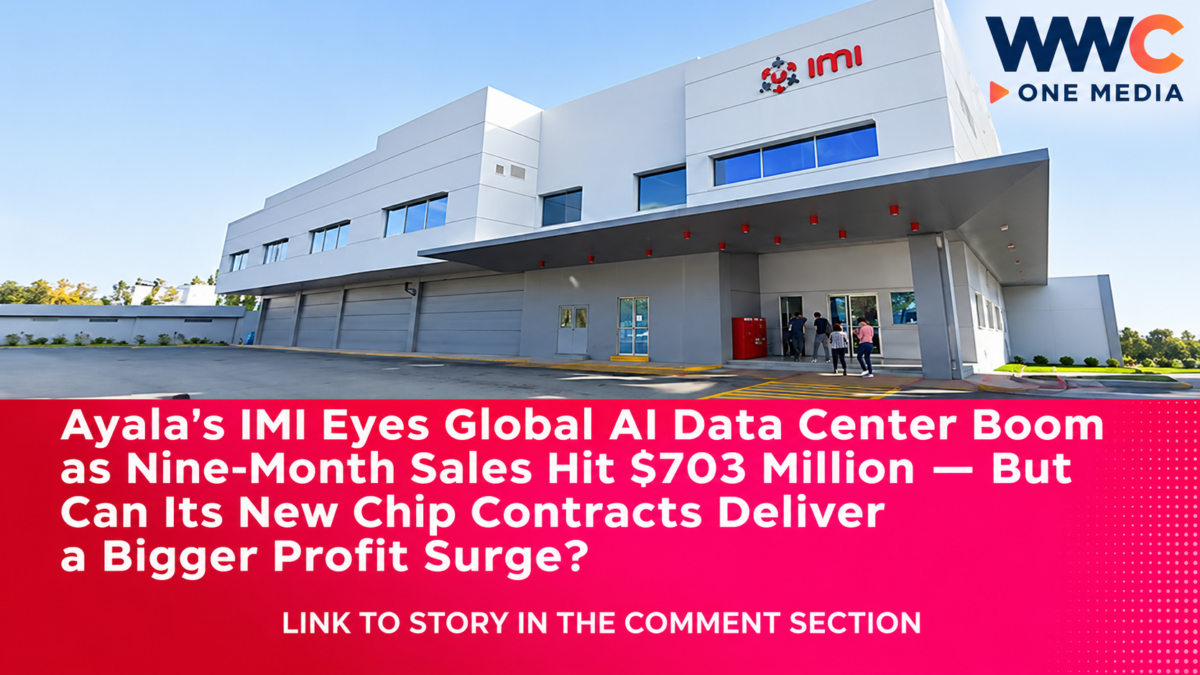
MANILA, Philippines — November 4, 2026 | WWC ONE MEDIA | Philippine Business, Technology, Semiconductors & Artificial Intelligence
Ayala Corporation’s electronics manufacturing arm, Integrated Micro-Electronics Inc. (IMI), is positioning itself to capture a share of the global artificial intelligence infrastructure boom after reporting stronger earnings and securing new contracts for power semiconductor modules used in data centers.
The Laguna-based manufacturer generated $703.2 million in revenue during the first nine months of 2026, an increase of 3.6% from the comparable period last year.
More significantly, core earnings before interest, taxes, depreciation and amortization (EBITDA) rose 12% to $56.5 million, reflecting improved manufacturing efficiency, tighter cost controls and a shift toward higher-value products.
Gross profit margins also increased to 10.4% from 9.0%, showing that the company’s profitability improved faster than its sales.
The turnaround comes after two years of restructuring designed to reduce costs, streamline manufacturing operations and strengthen IMI’s financial position.
Now, the Ayala-controlled company is targeting a potentially larger opportunity: the specialized electronic components needed to power the world’s rapidly expanding AI data centers.
But with technology giants committing enormous sums to computing infrastructure, can IMI transform its newly secured contracts into sustained profits—or could weak industrial demand and uncertainty over AI spending undermine its recovery?
IMI’s Nine-Month Earnings Show a Stronger Business
IMI’s financial performance suggests that its restructuring efforts are producing measurable improvements.
Revenue increased 3.6% to $703.2 million during the January-to-September period.
Core EBITDA climbed 12% to $56.5 million.
The company’s gross margin expanded by 1.4 percentage points to 10.4%.
These results indicate that IMI is generating more operating earnings relative to its sales than it did a year earlier.
The improvement reflects better factory utilization, stronger procurement controls, disciplined pricing and a more profitable product mix.
During the third quarter alone, core EBITDA increased 9.8% to approximately $19.5 million.
However, EBITDA is not equivalent to net income or operating cash flow.
It excludes interest, taxes, depreciation and amortization, and the company’s core measure may also adjust for certain nonrecurring items.
Investors should therefore examine the full financial statements before concluding how much profit was ultimately available to shareholders.
New Data Center Contracts Open a Major Growth Opportunity
The most important strategic development is IMI’s expansion into power semiconductor modules for data centers.
According to InsiderPH’s November 4 report, the company has already secured new contracts in this segment.
These components play an important role in managing and converting electricity within electronic systems.
AI data centers require substantial computing power, particularly for advanced processors used to train and operate artificial intelligence models.
But high-performance processors are only one part of the infrastructure.
The systems also need reliable power delivery, voltage conversion, cooling and electrical protection.
This creates opportunities for manufacturers specializing in advanced packaging and high-reliability electronics.
IMI is seeking to serve that market through its engineering and manufacturing capabilities.
President and CEO Louie Hughes said the company’s latest wins demonstrate the potential of its specialized technologies in demanding applications.
However, the values of the new data-center contracts and their expected revenue contributions have not been publicly quantified in the source report.
A contract win represents a business opportunity, not necessarily a guarantee of immediate revenue or profit.
The $2.1-Trillion AI Infrastructure Boom Explains the Opportunity
The global expansion of AI data centers could create demand across a broad range of electronics manufacturers.
Bank of America Global Research has projected that annual worldwide data-center spending could reach approximately $2.1 trillion by 2028.
WWC ONE MEDIA previously examined this forecast in Bank of America Predicts $2.1-Trillion AI Data Center Explosion by 2028 — But Could a Global Power Shortage Bring the Entire Boom Crashing Down?.
The projection reflects anticipated investment in servers, semiconductor systems, electrical equipment, cooling infrastructure and related facilities.
For IMI, the opportunity involves manufacturing specialized components used within that infrastructure.
However, the $2.1-trillion figure is an industry forecast.
It does not represent guaranteed spending, and it should not be interpreted as the size of IMI’s own addressable market.
The company’s actual revenue potential will depend on customer requirements, production capacity, contract terms and competitive conditions.
Why Power Modules Matter More as AI Becomes Energy-Intensive
One of the greatest technical challenges facing AI data centers is electricity consumption.
High-performance servers must deliver large amounts of electrical power while controlling heat and maintaining reliability.
Power semiconductor modules help manage electrical energy within those systems.
IMI has been developing capabilities involving advanced packaging materials, thermal management and manufacturing processes for power electronics.
In earlier 2026 investor discussions, company executives described work involving silicon carbide, gallium nitride, specialized bonding processes and improved cooling.
These technologies can help manufacturers develop smaller, more efficient power systems.
They also require sophisticated manufacturing techniques and testing.
For customers operating critical computing infrastructure, reliability is particularly important because equipment failures can disrupt expensive operations.
IMI’s strategy is to compete in applications where engineering capability and production quality matter as much as manufacturing cost.
But the technical advantages of any specific product must ultimately be demonstrated through customer qualification, performance and commercial adoption.
Global Server Growth Supports Component Demand
The potential demand for IMI’s products extends beyond individual data-center projects.
WWC ONE MEDIA previously reported in Server Shipments to Surge 15.1% as AI Boom Powers Global Data Center Expansion.
That article cited an industry forecast projecting worldwide server shipments of approximately 16.6 million units in 2026, with AI-focused shipments expected to grow faster than the broader market.
An increase in server production can support demand for electronics and power-management components.
However, server shipment growth does not translate into an equivalent percentage increase in IMI’s sales.
The company must win and fulfill specific customer programs.
The number of components required per server, selling prices and competition among suppliers will influence its actual financial performance.
Automotive Cameras Become IMI’s Second Growth Engine
IMI is not relying exclusively on data centers.
It is also expanding its automotive camera business.
The company supplies components for vehicle systems that help monitor drivers and support advanced safety features.
Modern automobiles increasingly rely on cameras, sensors and electronics to assist drivers and improve vehicle safety.
Driver-monitoring systems can detect certain signs of inattention or fatigue, depending on the technology and configuration.
Other cameras support visibility, parking assistance and advanced driver-assistance functions.
IMI sees opportunities as vehicle manufacturers introduce more sophisticated electronic systems.
However, the automotive sector remains highly competitive.
Production volumes depend on vehicle demand, manufacturers’ development schedules and the successful qualification of components.
A new product program can require significant development and testing before reaching full-scale production.
Consequently, the pace at which IMI converts automotive contracts into revenue remains an important indicator for investors.
Two Years of Restructuring Begin to Pay Off
IMI’s latest financial improvement follows a difficult period for the company.
Management spent approximately two years adjusting its manufacturing footprint, reducing expenses and focusing on businesses with stronger potential returns.
The company also moved away from selected noncore operations.
In 2025, it announced a divestment involving VIA Optronics, a business that had contributed to earlier financial losses.
The restructuring was intended to improve efficiency and release resources for more promising product segments.
The strategy began showing results before the latest nine-month report.
During the first half of 2026, IMI generated $465 million in revenue, up 4% from the comparable core-business figure.
First-half net income reached $14 million, approximately 50% higher than the $9.4 million reported on the comparable basis.
Gross margin increased to 10.5% from 8.7%.
These earlier results were disclosed by IMI and reported independently by Manila Bulletin.
The latest nine-month figures show that the company’s improved operating profitability continued through September.
However, the comparison bases matter because some earlier figures exclude losses and other effects associated with disposed businesses.
Debt Reduction Strengthens Financial Flexibility
IMI is also working to strengthen its balance sheet.
Total debt declined to $188.3 million at the end of September 2026, compared with $196 million at the end of December 2025.
The reduction amounted to approximately $7.7 million over nine months.
Lower borrowing can help reduce financial pressure and provide more flexibility for investment.
However, the amount of debt outstanding is only one measure of financial health.
Investors must also consider cash balances, financing costs, working-capital requirements and future capital expenditure.
Earlier in the year, IMI reported $26.8 million in first-half operating cash flow and repayment of $17.6 million in borrowings.
Those figures indicate progress in managing financial obligations.
But the company will need to maintain that discipline while expanding production for new customers.
The Philippines Is Also Building Its Own AI Data Center Industry
IMI’s expansion into data-center power components comes as other Philippine companies invest in the infrastructure needed to support artificial intelligence.
Meralco PowerGen and VITRO have been exploring projects that could integrate data centers with renewable-energy supply.
WWC ONE MEDIA covered the development in MGEN and VITRO Explore Renewable-Powered Data Centers to Support Philippine AI Growth.
The proposed collaboration focuses on evaluating potential sites, electricity availability, connectivity and the commercial viability of future facilities.
It remains at the feasibility-study stage.
IMI’s business model is different.
The company manufactures electronic components rather than primarily developing or operating large data-center buildings.
Nevertheless, both developments demonstrate how AI infrastructure could create opportunities across multiple parts of the Philippine economy.
These include power generation, electronics manufacturing, telecommunications, construction and technical services.
Converge’s AI Infrastructure Expansion Shows Another Side of the Market
Philippine telecommunications companies are also expanding their digital infrastructure capabilities.
Converge ICT Solutions has developed an AI-ready data-center facility in Angeles City and is positioning its network to support cloud and enterprise computing.
WWC ONE MEDIA examined the strategy in Converge Builds a Digital Fortress for Philippine Data as AI and Cloud Demand Accelerate.
The report described the company’s combination of domestic data centers, fiber connectivity and international submarine cable systems.
The connection to IMI is the wider infrastructure supply chain.
A data center needs both the facility in which computing equipment operates and the electronic systems that allow that equipment to function.
Manufacturers such as IMI may compete for opportunities involving those components.
However, the source reporting does not establish that IMI has secured contracts with Converge or MGEN-VITRO.
Those companies are cited as separate examples of the growing Philippine data-center ecosystem.
Electricity Constraints Could Limit the AI Boom
The strong outlook for AI infrastructure comes with significant risks.
Data centers require substantial electricity, and power availability can affect where new facilities are constructed.
Governments and utilities must balance the needs of new computing projects with those of households and existing businesses.
WWC ONE MEDIA examined that issue in Electricity Bills Are Soaring as Utilities Race to Upgrade Power Grids — But Who Will Pay for the AI Energy Boom?.
The report explored how grid upgrades and rising electricity demand can create difficult questions about infrastructure costs.
For IMI, insufficient data-center development or delays in customers’ projects could affect the timing of component demand.
The company also faces its own energy costs as a manufacturer.
Reliable electricity is therefore important both for its operations and for the market it hopes to serve.
Stronger Margins Do Not Eliminate Industrial Risks
Although IMI’s earnings performance has improved, some of its traditional markets remain weak.
Industrial demand has been uneven, while legacy automotive programs have faced softness.
These pressures help explain why nine-month revenue grew only 3.6%, even as core EBITDA expanded 12%.
The stronger margins indicate that the company has improved efficiency and its product mix.
But future growth will require more than cost reduction.
IMI must secure new orders, maintain production quality and scale its higher-value programs without allowing expenses to rise disproportionately.
International competition also remains substantial.
Electronics manufacturers in China, Taiwan, Southeast Asia and other markets are pursuing opportunities in power electronics, automotive systems and industrial technology.
Customers will evaluate suppliers based on reliability, engineering expertise, pricing, capacity and delivery performance.
IMI’s success will depend on maintaining an advantage in the specialized applications it is targeting.
What the Company and Independent Reporting Confirm
InsiderPH’s November 4 report confirms IMI’s nine-month revenue, core EBITDA, gross margin and September debt position.
It also reports newly secured contracts for data-center power semiconductor modules and expansion in automotive camera programs.
IMI’s August corporate announcement independently establishes the earlier first-half improvement, including stronger revenue, margins and net income.
The Philippine Stock Exchange published the company’s first-half results through its official disclosure system.
Manila Bulletin separately reported those first-half earnings and management’s focus on higher-value manufacturing.
IMI’s earlier investor discussions also support the strategic rationale for developing advanced power-module packaging technologies for AI infrastructure.
However, the new nine-month data and contract announcement were not accompanied in the reviewed sources by independently disclosed contract values or a detailed breakdown of revenue attributable to data-center customers.
Those limitations are important when evaluating how much future growth has already been secured.
The Bottom Line: IMI’s Turnaround Faces Its Biggest Commercial Test
Ayala’s Integrated Micro-Electronics is entering a new phase after two years of restructuring.
Its first nine months of 2026 delivered $703.2 million in revenue and $56.5 million in core EBITDA.
Gross margins improved, debt declined and new data-center power-module contracts provided another potential source of growth.
The company is also expanding its automotive camera business as manufacturers demand more sophisticated safety electronics.
These developments suggest that management’s operational changes are producing results.
But IMI’s success will depend on converting new programs into substantial revenue, maintaining strong margins and managing investment carefully.
The global AI infrastructure boom creates an enormous potential market, but spending forecasts remain uncertain and customer orders must ultimately translate into profitable manufacturing.
IMI has demonstrated that it can improve earnings even when revenue growth is modest. The next challenge is proving that higher-value products can deliver sustained expansion.
As Ayala’s electronics manufacturer enters the race to supply the world’s AI data centers, will its new power semiconductor contracts transform IMI into a major beneficiary of the computing revolution—or could a slowdown in global technology spending threaten the turnaround it has spent two years building?