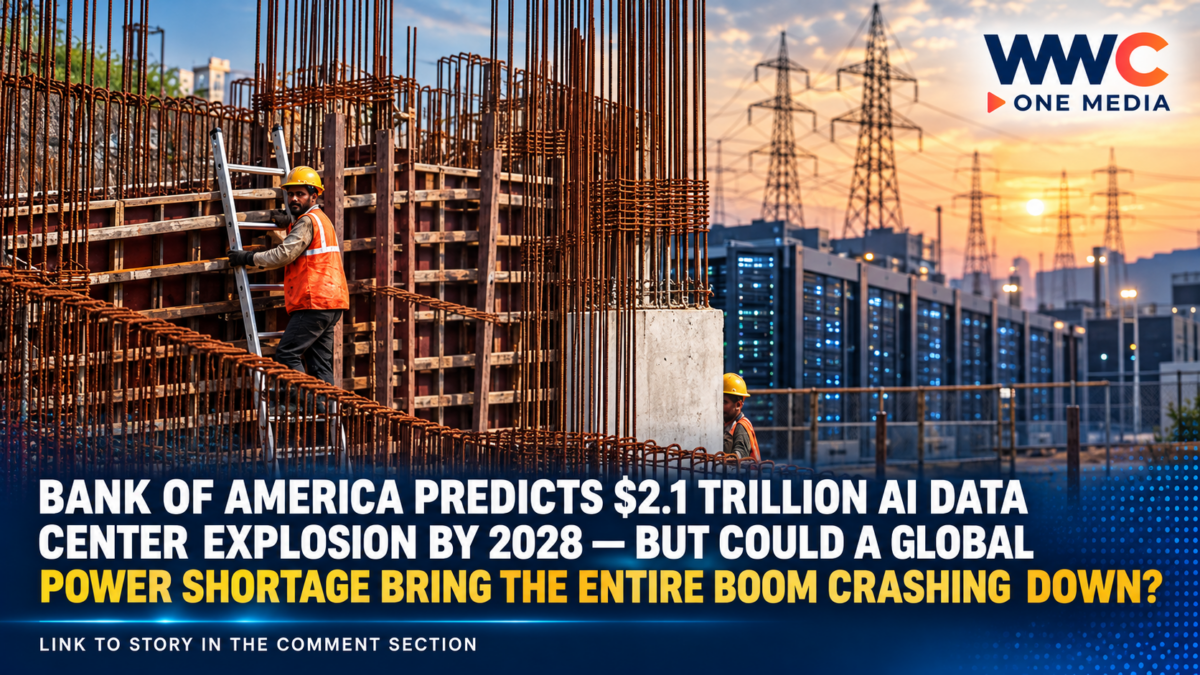
The global artificial intelligence race is entering a trillion-dollar spending era, with Bank of America forecasting a dramatic surge in data center investment. But behind the massive expansion lies a growing concern: Can the world’s electricity grids, construction industry and technology companies keep pace?
October 24, 2026 | WWC ONE MEDIA — Business & Technology
The worldwide race to dominate artificial intelligence is triggering one of the biggest infrastructure investment waves in modern technology, with global data center spending forecast to more than double to an extraordinary $2.1 trillion by 2028, according to BofA Global Research.
In a research note released Friday, October 23, Bank of America estimated that worldwide spending on data centers would reach approximately $1 trillion in 2026 before accelerating sharply over the following two years, driven by demand for AI computing, cloud platforms and increasingly powerful digital services.
The projection underscores how artificial intelligence is transforming far more than the technology industry. From semiconductor manufacturers and construction companies to electricity suppliers and cooling-system developers, a vast network of businesses is positioning itself to benefit from the spending boom.
However, the unprecedented investment wave also raises a critical question: Will the financial returns from artificial intelligence justify the enormous cost of building the infrastructure required to power it?
A trillion-dollar race that could transform the global economy
Bank of America’s projections reveal the extraordinary scale of the expansion.
The research firm estimates that the global data center market, valued at approximately $275 billion in 2022, could reach $2.93 trillion by 2030.
It projects a compound annual growth rate of approximately 37% between 2025 and 2030, with artificial intelligence serving as a major engine of expansion.
Much of that demand is coming from companies seeking additional computing power to train advanced AI models, deliver generative AI services and support cloud-based business applications.
Unlike traditional computing operations, many advanced AI workloads require dense networks of powerful processors, high-speed connections and sophisticated cooling systems.
Consequently, building the next generation of AI data centers involves far more than constructing large warehouses filled with computers.
It requires massive electrical connections, specialized chips, backup generators, cooling equipment and infrastructure capable of operating continuously.
Why AI data centers cost tens of millions of dollars per megawatt
According to Bank of America’s analysis, traditional data center development costs approximately $49 million per megawatt of capacity, with information technology equipment accounting for roughly 78% of total spending.
AI-focused facilities, sometimes described as neoclouds, are even more expensive, costing approximately $57 million per megawatt.
These specialized facilities are designed to support demanding artificial intelligence applications and can require less physical space for their computing operations than conventional facilities, despite their higher cost per megawatt.
Servers represent the largest expense, at approximately $31.4 million per megawatt, followed by networking equipment at roughly $4.8 million.
Additional spending goes toward switchgear, electrical distribution systems, generators, backup power, chillers and other cooling equipment.
This creates enormous commercial opportunities not only for chipmakers but also for industrial suppliers that rarely attract the same attention as major technology companies.
Tech giants are already committing historic investment budgets
Bank of America’s outlook is consistent with other major financial institutions reporting an extraordinary acceleration in artificial intelligence investment.
In research published on October 19, JPMorgan projected that global AI-related capital expenditures could reach approximately $900 billion in 2026, with cumulative spending potentially totaling $5.5 trillion by 2030.
Separately, Goldman Sachs Research estimated in August that worldwide AI investment could exceed $1 trillion in 2026, including approximately $581 billion in the United States.
These forecasts use different definitions and methodologies, meaning they should not be treated as identical measures or added together.
Nevertheless, they illustrate the immense financial commitments being made by technology companies, cloud providers and infrastructure investors.
Companies including Microsoft, Amazon, Alphabet and Meta are among the major corporations expanding the computing capacity needed to support artificial intelligence services.
The central challenge is turning these infrastructure investments into sustainable revenue and profits.
Electricity shortages could threaten the global AI expansion
Despite optimistic financial projections, one of the biggest threats to the industry may be surprisingly straightforward: electricity.
The International Energy Agency projects that worldwide data center electricity consumption could roughly double from 485 terawatt-hours in 2025 to approximately 950 terawatt-hours by 2030.
That would represent around 3% of global electricity demand.
The energy required to support AI-focused data centers is expected to grow even faster, potentially tripling over the same period.
These projections highlight growing pressure on electricity networks, power-generation capacity and transmission infrastructure.
In an October 22 Reuters report, French cable manufacturer Nexans warned that limited cable production capacity was emerging as another obstacle to data center expansion.
Building additional specialized cable manufacturing capacity can take years, potentially delaying projects even when investors have already secured financing.
Bloomberg also reported in October that data center operators were struggling with shortages of electrical power and skilled construction workers.
Together, these obstacles suggest that access to reliable electricity and essential infrastructure could become just as strategically important as access to advanced AI chips.
The investment boom carries significant financial risks
The extraordinary expansion is also raising questions about whether projected AI demand will translate into sufficient commercial returns.
Data center investments require large amounts of upfront capital, while projects can face construction delays, regulatory obstacles, rising financing costs and uncertain customer demand.
A separate Reuters investigation in September highlighted concerns about speculative electricity requests for proposed US data centers.
Some projects requesting power connections may never be constructed, complicating efforts by utilities and regulators to forecast future electricity demand.
This creates two competing risks.
Building too little infrastructure could slow AI innovation and limit economic growth.
Building too much could leave developers, lenders and electricity customers exposed to costly infrastructure that fails to generate expected returns.
The distinction between genuine, commercially supported demand and speculative development will become increasingly important as investment commitments rise.
Asia could benefit from the global AI infrastructure boom
Although much of the current expansion is concentrated in the United States, the growing demand for data center equipment and services also presents opportunities across Asia.
Countries with established semiconductor industries, electrical equipment manufacturing, renewable energy capabilities and digital infrastructure expertise may benefit from increasing investment.
Singapore, Malaysia, Japan, India and other Asian markets are strategically positioned to participate in different parts of the data center supply chain.
However, the benefits will depend on local electricity availability, connectivity, infrastructure policies and the economics of individual projects.
For the Philippines, the global boom could create potential opportunities for energy developers, telecommunications companies, construction firms and digital infrastructure providers.
Still, capturing meaningful investment would require reliable power, competitive operating costs, strong connectivity and long-term infrastructure planning.
Is the AI infrastructure boom sustainable?
The enormous spending forecasts highlight a fundamental shift in the global technology industry.
Artificial intelligence is no longer simply a competition to develop smarter software. It is becoming a contest over who can finance, construct, power and operate the infrastructure behind the next generation of computing.
Bank of America’s projection of $2.1 trillion in annual data center spending by 2028 represents a dramatic opportunity for technology and industrial companies alike.
But the numbers remain forecasts, not guaranteed investment outcomes.
Electricity limitations, equipment shortages, financing costs, advances in computing efficiency and the pace of AI adoption could all influence actual spending.
For investors and technology companies, the biggest question is no longer whether artificial intelligence will reshape the global economy. It is whether the extraordinary infrastructure spending required to support it will deliver returns large enough to sustain the boom.
And as trillions of dollars flow toward the world’s data centers, the industry may be approaching its biggest test yet: Will this investment revolution create the foundation of the next digital economy — or expose the financial limits of the global AI race?