
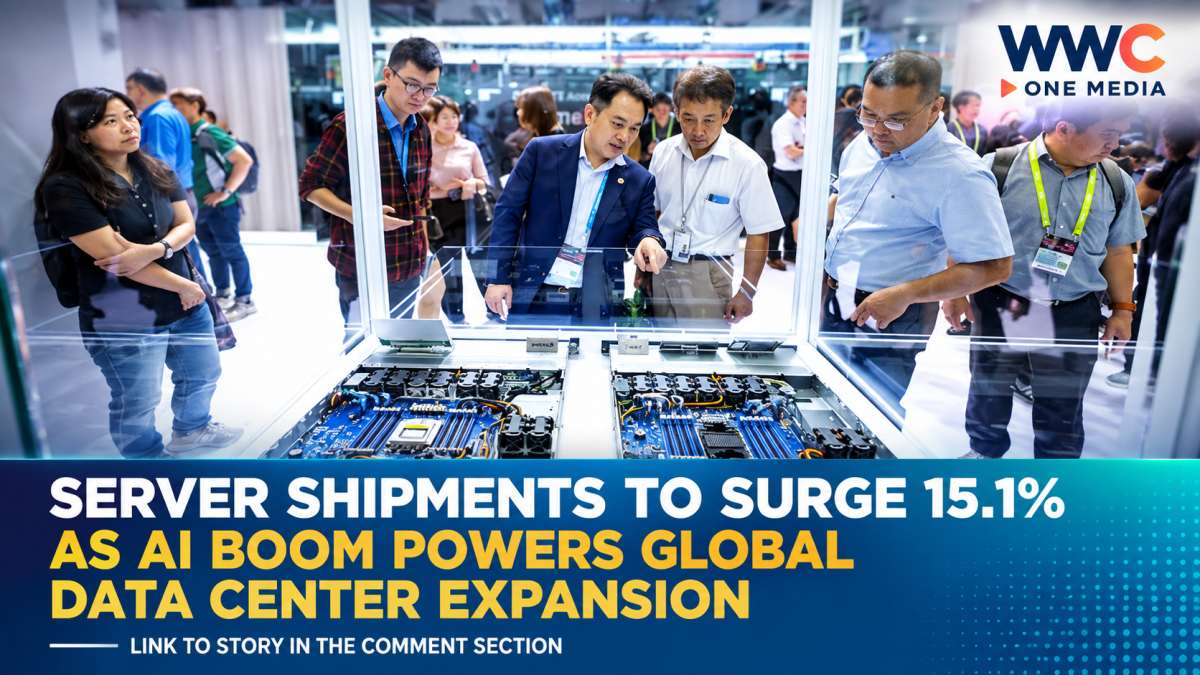
TAIPEI, Taiwan — Global server shipments are expected to jump 15.1% this year to 16.6 million units, driven by the relentless expansion of artificial intelligence infrastructure, as technology companies and cloud providers race to build the computing capacity needed for the next generation of AI.
Even more striking, AI server shipments are forecast to rise 20.7% to 4.6 million units, according to Taiwan’s Market Intelligence and Consulting Institute (MIC), highlighting how artificial intelligence is rapidly becoming one of the semiconductor and technology industry’s biggest growth engines.
AI Servers Are Growing Faster Than the Overall Market
The latest forecast shows that AI-focused servers are expanding faster than the broader server industry.
Companies around the world are investing heavily in massive data centers packed with advanced processors, memory chips, networking equipment and storage systems capable of training and running increasingly powerful AI models.
The result is a major shift in the global server market.
Traditional servers remain essential for cloud computing and enterprise operations, but AI servers — equipped with powerful accelerators and specialized hardware — are becoming an increasingly important source of growth.
Taiwanese technology companies are expected to play a major role in that expansion because of their deep involvement in server manufacturing and the global AI hardware supply chain.
Taiwanese Manufacturers Expand Beyond Taiwan
The AI boom is also changing where servers are made.
Taiwanese companies are increasingly diversifying production outside Taiwan to meet customer demands for local manufacturing and reduce geopolitical and supply-chain risks, according to the MIC.
This reflects a wider transformation across the technology industry as manufacturers build more geographically diversified supply chains.
Server makers are balancing several major pressures at once:
- Surging AI demand
- Customer requests for production closer to major markets
- Geopolitical risks
- Rising component costs
- Supply-chain security
- Competition for advanced semiconductor capacity
The expansion means Taiwan’s technology companies are no longer simply exporting servers from one manufacturing base.
They are increasingly building global production networks to support customers across multiple regions.
The AI Boom Is Reshaping Taiwan’s Technology Industry
The server forecast comes as Taiwan experiences a broader AI-driven technology boom.
Taiwan’s exports recently surged to a record, with the Ministry of Finance reporting that demand for AI continued spreading across semiconductors, servers and other high-tech products.
The country’s exports rose 41% year-on-year to US$82.4 billion, according to the latest Taipei Times report, underscoring how deeply AI infrastructure demand is influencing Taiwan’s economy.
For Taiwan’s technology sector, AI demand is creating opportunities across the entire supply chain.
That includes:
- Semiconductor foundries
- AI chip designers
- Server manufacturers
- Memory producers
- Advanced packaging companies
- Cooling system suppliers
- Networking equipment makers
- Data center infrastructure providers
More Servers Mean More Pressure on Chip Supply
But the rapid expansion also comes with challenges.
AI servers require enormous quantities of advanced chips and memory, putting increasing pressure on semiconductor supply chains.
The world’s biggest technology companies are competing for access to advanced processors and memory as they expand AI data centers.
That competition has already helped fuel strong demand for advanced semiconductors, while companies across the memory industry are spending billions of dollars to increase production capacity.
Taiwan Semiconductor Manufacturing Co’s foundry market share, for example, recently edged up to 72.5% in the second quarter, supported by robust AI and smartphone chip demand, according to TrendForce data reported by the Taipei Times.
AI Server Demand Could Stay Strong Into Next Year
The latest MIC forecast suggests the server boom is unlikely to be a short-term phenomenon.
Technology companies continue investing heavily in AI infrastructure as competition intensifies over generative AI, cloud services, autonomous systems and advanced computing.
However, the industry faces a growing question: Can supply keep up with demand?
Component shortages, higher prices and competition for advanced manufacturing capacity could affect how quickly companies can expand.
Global notebook shipments, by contrast, are expected to decline as weak demand, higher component prices and supply constraints weigh on the consumer technology market — highlighting the increasingly sharp divide between traditional computing and AI infrastructure.
Taiwan Remains at the Center of the AI Hardware Race
The numbers reinforce Taiwan’s critical position in the global AI ecosystem.
While US technology companies may be leading the race to develop AI software and cloud platforms, Taiwanese companies remain deeply involved in building the physical infrastructure behind the revolution.
From advanced chips and packaging to servers and networking equipment, Taiwan’s technology sector is becoming increasingly central to the global race for AI computing power.
And as production expands internationally, Taiwanese manufacturers could become even more important to technology companies seeking secure and diversified supply chains.
The Bottom Line
Global server shipments are on track to rise 15.1% to 16.6 million units this year, while AI server shipments are expected to surge even faster by 20.7% to 4.6 million units.
The forecast highlights just how quickly artificial intelligence is transforming the global technology industry — and why Taiwanese manufacturers are expanding production beyond Taiwan to meet demand and manage geopolitical risks.
With AI continuing to drive investment in chips, servers, memory and data centers, the boom shows few signs of slowing.
But as millions more servers enter production, the next question could be the one that determines the future of the AI race: can the world’s semiconductor and technology supply chains build enough computing power fast enough to keep up?
WWC ONE MEDIA J.M.D




Leave a Reply