MANILA, Philippines — November 4, 2026 | WWC ONE MEDIA | Philippine Business, Real Estate & Corporate Governance
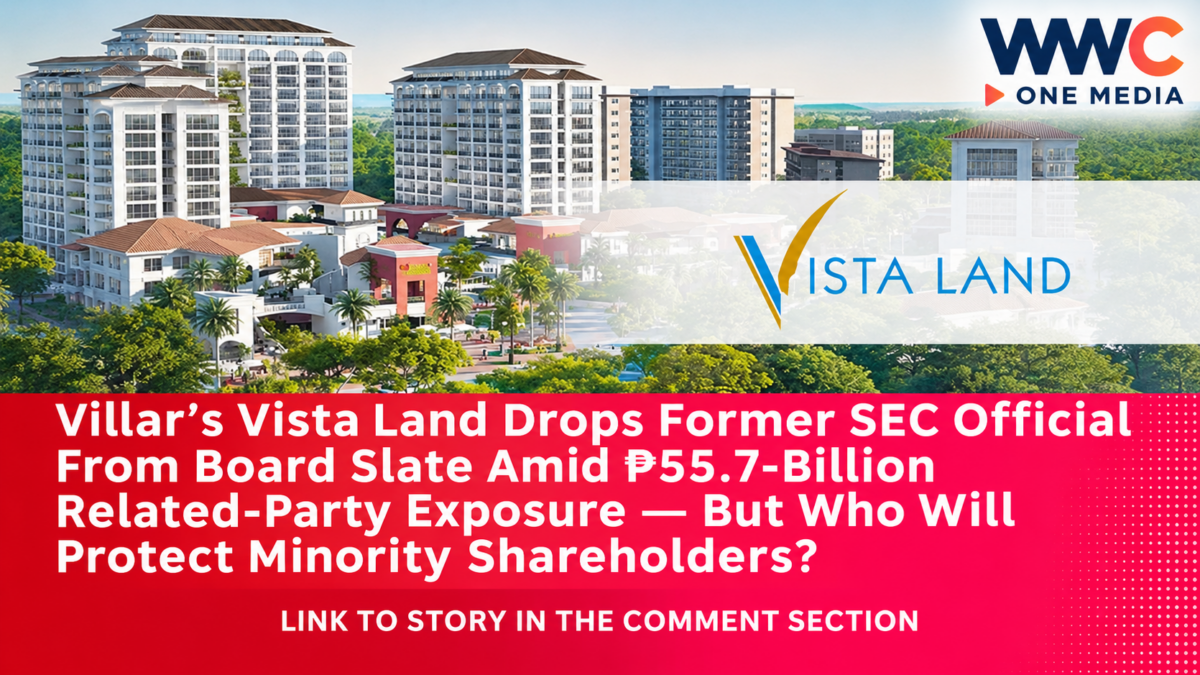
Billionaire Manuel Villar’s property giant Vista Land & Lifescapes Inc. is preparing for a significant boardroom change as questions mount over nearly ₱56 billion in related-party rental receivables, delayed financial disclosures and a sharp decline in annual earnings.
Former Securities and Exchange Commission official Justina F. Callangan has been left off the company’s proposed board reelection slate for its December 22 annual shareholders’ meeting, with former banker Susana M. So nominated in her place.
The development, reported by Bilyonaryo on November 4, comes at a sensitive moment for one of the Philippines’ major listed property developers.
Callangan currently chairs Vista Land’s Corporate Governance Committee and Related Party Transactions Committee, positions responsible for scrutinizing oversight practices and transactions involving affiliated companies.
Her omission from the reelection slate has drawn attention because Vista Land reported approximately ₱55.67 billion in rental receivables from related companies at the end of 2025, up 34.8% from the previous year.
Approximately ₱53.58 billion of that amount was attributable to the Villar family’s AllValue retail group, which includes AllHome and AllDay.
Meanwhile, Vista Land’s 2025 net income plunged 59.2% to ₱3.83 billion, compared with ₱9.37 billion in 2024.
The company has also faced repeated delays in submitting financial reports, contributing to trading suspensions and additional scrutiny from investors and regulators.
But there is an important distinction.
The proposed board change is not proof of misconduct, and the reported related-party receivables are not automatically losses or overdue debts.
External auditor SGV & Co. issued an unmodified opinion on Vista Land’s audited 2025 financial statements.
The central question is whether the incoming board can strengthen investor confidence, improve financial transparency and demonstrate that billions of pesos in transactions with affiliated businesses are being managed in the interests of all shareholders.
Former SEC Official Left Out of Board Nominees
Justina F. Callangan joined Vista Land’s board in 2021.
Before entering the company’s boardroom, she served as head of the SEC’s Corporation Finance Department from February 2001 until October 2017.
She subsequently worked as a consultant to the Philippine Stock Exchange’s Listings Department.
Her regulatory background made her an experienced figure in corporate disclosure and governance.
Within Vista Land, Callangan became chair of the Corporate Governance and Related Party Transactions committees.
She also participated in committees overseeing audit, risk and nominations.
According to Bilyonaryo, she is the only incumbent director excluded from the proposed reelection lineup.
However, the report does not establish why she was not renominated.
There is no verified basis to conclude that she was removed because of disagreements about accounting practices, related-party transactions or corporate governance.
Shareholders are expected to vote on the new board at the December 22 meeting.
Until then, the proposed change should not be described as a completed replacement.
Who Is Susana M. So?
Vista Land has nominated former banker Susana M. So to replace Callangan.
So has held senior positions at Union Bank, Planters Development Bank and Property Company of Friends.
Her background includes banking, corporate finance and real estate.
However, her previous connections to Villar-affiliated businesses are also relevant.
According to Bilyonaryo, So joined the boards of AllHome and AllDay as an independent director in March 2026 before resigning from both companies in September, reportedly for personal reasons.
She also serves as an independent director of VFund Management, the Villar-controlled fund manager associated with VistaREIT.
These relationships merit disclosure and consideration when assessing board independence.
But previous service at affiliated companies does not automatically make a director legally ineligible for independent status.
The relevant assessment depends on applicable regulations, ownership relationships, material business connections and other independence criteria.
For Vista Land, the challenge will be demonstrating that the board can make objective decisions when transactions involve businesses under common ownership.
Nearly ₱56 Billion in Related-Party Receivables Raises Questions
The central financial concern involves rental receivables from related companies.
At the end of 2025, Vista Land reported approximately ₱55.67 billion in such balances.
That represented a 34.8% increase from the preceding year.
Of this amount, approximately ₱53.58 billion was attributable to the AllValue group.
Related-party transactions are not automatically improper.
Large conglomerates frequently lease properties, provide services and transfer resources among companies under common ownership.
However, they create potential conflicts of interest.
A company may be negotiating with another business controlled by the same family or shareholder group.
The board must therefore determine whether the terms are fair and whether the transaction protects the interests of minority shareholders.
This is especially important when the amounts involved are substantial compared with the company’s annual earnings.
The question is not simply whether the transactions are legally permitted.
Investors also need to understand the terms, payment schedules, recoverability and economic benefits of the arrangements.
Why the ₱55.67 Billion Should Not Be Called a Confirmed Bad Debt
The accounting treatment requires careful explanation.
Approximately ₱35.93 billion of Vista Land’s related-party rental receivables represented rent recognized under long-term lease arrangements but not yet due for payment, according to Bilyonaryo’s review of the annual report.
Accounting rules can require rental income to be recognized over the life of a lease even when contractual cash payments follow a different schedule.
That means the receivable balance is not equivalent to overdue unpaid rent.
It would also be misleading to describe the entire ₱55.67 billion as money already lost.
Instead, the relevant issue is whether the company will ultimately collect the amounts it has recognized.
The quality of future cash collection matters because reported accounting income does not necessarily translate immediately into available cash.
For shareholders, a useful indicator will be how much of the receivable balance is converted into cash or otherwise settled under enforceable arrangements.
Fine Properties Provides Financial Support
Vista Land has stated that the related-party amounts remain recoverable because of support from its ultimate parent, Fine Properties Inc.
The company’s disclosures indicate that supporting assets could be used to settle applicable obligations through cash payments or asset transfers.
Including other receivables and advances, related-party balances reached approximately ₱60.73 billion at year-end 2025.
That broader total should not be confused with the narrower ₱55.67-billion rental receivables figure.
SGV examined relevant property records, valuation materials and supporting arrangements when evaluating the recoverability of the balances.
The auditor issued an unmodified opinion on the company’s 2025 financial statements.
However, an unmodified opinion is not a guarantee that every receivable will be collected in full or that all future business risks have disappeared.
Investors still need to assess the value, liquidity and realizability of supporting assets.
Bilyonaryo reported that the combined appraised value of assets supporting the balances was not separately disclosed in the detail investors would need for an independent comparison.
That makes future disclosures particularly important.
Vista Land Profit Falls 59% as Financing Costs Rise
The company’s financial difficulties extend beyond related-party balances.
Official Philippine Stock Exchange records show that Vista Land’s consolidated net income declined from approximately ₱9.37 billion in 2024 to ₱3.83 billion in 2025.
That represents a fall of about 59.2%.
Revenue also declined from approximately ₱34.93 billion to ₱33.77 billion.
Meanwhile, financing charges increased 37.6% to approximately ₱13.52 billion, according to Bilyonaryo’s analysis.
Operating expenses rose 30.5% to approximately ₱13.58 billion.
The combination of weaker earnings and elevated financing costs adds pressure to the company’s financial flexibility.
However, a decline in profitability does not independently establish insolvency.
The company’s balance sheet reported approximately ₱376.84 billion in total assets and ₱239.72 billion in liabilities at the end of 2025.
Those figures provide context but do not remove the need to examine cash flow, debt maturities and the recoverability of reported assets.
Repeated Financial Disclosure Delays Complicate Investor Confidence
Vista Land’s board change follows a prolonged period of disclosure delays.
The company postponed its annual stockholders’ meeting while completing its audited financial reports.
The meeting had been rescheduled for August 14 before eventually being set for December 22.
The Philippine Stock Exchange also identified Vista Land among companies that failed to submit their June 2026 quarterly reports by the applicable extended deadline.
The exchange stated that affected shares would remain suspended until further notice.
WWC ONE MEDIA previously examined the wider issue in Six Villar Companies Face PSE Sanctions Over Late Q2 Reports — What’s Behind the Delay?.
That earlier report identified six Villar-affiliated listed companies facing reporting difficulties, including Vista Land, AllHome, AllDay, Villar Land, Vistamalls and VistaREIT.
The situation raises questions about timely access to financial information.
Investors depend on quarterly and annual reports to evaluate profitability, liquidity, debt and financial risks.
Delayed disclosures can make those assessments more difficult and may affect trading access.
December 22 Meeting Becomes a Governance Test
Vista Land’s annual shareholders’ meeting is scheduled for December 22, 2026, at 10 a.m. through remote communication.
The meeting will cover the 2025 audited financial statements, director elections and appointment of external auditors.
It will also provide an opportunity for eligible shareholders to participate in the company’s governance process.
The nomination of So does not mean she has already been elected.
Shareholders must complete the required voting process.
The meeting may also provide an opportunity to address questions concerning the company’s financial position, disclosure schedule and oversight arrangements.
For minority investors, the most meaningful outcome will be clarity about who is responsible for monitoring transactions involving affiliated businesses.
Debt Maturities Add Pressure to the Villar Group
Vista Land is also preparing for significant financing obligations.
Credit research firm CreditSights has highlighted a $420-million bond maturity in July 2027.
A further $450 million in bonds matures in July 2029.
The company has examined possible funding options, including property sales, bank financing and asset transactions.
CreditSights warned that execution risk remains important.
A financing plan may identify potential sources of funds without guaranteeing that every transaction will be completed on time.
The research firm also raised questions about delayed reporting, governance and related-party exposure.
However, it reported finding no evidence of fraud or financial irregularities in its analysis.
Its concerns should therefore be understood as assessments of financial and governance risk rather than findings of criminal wrongdoing.
Villar Land’s Separate Valuation Controversy Adds Context
Another Villar-controlled company, Villar Land Holdings Corp., previously attracted regulatory attention over property valuations and financial disclosures.
Its unaudited 2024 financial information included an extraordinary valuation involving Villar City properties.
The subsequent audited figures were materially different.
Regulatory authorities took action involving reporting and valuation issues.
However, Villar Land Holdings and Vista Land & Lifescapes are separate listed legal entities.
Allegations, complaints or regulatory findings involving one company should not automatically be attributed to the other.
Similarly, the presence of common shareholders does not establish that the same accounting problems occurred in every affiliate.
For investors, the relevant consideration is the specific financial reporting and governance record of each listed business.
What Other Philippine Companies Show About Governance
The debate surrounding Vista Land highlights why independent oversight matters throughout the Philippine corporate sector.
WWC ONE MEDIA recently reported on Megaworld Wins Four Golden Arrows as ₱12.7-Billion Profit Drives Expansion.
That report examined governance recognition at another major Philippine property developer.
Megaworld’s circumstances differ from Vista Land’s, and a governance award does not establish that one company’s business model is financially superior to another’s.
But the comparison highlights the importance of transparent reporting and effective board oversight in property businesses.
WWC ONE MEDIA also examined these principles in Security Bank Wins Three Golden Arrows for Corporate Governance — But Can Its Leadership Deliver on the Trust Behind the Award?.
That article focused on accountability, risk oversight and transparent communication with investors.
The same broad principles apply to property developers, banks and other publicly listed companies.
Why Minority Shareholders Should Pay Attention
Minority shareholders rely on independent directors and board committees to scrutinize transactions that could favor controlling shareholders.
That responsibility becomes particularly important in family-controlled corporate groups.
A transaction between related businesses may create benefits for the wider group.
But the board must consider whether it is fair to the individual listed company and all its shareholders.
The issue involves pricing, payment terms, recoverability and potential conflicts of interest.
WWC ONE MEDIA explored related governance standards in Ayala Wins Top Governance Honors as Globe Makes Hall of Fame History.
That report discussed the ASEAN Corporate Governance Scorecard and its emphasis on shareholder rights, transparency and board accountability.
Those standards provide useful context for evaluating governance practices.
However, the fact that Vista Land has nominated a different independent director does not itself establish that minority shareholder protections have been weakened.
The key question is how the new board performs its responsibilities.
What Independent Sources and Official Disclosures Confirm
Bilyonaryo reported the proposed replacement of Callangan with So and detailed the related-party exposures.
Vista Land’s November 3 disclosure confirms the scheduled December 22 annual shareholders’ meeting.
The Philippine Stock Exchange independently confirms the company’s 2025 consolidated financial performance, including the 59.2% net income decline.
PSE notices also document the delayed second-quarter filing and associated trading suspension.
The Philippine Dealing System’s disclosure records establish that Vista Land has been communicating with regulators and investors about its financing arrangements and reported corporate developments.
Meanwhile, credit research reported by Bilyonaryo and InsiderPH provides context concerning upcoming debt maturities and possible financing options.
The available reporting does not establish that Callangan was removed because of a governance disagreement or that So’s nomination violates independence rules.
Those claims should not be made without additional evidence.
The Bottom Line: A Board Change With Billions at Stake
Vista Land’s decision to omit Justina Callangan from its board reelection slate comes at a particularly sensitive time.
The company is managing ₱55.67 billion in related-party rental receivables, a substantial earnings decline, disclosure delays and significant future financing obligations.
Its proposed replacement director brings experience in banking and property-related businesses but also has previous relationships with Villar-affiliated companies.
For investors, that combination makes transparency and independent oversight especially important.
The company’s external auditor has issued an unmodified opinion, and there is no verified basis to conclude that the board nomination itself represents misconduct.
Still, shareholders have legitimate reasons to examine how related-party transactions are reviewed and how financial obligations will be settled.
Vista Land is entering another critical period in which accounting transparency, debt management and board independence could shape market confidence.
As the Villar-led property group prepares to elect a new board while carrying nearly ₱56 billion in related-party rental receivables, will its next governance team restore investor trust—or could unanswered questions about cash collection and corporate oversight create even greater financial pressure?