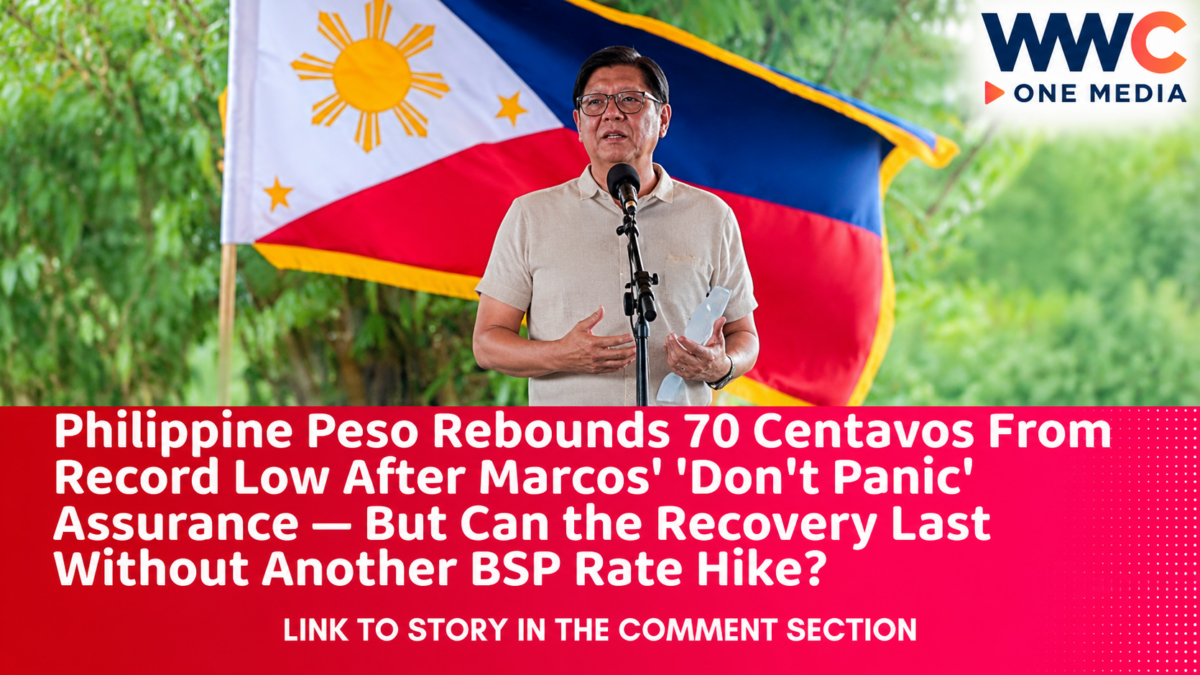
MANILA, PHILIPPINES — The Philippine peso has staged a significant comeback against the US dollar, recovering 70 centavos from its historic closing low after President Ferdinand Marcos Jr. urged Filipinos not to panic and assured financial markets that the government has the resources to defend the country’s currency.
But as the peso strengthens, a former senior central bank official is warning that the rebound may be temporary unless the Philippines addresses deeper economic problems involving inflation, imported oil, trade deficits and investor confidence.
According to Bilyonaryo’s November 4 report, former Bangko Sentral ng Pilipinas (BSP) Deputy Governor Diwa Guinigundo welcomed the improvement in market sentiment following Marcos’ October 28 assurance.
The peso closed at ₱63.47 against the US dollar on November 3, compared with its record-low closing rate of ₱64.17 on October 27.
The recovery occurred without another interest-rate increase after the BSP’s October 22 decision to raise its benchmark policy rate by 50 basis points to 5.50%.
Guinigundo suggested that the President’s remarks may have supported market confidence but emphasized that several other economic factors helped the peso recover.
For Filipino households, investors and businesses, the latest currency movement offers a moment of relief after weeks of alarming depreciation.
Yet the central question remains: Is the peso beginning a sustained recovery, or is this merely a temporary rebound before another round of pressure on the Philippine economy?
Peso Recovers 70 Centavos After Record-Breaking Decline
The Philippine currency experienced one of its most difficult periods in recent years during October as global oil prices, a strong US dollar and investor uncertainty pushed it to successive record lows.
On October 27, the peso closed at ₱64.17 against the dollar.
The following day, it weakened further during intraday trading before reversing direction.
By the October 28 close, the peso had strengthened to ₱64.025, gaining 14.5 centavos and ending a seven-session streak of record-low closing levels.
The recovery continued over subsequent trading sessions.
On October 29, the peso closed at ₱63.85.
It strengthened further to ₱63.74 on October 30 before reaching ₱63.47 on November 3, following the long holiday weekend.
That represented an improvement of 70 centavos from the October 27 record closing low.
The November 3 gain was 27 centavos compared with the previous trading session.
Although the rebound was encouraging, the peso remained considerably weaker than earlier in the year.
A short-term improvement therefore does not establish that depreciation pressures have disappeared.
Marcos’ ‘Don’t Panic’ Assurance May Have Helped Restore Confidence
President Marcos made his widely reported remarks on October 28 during an event at the New Bilibid Prison Reservation in Muntinlupa City.
Asked about the peso’s weakness, he urged the public not to panic and said the government remained committed to preventing excessive depreciation.
Marcos also expressed confidence in the country’s foreign-exchange reserves.
His statements came as Filipinos faced growing concerns over the impact of a weak currency on imported goods, fuel and the cost of living.
The President attributed part of the depreciation to elevated global petroleum prices and the resulting increase in demand for US dollars.
Because the Philippines imports almost all of its crude oil requirements, higher international energy prices can increase demand for foreign currency.
That can place additional pressure on the peso.
The administration’s reassurance was intended to demonstrate that authorities were monitoring the situation and had policy tools available to address disorderly market conditions.
However, the President does not independently set the BSP’s policy interest rate.
Monetary-policy decisions remain the responsibility of the central bank’s Monetary Board.
Former BSP Deputy Governor Explains Why the Peso Rebounded
Diwa Guinigundo, who previously served as BSP deputy governor, offered a more cautious assessment of the currency’s improvement.
In a November 3 report for GlobalSource Partners cited by Bilyonaryo, he highlighted how the peso strengthened after Marcos’ public reassurance without requiring another immediate monetary-policy adjustment.
Guinigundo suggested that improved market sentiment may have contributed to the rebound.
But he also identified several other possible influences.
These included the US Federal Reserve’s decision to maintain interest rates, easing global oil prices and seasonal foreign-exchange flows.
His interpretation is important because exchange rates do not respond to political statements in isolation.
Currency markets reflect economic fundamentals, investor expectations, international trade, interest-rate differences and global financial conditions.
Guinigundo also cautioned that the short-term recovery should not be mistaken for proof that the peso had entered a sustained appreciation trend.
The broader message was that confidence can help stabilize markets, but lasting currency strength requires sound economic fundamentals.
The BSP Already Delivered a Surprise 50-Basis-Point Rate Hike
The peso’s recovery occurred after the BSP had already taken aggressive action against inflation.
On October 22, the Monetary Board raised its benchmark Target Reverse Repurchase Rate by 50 basis points to 5.50%.
The increase was larger than the 25-basis-point adjustment most economists had anticipated.
WWC ONE MEDIA previously examined the policy decision in BSP Stuns Markets With a 50-Basis-Point Rate Hike — What Happens Next to Loans, Prices and the Peso?.
The move reflected concern that inflation was becoming increasingly persistent.
Guinigundo explained that the BSP’s primary objective was to address rising inflation and prevent expectations of higher prices from becoming entrenched.
The rate increase was not intended simply to defend a particular peso-dollar exchange-rate level.
Higher interest rates can make peso-denominated financial assets more attractive under certain conditions.
They can also discourage borrowing and spending, helping moderate inflation over time.
However, interest-rate increases do not guarantee immediate currency appreciation.
International oil prices, global investor confidence and dollar strength can outweigh the short-term effects of domestic monetary tightening.
The peso’s decline immediately after the BSP’s move therefore did not necessarily demonstrate that the policy had failed.
Why the US Federal Reserve and Global Oil Prices Matter
The Philippine peso is heavily influenced by developments outside the country.
One major factor is US monetary policy.
When American interest rates rise relative to rates elsewhere, dollar-denominated investments may become more attractive.
That can strengthen the US dollar and place pressure on currencies such as the peso.
Conversely, a less aggressive Federal Reserve outlook can reduce some of that pressure.
Another major factor is oil.
Elevated petroleum prices increase the dollar requirements of countries dependent on imported energy.
This is particularly important for the Philippines because higher fuel-import expenses can affect both foreign-exchange demand and domestic inflation.
As diplomatic developments involving the United States and Iran raised hopes of easing regional tensions, international oil prices declined from previous highs.
The softer oil market provided some support for the peso.
WWC ONE MEDIA previously examined these combined pressures in Peso Slips as US-Iran Tensions, Wage Hike and Higher Fares Fuel Inflation Concerns.
The report explained how geopolitical uncertainty, oil prices and domestic cost pressures can contribute to peso depreciation.
The latest rebound illustrates the opposite side of that relationship: easing external risks can provide temporary relief.
But renewed geopolitical escalation could quickly reverse market sentiment.
Holiday Remittances May Have Provided Additional Peso Support
Seasonal foreign-exchange activity also influenced the peso’s recent movement.
RCBC chief economist Michael Ricafort highlighted dollar conversions associated with the All Saints’ Day and All Souls’ Day holiday period.
Overseas Filipino workers and their families may exchange foreign currency into pesos to finance travel, household expenses and other seasonal spending.
When more dollars are converted into pesos, that can temporarily increase demand for the local currency.
Such flows may provide support during particular periods.
However, the precise contribution of holiday conversions to the November 3 rebound cannot be isolated confidently from other influences.
The currency also responds to corporate transactions, portfolio investment flows, import payments and expectations about interest rates.
That makes it difficult to attribute the peso’s improvement to any single event.
Could the Peso Still Fall to ₱65—or Even ₱70?
Despite the recovery, economists have warned that further depreciation remains possible.
Former BSP Governor Jose Cuisia Jr. previously cautioned that the ₱65-per-dollar level could be breached if adverse conditions persisted.
Other analysts have discussed more severe downside scenarios extending into 2027.
WWC ONE MEDIA examined those warnings in BSP Vows to Defend Peso as Analysts Warn of Possible ₱69–₱70 Exchange Rate in 2027.
The report discussed the risks associated with prolonged oil-price pressure, global dollar strength and underlying economic imbalances.
However, figures such as ₱65 or ₱70 should not be presented as inevitable outcomes.
They represent possible scenarios under unfavorable economic conditions.
Guinigundo has emphasized that no single exchange-rate level possesses special economic significance by itself.
More important are the pace and persistence of depreciation and whether those movements contribute to higher inflation or financial instability.
A gradual exchange-rate adjustment can have different consequences from a sudden disorderly decline.
For policymakers, preventing excessive volatility may therefore be more important than defending a fixed numerical threshold.
Philippines Still Faces a Serious Inflation Problem
The improvement in the peso comes while consumer prices remain under substantial pressure.
Official figures show that Philippine inflation accelerated to 7.2% in September 2026, up from 6.1% in August.
That is considerably above the BSP’s target range of 2% to 4%.
Food, transportation, housing and utility expenses contributed to the increase.
The combination of elevated inflation and a weak currency has become particularly difficult for lower-income households.
WWC ONE MEDIA explored the risks in Philippine Inflation Could Hit 8.1% as Fuel, Electricity and Transport Costs Surge — But Will the BSP Be Forced Into Another Rate Hike?.
The article examined the BSP’s forecast that October inflation could reach between 7.1% and 8.1%.
That range remains a forecast, not the official October inflation result.
The Philippine Statistics Authority is scheduled to release the actual October figures on November 5.
The data will help determine whether price pressures are intensifying or beginning to stabilize.
Even if the peso continues appreciating, consumer prices may not fall immediately.
Import costs, inventory contracts, transportation expenses and other factors can delay the effect of exchange-rate changes.
What a Stronger Peso Means for Filipino Consumers
A stronger peso can provide several economic benefits.
Importers generally need fewer pesos to purchase the same quantity of dollar-priced goods.
That can reduce cost pressures for companies purchasing fuel, industrial equipment, raw materials and certain food products from overseas.
If the improvement continues, it could eventually help moderate some consumer prices.
However, the effect is neither immediate nor uniform.
Local retail prices depend on global commodity quotations, transportation costs, supplier contracts and competition.
For overseas Filipino workers and their families, a stronger peso also creates a tradeoff.
A dollar remittance converts into fewer pesos when the local currency appreciates.
For example, a $1,000 remittance would have been worth ₱64,170 at the October 27 closing rate of ₱64.17 per dollar.
At the November 3 rate of ₱63.47, the same $1,000 would convert into ₱63,470.
That is a difference of ₱700 before transfer fees and other exchange-rate charges.
A stronger currency may help lower some imported expenses, but dollar-earning households may receive fewer pesos for the same remittance amount.
The overall economic effect therefore differs among consumers, exporters, importers and overseas workers.
Why Marcos’ Reassurance Cannot Replace Economic Reform
Guinigundo’s broader warning concerns the structural vulnerabilities of the Philippine economy.
He identified persistent trade deficits, dependence on imported fuel and production inputs, and limited export diversification as important long-term challenges.
These issues cannot be resolved by public reassurance or interest-rate adjustments alone.
A stronger export sector can generate additional foreign-currency earnings.
Productive investment can expand domestic manufacturing capacity and reduce certain import dependencies.
Improved infrastructure can help companies become more competitive.
Good governance and transparent public spending can also support investor confidence.
These measures may influence long-term economic performance more sustainably than repeated interventions intended solely to influence the exchange rate.
WWC ONE MEDIA previously examined the economy’s broader inflation risks in El Niño Emerges as Biggest Threat to Philippine Inflation as Prices Surge.
The report highlighted the danger that weather-related agricultural shortages could combine with high energy prices and existing inflation pressures.
The challenge illustrates why the government must address both monetary and non-monetary sources of inflation.
Higher interest rates cannot produce more agricultural output or directly lower international petroleum prices.
Will the BSP Raise Interest Rates Again?
The peso’s rebound does not eliminate the possibility of another BSP rate increase.
Governor Eli Remolona Jr. said on November 4 that the central bank was not yet considering a shift toward interest-rate cuts.
He indicated that monetary policy remained in a tightening phase as inflation continued to pose risks.
The BSP’s next scheduled Monetary Board policy meeting is December 17.
Before then, policymakers will receive additional information on inflation, growth, the peso and international financial conditions.
A stronger currency could help contain imported inflation if sustained.
But inflation remaining significantly above target could still support the case for restrictive monetary policy.
The central bank must balance the benefits of containing inflation against the risks that higher borrowing costs pose to households and businesses.
Its next decision will depend on economic evidence rather than the short-term movement of the peso alone.
The Bigger Picture: Is the Peso Recovery Real or Temporary?
The peso’s recovery from ₱64.17 to ₱63.47 offers a welcome change after a series of record lows.
President Marcos’ public reassurance may have helped strengthen confidence.
Lower oil prices, the Federal Reserve’s policy stance and seasonal currency flows also provided support.
Former BSP Deputy Governor Diwa Guinigundo welcomed the improvement while cautioning against assuming that a lasting reversal was already underway.
The underlying challenges remain substantial.
Inflation is running above target.
The Philippines remains highly dependent on imported energy.
The trade deficit continues to create demand for foreign currency.
And global financial uncertainty can quickly alter investor sentiment.
A sustained recovery will depend on more than a few positive trading sessions.
It will require stronger economic fundamentals, credible institutions, stable inflation expectations and favorable external conditions.