
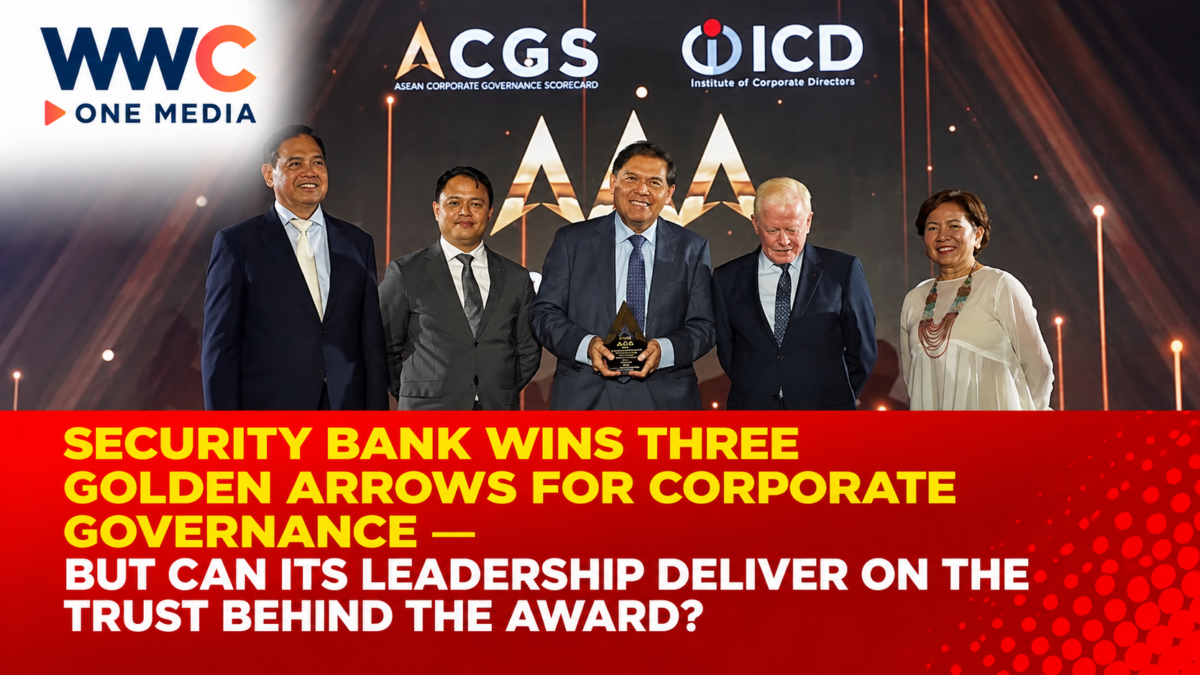
MAKATI CITY, PHILIPPINES — October 31, 2026. Security Bank Corporation has secured another major corporate governance recognition, earning Three Golden Arrows from the Institute of Corporate Directors as Philippine financial institutions face growing expectations for transparency, accountability and responsible management.
The award was presented during the Golden Arrow Awards 2026, held on October 23 at Makati Shangri-La.
Security Bank’s recognition reflects its performance under the ASEAN Corporate Governance Scorecard, a framework that evaluates publicly disclosed governance practices among participating companies.
For a bank entrusted with billions of pesos in customer deposits and loans, governance is more than a corporate distinction.
It is an essential part of protecting stakeholders, overseeing financial risks and ensuring that management decisions receive appropriate scrutiny.
The recognition comes during a period of significant change for Security Bank.
The lender is pursuing a three-year growth strategy under president and chief executive officer Victor Lee, investing in digital services, developing its relationship with Japan’s MUFG Bank and adjusting its organizational structure.
These developments create both opportunities and challenges.
Security Bank has earned recognition for its governance practices. But can the institution demonstrate that its principles of accountability and transparency are equally effective when it faces difficult business decisions, organizational changes and growing competition?
Security Bank receives Three Golden Arrows in Makati
The Institute of Corporate Directors recognized Security Bank during its annual Golden Arrow Awards ceremony on October 23.
The bank received the Three Golden Arrows distinction in the 2026 assessment.
Representing the institution were vice president and corporate governance and data protection officer Atty. Karreen Ballesteros and senior vice president and chief compliance officer Anna Christina M. Chinjen.
The award acknowledges the bank’s corporate governance practices as assessed through the ASEAN Corporate Governance Scorecard.
The framework examines matters such as shareholder rights, transparent disclosures, board accountability, sustainability and stakeholder relations.
Security Bank’s chairman, Atty. Cirilo P. Noel, emphasized the responsibility financial institutions carry when people entrust them with their money and financial plans.
His comments highlighted the importance of earning confidence through responsible management rather than relying on reputation alone.
But the award should be understood accurately.
It is recognition of assessed governance practices, not a guarantee that the bank will avoid future operational, financial or regulatory challenges.
A repeated recognition, not a first-time achievement
Security Bank’s governance recognition is not new.
The company’s official awards history records Three Golden Arrows in 2024, 2025 and 2026.
That means the latest recognition forms part of a continuing record rather than an inaugural win.
The bank’s November 2025 announcement stated that its earlier Three Golden Arrows distinction corresponded to an ASEAN Corporate Governance Scorecard assessment range of 100 to 109 points.
However, that historical range should not automatically be presented as Security Bank’s exact 2026 score without the corresponding assessment record.
The distinction is important because it shows that the bank has maintained recognition across successive assessment cycles.
But retaining an award tier and improving the underlying score are not necessarily the same thing.
A responsible evaluation should distinguish continuity in recognition from evidence of measurable year-on-year improvement.
Why corporate governance matters in banking
Corporate governance refers to the systems through which an organization is directed, supervised and held accountable.
In banking, these systems are particularly important.
Banks manage deposits, provide loans, process payments, invest capital and maintain sensitive customer information.
Weak oversight can expose a financial institution to credit losses, fraud, compliance failures, operational interruptions and reputational damage.
Strong governance is intended to help management identify and address those risks.
It can involve independent board oversight, internal audit functions, risk committees, disclosure standards and clear accountability for business decisions.
These arrangements do not eliminate uncertainty.
But they can establish processes for recognizing problems, challenging management assumptions and responding responsibly.
For customers, the benefit is not simply a prestigious award.
It is confidence that the institution has mechanisms designed to protect their interests.
For shareholders, governance provides information about how management uses capital and handles business risks.
What the ASEAN Corporate Governance Scorecard measures
The Golden Arrow Awards use the ASEAN Corporate Governance Scorecard framework.
The assessment is intended to encourage stronger governance standards among publicly listed companies in Southeast Asia.
It considers several broad areas.
Shareholder rights and equitable treatment are important because investors need fair access to relevant information and appropriate participation in company decisions.
Disclosure and transparency help stakeholders evaluate financial performance and business risks.
Board responsibilities examine oversight structures and accountability.
Stakeholder relations and sustainability considerations address how companies recognize responsibilities beyond short-term profits.
These dimensions are relevant to banks because financial institutions serve many groups whose interests can differ.
A bank may need to balance profitability, risk management, customer protection, employee welfare and regulatory obligations.
Sound governance requires those considerations to be handled through consistent decision-making processes.
An award cannot replace financial and operational transparency
Security Bank’s recognition offers a positive signal about its assessed policies and disclosures.
But depositors and investors should not treat it as a substitute for examining financial statements, regulatory information and actual service performance.
A bank may have recognized governance procedures while still experiencing slower loan growth, changes in management or higher credit costs.
Likewise, an institution may make difficult commercial decisions without automatically violating governance principles.
The relevant questions are whether decisions are appropriately supervised, clearly communicated and consistent with applicable laws and the bank’s responsibilities.
This distinction matters because Security Bank is currently undergoing substantial organizational and strategic changes.
Its ability to manage those developments will provide an important practical test of the governance standards highlighted by the award.
Security Bank’s restructuring puts accountability in focus
Security Bank’s latest recognition follows public discussion of workforce changes and leadership restructuring.
In October, the lender acknowledged targeted organizational adjustments affecting certain positions.
The bank did not disclose the number of employees affected or provide a complete breakdown of the positions involved.
WWC ONE MEDIA examined the development in Security Bank Confirms Job Cuts as New CEO Victor Lee Restructures Operations — But Is a Bigger Banking Shake-Up Coming?.
That report distinguished the bank’s confirmed organizational changes from unverified claims circulating online.
There is no established basis to describe the adjustments as proof of corporate governance misconduct.
But they make transparency especially important.
Employees, investors and customers may reasonably want to understand how the bank is managing operational continuity, workplace changes and its longer-term business plans.
A governance award does not resolve those questions by itself.
The measure of accountability will be how the bank communicates and manages its decisions.
Victor Lee’s three-year strategy reshapes the bank
Security Bank has been pursuing a new direction under president and chief executive officer Victor Lee.
The bank identified three priority areas in its September strategy:
Wealth management, entrepreneur banking, and corporate and institutional banking.
The approach is designed to concentrate resources on customer segments where the lender believes it can strengthen its competitive position.
But strategic repositioning can require changes to management responsibilities, technology and operating processes.
Those decisions create governance considerations.
Management must evaluate potential costs, the impact on customers and whether resources are being used effectively.
The board also has a responsibility to oversee strategic implementation.
The results of the three-year plan will not be determined by the Golden Arrow distinction.
They will depend on execution, financial performance and the bank’s ability to sustain stakeholder confidence.
Security Bank remained profitable in the first half of 2026
The bank’s financial results provide useful context for its governance recognition.
Security Bank reported approximately ₱6.1 billion in net income for the first six months of 2026, representing growth of about 4% from the comparable period a year earlier.
Total revenues increased 11% to approximately ₱34.9 billion.
Its reported total assets reached around ₱1.19 trillion as of June 30.
These figures show that the lender continued generating profits during a period of strategic change.
However, profitability growth was slower than in some previous periods.
The bank also reported more moderate loan growth.
These financial developments do not contradict the corporate governance award.
The scorecard and financial statements measure different aspects of performance.
For investors, both matter.
Governance assesses oversight and disclosure practices, while financial results reveal how effectively the company is generating returns and managing business conditions.
Credit risk remains an important responsibility
Banks must continually assess the risk that borrowers may be unable to repay their loans.
Security Bank’s first-half reporting showed approximately ₱7.6 billion in credit-loss provisions.
These provisions reflect the lender’s assessment of potential credit losses.
They should not be interpreted as proof that the entire amount has already been lost.
The bank also reported improvements in certain asset-quality indicators.
Credit risk is central to the responsibilities of a bank’s board and management.
Lending decisions must balance commercial opportunities with the potential cost of defaults.
That is especially important when economic conditions, interest rates and customer finances change.
Corporate governance systems can support disciplined risk management.
But their effectiveness must be evaluated through actual decisions, financial reporting and regulatory compliance over time.
MUFG partnership increases the importance of sound oversight
Security Bank’s relationship with Japan’s MUFG Bank is another important part of its business strategy.
MUFG acquired a 20% stake in Security Bank in 2016 as part of a strategic investment worth approximately ₱36.9 billion.
The two banks marked a decade of cooperation in 2026.
Their relationship has become especially relevant as MUFG expands its own Philippine operations.
WWC ONE MEDIA reported on the development in MUFG Put ₱36.9 Billion Into Security Bank 10 Years Ago — Now Its Manila Branch Can Do Much More, But the Two Banks Say They’re Not Merging.
The report explained how the strategic partnership is evolving as MUFG’s Manila branch expands its banking capabilities.
Security Bank and MUFG maintain separate operations and have not announced a merger.
The relationship illustrates why governance matters in complex financial partnerships.
Institutions must manage commercial cooperation, regulatory obligations, shareholder interests and potential conflicts through appropriate oversight.
Digital banking brings new governance responsibilities
Security Bank is also investing in digital banking services.
Its announced technology plans include preparations for Apple Pay and Google Pay card compatibility by the second half of 2027.
WWC ONE MEDIA covered the strategy in Security Bank Targets Apple Pay and Google Pay Integration for Cards by 2027.
The planned integration has not yet been completed.
It requires technology upgrades and coordination with relevant payment platforms.
For banks, digital expansion creates new opportunities to improve customer convenience.
But it also increases the importance of cybersecurity, data protection, transaction monitoring and operational resilience.
A failure involving digital systems can affect customer access to money and sensitive personal information.
Corporate governance therefore needs to cover technology decisions as carefully as lending and financial management.
The presence of a data protection officer among the bank’s award representatives reinforces the relevance of these responsibilities.
However, the award is not an independent certification that every digital system is secure.
Philippine banks face increasing expectations for transparency
Security Bank’s recognition comes during a period when governance standards are receiving significant attention across Philippine listed companies.
Other financial institutions and major conglomerates have also received Golden Arrow distinctions.
WWC ONE MEDIA examined this wider trend in Ayala Wins Top Governance Honors as Globe Makes Hall of Fame History — But Can Its Leadership Survive the Next Big Business Test?.
That report noted that Bank of the Philippine Islands received Five Golden Arrows in the 2026 assessment.
The two banks received different award tiers.
But those ratings should not be interpreted as a direct ranking of which institution is financially safer or offers better products.
The governance scorecard evaluates specified corporate practices.
Customers and investors must still consider capital strength, financial statements, service quality and product terms.
The awards help illuminate one part of corporate performance without resolving every question about business outcomes.
Why trust is particularly important during organizational change
Security Bank is simultaneously navigating governance expectations, strategic repositioning and technological investment.
That combination creates a challenge for management.
A bank seeking growth may need to revise internal structures, develop new products and adjust how it serves customers.
Those changes can produce uncertainty.
Employees may have concerns about responsibilities and job security.
Customers may want reassurance about service continuity.
Investors may examine whether the strategy can improve financial returns.
Good governance provides a framework for managing these competing demands.
But its credibility depends on implementation.
The strongest evidence of responsible management comes when companies communicate clearly during difficult circumstances, not only when they receive public recognition.
For Security Bank, that is the practical test facing its leadership.
What customers and investors should watch next
The latest Golden Arrow distinction gives Security Bank an opportunity to demonstrate continuity in its governance practices.
But several developments will help determine whether the recognition translates into stronger confidence.
The bank’s future financial results will reveal whether its three-year strategy produces sustainable growth.
Investors will evaluate asset quality, profitability, capital adequacy and operating expenses.
Customers will judge service quality, digital reliability and the suitability of the products they use.
Employees will look for clarity as organizational changes are implemented.
The progress of the MUFG partnership and digital-payment initiatives will provide additional indicators of how the bank is executing its plans.
None of these outcomes is guaranteed by an award.
They require sustained management attention and effective oversight.
The bigger question: Can Security Bank turn governance into measurable trust?
Security Bank’s Three Golden Arrows recognition reflects a continuing record of assessed corporate governance practices.
The award acknowledges important principles involving shareholder rights, transparency and board accountability.
For a bank managing customer savings, business financing and investment relationships, those principles carry substantial importance.
But the recognition arrives at a meaningful moment.
Security Bank is restructuring parts of its organization, pursuing new strategic priorities and preparing for further digital transformation.
It must also manage the ordinary financial risks that accompany banking operations.
The challenge is ensuring that the standards recognized by the Institute of Corporate Directors are reflected in the decisions that customers, employees and investors experience.
Security Bank has retained its Three Golden Arrows distinction, reinforcing its stated commitment to responsible banking. But as restructuring and digital transformation accelerate, the crucial question is whether its governance framework can deliver lasting accountability, financial resilience and customer confidence—or whether the true test is only beginning.










