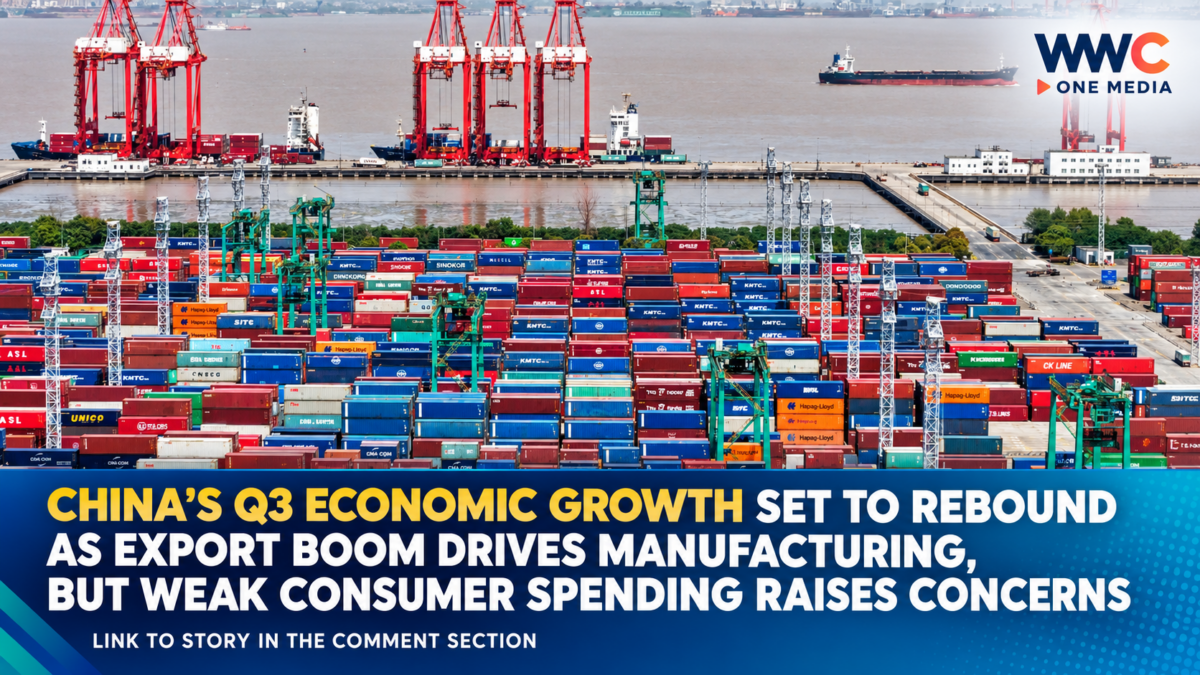
China’s economy is expected to regain some momentum in the third quarter of 2026, supported by strong exports, resilient high-tech manufacturing and fresh government stimulus measures. However, persistent weakness in domestic consumption, declining investment and a prolonged property market downturn continue to threaten the country’s economic recovery.
Gross domestic product (GDP) is forecast to have grown 4.4% year-on-year between July and September, slightly faster than the 4.3% recorded in the second quarter, according to a Reuters poll of economists ahead of the official data release on October 19.
The projected improvement would mark a modest recovery from China’s slowest quarterly growth rate in more than three years. Nevertheless, it would remain below the lower end of Beijing’s official full-year growth target of 4.5% to 5%.
The outlook highlights a growing imbalance in the world’s second-largest economy: factories are benefiting from strong overseas demand for technology products, while households remain cautious about spending and businesses continue to hold back on investment.
For policymakers in Beijing, the challenge is no longer simply maintaining export growth. It is ensuring that manufacturing strength translates into stronger domestic demand, more sustainable investment and a broader economic recovery.
China’s Export Boom Provides a Crucial Growth Lifeline
Exports have become one of the most important drivers of China’s economic performance in 2026, helping offset sluggish domestic demand and persistent weakness in the property sector.
Chinese manufacturers have benefited from strong international demand for semiconductors, electric vehicles, batteries, data-processing equipment and other high-tech products linked to the global expansion of artificial intelligence infrastructure.
Customs data released in October showed that China’s exports surged 36.3% year-on-year in September, accelerating from 25% growth in August. Imports also rose strongly, increasing 31% compared with the same month a year earlier.
The country’s trade surplus reached approximately US$133.5 billion in September, while its cumulative surplus for the first nine months of 2026 climbed to about US$938.1 billion.
The figures put China on course to potentially exceed the record annual trade surplus of roughly US$1.2 trillion recorded in 2025.
The export performance has provided manufacturers with a critical source of demand at a time when domestic consumers and businesses remain reluctant to spend more aggressively.
However, the growing reliance on overseas markets creates vulnerabilities. Any slowdown in global demand, new trade restrictions or escalation in geopolitical tensions could undermine one of the economy’s strongest sources of growth.
The European Union’s efforts to limit Chinese hybrid-vehicle imports could also weigh on the country’s automotive exports, while broader concerns about industrial overcapacity threaten to intensify trade disputes with major trading partners.
High-Tech Manufacturing Strengthens as Traditional Growth Engines Weaken
China’s manufacturing sector has shown signs of renewed momentum, supported by government efforts to redirect resources towards advanced industries and reduce the economy’s reliance on property development.
Official manufacturing purchasing managers’ index data showed factory activity returned to expansion in September, with the index rising to 50.1 from 49.8 in August. A separate private-sector manufacturing survey also indicated that business activity had strengthened to a five-month high.
These improvements suggest that export demand and targeted policy support are helping manufacturers maintain production despite a difficult domestic economic environment.
The government’s strategy prioritises sectors such as artificial intelligence, semiconductors, electric vehicles, industrial robotics and advanced equipment manufacturing.
While these industries are helping China maintain its competitiveness in global markets, their growth has not yet generated an equally strong recovery in household spending or private-sector investment.
This creates a two-speed economy in which export-oriented manufacturers continue to expand while other parts of the domestic economy struggle to regain momentum.
The divergence also raises questions about whether high-tech production can sustain economic growth if overseas demand weakens or trade barriers increase.
Weak Consumer Spending Remains a Major Economic Challenge
Despite the strength of exports, domestic consumption remains one of the biggest obstacles to a more balanced recovery.
China’s retail sales rose just 0.4% year-on-year in August, reflecting cautious household spending and continued pressure on consumer confidence. Economists expected retail sales growth to improve only slightly to 0.6% in September, according to the Reuters survey.
The prolonged downturn in the property market has also weighed on household wealth and spending decisions. Many consumers remain reluctant to make major purchases amid uncertainty about property values, employment prospects and future income growth.
Weak consumption matters because domestic spending is essential to reducing China’s dependence on exports. If households do not increase their spending, manufacturers may become even more reliant on overseas customers to absorb production.
That dependence could become increasingly difficult to sustain as trading partners scrutinise Chinese exports and consider additional measures to protect their domestic industries.
Economists have therefore urged Beijing to introduce stronger measures to support household incomes, employment and consumer demand rather than relying predominantly on industrial investment and export growth.
Property Slump and Falling Investment Add to Pressure
China’s real estate crisis continues to be another major drag on the economy.
The prolonged property downturn has weakened confidence among homebuyers, developers and investors, while falling construction activity has affected industries ranging from steel and cement to household appliances and furniture.
Fixed-asset investment, which includes spending on infrastructure, property and equipment, fell 7.2% year-on-year during the first eight months of 2026. Property investment declined 19.9% over the same period, underscoring the scale of the sector’s difficulties.
The investment weakness presents a challenge for Beijing because private businesses may remain reluctant to commit capital when future demand is uncertain.
Although the government is directing more resources towards advanced manufacturing and infrastructure, those investments may not fully compensate for the prolonged contraction in property-related activity.
A sustained recovery will likely require both effective support for productive industries and measures that restore confidence among households and private businesses.
Beijing Steps Up Stimulus to Support Economic Growth
Chinese policymakers have introduced additional measures to prevent economic momentum from weakening further.
In late September, authorities rolled out targeted interest-rate cuts and mortgage subsidies aimed at supporting economic activity and easing pressure on borrowers.
The government also allocated 550 billion yuan, equivalent to approximately US$77 billion, in previously unused government debt quotas to help ease local government financial pressures and support infrastructure spending.
These measures are intended to support investment, improve financing conditions and help China meet its annual economic growth objective.
However, economists remain divided over how much additional stimulus will be necessary. If exports continue performing strongly, Beijing may be able to rely on relatively measured support. If overseas demand weakens or domestic consumption deteriorates further, broader fiscal measures could become necessary.
The government must also balance economic support against concerns about debt accumulation and the effectiveness of investment-led growth.
Trade Tensions Could Threaten China’s Export Advantage
China’s export success has brought renewed scrutiny from major trading partners, particularly the United States and the European Union.
The country’s widening trade surplus has intensified concerns about manufacturing overcapacity and the competitive pressure Chinese goods place on overseas producers.
The surge in exports has been especially pronounced in technology-related products and vehicles, sectors that are increasingly important to China’s industrial strategy.
But stronger exports do not necessarily translate into stronger economic relationships with trading partners. Additional tariffs, import restrictions or other trade measures could reduce market access for Chinese manufacturers and disrupt supply chains.
The EU’s efforts to rein in Chinese hybrid-vehicle shipments represent one potential challenge, although the eventual economic impact will depend on the implementation and scope of the measures.
For Beijing, preserving access to overseas markets while strengthening domestic demand will be critical to sustaining growth beyond 2026.
What to Expect From China’s Q3 GDP Report
China’s official third-quarter GDP figures and September activity data are due on October 19. The forecasts below are expectations ahead of the release, not confirmed results.
| Economic indicator | Forecast |
|---|---|
| Q3 GDP growth, year-on-year | 4.4% |
| Q3 GDP growth, quarter-on-quarter | 1.1% |
| September industrial output growth | 5.5% |
| September retail sales growth | 0.6% |
| Fixed-asset investment, January–September | Down 7.3% year-on-year |
The figures will provide a clearer picture of whether export strength and government support are sufficient to offset weak domestic demand.
A stronger-than-expected GDP result could ease immediate concerns about China’s ability to meet its annual growth target. However, a recovery driven mainly by exports would leave questions about the sustainability of growth unresolved.
Conversely, weaker consumption or investment figures could increase pressure on policymakers to introduce additional support measures.
China’s Economic Outlook: Recovery or Temporary Rebound?
China’s economy is showing signs of stabilisation, but the recovery remains uneven.
Strong exports and improving manufacturing activity are providing important support, while the property downturn, weak consumer demand and declining investment continue to weigh on the broader economy.
Economists surveyed by Reuters expect full-year growth of around 4.5% in 2026, with growth potentially easing to 4.4% in 2027. These projections highlight the challenge of sustaining momentum once export-driven support becomes less reliable.
The next phase of China’s recovery will depend on whether Beijing can encourage households to spend more, restore confidence in the property market and make private investment more attractive.
For global markets, the implications extend well beyond China. The country is a major manufacturing hub and a key trading partner for economies across Asia, Europe and the Americas. Changes in its demand for commodities, industrial goods and imported products can influence businesses and supply chains worldwide.
The bottom line: China’s expected third-quarter rebound offers some relief, but strong exports alone may not be enough to secure a durable recovery. The critical test will be whether the government can turn manufacturing strength into broader domestic economic growth.