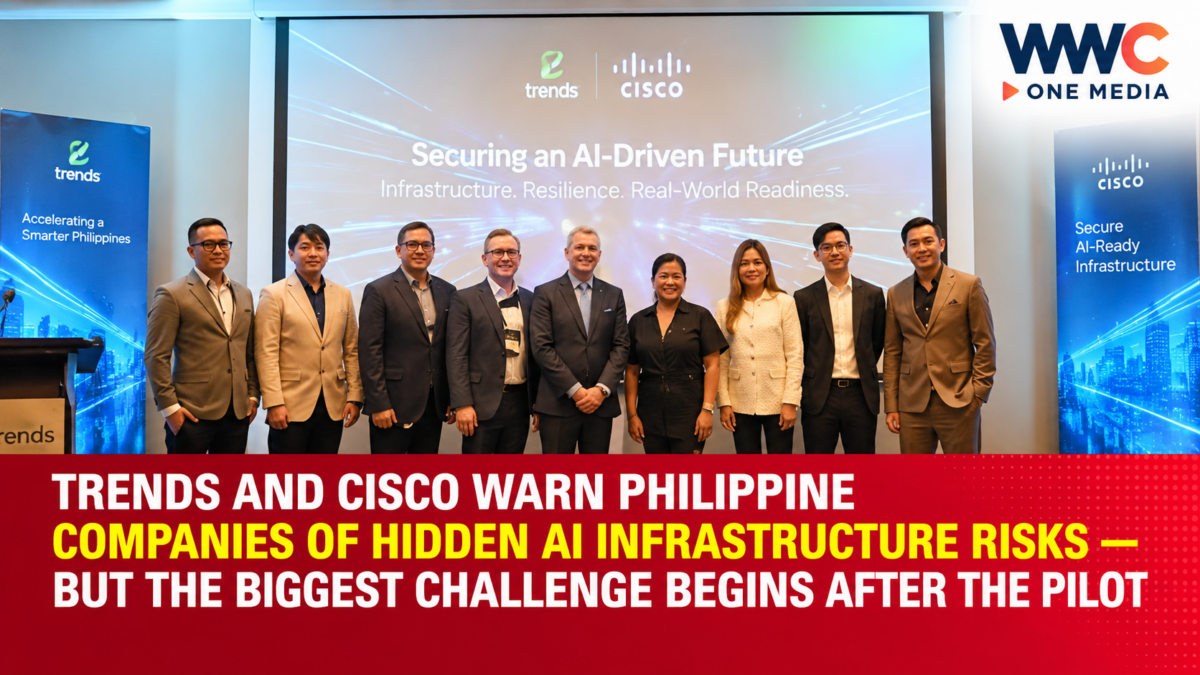
MANILA, Philippines — Artificial intelligence is moving rapidly into Philippine workplaces, but technology companies Trends & Technologies Inc. and Cisco are warning that many organizations may be underestimating what it takes to turn promising AI experiments into reliable, enterprise-wide systems.
The companies highlighted the challenge during a joint forum titled “Thriving in the AI Era: Future-Proofing Your Data Center for What Comes Next,” which brought together technology leaders from the public and private sectors.
Their message was straightforward: adopting sophisticated AI applications is only the beginning.
Businesses must also ensure that their networks, servers, storage platforms, cybersecurity controls and management systems can handle the operational demands of AI.
Without these foundations, companies risk creating expensive projects that perform well during demonstrations but struggle when exposed to real workloads, sensitive information and large numbers of users.
The discussions build on a partnership between Trends and Cisco spanning more than two decades.
But as Philippine enterprises rush to deploy AI, the bigger question is whether their existing infrastructure and cybersecurity defenses are ready for the technology they want to scale.
Trends and Cisco Target the Gap Between AI Experiments and Business Deployment
Many companies begin exploring artificial intelligence through small pilot programs.
They may experiment with chatbots, automated document analysis, predictive systems or software designed to assist employees.
Initial results can be encouraging.
But moving from a controlled pilot to an enterprise-wide deployment introduces more complicated challenges.
A system serving a few employees may behave differently when thousands of users depend on it.
Data may need to move between different applications and storage platforms.
Security controls must prevent unauthorized access to confidential information.
IT departments also need tools to identify performance problems and control operating expenses.
Trends and Cisco say these requirements should be addressed before organizations attempt to scale AI across their operations.
The forum focused on building infrastructure capable of supporting AI as a long-term business function rather than treating it as a standalone technology experiment.
Two-Decade Partnership Moves Into the AI Era
Trends Group chief operating officer Christine Fard emphasized the value of the company’s longstanding relationship with Cisco.
The collaboration, which spans more than 20 years, has involved helping organizations modernize enterprise technology environments.
Those activities include networking, data center infrastructure, cloud services and cybersecurity.
The AI-focused discussions represent an extension of that existing work.
For Trends, the business opportunity lies in helping customers combine appropriate technologies and deploy them within their specific operating environments.
Cisco provides networking, security and infrastructure technologies that can form part of those solutions.
However, the October report did not disclose a new investment amount, exclusive contract, customer deployment count or nationwide rollout timetable.
The development is best understood as a strengthened enterprise technology initiative built on an established commercial partnership.
It should not be described as a newly formed joint venture or the construction of a confirmed AI data center.
Six Technology Foundations Are Essential for AI
At the forum, Trends and Cisco identified six interconnected components required to support enterprise AI.
Networking provides connectivity among servers, graphics processors, storage platforms and applications.
Computing supplies the processing power required to train or run AI models.
Storage enables organizations to access and manage the large datasets used by AI systems.
Security protects sensitive information, models and infrastructure against unauthorized access and other threats.
Observability gives administrators visibility into performance, system activity and potential problems.
Software provides the management, development and orchestration tools used to coordinate AI workloads.
These foundations must operate together.
A company may purchase powerful processors but still experience delays if its network cannot move data efficiently.
Likewise, expensive AI applications may become risky if security and access controls are weak.
The central issue is not simply having the latest hardware.
It is ensuring that different technologies operate reliably as one system.
Why Networks Become a Bottleneck
Modern AI workloads can place significant demands on enterprise networks.
Large models may require data to move rapidly among graphics processors, storage systems and computing clusters.
Network congestion can slow those transfers.
In an organization running AI services for many users, delayed responses may affect productivity and service quality.
Trends technology management group manager James Anthony Jimeno identified network strain as one of the practical problems companies encounter when moving from pilot projects to production environments.
The companies discussed high-speed connectivity, switching equipment, transceivers and infrastructure processing technologies as possible components of AI-ready networks.
But not every enterprise needs the same architecture.
The appropriate infrastructure depends on the AI applications being used, expected workloads, existing systems and available budget.
A business using externally hosted AI services may have different requirements from one operating its own large computing cluster.
Computing Power Is Only Part of the Equation
AI applications require computing capacity, but organizations should distinguish between training and inference.
Training involves developing or updating a model using data and computational resources.
Inference involves running an existing model to generate responses, predictions or other outputs.
Some companies may need extensive computing infrastructure.
Others may be able to meet their business requirements through cloud services or smaller deployments.
The forum highlighted processors, graphics processing units, AI accelerators and cooling systems as important infrastructure considerations.
Companies must evaluate how much capacity they actually need.
Purchasing more computing equipment than necessary can create unnecessary costs.
Underestimating capacity may cause delays or service disruptions.
Effective planning requires matching technology investments to real business demand.
Cybersecurity Risks Increase as AI Accesses Sensitive Data
Security was a major concern raised during the forum.
AI applications may interact with company documents, financial information, customer records and internal databases.
Poorly configured systems could expose information to unauthorized users.
Attackers may also try to exploit vulnerabilities in software, networks or AI-enabled workflows.
Organizations therefore need appropriate identity verification, access restrictions, monitoring and data protection controls.
The risks are not limited to the AI model itself.
Supporting infrastructure and connected business applications can also become targets.
Jimeno identified emerging security threats and complicated system integration as significant obstacles to broader AI deployment.
Companies must consider cybersecurity early in system design rather than treating it as an afterthought.
New Cisco Report Raises Serious Questions About Philippine AI Security
Separate research released on October 19 provides additional context.
According to Cisco’s latest Relentless Defense Report, 93% of surveyed Philippine organizations experienced a material cybersecurity incident that disrupted business operations during the previous 12 months.
The same research found that only 59% expressed high confidence in their ability to detect and respond to compromised AI agents.
Nearly half of the organizations surveyed reported encountering AI-enhanced attacks.
These findings show why security concerns are becoming more urgent as companies introduce AI into business processes.
However, the figures come from Cisco’s cybersecurity research, not from the Trends–Cisco forum.
They also reflect survey responses and the study’s definitions, not a verified count of every Philippine company’s security incidents.
The findings do not establish that Trends customers experienced these problems or that Cisco products caused or prevented them.
They provide independent context for the vulnerabilities enterprises must address.
Observability Helps Companies Understand What Their AI Systems Are Doing
Another major technology foundation is observability.
The term refers to tools and processes that help IT teams understand the behavior and condition of their systems.
For AI deployments, this can include monitoring workloads, data movement, processing performance, infrastructure usage and security events.
Without adequate visibility, a company may struggle to determine why an application is slow or producing unexpected errors.
It may also find it difficult to identify which systems are responsible for rising costs.
Observability can help administrators investigate problems and improve reliability.
But monitoring systems must also be configured appropriately.
More data collection is not automatically better.
Organizations need relevant information, clear operational responsibilities and safeguards for any sensitive data collected during monitoring.
Data Governance Is as Important as Storage Capacity
AI systems depend heavily on data quality and availability.
An organization may have large amounts of information stored across databases, spreadsheets and cloud applications.
But the information may be incomplete, outdated, inconsistent or subject to access restrictions.
Expanding storage capacity alone does not solve those problems.
Companies must establish procedures for classifying, validating, protecting and managing data.
They should determine which information AI applications can access and how outputs will be reviewed.
Sensitive personal or commercial data may require additional safeguards.
The Philippines’ Data Privacy Act remains relevant when enterprises process personal information through AI systems.
Responsible deployment involves examining how data is collected, stored, used and shared.
A technically advanced AI platform can still produce poor results if the information supplied to it is unreliable.
Six Organizational Readiness Areas Also Matter
Beyond the technology stack, Trends and Cisco outlined six areas of organizational readiness.
These are strategy, infrastructure, data, governance, talent, and organizational culture and change readiness.
Strategy involves identifying specific problems AI should solve.
Infrastructure concerns whether existing technology can support the application.
Data readiness addresses information quality, availability and controls.
Governance establishes rules, responsibilities and accountability.
Talent concerns the skills employees need to deploy and manage AI.
Culture and change readiness addresses whether an organization can adapt processes and ways of working.
A technically sophisticated AI system may fail if employees do not trust it or understand how to use it.
Likewise, a promising pilot may never produce financial benefits if the organization lacks an implementation plan.
The companies argue that successful adoption requires these areas to develop together.
Cisco’s Global Research Highlights Security and Return-on-Investment Problems
The local forum reflects concerns Cisco has also raised internationally.
In September 2026, Cisco published findings from its Global AI Partner Study, involving 1,702 technology partners across 30 countries.
One notable result was that only 29% of surveyed partners reported high awareness of AI-specific security threats, down from 35% in the previous study.
The findings suggest that many technology providers and their customers still need to strengthen their understanding of emerging AI risks.
Independent technology industry publication CRN also reported that Cisco partners are encountering customer concerns about security gaps, return on investment and the growing cost of running AI agents.
These issues matter because a successful AI pilot does not automatically create a profitable long-term business service.
Organizations must consider operating expenses, staffing, infrastructure and measurable results.
The Cisco global study is separate from the Philippines-specific cybersecurity report and should not be treated as a survey of Philippine firms alone.
AI Factories Are Not Necessarily New Buildings
Trends and Cisco used the concept of an AI factory to describe infrastructure supporting AI development and operation.
The term refers to a coordinated technology environment combining computing, networking, storage, security and software.
It does not always mean a new physical factory or a newly constructed data center.
A company may build an AI-capable environment using existing infrastructure, a cloud platform, dedicated computing systems or a hybrid arrangement.
The relevant choice depends on performance, cost, security and operational requirements.
The October forum did not announce the groundbreaking of a new data center or disclose a peso-denominated construction investment.
Therefore, reporting that Trends and Cisco are building a new AI factory in the Philippines would go beyond the evidence available.
The partnership’s current emphasis is on helping organizations prepare and modernize their technology environments.
Cisco Expands AI Infrastructure Technology With NVIDIA
Recent developments at Cisco illustrate the broader direction of enterprise AI infrastructure.
In August, the company announced an expansion of its Secure AI Factory initiative with NVIDIA through a partnership involving Supermicro.
The offering integrates high-density computing infrastructure with networking, security and management technologies.
Cisco said certain rack-scale solutions would become available through its channel ecosystem in October 2026.
At the Open Compute Project Global Summit on October 12, Cisco also announced additional advances in silicon, systems and optical connectivity for large AI workloads.
Those announcements demonstrate Cisco’s global efforts to support more demanding AI infrastructure.
But they are separate from the Trends Philippines forum.
Their existence does not establish that a specific Philippine enterprise has already purchased or deployed those systems.
Philippine Businesses Need Clearer AI Investment Priorities
For companies considering AI deployments, the most important starting point may be identifying what the technology is supposed to accomplish.
A retailer might want better demand forecasting.
A financial institution may focus on fraud detection and customer operations.
A manufacturer may examine equipment monitoring or production scheduling.
A government agency may explore administrative automation or information retrieval.
Each use case requires different technology, data controls and levels of reliability.
Businesses should evaluate expected benefits before committing to expensive infrastructure.
They also need to assess legal responsibilities, security risks and employee training requirements.
AI projects can become costly when organizations invest in hardware or software without a clear plan for integration into actual operations.
The Biggest Challenge Is Measuring Business Results
Enterprise AI announcements often emphasize powerful technology and future possibilities.
But companies ultimately need to demonstrate value.
That may involve reducing processing times, improving customer service, lowering certain operating costs or increasing the reliability of business processes.
Results should be measured against clear baselines.
For example, a company might evaluate whether AI reduces the time required to handle a defined administrative task.
But it should also examine error rates, review requirements and the costs of maintaining the system.
A faster process does not necessarily create savings if it introduces new security or accuracy problems.
The Trends–Cisco forum emphasized that technology investments should lead to measurable outcomes.
However, the public announcements did not provide verified financial returns from specific Philippine customer deployments.
Claims of guaranteed productivity gains or savings would therefore be premature.
The Bigger Test: Can Philippine Companies Move Beyond AI Hype?
The collaboration between Trends and Cisco reflects a growing shift in the technology sector.
Businesses are moving from asking whether they should experiment with AI to determining how to deploy it safely and sustainably.
That transition requires substantial planning.
Organizations need dependable networks, computing and storage systems.
They also need effective cybersecurity, system monitoring, governance and skilled employees.
Recent research suggests that Philippine businesses face significant security challenges as AI becomes part of more operations.
For Trends and Cisco, the opportunity is to help customers address those requirements through integrated enterprise technology solutions.
But the effectiveness of that approach will depend on actual customer deployments, system reliability, security performance and measurable commercial benefits.
Trends and Cisco are urging Philippine businesses to build stronger technology foundations before expanding artificial intelligence across their organizations. But the real test is whether companies can turn promising AI demonstrations into secure, dependable operations — without allowing infrastructure costs, cybersecurity threats and organizational weaknesses to undermine the expected benefits.