JAKARTA, Indonesia — Indonesia’s stock market is facing its deepest crisis in decades after a historic selloff wiped out a substantial portion of its value, sent foreign investors rushing for the exits and raised the possibility that Southeast Asia’s largest economy could lose its coveted emerging-market classification.
The Jakarta Composite Index plunged 11.57% on October 16, 2026, recording its steepest one-day fall since the Asian financial crisis of 1998.
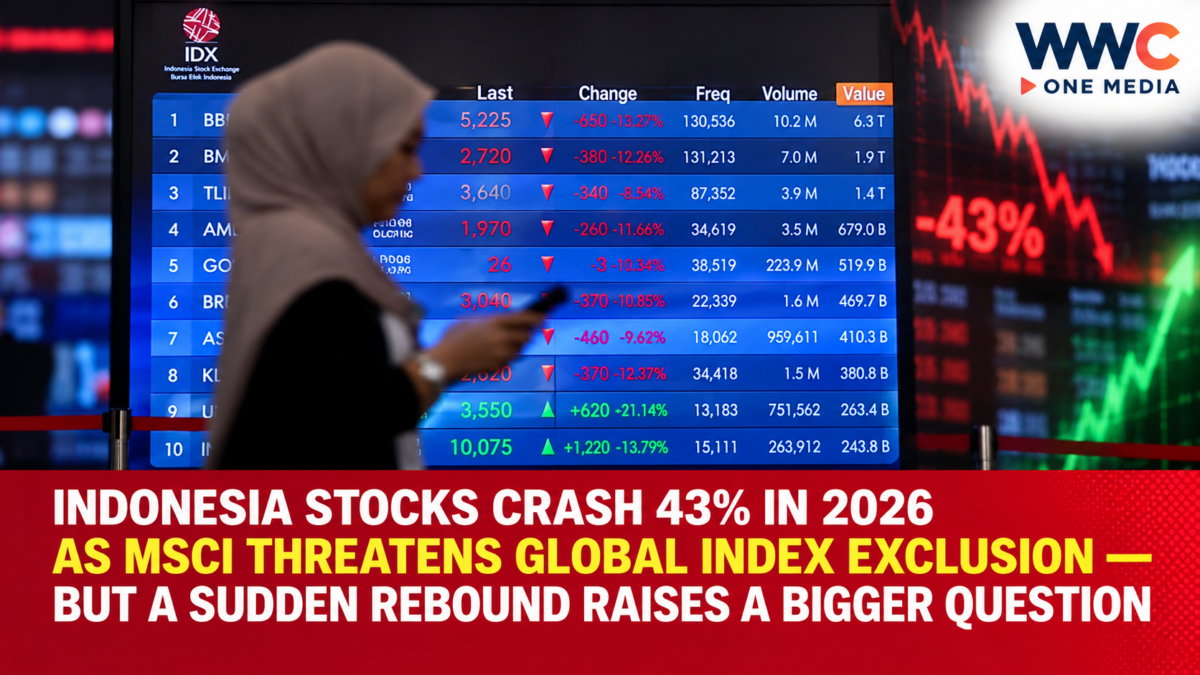
Selling continued on October 19, pushing the benchmark close to a six-year low and leaving it approximately 43% below its end-2025 level during intraday trading.
The immediate trigger was a warning from global index provider MSCI that Indonesia could be downgraded from an emerging market to a standalone market because of continuing concerns about ownership transparency, limited free floats and suspected coordinated trading activity.
The warning raised fears that major international funds could be forced to reduce their Indonesian equity holdings.
But the latest trading session brought an unexpected reversal.
On October 20, the Jakarta Composite rebounded 5.08% to close at 5,250.26 after Indonesian authorities announced measures aimed at improving market access and restoring confidence.
The rebound offered investors temporary relief, but the much bigger question remains: Can Indonesia repair its market’s structural weaknesses before MSCI delivers a potentially devastating classification decision in June 2027?
Jakarta’s 2026 Stock Market Collapse Shocks Southeast Asia
Indonesia’s equity market entered October already struggling with persistent selling pressure.
The benchmark Jakarta Composite Index ended 2025 at approximately 8,646.94 points.
By October 16, the index had fallen to 5,185.11.
That represented a year-to-date decline of about 40%.
During October 19 trading, the index slipped to approximately 4,922.51, equivalent to a loss of roughly 43% from the previous year-end.
The intraday slump placed Indonesia far behind other major Southeast Asian stock markets.
The decline is especially striking because Indonesia is the region’s largest economy and home to major banks, commodities companies, consumer businesses and industrial groups.
However, the severe stock-market losses do not mean the Indonesian economy itself has contracted by 43%.
An equity index measures the changing market prices of selected listed companies.
It is not the same as gross domestic product, employment or household income.
The collapse primarily reflects investor valuations and concerns about the market’s structure and outlook.
One-Day Plunge Was the Worst Since the Asian Financial Crisis
October 16 marked a dramatic escalation.
The Jakarta Composite plunged 11.57% during the session, falling to approximately 5,185 points.
It was the index’s worst daily decline since 1998, when Southeast Asian financial markets were engulfed by a regional currency and banking crisis.
The latest rout was triggered by concerns over MSCI’s review of Indonesia’s eligibility for its major global indexes.
Investors feared that a downgrade could make Indonesian shares unsuitable for funds required to follow emerging-market benchmarks.
Selling spread across major sectors, including banks, commodities and energy.
The downturn was not simply a routine correction affecting one company or industry.
It was a broad reassessment of the risks of investing in Indonesian equities.
The sudden fall also raised concerns about market liquidity, price discovery and the ability of foreign investors to exit positions.
MSCI Warns Indonesia Could Lose Emerging-Market Status
MSCI announced on October 15 that it was consulting investors on a proposal to reclassify Indonesia from emerging-market to standalone-market status.
The company identified persistent concerns about the investability of Indonesian equities.
These included opaque shareholder structures, concentrated ownership and suspected coordinated trading.
MSCI had previously raised concerns about the limited number of shares genuinely available for public trading.
Some listed companies may have substantial market valuations but relatively small public floats, reducing the volume that institutional investors can readily buy or sell.
This can make price movements more volatile and create questions about whether market capitalization accurately reflects tradable investment opportunities.
MSCI’s proposed action would represent a serious downgrade.
Standalone-market classification is below both emerging-market and frontier-market status in MSCI’s classification framework.
The downgrade has not yet taken effect.
It remains a proposal subject to consultation and the outcome of Indonesia’s reform efforts.
Why MSCI’s Classification Matters to Investors
MSCI indexes are widely used by global institutional investors.
Investment funds may track these indexes directly or use them to determine how much capital to allocate to individual markets.
An emerging-market classification can help a country attract international investment by keeping its listed companies eligible for major benchmark portfolios.
If Indonesia were removed from that category, index-tracking funds could be required to sell affected securities.
Active investors might also reduce their holdings because of changing investment mandates or concerns about liquidity.
This could create additional selling pressure.
The scale of potential withdrawals is uncertain and depends on the eventual decision, fund mandates and market prices.
Reuters reported estimates that passive fund outflows could reach $5.6 billion if Indonesia were downgraded.
Other estimates include potential withdrawals from actively managed portfolios and may be considerably larger.
Those amounts are scenarios, not confirmed future losses.
MSCI’s Concerns Go Beyond Falling Share Prices
The central issue is not simply that Indonesian stocks have performed badly.
Markets can experience sharp declines without losing their global index classifications.
MSCI’s concerns involve whether investors can accurately identify who owns listed securities and whether sufficient shares are freely tradable.
The index provider has also referred to suspected coordinated trading behavior.
These issues can affect how prices are established and whether investors believe that trading conditions are fair.
For international fund managers, confidence in ownership information and market supervision is essential.
An investor may be willing to accept economic volatility but still hesitate if market structures make trading difficult or opaque.
Indonesia has announced reforms, including more detailed shareholder disclosures and a roadmap toward a minimum 15% public free-float requirement.
MSCI nevertheless said investors wanted consistent implementation and evidence of meaningful improvements.
The problem is therefore one of credibility and execution, not merely announcing new regulations.
Foreign Investors Have Already Withdrawn Billions
Indonesia entered the latest crisis with significant foreign selling pressure.
Reuters reported that international investors had withdrawn nearly $5 billion from Indonesian equities during 2026.
The departures reflect concerns extending beyond a single trading session.
Investors have been assessing corporate governance, market access, domestic policy and currency risks.
When foreign investors reduce exposure, selling pressure can increase, especially in securities with limited liquidity.
A weakening currency can further reduce returns for international investors because share values must often be converted into dollars or another home currency.
The Indonesian rupiah has also come under pressure during the market turmoil.
But foreign capital flows should be interpreted carefully.
Net foreign outflows measure buying and selling activity over a defined period.
They are not equivalent to the total amount of stock-market capitalization erased by falling prices.
The figures describe different aspects of the financial crisis.
A $82-Billion Selloff Exposes the Scale of the Panic
Reuters reported that approximately $82 billion in stock-market value was erased during the October 16 and October 19 selloff.
This figure describes the decline in the market value of listed equities during the two-day period.
It does not mean $82 billion in cash physically left Indonesia.
When share prices decline, the implied value of all outstanding shares also falls.
Actual cash transactions may involve much smaller amounts.
The distinction matters because reports about massive market losses can otherwise create confusion about capital flows.
The $82-billion figure nevertheless demonstrates how quickly investor sentiment deteriorated following MSCI’s warning.
For public companies, falling share prices can affect financing plans and investor confidence.
For individual shareholders, market declines can reduce portfolio values even when the companies they own continue operating.
Indonesia Rebounds More Than 5% After Emergency Measures
On October 20, Indonesian stocks staged a sharp recovery.
The Jakarta Composite closed at 5,250.26, up 5.08% from the previous day’s close of 4,996.61.
The rebound followed efforts by authorities to respond to MSCI’s concerns and stabilize the market.
The Indonesia Stock Exchange announced plans to remove companies with highly concentrated share ownership from its benchmark index.
According to Reuters and the Financial Times, the affected companies represented roughly 18% of the index’s market value.
Authorities also introduced tighter daily price-movement limits and held emergency discussions about the crisis.
The recovery indicates that investors responded positively to at least some of the measures.
But a strong single-day rebound does not erase the previous losses.
Despite the October 20 gain, the benchmark remained approximately 39.3% below its end-2025 level.
The market is still facing substantial uncertainty.
Indonesia Moves to Address Concentrated Ownership
One of the exchange’s most significant responses involves stocks with highly concentrated ownership.
Large shareholders can control substantial portions of a company’s equity, leaving relatively few shares available to other investors.
This may reduce trading liquidity.
It can also make benchmark indexes vulnerable to sharp changes in the prices of stocks with limited public floats.
The Indonesia Stock Exchange plans to remove certain tightly held companies from its benchmark calculations as part of its response to MSCI.
The reform is intended to make the benchmark more reflective of securities that investors can realistically trade.
However, the exchange has not established that this single change will satisfy all of MSCI’s concerns.
Questions about market surveillance, disclosure and trading behavior remain.
Authorities will need to demonstrate that reforms are applied consistently and produce genuine improvements in market functioning.
Thailand and Singapore Outperform Jakarta
The original regional comparison shows how sharply Indonesia has diverged from its neighbors.
As of the October 19 reporting period, Thailand’s SET Index had gained approximately 24.9% year to date.
Singapore’s Straits Times Index had advanced about 16.6%.
By comparison, the Philippine Stock Exchange Index was down approximately 4.5%.
Vietnam’s VN-Index had declined about 4.4%, while Malaysia’s benchmark KLCI had slipped about 4.3%.
Indonesia’s approximately 43% intraday loss was dramatically worse than the performance of these markets.
The gap illustrates the extraordinary selling pressure facing Jakarta.
But the comparison should be treated as a snapshot from the source report rather than a fixed ranking for the entire year.
Equity indexes change with each trading session, and the percentages will move as prices change.
The Indonesian benchmark’s October 20 rebound has already reduced the magnitude of its year-to-date decline.
The Philippines Faces Its Own Market Challenges
The Philippine stock market has also struggled in 2026, but its reported year-to-date decline was much smaller than Indonesia’s at the time of the comparison.
The PSE Index had lost approximately 4.5%, compared with Jakarta’s roughly 43% intraday decline.
This does not mean the Philippine market is free from structural challenges.
Local investors and regulators continue to focus on liquidity, corporate listings, market participation and the depth of domestic capital markets.
The Philippine Securities and Exchange Commission recently introduced new rules to encourage market making in eligible equities and fixed-income securities.
Those rules seek to make buying and selling securities easier under specified conditions.
The Philippine reforms are separate from Indonesia’s MSCI crisis.
But both developments highlight the importance of liquid, transparent and credible capital markets.
Investors need confidence that they can obtain reliable information and trade under fair rules.
Indonesia’s Economic Fundamentals Are Not Identical to Its Stock-Market Problems
The severe share-price decline has raised questions about Indonesia’s wider economic prospects.
However, analysts caution against treating the stock-market collapse as proof that every part of the country’s economy is failing.
The Financial Times noted that several major Indonesian banks remain profitable and maintain substantial returns on equity.
The market’s problems are also tied to governance, ownership concentration and investor access.
That distinction is important.
A fundamentally profitable company can experience a steep decline in its share price when investors demand a higher risk premium.
Similarly, weak market liquidity can amplify price movements even when underlying business operations remain stable.
Indonesia’s challenge is therefore not simply to persuade investors that its economy can grow.
It must convince them that its listed securities are transparent, accessible and subject to effective supervision.
MSCI Decision Could Come in June 2027
The MSCI consultation creates a timetable for Indonesian authorities.
The index provider will accept feedback from market participants until April 30, 2027.
It plans to announce its final classification decision no later than June 30, 2027.
This gives regulators, exchanges and listed companies a limited window to demonstrate improvements.
MSCI has indicated that investors expect evidence of meaningful change rather than commitments alone.
That may require more transparent ownership disclosures, stronger enforcement and better public floats.
A successful response could help Indonesia maintain its emerging-market classification.
Failure to satisfy MSCI could lead to the proposed downgrade.
Until the decision is final, investors will continue evaluating the probability and potential financial consequences of each outcome.
Why the Crisis Matters Across ASEAN
Indonesia is one of Southeast Asia’s most important financial markets.
Its companies operate across banking, mining, energy, telecommunications and consumer industries.
A major loss of investor confidence in such a large market can influence perceptions of the region.
Some investors may shift capital toward neighboring markets offering different risk profiles.
Others may reduce exposure to Southeast Asia more broadly while reassessing regional investment conditions.
But there is no guarantee that money leaving Indonesian stocks will automatically flow into the Philippines, Thailand or Singapore.
Investment decisions depend on company valuations, exchange rates, fund mandates and macroeconomic conditions.
The crisis does, however, offer a clear lesson to regional exchanges.
Investor confidence depends on the quality of market governance as much as the headline growth of the underlying economy.
The Bigger Test: Can Jakarta Restore Confidence Before MSCI Acts?
Indonesia’s stock market crisis has developed rapidly.
A historic October 16 crash triggered an additional selloff on October 19, bringing the benchmark to its lowest level in years.
The government and financial authorities responded with emergency measures to address investor concerns.
Those actions helped produce a strong October 20 rebound.
But the market remains deeply below its year-end 2025 level.
Foreign investors have already withdrawn billions, and MSCI’s proposed standalone-market downgrade continues to hang over Indonesian equities.
The immediate challenge is stabilizing prices.
The longer-term challenge is restoring trust in ownership transparency, trading practices and regulatory enforcement.
Indonesia’s stock market has recovered some ground after its historic rout. But the real test will come in the months ahead: whether financial authorities can deliver reforms convincing enough to keep the country in MSCI’s emerging-market universe — or whether another wave of international selling awaits before June 2027.