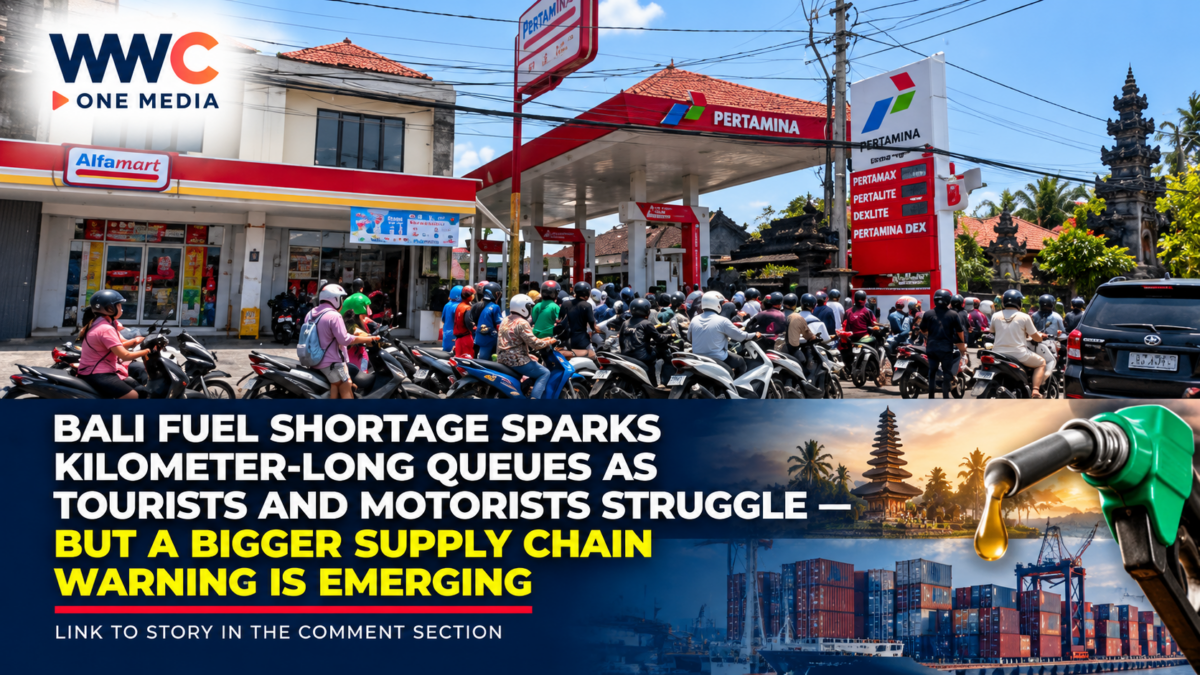
DENPASAR, BALI, INDONESIA — October 14, 2026 — One of Southeast Asia’s most popular holiday destinations is facing a disruptive fuel supply crisis, with motorists lining up for hours at petrol stations across Bali as delayed tanker deliveries interrupt the flow of gasoline to local businesses, residents and tourists.
Long lines of motorcycles and cars have been reported in Denpasar, Badung and other parts of the island, with some drivers finding that nearby stations have temporarily run out of fuel.
The disruption has forced tourists to cancel planned excursions, delayed local business operations and increased pressure on transportation services.
According to reporting by Bloomberg, AFP and Indonesian news outlets, fuel shortages at individual filling stations have persisted even as authorities insist that sufficient fuel remains available in storage.
Indonesia’s state-owned energy company Pertamina has moved to accelerate deliveries after technical problems involving a fuel tanker delayed unloading operations.
Meanwhile, Bali Governor Wayan Koster has urged residents not to panic-buy, saying additional supplies are arriving and distribution is being reorganized.
But the incident highlights a vulnerability beyond the immediate queues.
For an island economy heavily dependent on tourism, logistics and road transport, a temporary shipping disruption can quickly become a problem affecting thousands of residents and visitors.
Long Queues Spread Across Bali
Petrol stations in Denpasar and the heavily visited Badung region have experienced extended queues as motorists search for fuel.
AFP reported on October 14 that lines stretched as far as one kilometer in some locations.
Local outlet BaliNews described even longer queues at individual stations, including areas around Sesetan, Sidakarya and other neighborhoods of Denpasar.
Motorcyclists and drivers have reported waiting for several hours, while some petrol stations temporarily suspended sales after exhausting available supplies.
The disruption has affected both subsidized Pertalite gasoline and the higher-octane Pertamax product.
Queues have also been reported around Kuta, South Kuta, Kerobokan and other parts of southern Bali.
These observations describe affected locations, not proof that every petrol station on the island is without fuel.
The extent of shortages varies by station and by the availability of new deliveries.
Tourists Forced to Cancel Travel Plans
The shortage has created immediate problems for international visitors, many of whom depend on rented scooters or cars to explore Bali.
AFP interviewed Moldovan tourist Raisa Neagu, 43, who said she had spent hours trying to refuel her scooter.
The delay forced her to abandon planned activities, leaving uncertainty about whether she could visit northern Bali before her scheduled October 21 departure.
Other visitors have described difficulty finding fuel close to popular tourist destinations.
Local transportation workers and businesses are also affected when vehicles cannot obtain gasoline on schedule.
For tour operators, ride-hailing drivers and accommodation providers, unreliable fuel availability can interrupt normal services.
The situation comes at a time when Bali continues to rely heavily on tourism-related spending.
Although temporary fuel delays do not automatically translate into a prolonged tourism downturn, they can immediately disrupt the visitor experience.
What Caused Bali’s Fuel Shortage?
Authorities say the main problem originated with delayed fuel deliveries and difficulties unloading a tanker.
Pertamina President Director Simon Aloysius Mantiri acknowledged that a technical problem had interrupted the unloading of fuel shipments.
According to AFP, the issue involved a tanker that encountered difficulties discharging its cargo.
Indonesia’s Director General of Oil and Gas, Laode Sulaeman, confirmed on October 14 that fuel deliveries were delayed by logistical problems.
He said the situation was connected to distribution rather than a depletion of national fuel reserves.
Weather and sea conditions can also create challenges for vessels delivering fuel to island terminals.
Even when a tanker reaches its destination, delays in docking or unloading can prevent fuel from reaching storage depots and petrol stations at the expected time.
Bali depends on regular shipments because much of its fuel supply is transported to the island by sea.
That dependence makes delivery schedules important to maintaining reliable retail supplies.
Pertamina Moves to Deliver 26.2 Million Liters
Pertamina Patra Niaga is responding with additional shipments intended to restore normal distribution.
According to ANTARA, the company arranged deliveries totaling 26,200 kiloliters, equivalent to 26.2 million liters, in stages.
The shipments were scheduled for October 12, October 14 and October 16.
They are intended to supply fuel storage facilities in Sanggaran, Denpasar, and Manggis, Karangasem.
Pertamina is also adjusting distribution routes and delivery schedules to improve the flow of fuel from depots to petrol stations.
A tanker carrying more than 22 million liters had already arrived by October 13, according to Bali’s governor.
However, the arrival of a tanker does not mean every filling station immediately receives sufficient supplies.
Fuel must be unloaded, transferred to terminals and transported by road to individual outlets.
That process helps explain why queues can continue even after major shipments reach the island.
Dozens of Petrol Stations Extend Operations
To help ease congestion, Pertamina has identified 52 petrol stations for round-the-clock service.
The extended hours are intended to help vehicles refuel once deliveries reach the stations.
Authorities are also coordinating distribution in areas experiencing particularly long queues.
The initiative should reduce pressure on individual outlets by making refueling available over a longer period.
However, operating around the clock is only useful when stations have fuel available.
Restoring stable delivery volumes remains the central objective.
Indonesia’s energy ministry indicated on October 14 that the distribution problem could begin easing by October 15 as additional supplies move through the system.
That is an official expectation, not confirmation that all shortages have already ended.
Bali Governor Says Fuel Reserves Remain Sufficient
Governor Wayan Koster has sought to reassure residents that Bali is not experiencing a complete depletion of fuel reserves.
Speaking on October 13, Koster said storage facilities in Denpasar and Karangasem still held fuel.
He urged people not to purchase more gasoline than needed, warning that panic buying could worsen queues and intensify pressure on distribution systems.
The governor also rejected claims that supplies had been diverted to support the Mandalika MotoGP event in neighboring West Nusa Tenggara.
That denial is important because unverified rumors can influence consumer behavior during a temporary shortage.
When motorists fear supplies may disappear, additional people can rush to petrol stations.
Such demand spikes may cause individual stations to sell through available stocks more rapidly.
This can create a cycle in which concern over shortages contributes to even longer queues.
Indonesia Says National Fuel Stocks Are Secure
The central government is also seeking to distinguish the Bali disruption from a nationwide fuel emergency.
Director General Laode Sulaeman said Indonesia’s national fuel reserves remained sufficient to cover approximately 18 to 20 days of consumption.
The figure represents national reserve cover, not the number of days every Bali petrol station can continue operating without new deliveries.
A country may have adequate fuel in storage while particular locations experience temporary shortages because of transportation or distribution failures.
This distinction is central to understanding the current situation.
The evidence supports reports of real shortages at individual stations and serious disruptions to motorists.
It does not support claims that Indonesia has exhausted its national gasoline reserves.
The problem is primarily getting available fuel to the places where consumers need it.
Local Businesses Face Delays and Higher Operational Pressure
Fuel shortages create problems beyond private motorists.
Bali’s economy depends on a large network of small businesses, tourism operators, delivery workers and transportation providers.
Drivers may lose working hours while waiting at petrol stations.
Businesses relying on road deliveries may have difficulty maintaining schedules.
Food distribution, hotel transport and other services can experience interruptions when vehicles are delayed.
Bank Indonesia’s Bali representative office acknowledged on October 14 that the fuel disruption was affecting mobility and some business operations.
However, it expected the overall impact on the regional economy to remain limited and temporary as supplies recovered.
That assessment is important because disruptions visible on the streets do not necessarily translate into a lasting macroeconomic crisis.
The eventual economic impact will depend on how quickly distribution returns to normal and whether shortages recur.
Officials Face Calls to Fix Fuel Distribution
The incident has prompted political scrutiny.
Indonesian lawmaker Rivqy Abdul Halim urged Pertamina on October 14 to improve its fuel distribution system and management.
He argued that recurring supply disruptions should lead to more effective operational planning.
The criticism highlights a key question for the state-owned energy company.
Even when sufficient fuel exists nationally, can Pertamina ensure that shipments and local distribution remain resilient when technical problems or unfavorable weather interfere with regular operations?
Better contingency planning could include alternative delivery schedules, stronger storage arrangements and earlier coordination with affected stations.
However, those measures would require assessment of the actual causes, costs and operating requirements.
The immediate priority remains restoring normal access to fuel.
A Wider Energy Security Warning for Southeast Asia
Bali’s fuel disruption comes amid heightened concern about energy security across Asia.
The conflict involving Iran and disruptions to international oil trade have encouraged governments to reassess fuel reserves and supply routes.
Reuters reported on October 8 that Asian countries were accelerating discussions about oil stockpiling, energy diversification and regional cooperation.
Several Southeast Asian economies are especially exposed to changes in international petroleum markets.
The Philippines is among the countries exploring stronger national fuel reserves.
But it is important not to confuse the broader regional energy situation with the immediate cause of Bali’s queues.
Indonesian authorities have attributed the Bali disruption principally to tanker unloading and distribution difficulties.
There is no verified evidence in the accessible reporting that the local shortage was caused directly by the conflict involving Iran.
Nevertheless, the incident illustrates a wider lesson.
Even when fuel reserves are adequate, transportation bottlenecks can create severe local disruptions.
Energy security depends not only on how much fuel is available, but also on whether it can be delivered reliably to consumers.
What Tourists and Residents Should Know
For visitors currently in Bali, the main concern is planning transportation while queues continue.
Motorists should allow extra time for refueling, particularly before longer journeys.
Travelers arranging airport transfers, excursions or other transport may wish to confirm that their service providers have sufficient fuel.
Residents and tourists should follow official announcements from Pertamina and local authorities for updates on station availability.
Unverified reports about widespread closures or permanently exhausted supplies can worsen confusion.
The situation remains fluid.
Some stations may receive fuel and resume normal service before others.
Normal operations cannot be assumed islandwide until distribution stabilizes and queues return to usual levels.
What Happens Next?
The immediate focus is on the additional shipments scheduled through October 16 and the ability of Pertamina’s distribution network to deliver them quickly.
Authorities expect the queues to ease as shipments reach storage terminals and petrol stations.
Bank Indonesia believes the regional economic impact is likely to remain temporary.
But the disruption has exposed vulnerabilities in the fuel supply chain serving one of Indonesia’s most internationally recognized tourism destinations.
For the government, the challenge will be determining whether distribution planning, storage capacity or emergency delivery procedures need improvement.
For Pertamina, restoring confidence will require consistent supplies rather than simply reassuring the public that fuel exists.
And for Bali’s residents and visitors, relief will come when petrol stations can once again provide reliable service without hours of waiting.
Bali’s kilometer-long petrol queues may be the result of temporary delivery problems, but the bigger warning is how quickly a technical disruption at sea can affect tourism, local businesses and everyday mobility—even when national fuel reserves remain sufficient.