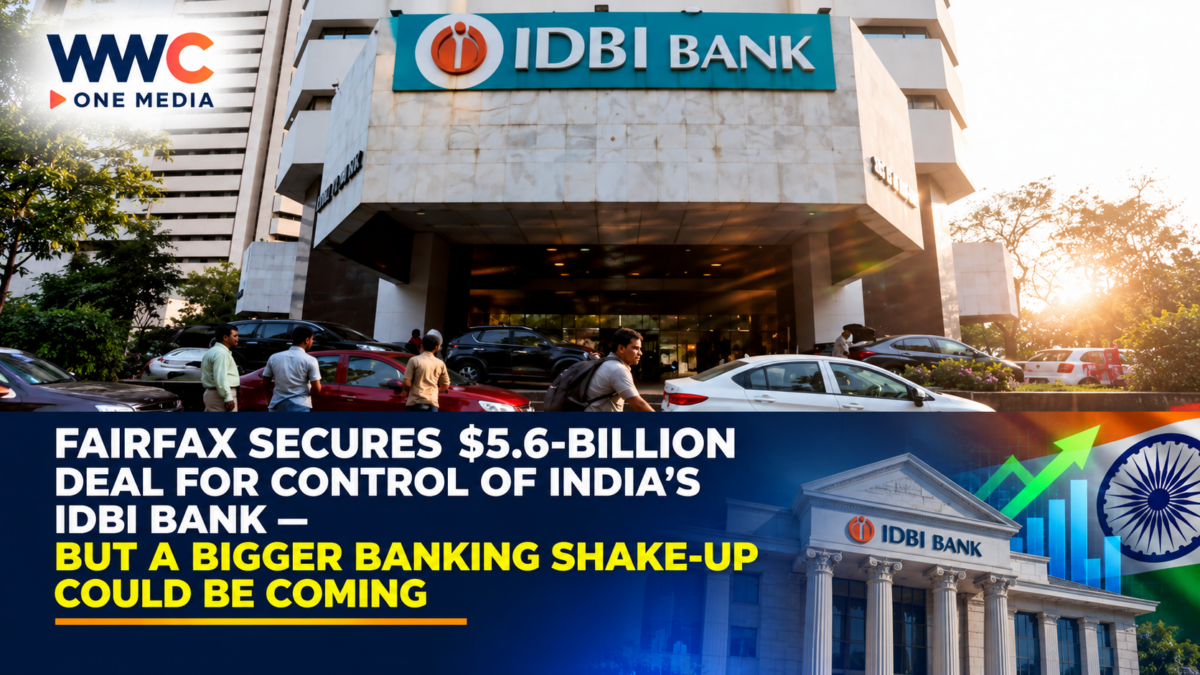
NEW DELHI / MUMBAI, INDIA — October 14, 2026 — Canadian billionaire Prem Watsa’s Fairfax Financial Holdings is set to take control of India’s IDBI Bank in a landmark ₹52,878-crore transaction, equivalent to approximately US$5.6 billion, marking a major breakthrough in one of the country’s longest-running banking privatization efforts.
India’s Union Cabinet approved the sale of a combined 60.72% stake in the Mumbai-based lender to a Fairfax subsidiary on Wednesday, opening the door to what government officials described as the country’s largest foreign direct investment transaction in the financial sector.
The agreement could reshape the competitive landscape of Indian banking at a time when international financial institutions are seeking greater exposure to the world’s fastest-growing major economy.
But the deal also creates difficult questions.
Fairfax must satisfy regulatory requirements, address its existing investment in another Indian bank and demonstrate that private ownership can unlock new growth at a lender that previously struggled with substantial bad loans.
For Prime Minister Narendra Modi’s government, the transaction represents an important test of its strategy to attract foreign capital and restructure state-backed businesses.
And for investors, the biggest question is whether the acquisition can become the beginning of a wider transformation in India’s banking industry.
Fairfax Wins Control With a 60.72% Stake
Under the Cabinet-approved arrangement, Fairfax will acquire 60.72% of IDBI Bank through its Canadian investment vehicle.
The total transaction value is approximately ₹52,878 crore.
The Indian government will sell a 30.48% stake, while state-owned Life Insurance Corporation of India, or LIC, will sell another 30.24%.
Following completion, the government will retain a 15% holding and LIC will maintain approximately 19%.
Together, the two Indian public-sector shareholders will continue to own 34% of the bank.
This means Fairfax will gain majority ownership while the Indian government and LIC remain significant minority investors.
The acquisition is structured as a strategic change in ownership rather than the purchase of every outstanding IDBI share.
The difference matters because minority shareholders will continue to have an interest in the bank’s performance after the transaction.
India Approves ₹81-Per-Share Offer
Fairfax’s winning bid values IDBI Bank shares at ₹81 each.
That price is above the ₹75.99-per-share benchmark established by the government using independent valuations.
However, it is below IDBI’s closing market price of ₹90.40 on October 14.
The difference illustrates an important feature of large banking transactions.
A strategic buyer and the selling shareholders may negotiate a block transaction at a price that differs from the stock’s prevailing market quotation.
The agreed purchase price does not automatically establish the value of every publicly traded share, nor does it guarantee future gains for investors.
According to Bloomberg, the transaction values IDBI Bank as a whole at approximately ₹871 billion.
The final financial outcome for Fairfax will depend on the bank’s future profitability, growth, regulatory obligations and investment performance.
Prem Watsa Expands His Financial Empire in India
Fairfax Financial Holdings is controlled by Indian-born Canadian billionaire Prem Watsa, a prominent global investor often associated with long-term value investing.
The Toronto-based company operates across insurance, reinsurance and investment businesses.
India has become an important part of its international investment portfolio.
Fairfax already has interests in Indian financial services, including CSB Bank and IIFL Capital Services.
The IDBI transaction would significantly increase its exposure to traditional banking and provide control over a much larger financial institution.
For Fairfax, the acquisition represents an opportunity to participate more directly in India’s growing credit market, rising household wealth and expanding demand for financial services.
But running a major banking institution also presents operational and regulatory challenges that differ from holding minority investment positions.
The company will need to manage capital requirements, risk controls, customer relationships and competition from established domestic lenders.
Fairfax Must Resolve Its Existing CSB Bank Investment
One of the most significant regulatory conditions involves Fairfax’s existing investment in CSB Bank.
According to Bloomberg’s report, Fairfax will be required to merge or exit its approximately 40% holding in CSB Bank within two years of signing the share purchase agreement.
The requirement reflects regulatory concerns surrounding ownership and control of multiple Indian banking institutions.
The ultimate arrangement could involve a sale of shares, a qualifying corporate restructuring or another solution accepted by regulators.
No final decision on the precise structure has been confirmed.
This condition could become one of the most closely watched consequences of the IDBI takeover.
Investors in both IDBI Bank and CSB Bank will want to understand whether Fairfax intends to consolidate its Indian banking interests or concentrate its resources on the larger institution.
Any merger or restructuring would require separate consideration of shareholder rights, competition, capital requirements and regulatory approvals.
The IDBI transaction therefore has the potential to influence more than one Indian banking business.
A Privatization Plan Delayed for Years Finally Advances
India originally launched the process to sell control of IDBI Bank in 2022.
The government wanted to reduce public ownership and attract an investor capable of improving the lender’s commercial performance.
But the sale faced repeated delays involving regulatory clearances, bidding requirements and disagreements over valuation.
The process suffered another setback in March 2026 when the government paused the transaction after offers failed to satisfy its price expectations.
Fairfax had previously submitted a bid below the government’s reserve valuation.
The new agreement represents a breakthrough after months of uncertainty.
The successful offer clears an important political and commercial obstacle for the Modi administration.
However, Cabinet approval is not the same as the complete transfer of ownership.
The agreement still requires the remaining transaction steps and applicable regulatory conditions to be satisfied.
Reports indicate that completion is expected by March 2027.
Until closing occurs, the buyer and sellers must continue addressing outstanding requirements.
IDBI Bank’s Recovery Helps Make the Deal Possible
IDBI Bank was once among the Indian lenders most affected by deteriorating asset quality.
The institution accumulated substantial non-performing loans, weakening its financial position and requiring major restructuring.
LIC became the bank’s controlling shareholder in 2019 after acquiring a majority stake, while the government continued to hold a significant interest.
This restructuring led to IDBI Bank being classified as a private-sector bank for regulatory purposes, even though public-sector entities remained its principal owners.
Over subsequent years, the lender improved its balance sheet through capital support, recoveries and efforts to reduce troubled loans.
Its return to profitability helped make a strategic ownership transaction more attractive.
The improvement does not mean future credit risks have disappeared.
Banks remain exposed to changes in interest rates, economic conditions, borrower defaults and regulatory requirements.
For Fairfax, the challenge will be building on IDBI’s recovery while expanding its business in a competitive market.
A Landmark for India’s Financial-Sector Investment
Indian officials described the transaction as the largest foreign direct investment in the country’s financial sector.
The announcement follows growing interest from international banks and investment groups seeking access to India’s domestic financial market.
The country’s expanding middle class, demand for loans and growth in digital financial services have strengthened its appeal.
Bloomberg reported that Japanese financial institutions invested more than US$6 billion combined in stakes in Indian banks during the previous year.
Major international banking groups see opportunities in corporate lending, consumer banking, wealth management and financial technology.
But the entry of foreign investors can also intensify competition for deposits, borrowers and experienced banking professionals.
For established Indian lenders, a more commercially aggressive IDBI Bank could present a new competitive challenge.
For customers, stronger competition may eventually support innovation and service improvements, although those benefits are not guaranteed.
Modi’s Government Gets a Boost From a Major Asset Sale
The transaction also carries significant fiscal and political implications.
India has been pursuing a program of asset sales and restructuring to reduce government ownership in selected businesses.
The government has targeted approximately ₹800 billion in proceeds from asset sales during the current fiscal year.
The IDBI transaction could provide a substantial contribution to that goal.
However, the full ₹52,878-crore purchase price will not go entirely to the government.
The proceeds must be divided between the government and LIC according to the stakes each is selling.
Consequently, the headline value of the transaction should not be reported as though it were entirely government revenue.
The sale comes at a time when India faces spending pressures and economic uncertainty linked to elevated international energy prices.
Additional non-tax receipts may help support the government’s financial position, but a single transaction cannot resolve all fiscal challenges.
Why India Wants Larger and Stronger Banks
India’s government has been discussing ways to create financial institutions capable of supporting a much larger economy.
Prime Minister Narendra Modi has set a long-term ambition of transforming India into a developed country by 2047.
Meeting that goal would require substantial financing for infrastructure, industrial production, housing, technology and private enterprise.
Banks are central to that process because they provide credit to companies and households.
Government officials and industry participants have discussed the possibility of creating larger banking institutions through consolidation and increased investment.
But bigger banks do not automatically produce stronger economic outcomes.
Effective lending requires disciplined risk assessment, adequate capital and reliable governance.
Poorly managed credit growth can lead to new non-performing loans.
The policy challenge is therefore expanding financing capacity without creating excessive financial-system risks.
Fairfax’s ownership of IDBI Bank will be assessed partly on its ability to combine growth with prudent management.
What Happens to IDBI Customers and Employees?
The acquisition does not mean that IDBI Bank branches will immediately close or that customers must automatically transfer accounts.
According to Indian media reporting on the announced conditions, the bank is expected to retain its existing brand name for three years.
Existing banking services remain subject to the institution’s normal operating arrangements and regulatory requirements.
Over time, Fairfax may seek improvements in digital banking, lending operations, customer services and efficiency.
Such changes could create opportunities to modernize the lender.
However, the precise effect on employees, branch networks and management has not been fully established.
No specific number of job reductions has been confirmed as part of the announcement.
Customers and employees should therefore distinguish between the approved change in ownership and any future operational restructuring decisions.
The Real Challenge Begins After Regulatory Approval
Fairfax is expected to present its credentials to the Reserve Bank of India for the relevant fit-and-proper assessment and outline its plan for complying with regulatory conditions.
The share purchase agreement is expected to be signed within the current calendar year, according to Indian government briefings.
Other transaction steps will follow before the anticipated March 2027 completion.
Investors will be watching closely for details of the closing arrangements, ownership restrictions and the future of Fairfax’s CSB Bank investment.
The market will also assess whether Fairfax can improve IDBI’s profitability and lending franchise without exposing the bank to excessive risk.
For India, the transaction could encourage additional foreign participation in banking and renewed interest in restructuring state-backed institutions.
But each future transaction would have its own financial and regulatory considerations.
What Happens Next?
The immediate focus will be on signing the purchase agreement and securing the necessary banking approvals.
Further information may emerge about IDBI’s management structure, business strategy and Fairfax’s plans for its other Indian investments.
The government and LIC will remain significant shareholders even after the majority stake is transferred.
For Prem Watsa, the acquisition represents one of his most consequential investments in India’s banking industry.
For Narendra Modi’s government, it is a major milestone in a privatization effort that encountered repeated delays.
But the success of the transaction will ultimately be measured by what happens after ownership changes.
Fairfax has secured approval for a US$5.6-billion deal giving it control of IDBI Bank, but the bigger story may be what follows: a possible restructuring of Fairfax’s other Indian banking interests and a new phase of competition for one of Asia’s most important financial markets.