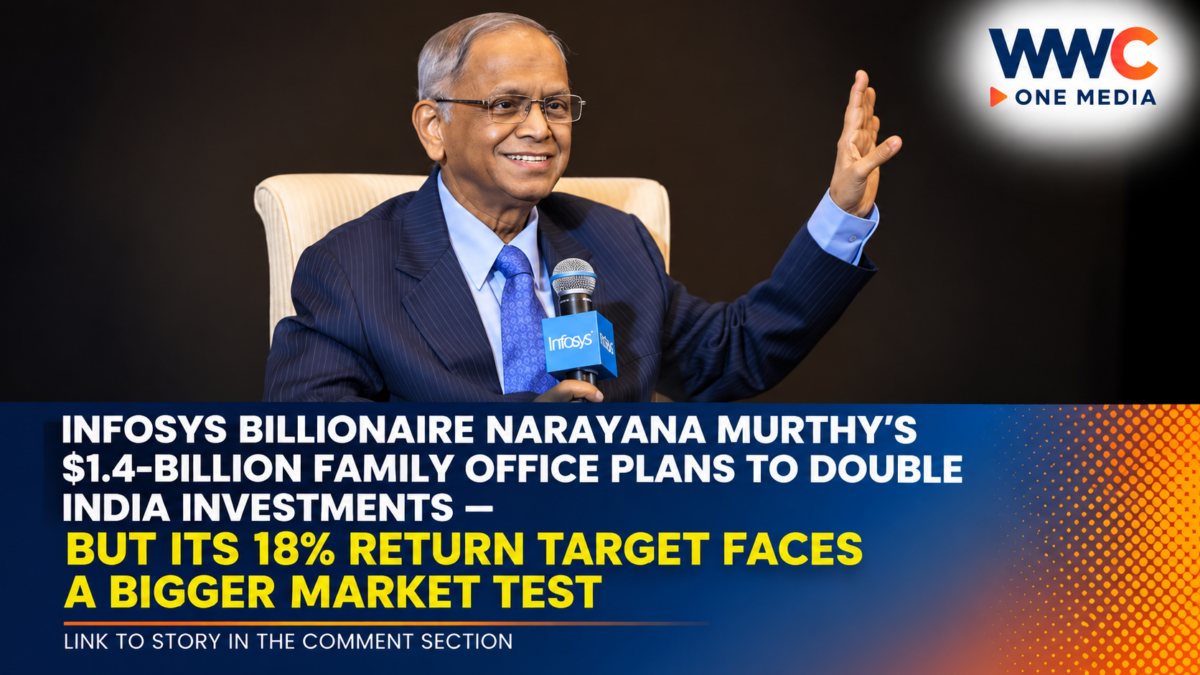
BENGALURU / NEW DELHI, INDIA — October 14, 2026 — Indian technology billionaire Narayana Murthy is making an ambitious new bet on his home country’s economic future, with his US$1.4-billion family investment office planning to double its exposure to India over the next five years.
Catamaran, the investment firm managing wealth for the Infosys co-founder and his family, is positioning itself to capitalize on opportunities in artificial intelligence, precision manufacturing, engineering and businesses serving international customers.
The expansion comes despite significant volatility in Indian financial markets, pressure on the rupee and continued selling by some foreign institutional investors.
According to Bloomberg, Catamaran President Deepak Padaki outlined the strategy during the Bloomberg New Economy Forum on Wednesday, October 14.
The firm is targeting annual investment returns of 16% to 18% while seeking opportunities across publicly traded companies and privately held businesses.
But the investment plan carries a bigger question.
Can India transform its growing technology and manufacturing capabilities into globally competitive businesses capable of delivering attractive long-term returns, even as currency volatility, high valuations and international economic uncertainty challenge investors?
Catamaran Plans to Double Its India Exposure in Five Years
Catamaran intends to significantly increase its exposure to Indian investments over the next five years.
The firm already manages approximately US$1.4 billion on behalf of Narayana Murthy and his family, making it a significant participant in India’s private investment market.
Padaki said the strategy will prioritize sectors in which Indian companies can provide specialized products, technology and services to customers around the world.
The plan includes investment opportunities in both public equity markets and privately held businesses.
However, Catamaran has not publicly disclosed the precise amount of additional capital it intends to deploy.
Doubling India exposure does not necessarily mean doubling all assets under management.
The final level of investment will depend on existing portfolio allocations, market valuations, new opportunities and future investment decisions.
The five-year timeline also indicates a gradual expansion rather than an immediate transfer of billions of dollars into Indian assets.
Catamaran Targets Annual Returns of 16% to 18%
One of the most striking aspects of Catamaran’s strategy is its return objective.
According to Bloomberg, Padaki said the family office is targeting annual returns of 16% to 18%.
That is an ambitious investment goal, particularly for a diversified portfolio involving public equities, private businesses and growth-stage investments.
Achieving such results over multiple years would require careful selection of companies, disciplined valuations and successful execution by portfolio businesses.
The objective also underscores Catamaran’s willingness to pursue growth opportunities that may carry greater risk than more conservative investments.
However, the return target is not a forecast guaranteed by the firm.
Actual returns will depend on market conditions, currency movements, company performance and the timing of investment exits.
Private investments can also take several years to generate realized returns.
For investors, the distinction between a targeted return and money actually earned is especially important.
Artificial Intelligence Becomes a Major Investment Priority
Artificial intelligence is one of the central pillars of Catamaran’s planned expansion.
But the firm’s strategy differs from the approach of investors focused exclusively on developing large language models or competing directly with major global AI laboratories.
Padaki said Catamaran is particularly interested in Indian businesses providing specialized AI services, solutions and capabilities to large international enterprises.
These could include technologies that help companies automate processes, analyze information, improve operational efficiency or build industry-specific applications.
The strategy reflects India’s existing strengths in software services, engineering talent and relationships with international corporate customers.
For years, Indian technology companies have supplied software development, consulting and outsourced business services to major global firms.
Artificial intelligence is changing the nature of those services.
Companies increasingly want technology partners capable of integrating AI into business operations rather than simply developing software according to conventional specifications.
That transition could create opportunities for Indian businesses that combine technical expertise with deep understanding of specific industries.
However, it also creates competitive pressure.
AI may automate portions of work historically performed by traditional information technology services companies.
The businesses most likely to benefit may therefore be those capable of moving toward higher-value services and differentiated technological capabilities.
Data Centers Offer Another Major Opportunity
Catamaran is also monitoring businesses connected to the expanding global AI infrastructure market.
The growing use of artificial intelligence is increasing demand for computing facilities, electricity infrastructure, cooling equipment, storage and related services.
Modern AI data centers require substantial investment in power systems, advanced cooling technologies, networking equipment and specialized hardware.
India’s opportunity may extend beyond operating data centers.
Domestic companies could potentially manufacture electrical equipment, mechanical systems, cooling components and other infrastructure required by global technology providers.
This could create opportunities for businesses combining engineering capabilities with advanced manufacturing.
In a separate development reported by Reuters on October 13, Apple supplier Jabil and India’s Adani Enterprises signed a non-binding agreement to explore a 50-50 joint venture involving AI and data center equipment manufacturing.
That transaction illustrates the growing international interest in India’s role as a supplier to the AI infrastructure industry.
However, it is separate from Catamaran’s own investment strategy.
There is no confirmed report that Catamaran is participating in the proposed Jabil–Adani venture.
Precision Manufacturing Emerges as a Key Growth Strategy
Beyond artificial intelligence, Catamaran sees substantial potential in India’s precision manufacturing sector.
Precision manufacturers produce specialized components and equipment designed to meet demanding engineering and quality standards.
Their products can serve industries including aerospace, automotive manufacturing, industrial machinery, electronics and energy systems.
The sector is attracting interest as international companies diversify manufacturing supply chains and seek additional suppliers outside their traditional production hubs.
Padaki believes Indian companies have opportunities to move into higher-value manufacturing rather than relying primarily on low-cost production.
Such businesses often require specialized machinery, technical expertise, certifications and long-term customer relationships.
Those requirements can create competitive advantages for companies capable of meeting global standards.
However, expanding manufacturing capacity also requires significant investment.
Companies face risks involving raw-material prices, customer concentration, technological changes and the challenge of maintaining quality while scaling production.
Catamaran’s strategy suggests that it sees long-term value in Indian firms that can overcome these obstacles and become important suppliers to international industries.
Catamaran Already Has Significant Manufacturing Investments
The company’s official profile supports its growing emphasis on industrial investment.
Catamaran says approximately 30% of its portfolio is invested in export-oriented precision manufacturing and engineering businesses.
Its public-market investments have included companies such as Sansera Engineering, TD Power Systems and Vardhman Special Steels.
Sansera produces precision-engineered components for automotive and other industrial markets.
TD Power Systems supplies equipment used in power generation and related applications.
Vardhman Special Steels serves industrial customers requiring specialized steel products.
Catamaran’s wider investment portfolio also includes private businesses involved in advanced engineering and technology.
In September, the firm highlighted its investment in Matel Motion and Energy Solutions, a company developing electric motors, controllers and integrated powertrain systems.
These investments demonstrate that the focus on manufacturing predates the latest announcement.
The planned expansion represents a continuation and potential acceleration of an existing strategy.
A Portfolio Spanning SpaceX and India’s Stock Exchange
Although Catamaran is increasing its focus on India, the firm already has a diverse investment history.
Bloomberg reported that its holdings include Elon Musk’s SpaceX and the National Stock Exchange of India.
The combination illustrates the breadth of the firm’s investment interests.
SpaceX provides exposure to commercial space technology and associated businesses, while the National Stock Exchange represents an investment in India’s financial-market infrastructure.
Catamaran’s official portfolio also identifies investments in businesses operating across financial services, technology, insurance and manufacturing.
The family office has previously formed strategic business partnerships involving major international companies.
Its diversified approach allows it to pursue opportunities across different business models and stages of growth.
But diversification does not eliminate risk.
Investments in private companies may be difficult to sell quickly, while publicly traded holdings remain vulnerable to market volatility.
A portfolio containing both types of assets requires careful management of liquidity, valuation and long-term capital commitments.
India’s Wealthy Families Are Becoming Major Startup Investors
Catamaran’s strategy reflects a wider transformation in India’s investment industry.
Family offices, which manage the investments and financial affairs of wealthy families, are becoming increasingly influential sources of capital for startups and growing businesses.
According to Channel News Asia reporting in June 2026, the number of structured family offices in India increased to approximately 300 in 2024 from just 45 six years earlier, citing PwC research.
The expansion has been driven by growing private wealth, younger generations participating in investment decisions and increasing interest in venture capital and private equity.
Family offices may offer advantages to entrepreneurs because they can sometimes invest with longer time horizons than conventional investment funds.
However, their investment strategies vary significantly.
Some focus on wealth preservation, while others pursue aggressive expansion and higher-risk growth opportunities.
Catamaran’s latest announcement places it among the investors seeking opportunities from India’s developing innovation and manufacturing ecosystem.
Its plans also show how capital accumulated through India’s earlier technology boom is being reinvested in newer industries.
Foreign Investors Are Selling Indian Stocks Despite Domestic Optimism
The decision to expand comes during a difficult period for Indian financial markets.
On October 12, Reuters reported that foreign investors continued withdrawing money from Indian equities in September.
India’s benchmark Nifty 50 index declined approximately 6.1% during the month and was down around 14.4% for the year at that point.
Global investors have been concerned about elevated oil prices, pressure on India’s currency and the relative attractiveness of domestic share valuations.
At the same time, domestic investment flows have remained resilient.
Reuters reported that equity mutual funds received approximately 383 billion rupees in net inflows during September, the highest level in five months.
Systematic Investment Plan contributions also reached a record level.
These developments highlight an important change in India’s financial markets.
Domestic investors are increasingly helping support equity demand even during periods of substantial foreign selling.
For Catamaran, this creates a complicated environment.
Lower share prices may offer opportunities to acquire stakes in promising companies.
But market volatility can also indicate genuine economic and financial risks.
Success will depend on identifying businesses whose long-term prospects justify their valuations.
India’s Manufacturing Boom Faces a Global Competitiveness Test
Catamaran’s manufacturing strategy is tied to India’s ambition to become a more important participant in international industrial supply chains.
The country has been working to attract investment in electronics, engineering, semiconductors and industrial production.
International businesses are increasingly examining alternatives to highly concentrated manufacturing networks.
India offers a large domestic market, engineering talent and opportunities for businesses seeking to diversify production.
However, building a globally competitive manufacturing sector requires more than low labor costs.
Companies need reliable electricity, efficient transportation, advanced equipment, skilled workers and consistent product quality.
They must also be able to compete against established manufacturers in China, Southeast Asia, Europe and the United States.
In another development, Reuters reported that manufacturing company Zetwerk was seeking a valuation of approximately US$2.64 billion in its upcoming Indian IPO.
The company’s activities span industrial equipment and precision manufacturing.
The planned listing demonstrates growing investor interest in businesses serving global supply chains.
But valuation and fundraising activity should not be confused with guaranteed business success.
Companies must still convert investment into sustainable earnings and competitive products.
What This Means for Other Asian Economies
Catamaran’s strategy also has implications for the broader Asian investment landscape.
Countries including the Philippines, Malaysia, Vietnam, Thailand and Indonesia are competing to attract capital into electronics, advanced manufacturing and technology services.
As international firms diversify their suppliers, these economies could benefit from additional industrial activity.
But competition is also likely to intensify.
If India develops stronger precision engineering and high-value manufacturing capabilities, businesses elsewhere in Asia may face new competitive pressure.
At the same time, expanded regional supply chains could create partnerships among Indian companies and Southeast Asian suppliers.
For the Philippines, the implications may be particularly relevant to semiconductor assembly, electronics manufacturing and business-process services.
However, Catamaran’s announced strategy does not confirm specific investments in Philippine companies or establish how regional trade patterns will change.
Those effects will depend on actual corporate investments, customer demand and future business decisions.
Can Catamaran Deliver Its Ambitious Return Target?
The biggest challenge facing Catamaran may be translating a convincing long-term investment thesis into realized returns.
India’s growth potential is widely recognized, but attractive industries do not automatically produce attractive investments.
High valuations can limit future gains even when businesses continue expanding.
Manufacturing companies may require substantial capital before reaching their expected profitability.
AI startups face rapidly changing technology and intense competition from global firms.
Data center businesses must manage power availability, construction costs and customer demand.
Currency movements also matter for investors evaluating performance in U.S. dollars.
A weakening rupee can reduce the dollar value of returns earned in Indian assets.
Catamaran’s diversified investment strategy may help manage some of these risks, but it cannot eliminate them.
The five-year expansion plan will ultimately be judged by the quality of its investments, rather than simply by how much capital it deploys.
What Happens Next?
Investors will be watching for Catamaran’s next investments in artificial intelligence, precision manufacturing and companies supplying global enterprise customers.
New portfolio announcements could provide additional evidence of how the firm intends to implement its India-focused strategy.
Developments in India’s stock market, interest rates, currency and manufacturing sector will also influence the investment environment.
For Narayana Murthy’s family office, the plan represents a significant vote of confidence in India’s long-term economic potential.
But it also reflects the changing nature of the country’s investment opportunities.
India is no longer attracting capital solely because of its large consumer market or traditional software services industry.
Investors are increasingly looking for companies capable of supplying specialized technology and advanced manufacturing solutions to the world.
Narayana Murthy’s US$1.4-billion family office is preparing to double its India exposure as it targets annual returns of up to 18% — but the real test will be whether India’s AI and manufacturing ambitions can generate enough sustainable profits to reward that confidence over the next five years.