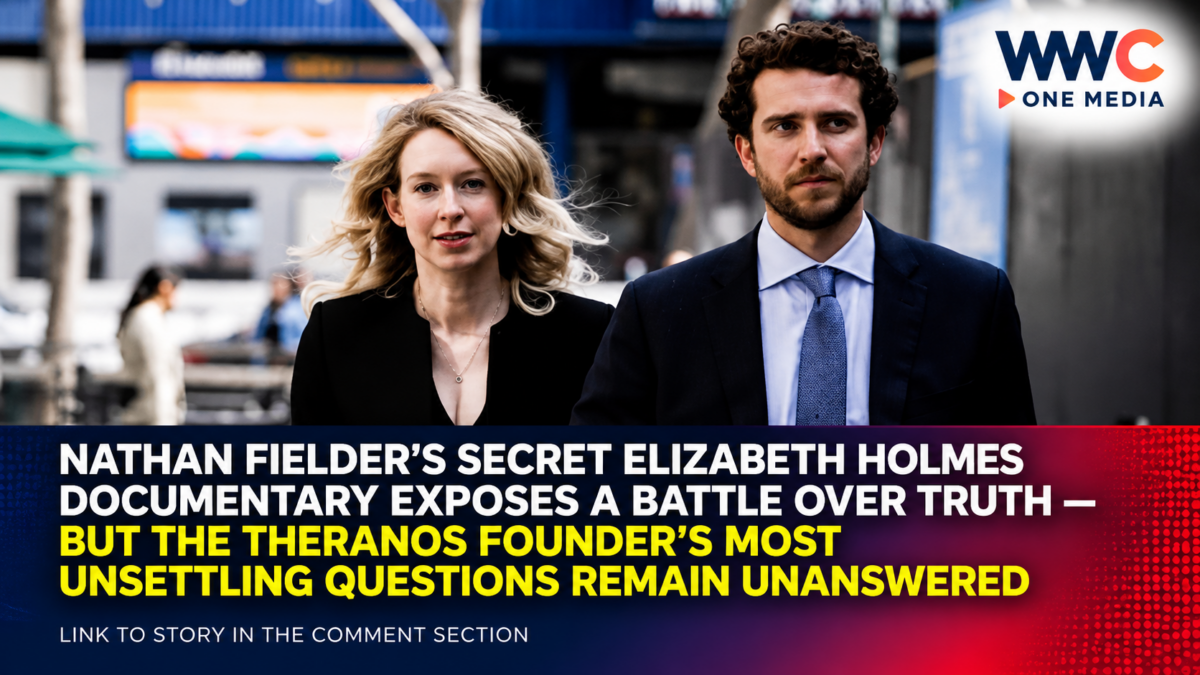
LOS ANGELES / NEW YORK — October 14, 2026 — Convicted Theranos founder Elizabeth Holmes is returning to the spotlight in one of the year’s most unusual and widely discussed documentaries, as comedian and filmmaker Nathan Fielder takes audiences inside her private life during the final weeks before she entered federal prison.
Titled You Can See Everything, the nearly three-hour A24 documentary was directed by Fielder and Lance Oppenheim, combining intimate access, uncomfortable interviews, dark humor and psychological tension in a film that critics say challenges the boundaries between truth and deception.
The documentary arrives in U.S. theaters on October 16 following a surprise premiere at the Telluride Film Festival in September and a high-profile screening at the New York Film Festival.
But the film’s most intriguing question is not simply whether Holmes continues to defend the actions that led to her fraud conviction.
It is whether granting filmmakers extraordinary access to a disgraced Silicon Valley entrepreneur actually brings audiences closer to the truth—or allows its subject to construct another carefully controlled version of reality.
Nathan Fielder Enters Elizabeth Holmes’s Private World
The documentary begins with an extraordinary arrangement.
In 2023, just 34 days before Holmes was scheduled to report to federal prison, she invited a film crew into the home she shared with her partner, Billy Evans, and their two young children.
Fielder and Oppenheim were given access to the family’s daily life during an intensely sensitive period.
Holmes had already been convicted of defrauding investors in Theranos, the blood-testing company she founded and promoted as a revolutionary force in healthcare.
Once celebrated as a visionary entrepreneur, she had become one of Silicon Valley’s most notorious examples of corporate deception.
The documentary offers Holmes an opportunity to explain herself directly, rather than through a conventional retrospective assembled primarily from archival footage and outside interviews.
But Fielder’s approach makes the experience far from an ordinary celebrity profile.
Known for Nathan for You and The Rehearsal, Fielder specializes in situations where the boundary between genuine human behavior and staged performance becomes increasingly difficult to identify.
That filmmaking style creates an uncomfortable dynamic when applied to a person convicted of misleading investors.
A Film That Turns Transparency Into a Psychological Puzzle
The title You Can See Everything suggests that viewers will receive an unusually complete picture of Holmes.
Yet several critics argue that the film demonstrates the limitations of access.
An audience may be permitted to observe private conversations, domestic routines and emotional moments without gaining a reliable understanding of the motivations behind them.
In its October review, The New Yorker examined how Holmes attempts to reshape public perceptions of her identity and credibility.
The publication described a film deeply concerned with the distinction between presenting oneself as authentic and actually being truthful.
The Guardian similarly praised the documentary’s unsettling exploration of deception and performance.
Rather than following the familiar structure of a true-crime documentary, the film reportedly evolves into an examination of how people justify their behavior and construct personal narratives.
The result is an unusual combination of investigative filmmaking, psychological portraiture and dark comedy.
Elizabeth Holmes Continues to Defend Herself
At the center of the documentary is Holmes’s continued insistence that she did not intentionally deceive people through Theranos.
Holmes was convicted in January 2022 on four counts involving fraud and conspiracy against investors.
The verdict followed years of investigations into claims that Theranos could perform numerous medical tests using very small blood samples.
Prosecutors established that Holmes misled investors about the capabilities and commercial progress of the company’s technology.
She was sentenced to more than 11 years in federal prison in November 2022 and began serving her sentence in May 2023.
Her continuing assertions of innocence do not change the outcome of the criminal proceedings.
The documentary is therefore not an exoneration.
Instead, it examines the distance between Holmes’s understanding—or presentation—of her actions and the legal findings established during her trial.
For viewers familiar with the Theranos scandal, that tension may be more revealing than another chronological retelling of the company’s downfall.
The Filmmakers Admit They Were Unsettled by the Experience
Fielder has publicly acknowledged that making the documentary left him with unanswered questions.
In interviews and post-screening appearances, he described the difficulty of interpreting his interactions with Holmes.
At the New York Film Festival, he explained that she could appear convincing during conversations even though he knew she had been convicted of serious fraud.
The conflict between those impressions became central to the film.
Fielder and Oppenheim also revealed that their relationship with Billy Evans deteriorated during production.
According to reporting by Variety, People and Entertainment Weekly, the filmmakers said Evans attempted to exert influence over the filmmaking process.
Communication eventually broke down.
During a Los Angeles screening, the directors said Holmes and Evans had not yet watched the completed documentary.
The filmmakers’ account does not establish every detail of the private disagreements, and Evans’s perspective should not be assumed from their comments alone.
Nevertheless, the reported dispute adds another layer to the film’s central theme: who controls a story when the person being filmed wants a say in how that story is told?
Billy Evans Becomes an Important Part of the Story
Although Holmes is the central subject, critics have pointed to her relationship with Evans as a significant part of the documentary.
The film examines their domestic life and interactions as the date of her imprisonment approaches.
In some sequences, the filmmakers’ questions appear to expose tension between their subjects’ desire for privacy and the documentary’s stated pursuit of openness.
Critics writing for The Atlantic and The New Yorker have interpreted the relationship dynamics as an important part of the film’s exploration of control, belief and public image.
However, the documentary is a constructed work edited from recorded material, not an unrestricted window into every aspect of the couple’s lives.
Audiences should distinguish what is shown on screen from conclusions about private motives that cannot be independently verified.
That distinction is particularly important in a film whose central premise concerns the difficulty of knowing what is real.
Why Critics Are Calling the Documentary Extraordinary
Early critical reaction has been unusually enthusiastic.
The film premiered unexpectedly at Telluride on September 6, immediately generating discussion among festival audiences and entertainment journalists.
At the New York Film Festival, its October screening reportedly produced a mixture of laughter, disbelief and discomfort.
Variety described the audience’s intense reactions, while The Hollywood Reporter characterized the documentary as boundary-pushing and absurd.
RogerEbert.com praised its unusual ambition, and The Guardian offered a particularly enthusiastic assessment of the filmmakers’ handling of truth and manipulation.
The New Yorker focused on its exploration of the limits of observation.
Not every critic agrees that the experiment is entirely successful.
Some reviewers question whether the film’s extended runtime and unconventional style produce greater understanding or simply encourage viewers to become fascinated by Holmes’s public persona.
The competing responses demonstrate why the documentary has become a significant cultural talking point even before its general theatrical release.
The Film Also Raises Questions About Nathan Fielder
One of the documentary’s most interesting developments is the way Fielder’s presence becomes part of the story.
Unlike traditional interviewers who attempt to remain outside the narrative, Fielder openly participates in the encounters he films.
His questions, reactions and uncertainties shape the audience’s experience.
That approach has been central to his earlier television work.
In The Rehearsal, he explores human behavior through increasingly elaborate scenarios designed to prepare people for difficult real-life experiences.
In You Can See Everything, the same fascination with performance and authenticity is directed toward a person whose public identity has already been shaped by a major fraud scandal.
The result raises questions not only about Holmes’s credibility, but also about the filmmaker’s ability to remain objective.
If both interviewer and subject understand that a camera can change how people behave, what can an audience truly learn from the footage?
The Theranos Scandal Remains a Warning for Silicon Valley
The documentary also revisits one of the technology industry’s most consequential corporate failures.
Holmes founded Theranos in 2003 and promoted the company as a way to transform medical testing.
Its promise was extraordinary: a small blood sample could potentially replace many conventional laboratory tests.
Theranos attracted prominent investors and powerful supporters, eventually reaching a private valuation of approximately US$9 billion.
But investigations revealed that the company’s technology could not reliably deliver many of the capabilities it had promoted.
The scandal raised major concerns about investor due diligence, corporate governance, laboratory oversight and the willingness of influential figures to accept ambitious technological claims without sufficient independent verification.
Although the documentary focuses heavily on Holmes as an individual, the broader failure involved institutions and business practices that helped enable the company’s rise.
This context remains relevant as investors pour money into new technologies, including artificial intelligence and healthcare innovation.
The lesson is not that ambitious technology companies are inherently fraudulent.
It is that extraordinary claims require credible evidence, independent testing and transparent governance.
A24’s October 16 Release Could Bring the Debate to Wider Audiences
A24 is scheduled to release You Can See Everything in U.S. theaters on October 16.
The film runs 174 minutes and carries an R rating.
Its unconventional length and unsettling subject matter make it a distinctly different offering from traditional mainstream documentaries.
However, Fielder’s established audience and the continuing fascination with Holmes have generated strong interest.
The film is also arriving during renewed Hollywood attention to Silicon Valley scandals and the influence of powerful technology executives.
Other recent screen projects have explored the social and political consequences of major technology companies.
For You Can See Everything, the challenge will be maintaining the interest of broader audiences who may already know the essential facts of the Theranos scandal.
The film’s appeal rests less on revealing the familiar outcome of Holmes’s trial and more on examining how its subject responds when confronted with questions about honesty.
Could the Documentary Change Public Opinion About Holmes?
One of the central concerns surrounding intimate documentaries about convicted public figures is whether they provide a platform for image rehabilitation.
Holmes’s participation gives her an opportunity to present her personal experience, including the period before her imprisonment.
Some viewers may respond sympathetically to the family circumstances depicted in the film.
Others may see the documentary as evidence of her continued refusal to accept responsibility for the conduct underlying her conviction.
Both reactions are interpretations rather than measurable outcomes established before the film’s wide release.
The filmmakers’ unusual approach complicates the question further.
Rather than presenting a simple argument in favor of Holmes or against her, the documentary appears designed to expose how difficult it can be to distinguish self-belief, denial and deliberate deception.
That complexity may be the film’s greatest strength.
It may also leave some audiences frustrated by the absence of definitive psychological answers.
What Happens Next?
Following its October 16 U.S. theatrical release, attention will turn to broader audience reactions and the documentary’s performance outside the festival circuit.
Its unusual form, strong early critical response and controversial subject could sustain debate in entertainment and technology circles.
The film may also renew discussion about accountability in the startup industry, the ethics of documentary access and the responsibility of filmmakers when working with subjects convicted of serious crimes.
For Holmes, the legal judgment established by her conviction remains unchanged.
For Fielder and Oppenheim, the documentary represents an ambitious attempt to examine a person whose public identity has been shaped by competing narratives of innovation, deception and downfall.
But the film’s central idea goes beyond the Theranos scandal.
Nathan Fielder’s documentary promises unprecedented access to Elizabeth Holmes—but the more closely audiences examine her story, the more troubling the underlying question becomes: If someone appears completely sincere, does that make what they are saying true?