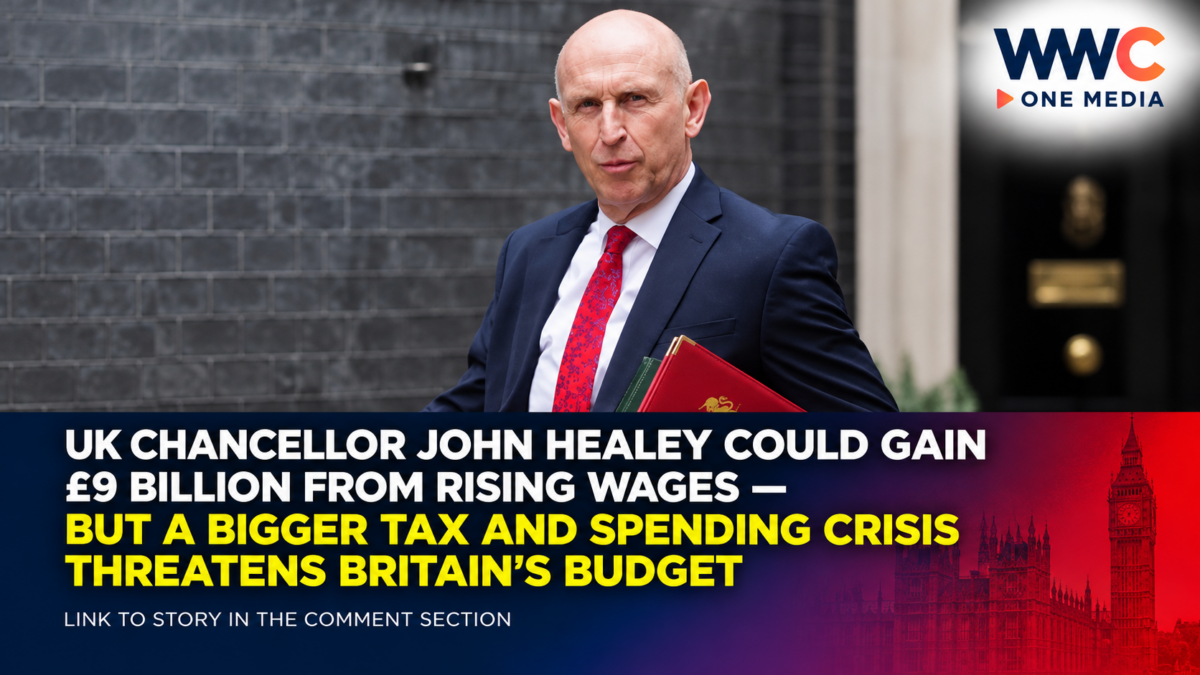
LONDON, UNITED KINGDOM — October 14, 2026 — Britain’s government could receive an unexpected £9-billion financial boost as rising wages increase income tax collections, potentially offering Chancellor John Healey some relief ahead of his first Budget on October 28.
But the apparent windfall comes with a painful twist for British workers.
Much of the additional revenue could result from higher nominal salaries pushing employees into paying more tax under frozen income tax thresholds, even as inflation continues to erode household purchasing power.
The development comes as Healey attempts to balance competing demands for cost-of-living relief, public spending, defense funding and fiscal stability amid elevated government borrowing costs.
According to Bloomberg’s October 14 report, wage developments may deliver a boost worth approximately £9 billion to the Chancellor’s Budget calculations.
The Institute for Fiscal Studies (IFS) separately confirmed that higher inflation and wage growth could increase the government’s tax receipts, partly offsetting rising debt-interest and welfare costs.
However, the benefit is far from guaranteed.
The same inflationary pressures that increase government revenue also raise the cost of public services, pensions, welfare payments and government borrowing.
For Healey, the bigger challenge is whether the additional tax receipts can genuinely improve Britain’s finances without deepening the financial strain facing workers and businesses.
How Rising Wages Could Generate £9 Billion for the Treasury
The potential revenue increase is largely connected to the way Britain’s income tax system interacts with wage inflation.
When salaries rise, workers generally pay more tax because their taxable earnings increase.
But the effect is more significant when income tax thresholds remain frozen.
Britain’s personal income tax allowance has been held at £12,570 since April 2021.
The higher-rate tax threshold in England, Wales and Northern Ireland has also remained at £50,270 for most taxpayers.
When wages rise but these thresholds do not move, a greater proportion of an employee’s income can become taxable.
Some workers who previously earned below the personal allowance may begin paying income tax.
Others may find that a larger share of their earnings is taxed at higher marginal rates.
Economists call this phenomenon fiscal drag.
It allows the government to collect additional revenue without necessarily increasing the headline rates of income tax.
The mechanism helps explain why higher wages could improve the Treasury’s revenue forecasts while leaving many households feeling little better off.
Why a Bigger Paycheck May Not Mean Greater Financial Security
For workers, nominal wage growth does not automatically mean an improvement in living standards.
If a salary increases by 4% while consumer prices rise by 5%, the employee’s purchasing power falls despite earning more money.
The combination becomes more challenging when frozen tax thresholds cause a greater share of income to be taxed.
Households may therefore experience three simultaneous pressures: rising prices, higher tax deductions and elevated borrowing costs.
Energy bills are particularly important because the conflict involving Iran has increased pressure on international oil and gas markets.
Higher fuel costs can raise transportation expenses, food distribution costs and household utility bills.
The International Monetary Fund warned on October 13 that Britain could experience average inflation of approximately 3.3% in 2026 and 2.8% in 2027.
Those forecasts underline the difficulties confronting households.
Even if workers receive salary increases, some of the gains may be absorbed by higher expenses and taxes.
This creates a politically sensitive situation for Healey.
A measure that improves the public finances may simultaneously worsen perceptions of affordability among voters.
The Institute for Fiscal Studies Warns of £35 Billion in Spending Pressures
The possible £9-billion revenue boost comes against a much larger fiscal challenge.
In its October 12 Green Budget analysis, the Institute for Fiscal Studies warned that Healey faces approximately £35 billion in pressures associated with government spending plans.
The think tank argued that higher inflation is reducing the real value of previously announced departmental budgets.
When public services receive fixed cash allocations, rising prices mean those allocations purchase fewer goods, services and staff hours.
Departments may therefore need additional money simply to maintain existing levels of service.
The IFS warned that the government could otherwise face significant real-terms reductions in some public services.
The pressures are particularly difficult because the Treasury must also account for welfare spending, debt interest and other mandatory commitments.
Higher tax revenue can help offset some of these costs.
But it cannot automatically solve all the financial problems created by inflation.
The IFS emphasized that credible budgeting requires realistic decisions about future spending, rather than relying on optimistic assumptions or postponing difficult choices.
Higher Borrowing Costs Threaten to Cancel Out the Windfall
One of the biggest threats to Britain’s public finances comes from the government bond market.
The United Kingdom relies on government bonds, known as gilts, to finance borrowing.
When gilt yields rise, the cost of issuing new debt generally increases.
Britain is also particularly exposed to inflation through its stock of inflation-linked government bonds.
As inflation rises, the cost of servicing those liabilities can increase.
According to the IFS, higher interest rates could add roughly £10 billion to government borrowing by the 2029–2030 financial year.
That would offset a substantial share of the potential additional revenue resulting from stronger nominal wages and inflation.
The figures illustrate why the impact of inflation on government finances is complicated.
Higher wages and prices can increase tax collections, but higher interest rates and inflation-linked obligations can also increase spending.
The net result depends on how quickly tax receipts, benefit payments, public-service costs and debt interest change.
This balance will be central to the Office for Budget Responsibility’s updated forecasts.
Healey’s Budget Buffer Has Come Under Pressure
Healey is preparing the October 28 Budget with limited room to absorb unexpected economic shocks.
Earlier government projections suggested fiscal headroom of approximately £23.6 billion against a key borrowing rule.
But rising government borrowing costs, fueled partly by the Middle East conflict, have reduced that cushion.
Bloomberg and Financial Times reporting indicates that the available buffer may have fallen to around £12 billion, although the precise figure will depend on updated official forecasts.
Fiscal headroom is the difference between the government’s projected fiscal position and the limit established by its own budget rules.
It is not a separate bank account containing money that can be spent immediately.
Changes to wage forecasts, inflation, economic growth and interest rates can therefore alter the calculated buffer.
This is why the potential £9-billion revenue improvement is attracting attention.
Even a relatively modest change in expected tax receipts could make a substantial difference when the government is operating with a narrow fiscal margin.
However, any improvement must be considered alongside additional spending obligations and changing borrowing costs.
UK Budget Could Include Cost-of-Living Relief
Healey is expected to announce targeted assistance for households facing high energy and transportation costs.
According to the Financial Times and Reuters, the Chancellor plans to finance new support through offsetting tax or spending decisions rather than permanently increasing borrowing.
Measures under consideration include additional winter energy assistance and postponement of planned fuel-duty increases.
The government is also examining ways to provide relief to smaller businesses and high-street retailers.
But the Chancellor faces constraints.
Broad financial support can be expensive, while measures that stimulate demand too aggressively may complicate efforts to reduce inflation.
The IMF has advised Britain to keep cost-of-living interventions targeted and temporary.
That approach would focus assistance on households and businesses most affected by higher prices, without creating large permanent spending commitments.
The final details will not be confirmed until the Budget is presented.
British Businesses Warn That Higher Taxes Could Damage Hiring
The budget debate has also exposed tensions between the government and employers.
On October 13, major retail and hospitality executives met with Healey and Prime Minister Andy Burnham to discuss the cost of employing workers.
Business leaders argued that increases in employer National Insurance contributions had raised labor costs and discouraged recruitment, particularly among younger people.
Retailers have called for changes to employer contribution thresholds and business taxes.
But providing substantial relief would require additional government revenue or spending reductions elsewhere.
Higher wages can also raise costs for businesses.
If companies face stronger wage growth without corresponding improvements in productivity or revenue, they may reduce hiring or pass costs on to customers.
This creates another difficult balance for policymakers.
Wage growth can benefit workers and public finances, but sustained increases in labor costs can affect competitiveness and employment.
The government must therefore consider how tax policy influences business investment and job creation.
Britain May Avoid Major New Borrowing
Despite the challenges, Healey is reportedly attempting to deliver a Budget that does not materially increase borrowing over the medium term.
The Financial Times reported on October 14 that new Budget measures are expected to be funded through tax changes or spending reductions.
The government wants its plans to remain consistent with fiscal rules requiring day-to-day spending to be covered by tax revenue by the end of the forecast period.
The Chancellor also faces pressure to demonstrate that Britain’s public finances remain credible to bond investors.
The country’s experience during the 2022 gilt-market disruption remains an important reminder of how quickly investor confidence can deteriorate.
A Budget that appears to increase borrowing without a convincing financial plan could push bond yields higher.
That would make government financing more expensive and potentially affect mortgage rates and other borrowing costs.
Conversely, a credible fiscal plan may help reassure investors.
The challenge is providing enough support for households and public services while maintaining confidence in the government’s ability to control borrowing.
IMF Says Britain Should Maintain Fiscal Discipline
The International Monetary Fund has offered a qualified endorsement of Britain’s fiscal direction.
On October 14, IMF officials said the UK does not necessarily need to accelerate its planned deficit reduction.
The organization recognized that Britain has already taken substantial steps toward stabilizing its public finances.
However, it warned that governments facing elevated debt and high borrowing costs must remain disciplined.
The IMF also highlighted the importance of making transparent choices about public spending priorities.
This message is significant for Healey.
It suggests international financial institutions are not demanding immediate, indiscriminate austerity.
But they are urging the government to avoid unfunded permanent commitments and unrealistic spending projections.
Britain’s fiscal credibility will depend on whether the Budget presents a sustainable path for borrowing, debt and public services.
Government Spending Could Face a Difficult Squeeze
Even if revenue forecasts improve, departments may still face a financial squeeze.
The IFS warned that previously announced spending plans could require substantial adjustment because inflation has reduced their real purchasing power.
This is especially relevant for areas such as education, transport, local government and public administration.
Public services face higher bills for energy, construction, supplies and employee compensation.
Without additional funding, they may have to reduce activities, delay projects or find efficiency savings.
But increasing departmental budgets would consume fiscal resources that could otherwise reduce borrowing or support households.
The trade-off is politically difficult.
The government must decide which services require protection and where spending can be restrained.
A possible wage-related tax windfall may provide some relief, but it does not remove those decisions.
Why the Office for Budget Responsibility Matters
The final assessment will come from the Office for Budget Responsibility, Britain’s independent fiscal watchdog.
The OBR produces official economic and fiscal forecasts that underpin government Budget decisions.
Its calculations consider economic growth, wages, inflation, employment, tax receipts, public spending and debt-interest costs.
A change in the wage forecast can affect income tax and National Insurance revenue.
But the OBR also considers how inflation affects benefits, pensions and government expenditure.
The final fiscal impact may therefore differ from individual estimates produced before the Budget.
The £9-billion figure should be treated as a possible revenue improvement rather than a final official determination.
The October 28 Budget will reveal how much fiscal relief the Chancellor actually receives and how he intends to use it.
What This Means for UK Workers and Households
For ordinary workers, the most important issue is whether wage growth improves living standards after inflation and tax.
A rise in gross pay can be welcome, but it may provide limited relief when energy bills, food prices and housing expenses are increasing.
Frozen income tax thresholds can further reduce the proportion of wage growth that reaches household budgets.
For businesses, higher wage bills and payroll taxes can affect profitability and hiring.
For the government, additional tax receipts may improve the fiscal outlook without the need for immediate increases in headline tax rates.
These competing effects explain why the potential £9-billion boost is politically sensitive.
It may ease pressure on the Treasury while doing little to resolve the frustrations of households struggling with living costs.
Could Britain Face a Bigger Tax Debate?
The October Budget may also shape the direction of future tax policy.
If the government continues relying on frozen thresholds, more taxpayers may gradually move into higher effective tax burdens.
Critics argue that fiscal drag reduces transparency because government revenues rise without explicit increases in statutory tax rates.
Supporters of maintaining thresholds contend that the additional revenue can help finance public services and reduce borrowing during a difficult fiscal period.
The government must balance these considerations against the broader effects on work incentives, household spending and economic growth.
For Healey, the challenge is particularly acute because Labour has already introduced substantial tax increases through earlier Budgets.
Further measures could provoke resistance from businesses and taxpayers.
But avoiding additional revenue may require more difficult spending decisions.
The October 28 Budget Could Be a Turning Point
The upcoming Budget will test whether Healey can translate possible improvements in tax revenue into a credible economic plan.
Investors will watch the OBR forecasts for wages, inflation, borrowing and fiscal headroom.
Households will focus on measures affecting energy bills, fuel costs and taxes.
Businesses will look for changes that influence hiring, investment and operating costs.
Public-service leaders will examine whether existing funding plans are sufficient to maintain services.
A stronger wage-related revenue forecast could provide some breathing room.
But the larger questions remain unresolved.
Can Britain restore fiscal confidence while protecting living standards?
Can the government maintain public services without substantially increasing taxes?
And will nominal wage growth translate into genuine improvements in household purchasing power?
A potential £9-billion tax boost from rising wages could give Chancellor John Healey valuable room ahead of the October 28 Budget — but the bigger question is whether Britain’s Treasury can benefit from inflation without leaving workers, businesses and public services to bear an even heavier financial burden.