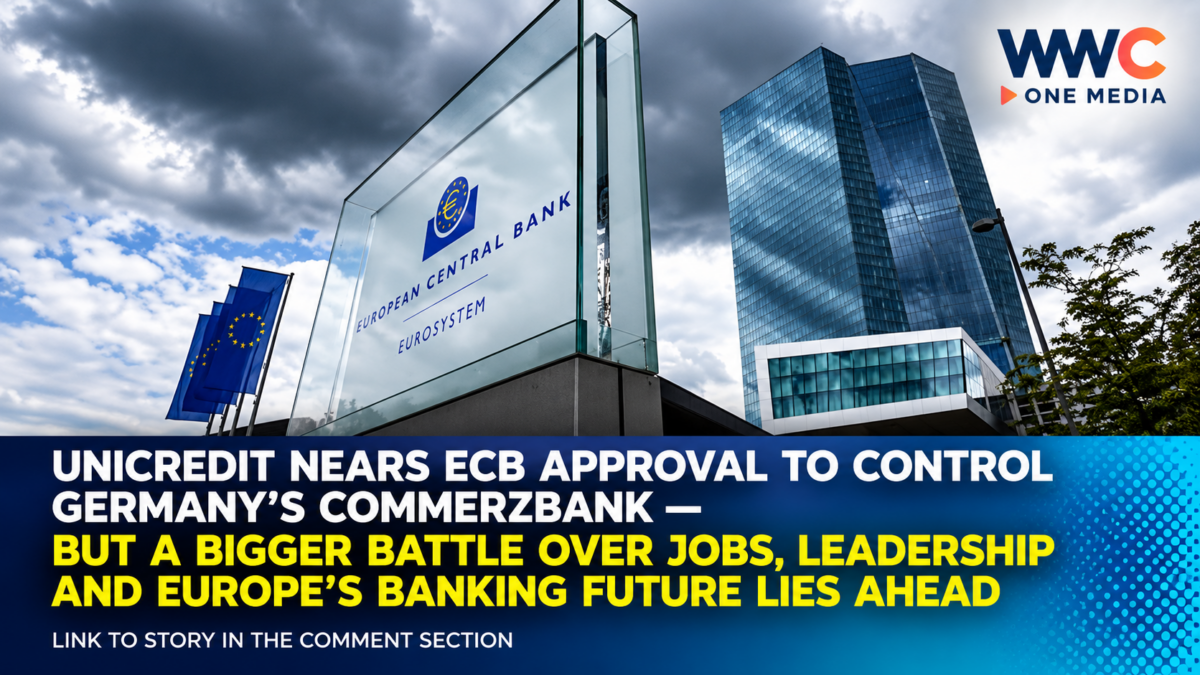
FRANKFURT, GERMANY — October 14, 2026 — Italy’s UniCredit is approaching a decisive breakthrough in its campaign to take control of Germany’s Commerzbank, with the German lender’s chief executive expecting the European Central Bank to deliver a crucial regulatory decision within days or weeks.
Commerzbank Chief Executive Officer Bettina Orlopp said the long-running takeover process is entering a critical phase after UniCredit accumulated an ownership position approaching 50%, placing the Italian banking giant close to securing effective control over one of Germany’s most important financial institutions.
Speaking to Bloomberg Television on Wednesday, Orlopp indicated that the ECB’s decision could arrive sooner than other regulatory approvals, which may not be completed until later this year or early 2027.
But the anticipated regulatory milestone does not mean a full merger has been completed.
Major questions remain over Commerzbank’s independence, its future leadership, potential job reductions, and the influence of the German government, which still owns a significant minority stake.
For UniCredit Chief Executive Andrea Orcel, the expected approval could represent a major victory after more than two years of pursuing the German lender.
For Commerzbank, however, the next phase could be even more consequential.
ECB Approval Could Come Within Days or Weeks
Orlopp told Bloomberg that the companies are awaiting decisions from multiple regulators regarding UniCredit’s planned control of Commerzbank.
The ECB, which supervises major banks in the euro area, is expected to make its decision relatively soon.
Orlopp said the bank anticipates that outstanding approvals will be completed by the end of 2026 or, at the latest, early next year.
The ECB’s decision is particularly important because it could formally establish UniCredit as having regulatory control over Commerzbank.
Such a determination can carry implications for financial reporting, capital requirements, supervisory responsibilities and risk management.
However, approval to acquire control is not the same as approval of every possible future merger arrangement.
The structure of any subsequent combination, including the treatment of Commerzbank’s existing businesses and shareholders, remains subject to further decisions.
UniCredit Moves Close to 50% Ownership
The takeover campaign has transformed UniCredit from a minority investor into Commerzbank’s dominant shareholder.
Earlier this year, UniCredit launched a voluntary share-exchange offer intended to increase its ownership above the 30% threshold that triggers German takeover rules.
The offer concluded in June, initially resulting in a stake of approximately 42.5%.
Subsequent adjustments and tendered shares brought the Italian bank’s position close to 50%, subject to relevant regulatory approvals and settlement requirements.
The near-majority position is important because shareholder meetings do not always attract participation from every investor.
Consequently, an owner holding less than 50% of total outstanding shares may still exercise effective control over voting decisions.
UniCredit’s position has therefore increased the likelihood that regulators will treat Commerzbank as controlled by the Italian group.
The distinction between majority ownership and effective control is central to the ongoing regulatory process.
Germany’s Resistance Faces a New Reality
Germany has long opposed the prospect of Commerzbank being absorbed into a foreign banking group without a negotiated agreement.
The German government currently holds approximately 13.3% of the lender.
Its concerns extend beyond national ownership.
Commerzbank is a major provider of financing to Germany’s Mittelstand, the network of small and medium-sized businesses that plays a central role in the country’s industrial economy.
Government officials have argued that any takeover must protect Commerzbank’s role in supporting those companies.
Berlin has also emphasized the importance of preserving Frankfurt as the lender’s headquarters and safeguarding employee interests.
These conditions were reiterated in September ahead of discussions involving German Finance Minister Lars Klingbeil and UniCredit’s Orcel.
But Germany’s minority stake does not automatically give it a veto over every corporate transaction.
The government’s influence will depend on applicable shareholder rights, regulatory procedures and the negotiations between the parties.
Commerzbank CEO’s Future Comes Under Scrutiny
One of the most closely watched issues is whether Bettina Orlopp will remain chief executive once UniCredit establishes control.
Orcel has previously indicated that changes to Commerzbank’s leadership may be considered after the Italian bank gains control.
Asked about her future, Orlopp acknowledged that her position remains uncertain.
Her current contract runs until 2029.
However, she emphasized that remaining chief executive depends on having the confidence of Commerzbank’s supervisory board and alignment over the bank’s strategic direction.
This creates a potentially sensitive management situation.
Orlopp has been leading Commerzbank through a period of restructuring, financial improvement and resistance to UniCredit’s unsolicited takeover approach.
A new controlling shareholder could seek changes to strategy, governance or management.
But no final decision removing Orlopp has been confirmed.
Could the Two Banks Combine Their German Operations?
The next stage may involve a choice between several possible transaction structures.
Commerzbank and UniCredit have already discussed options for bringing their businesses closer together.
One possibility involves Commerzbank acquiring UniCredit’s German subsidiary, HypoVereinsbank, commonly known as HVB.
Such a transaction could potentially be structured through a share exchange, increasing UniCredit’s ownership of Commerzbank while combining German banking operations.
Other options include a broader merger or an offer by UniCredit to acquire additional Commerzbank shares.
In September, Orlopp confirmed that different structures remained under consideration.
Each option would carry distinct consequences for shareholders, employees and regulatory authorities.
A merger could create opportunities to consolidate technology platforms, branch networks and administrative functions.
But integration would also involve costs, operational risks and difficult decisions about overlapping businesses.
No final merger structure has been announced.
Europe’s Banking Consolidation Debate Intensifies
The possible takeover has become one of the most closely watched transactions in European banking.
Supporters of cross-border consolidation argue that Europe needs larger financial institutions capable of competing with major American banks.
A combination of UniCredit and Commerzbank could create a stronger banking group with significant operations across several major European economies.
Potential benefits include economies of scale, broader customer relationships, stronger technology investment capacity and diversified revenue.
However, critics warn that bigger banks are not automatically better for customers or financial stability.
Cross-border mergers can create complex governance arrangements and additional challenges for national regulators.
They can also reduce competition in certain banking markets if overlapping operations are consolidated.
The UniCredit–Commerzbank dispute therefore highlights a fundamental tension in European financial policy.
Regulators and policymakers want a more integrated European banking industry, but individual governments often remain concerned about losing influence over strategically important domestic lenders.
The European Commission Has Its Own November Deadline
The ECB is not the only authority examining the transaction.
On October 9, Reuters reported that the European Commission had set November 16, 2026, as the deadline for its initial antitrust assessment of UniCredit’s proposed acquisition.
The Commission must consider whether the deal would significantly reduce competition in relevant markets.
It may approve the transaction, seek remedies or launch a more detailed investigation if significant concerns remain.
This review is distinct from the ECB’s supervisory assessment.
The central bank focuses on banking supervision, prudential requirements and related questions of financial control.
The Commission examines competition and market concentration.
As a result, an ECB approval would not necessarily mean all remaining regulatory hurdles have disappeared.
What the Takeover Could Mean for Commerzbank Employees
Potential employment consequences remain a major concern.
Bank mergers often seek cost savings by combining overlapping functions and reducing duplicated operations.
These can involve technology services, administration, compliance systems, branches and other support functions.
However, integration does not automatically result in a specific number of job losses.
The impact depends on the transaction structure, business strategy and negotiations with employee representatives.
Commerzbank has already been implementing its own restructuring and efficiency plans.
Any new strategy under UniCredit control would need to account for those existing changes.
German officials have stressed that employee interests must be protected in any takeover arrangement.
The potential effect on the bank’s workforce is likely to remain one of the most politically sensitive aspects of future negotiations.
Commerzbank’s Financial Performance Strengthens Its Negotiating Position
Commerzbank has argued that it can deliver substantial value to shareholders through its existing strategy.
The bank’s management has emphasized improvements in profitability, cost efficiency and capital strength.
These results have supported its position that shareholders should carefully assess the financial benefits of any combination with UniCredit.
However, as UniCredit’s stake has increased, Commerzbank’s leadership has shifted toward discussing how the two institutions might work together.
In September, Orlopp said the bank was prepared for a future involving UniCredit while continuing to focus on creating value for shareholders and other stakeholders.
The change does not mean Commerzbank has endorsed an unconditional merger.
Rather, it reflects recognition that UniCredit’s growing ownership has altered the practical choices available.
Investors Face Questions About Valuation and Control
For investors, the potential takeover presents several important questions.
A stronger European banking group could generate benefits from cost reductions, additional business opportunities and more efficient use of capital.
However, those potential gains must be weighed against integration expenses and execution risks.
Shareholders will also need to assess whether the terms of any future offer fairly reflect Commerzbank’s value.
Earlier in the takeover battle, Commerzbank criticized aspects of UniCredit’s share-exchange proposal, arguing that it did not offer an adequate premium.
The future structure of the transaction could therefore determine how much additional value is available to remaining shareholders.
A controlling stake does not automatically allow UniCredit to compel all other investors to sell.
Additional corporate and legal thresholds may be required for deeper integration or a complete takeover.
Why the Deal Matters Beyond Germany and Italy
European banks operate across interconnected financial markets.
A major combination involving UniCredit and Commerzbank could influence competition, corporate lending and future merger strategies across the region.
For Germany, the stakes include the availability of financing to industrial businesses and medium-sized companies.
For Italy, the transaction could further strengthen UniCredit’s position as one of Europe’s major financial groups.
For European regulators, it presents a test of how cross-border banking consolidation can be managed while protecting financial stability and competition.
International investors will also be watching closely.
A successful transaction could encourage other banks to consider consolidation.
A prolonged dispute or difficult integration could demonstrate the challenges that remain in creating larger European banking groups.
What Happens Next?
The immediate milestone is the ECB’s expected decision on UniCredit’s control of Commerzbank.
If approval is granted, attention will turn to the practical implications of regulatory consolidation and any additional approvals required.
The European Commission’s November 16 antitrust review is another important date.
Beyond those regulatory decisions, the banks must still determine what form their future relationship will take.
That could involve continued separate operations, a combination of German businesses or a more comprehensive merger.
Leadership arrangements, shareholder treatment, employee protections and strategic priorities remain unresolved.
For UniCredit, regulatory approval could mark a major step toward realizing its ambitions in Germany.
But for Commerzbank, the most consequential decisions may still be ahead.
UniCredit may be only days or weeks away from gaining the ECB’s approval to control Commerzbank — but the bigger question is whether Europe’s regulators, Germany’s government and the banks’ shareholders can agree on a future that protects jobs, competition and the value of one of Europe’s most important banking franchises.