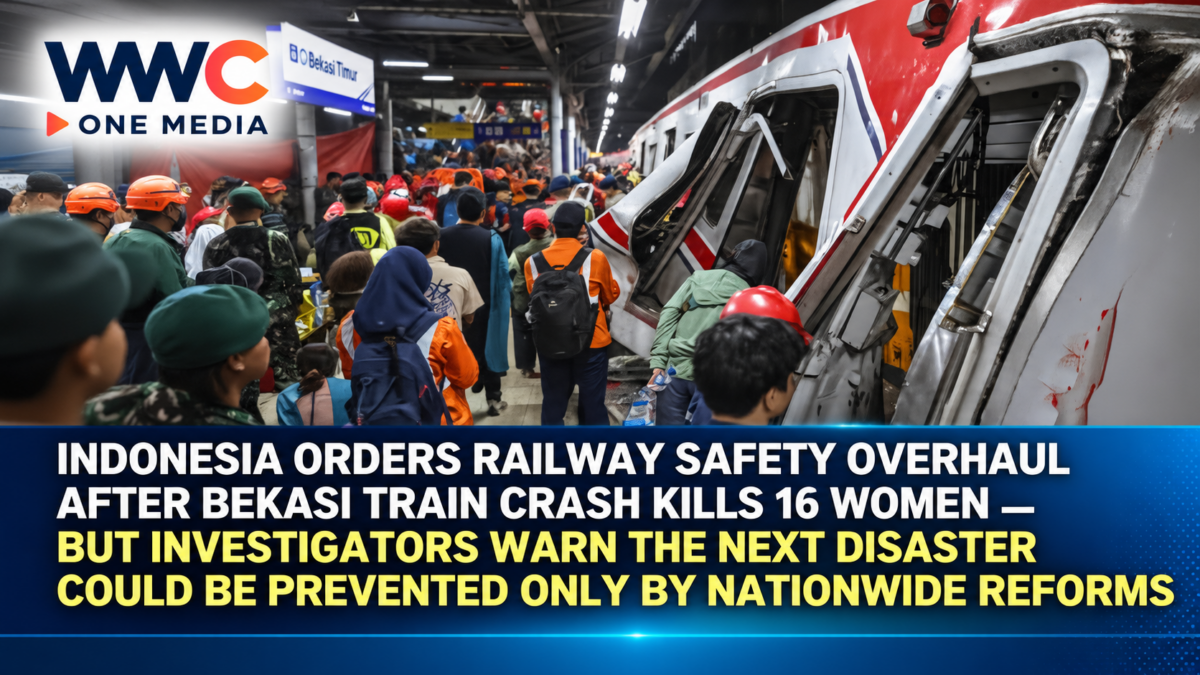
JAKARTA, INDONESIA — Indonesia is accelerating railway safety reforms following a devastating train collision in Bekasi that killed 16 women and injured 107 people, after investigators uncovered serious failures involving emergency communication, railway signals and operating procedures. Although authorities have begun installing safety barriers and improving infrastructure near the crash site, transportation experts warn that similar weaknesses exist throughout Indonesia’s rail network — raising fears that another deadly accident could occur unless nationwide reforms are implemented.
Indonesia’s railway industry is confronting a major safety challenge nearly six months after one of the country’s deadliest train accidents of 2026 exposed weaknesses in railway operations.
The April 27 disaster at East Bekasi Station, approximately 17 kilometers east of Jakarta, involved a chain of events that began with a stalled electric taxi and ended with a long-distance express train crashing into a stationary commuter train.
All 16 people killed were women traveling in the rear women-only carriage of the commuter train.
According to an October 11 investigation published by Channel NewsAsia (CNA), Indonesia has begun addressing some of the problems identified in the crash investigation, including railway signal visibility, unsafe crossings and emergency communication procedures.
However, transportation specialists argue that measures concentrated around Bekasi are insufficient.
They want comprehensive national reforms to improve railway safety and prevent similar disasters elsewhere.
The warning follows the release of a 141-page investigation by Indonesia’s National Transportation Safety Committee, or KNKT, which identified multiple contributing factors and issued 17 safety recommendations.
For millions of Indonesians who rely on trains for transportation, the central question is whether the government can implement these reforms before another serious accident occurs.
How a Stalled Electric Taxi Triggered a Deadly Train Collision
The sequence began on April 27, when an electric taxi stalled at an unmanned railway crossing near East Bekasi Station.
A commuter train traveling west struck the vehicle.
The incident prompted concerns along the railway line as people gathered near the tracks and railway staff attempted to respond.
A second commuter train traveling in the opposite direction was instructed to remain at East Bekasi Station.
But a third train, the Argo Bromo Anggrek express service traveling from Jakarta toward Surabaya, was approaching the station.
The express train subsequently collided with the rear of the stationary commuter train.
Its impact crushed the packed women-only carriage.
Investigators determined that the entire chain of events, from the initial taxi collision to the fatal train crash, unfolded in just three minutes and 48 seconds.
The extraordinary speed of the sequence left railway personnel with little time to coordinate an effective emergency response.
The disaster also demonstrated how an incident at an inadequately protected crossing could escalate into a much larger railway catastrophe.
Investigators Find Critical Communication Failures
One of the most disturbing findings involved the breakdown in communication between train personnel and railway traffic controllers.
According to the KNKT investigation released on September 29, the driver of the commuter train involved in the initial taxi collision did not communicate the emergency clearly enough for controllers to respond immediately.
The southern railway traffic controller required approximately three minutes and 20 seconds to understand the situation fully and activate the appropriate emergency response.
By then, the approaching express train had less than 30 seconds to react.
That communication delay became a crucial factor in the disaster.
Investigators also identified weaknesses in timetable management and the absence of sufficiently clear standard operating procedures for reporting and responding to emergencies.
These findings suggest the crash cannot be explained by one mistake alone.
The disaster involved a series of failures that compounded one another during a rapidly unfolding emergency.
For railway safety specialists, the lesson is that critical information must reach train drivers and traffic controllers quickly, clearly and consistently.
Express Train Was Traveling at More Than 100 Kilometers Per Hour
The KNKT investigation reconstructed the express train’s approach to East Bekasi Station.
The train had been traveling at more than 100 kilometers per hour before the driver encountered a red signal directing him to stop.
The signal was approximately 500 meters from the station.
However, it was positioned near a curve, limiting the driver’s ability to assess the situation.
The driver reduced the train’s speed to approximately 78 kilometers per hour before applying the emergency brakes around 275 meters from the station.
Despite those efforts, the express train was still moving at approximately 40 kilometers per hour when it struck the stationary commuter train.
Investigators concluded that the train would have required an additional 500 to 550 meters to stop completely.
The findings highlight how braking distance, track curvature, signal visibility and emergency communication can interact during dangerous situations.
They also raise questions about whether existing operating procedures adequately prepare train crews for emergencies on curved railway tracks.
Railway Signals Were Obscured by Nearby Lights
Another important finding concerns the physical environment surrounding the railway.
According to CNA’s investigation, bright lights from nearby businesses, street lamps and a local scrapyard interfered with the visibility of railway signals.
The affected area includes a working-class neighborhood near East Bekasi Station known as Gang Delima.
At night, lights from surrounding buildings could make it more difficult for train drivers to distinguish railway signals.
Investigators also found that scratches and cracks on the express train’s windscreen further reduced visibility.
The combination of environmental lighting and equipment conditions created additional safety concerns.
Authorities have since taken steps to address the problem.
Some nearby lights have been removed, redirected or fitted with shades.
Residents and businesses have also been instructed not to install red, green or orange lights that might be confused with official railway signals.
Officials are considering additional barriers to reduce interference from surrounding commercial activity.
These measures demonstrate that improving railway safety sometimes requires changes outside railway property itself.
Indonesia Issues 17 Recommendations to Prevent Another Disaster
The KNKT investigation produced 17 recommendations aimed at addressing weaknesses identified in the April collision.
Six recommendations were directed to state-owned railway operator Kereta Api Indonesia, commonly known as KAI.
Three were directed to its commuter rail subsidiary, Kereta Commuter Indonesia.
The remaining eight were issued to Indonesia’s Ministry of Transportation.
The recommendations include improvements to communication protocols, staff training, railway infrastructure, signaling arrangements and emergency procedures.
Investigators also highlighted the need to review procedures for emergency braking on curved tracks.
For railway operators, clearer instructions could help staff respond more effectively when unexpected incidents occur.
For regulators, the recommendations emphasize the importance of ensuring that operating systems and infrastructure meet appropriate safety requirements.
However, implementing 17 recommendations at the affected location does not automatically address comparable risks across the rest of the country.
That distinction is becoming central to the national debate over railway safety.
KAI Begins Safety Improvements Following KNKT Investigation
State-owned railway operator KAI has pledged to cooperate with investigators and implement the recommendations.
In an official statement dated September 30, KAI said it had already introduced precautionary measures while the investigation was underway.
These included additional operational restrictions in the Bekasi area, coordination over level-crossing safety and cooperation with the Ministry of Transportation’s Directorate General of Railways.
KAI also confirmed that it would review the findings to identify improvements capable of preventing similar incidents.
On October 3, KAI president director Bobby Rasyidin said the company was prioritizing recommendations that could be implemented immediately while accelerating those requiring more detailed planning.
Transportation Minister Dudy Purwagandhi also pledged to ensure the recommendations would be implemented.
The commitments indicate that Indonesian authorities and railway operators recognize the seriousness of the findings.
However, the ultimate effectiveness of the reforms will depend on implementation, enforcement and continued monitoring.
Dangerous Level Crossing Now Has Barriers and Warning Systems
One of the most visible changes has taken place near the crossing where the stalled taxi was initially struck.
Previously, the crossing had no railway barriers.
According to CNA, authorities have now installed protective barriers, warning lights and bells to alert motorists and pedestrians when trains are approaching.
The changes are intended to prevent vehicles from entering the tracks when railway traffic is approaching.
The installation is a significant improvement at the specific location.
However, experts argue that similar protection is needed at other risky crossings across Indonesia.
A single upgraded crossing cannot eliminate the dangers associated with thousands of locations where road vehicles and trains interact.
The challenge for authorities is deciding how quickly additional crossings can be upgraded, closed or replaced with safer arrangements.
Experts Warn Indonesia Has About 3,800 Railway Level Crossings
Transportation specialists are calling for a much broader response.
CNA reported that Indonesia has approximately 3,800 level crossings, with local studies linking such crossings to around 300 accidents annually.
Experts have advocated closing unsafe crossings and reducing conflicts between trains and road vehicles.
They also recommend improving the consistency of railway signals and introducing modern train protection technologies.
These include systems capable of automatically applying emergency brakes when a train approaches a dangerous situation.
Such technologies can provide an additional layer of protection when drivers receive warnings too late or fail to respond appropriately.
However, the installation of advanced systems requires substantial investment, technical planning and compatibility with existing railway infrastructure.
Authorities must also evaluate the needs of local communities that depend on crossing points for access to roads, homes and businesses.
The broader objective is to minimize opportunities for dangerous interactions between rail traffic and other vehicles.
Railway Experts Demand a Nationwide Safety Audit
Several Indonesian transportation specialists believe that the problems exposed in Bekasi may exist in other parts of the railway network.
Yusa Permana, a transportation planning and policy expert, told CNA that safety weaknesses identified in the crash investigation should be examined nationally.
He warned that Indonesia’s railway signaling systems use technologies supplied by different manufacturers and countries.
This mixture can complicate railway operations if systems are not properly integrated, maintained and managed.
Experts have called for greater standardization to reduce the possibility of operational problems.
Djoko Setijowarno, a transportation specialist from Soegijapranata Catholic University, also urged the government to conduct a nationwide railway safety audit.
He argued that recommendations following major accidents have historically been implemented unevenly or concentrated near the affected areas.
Without sustained national improvements, similar weaknesses may remain unresolved elsewhere.
The experts’ warning highlights a central concern: railway safety reforms should not depend solely on where the most recent tragedy occurred.
Train Driver Faces Up to 12 Years in Prison
The investigation has also triggered a controversial criminal case.
Jakarta police identified the 37-year-old express train driver, referred to by the initials AN, as a suspect.
Police allege that he could have applied the emergency brakes earlier.
If convicted, he faces a possible prison sentence of up to 12 years.
However, transportation experts and lawmakers have questioned whether it is appropriate to concentrate responsibility on the driver when the KNKT investigation identified multiple systemic failures.
They argue that inadequate emergency communications, signal visibility problems and insufficient operating procedures must also be considered.
The driver has not been detained, according to CNA’s October 11 report.
KAI has said it will provide legal assistance to the employee while cooperating with the investigation.
The electric taxi driver involved in the original level-crossing incident was also named a suspect on a separate negligence allegation.
Both cases remain subject to the legal process.
Being named a suspect does not establish criminal guilt.
The disagreement reflects a broader challenge facing transportation investigations: determining individual accountability without overlooking failures in the systems responsible for passenger safety.
Associated Press and Reuters Document the Scale of the Tragedy
International reporting from Associated Press and Reuters documented the emergency response following the April 27 collision.
Initial reports confirmed at least four deaths and dozens of injuries while rescue operations were still underway.
Associated Press later reported that rescue teams recovered victims trapped in the severely damaged commuter carriage.
The final KNKT findings, as subsequently reported by CNA, recorded 16 deaths and 107 injuries.
The differences in early and later casualty figures reflect updates as rescue and investigative work progressed.
According to the early reports, all 240 passengers aboard the long-distance train survived.
The women-only carriage at the rear of the commuter train sustained the most devastating damage.
The tragedy highlighted the vulnerability of passengers when a moving train collides with a stationary train in a heavily used railway corridor.
It also reinforced the importance of reliable warning systems and emergency coordination.
Why the Bekasi Disaster Matters Beyond Indonesia
The safety issues identified in Bekasi carry lessons for railway operators across Southeast Asia.
Countries in the region are expanding rail networks to improve urban mobility, reduce road congestion and support economic growth.
But investment in new trains and railway infrastructure must be accompanied by dependable safety systems.
The Bekasi investigation demonstrates how communication delays, incomplete operating procedures and environmental conditions can combine to create a catastrophic outcome.
For the Philippines, the lessons are relevant to ongoing railway modernization and expansion.
Railway operators and regulators must ensure that signaling systems, track conditions, crossing protection, staff training and emergency-response procedures receive sustained attention.
However, the Indonesian findings do not establish that Philippine railway networks have the same defects.
Any assessment of local safety must rely on inspections, technical evaluations and evidence relating to specific Philippine systems.
The broader lesson is that railway safety depends on continuous oversight rather than improvements made only after serious accidents.
The Bigger Picture: Indonesia Must Turn Tragedy Into Lasting Reform
Nearly six months after the Bekasi collision, Indonesia has begun implementing safety improvements around the crash site.
Street lighting has been modified, signals are receiving closer scrutiny and the previously unmanned level crossing now has protective barriers and warnings.
KAI and the Ministry of Transportation have pledged to act on KNKT’s 17 recommendations.
But experts argue that these changes are only the beginning.
Thousands of level crossings, differing signal technologies and the need for stronger operational procedures remain major national challenges.
The consequences of incomplete reform could be severe.
An emergency involving one stalled vehicle should not be allowed to escalate into a collision that costs multiple lives.
The KNKT investigation has provided authorities with a clearer understanding of the failures that contributed to the April tragedy.
The next challenge is ensuring that the lessons are applied consistently.
Indonesia’s deadly Bekasi train crash claimed 16 women’s lives and exposed serious failures in railway communication, signaling and emergency preparedness.
But the bigger question is whether authorities will address those weaknesses across the country’s rail network — or limit improvements to the site of the latest tragedy.
For millions of railway passengers, the difference could ultimately determine whether Indonesia prevents its next major train disaster before it happens.