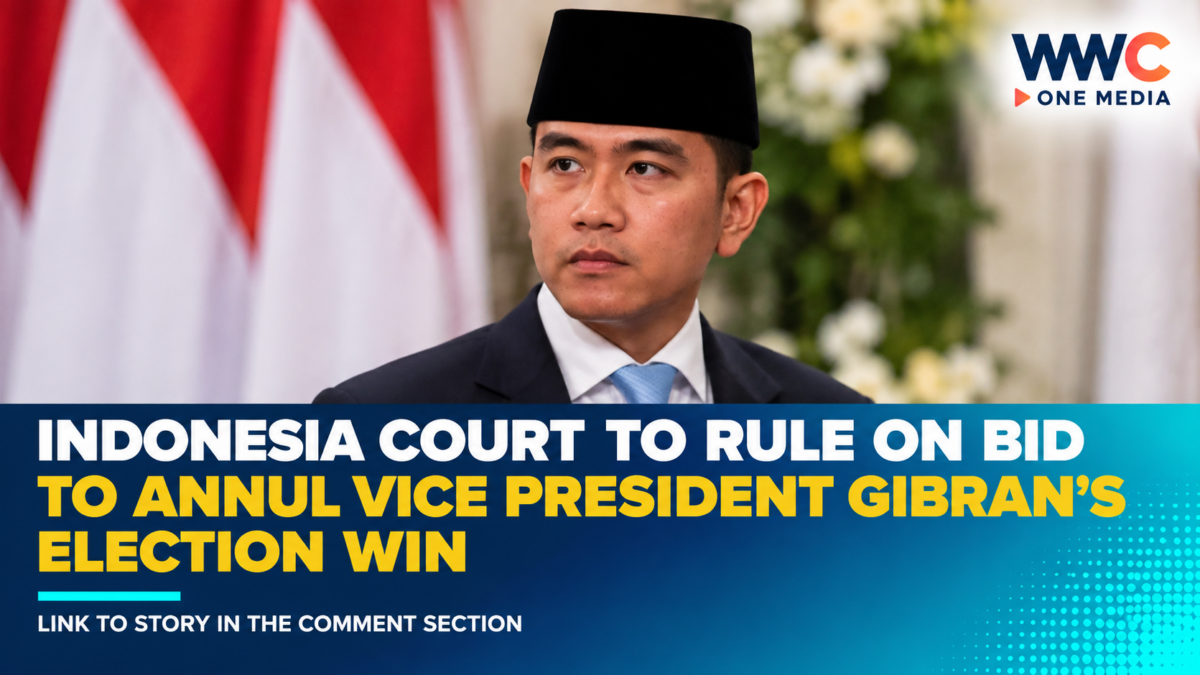
Indonesia’s Constitutional Court is set to rule on Tuesday (Oct 6) on a petition seeking to annul Vice President Gibran Rakabuming Raka’s 2024 election victory, with the case centred on allegations that his overseas education credentials did not meet the country’s eligibility requirements.
A ruling against Gibran could remove him from office and create fresh political uncertainty for President Prabowo Subianto’s administration.
The nine-judge Constitutional Court is scheduled to deliver its decision at 8pm local time in Jakarta in a case filed by 12 petitioners, including former deputy law minister Denny Indrayana.
Challenge Centres on Gibran’s Education
The petition argues that Gibran did not adequately meet the educational requirements for a presidential or vice-presidential candidate under Indonesian election law.
Indonesian law requires presidential and vice-presidential candidates to have completed senior high school or an equivalent level of education.
The petitioners contend that Gibran’s overseas education credentials did not satisfy that requirement and that election authorities improperly accepted government-issued equivalency documents when approving his candidacy.
The case has focused particularly on whether Gibran’s education abroad can legally be treated as equivalent to the required Indonesian qualification.
Gibran Studied in Singapore and Australia
Gibran, 39, attended Orchid Park Secondary School in Singapore before continuing his studies at UTS Insearch in Australia.
He later obtained a bachelor’s degree through the Management Development Institute of Singapore, or MDIS.
The Indonesian Education Ministry has defended its assessment of his educational background. During a hearing on Oct 2, ministry official Taufiq Damarjati said the equivalency assessment was based on Gibran’s overall academic history.
However, he acknowledged that no diploma had been submitted during the application process, according to court records cited by Reuters.
The dispute therefore goes beyond whether Gibran attended schools overseas. At issue is whether the documents and government equivalency assessment used during the 2024 election process were legally sufficient to establish that he met the required educational standard.
Petition Seeks to Undo Gibran’s Vice Presidency
The petitioners are asking the Constitutional Court to declare Gibran’s candidacy legally defective and invalidate the election authorities’ decision recognising him as a vice-presidential candidate.
They have also asked the court to cancel his inauguration and order Indonesia’s People’s Consultative Assembly to hold a process to select a replacement vice president if the challenge succeeds.
The case was filed under case number 01/PHPU.PRES-XXIV/2026.
Court proceedings began in September and included testimony from election officials, legal experts, witnesses and representatives from Indonesia’s education ministry, as well as education officials from Indonesian diplomatic missions in Singapore and Australia.
Court Has Heard Arguments From Both Sides
Indonesia’s General Elections Commission, or KPU, has challenged the petitioners’ attempt to reopen the issue.
During a September hearing, the KPU argued that the case concerns the election process rather than a dispute over the election result, raising questions about whether the Constitutional Court has jurisdiction to examine it.
The court has nevertheless proceeded with hearings and examined evidence relating to Gibran’s educational qualifications.
A former KPU chairman, Hasyim Asy’ari, also rejected allegations that there had been an administrative defect or manipulation in the rules governing proof of education for candidates who studied at foreign schools.
He said the relevant election regulation was developed following input from the Education Ministry and was not created specifically to benefit Gibran.
Gibran’s Candidacy Has Been Controversial
The latest legal challenge adds to the controversy surrounding Gibran’s path to the vice presidency.
In 2023, the Constitutional Court issued a controversial ruling that effectively created an exception to the minimum age requirement for presidential and vice-presidential candidates, allowing Gibran to run despite being below the previously stipulated threshold.
Gibran is the eldest son of former president Joko Widodo, who backed Prabowo during the 2024 presidential campaign.
The 2023 decision sparked protests and criticism from activists, students and legal scholars, who accused the court of paving the way for Widodo’s son to join the presidential ticket.
Gibran and Prabowo subsequently won the 2024 election and took office as president and vice president.
Potential Political Impact
A decision against Gibran could have significant consequences for Prabowo’s administration.
Prabowo became Indonesia’s eighth president after defeating his rivals in the 2024 election, with Gibran serving as his running mate.
The vice president’s position is less powerful than the presidency under Indonesia’s political system, but removing Gibran after he has already taken office would create an unusual constitutional and political situation.
The petitioners have specifically asked for a mechanism that would allow a new vice president to be selected if Gibran’s position is invalidated.
The case also comes as relations between Prabowo and Widodo have attracted increasing attention.
Prabowo has replaced several senior officials in recent months, including the national police chief and the coordinating minister for human development and culture. Local reports have viewed some of these changes as signs of tensions between Prabowo and Widodo, although the political significance of the appointments remains disputed.
Decision Expected Tuesday Night
The Constitutional Court has scheduled the reading of its decision for 8pm on Oct 6.
The ruling will determine whether the petition succeeds in challenging Gibran’s eligibility and election victory, or whether his position as vice president remains legally intact.
Regardless of the outcome, the case has renewed scrutiny of the rules governing political eligibility in Indonesia and the role of the courts in determining whether candidates meet those requirements.
For now, Gibran remains Indonesia’s vice president, and the allegations concerning his educational qualifications remain matters before the court rather than established findings of wrongdoing.