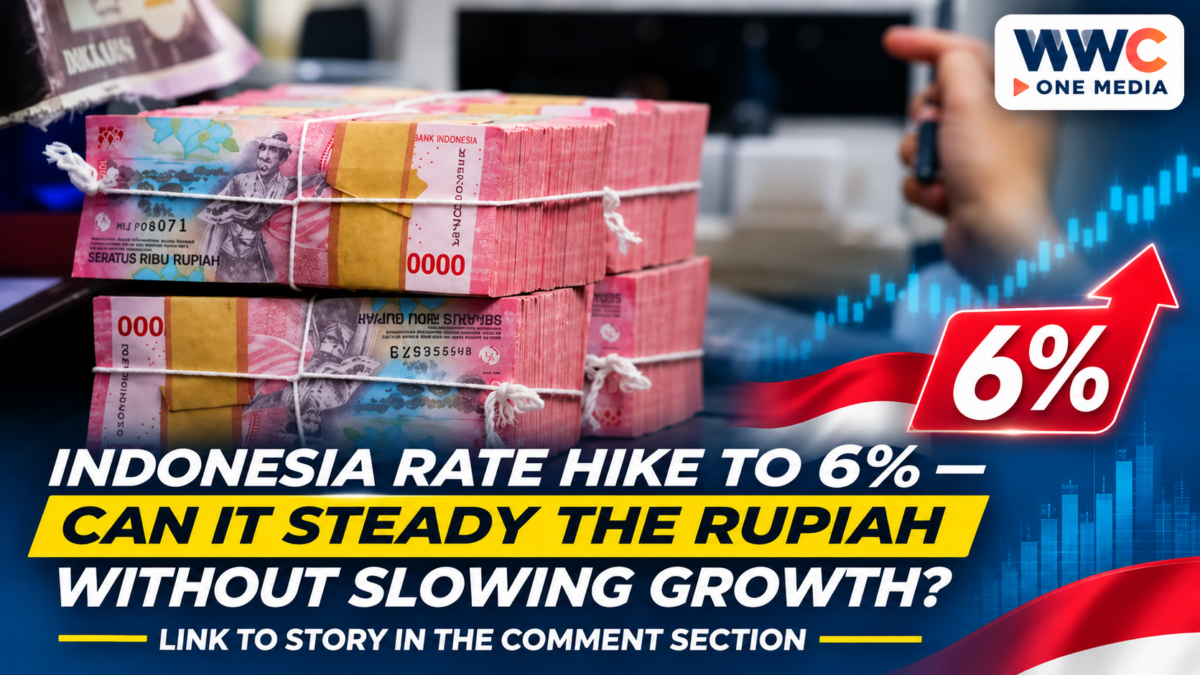
Indonesia’s central bank raised its benchmark interest rate by 25 basis points to 6.00% on Nov. 18, 2026, after another period of pressure on the rupiah. Bank Indonesia also increased its Deposit Facility and Lending Facility rates, describing the decision as a move to reinforce currency stability and keep inflation within its target range.
The Indonesia rate hike creates a balancing test for Southeast Asia’s largest economy. A more attractive return on rupiah assets could support confidence in the currency, but tighter borrowing conditions can also affect households and businesses even while economic growth remains positive.
Indonesia rate hike: what changed on Nov. 18?
The board meeting held on Nov. 17–18 increased the BI-Rate from 5.75% to 6.00%. The Deposit Facility rate rose by the same 25 basis points to 5.25%, while the Lending Facility rate increased to 6.75%.
These are separate instruments. The benchmark rate signals monetary-policy direction, while the facility rates help shape the terms under which banks place or obtain liquidity from the central bank. None of the three figures is an automatic interest rate paid by every borrower.
The latest step follows the October meeting, when Bank Indonesia held its main rate at 5.75%. Its official rate-history table confirms the November increase, making the change measurable rather than a market forecast.
Why it matters: Bank Indonesia is prioritising stability without describing its broader policy programme as uniformly restrictive. It continues to deploy measures intended to support bank lending and payment services alongside its higher benchmark rate.
Rupiah weakness explains the immediate concern
The central bank reported the rupiah at Rp18,245 per US dollar on Nov. 17, a depreciation of 0.66% against the end-October level. It attributed the pressure to global uncertainty and continued foreign-investor sentiment affecting Indonesian equities.
A weaker rupiah can raise local-currency costs for businesses importing dollar-priced goods or servicing unhedged dollar liabilities. Exporters earning foreign currency may experience different effects. Actual outcomes depend on contracts, input costs and whether firms have hedged exchange-rate exposure.
WWC’s previous report on rupiah pressure and investor concerns provides context for why the currency had already become a policy issue. The Nov. 18 announcement adds an actual central-bank decision; it does not establish that the exchange rate has permanently stabilised.
Analysis: A rate increase may improve the relative appeal of rupiah-denominated assets, but global dollar strength and capital flows can offset that effect. A policy announcement is not a guarantee of a particular exchange-rate level.
Inflation is within target, but risks remain
Indonesia’s annual consumer-price inflation eased to 3.23% in October from 3.28% in September. Core inflation declined to 2.56%, while volatile-food inflation increased to 5.81% in the central bank’s November assessment.
Bank Indonesia’s stated inflation target for 2026 and 2027 is 2.5% plus or minus one percentage point. October headline inflation was therefore inside the target band, not above it. The bank described its increase as a pre-emptive response intended to maintain that position as external risks continued.
Food-price pressures illustrate why a single inflation number does not tell the whole story. Weather-related disruption to production in certain regions was among the factors the central bank identified in discussing volatile food prices.
A higher interest rate cannot directly produce crops or remove a supply disruption. It can influence spending, financing conditions and the exchange rate, which are different channels through which inflation may develop.
Economic growth makes the decision harder
Bank Indonesia recorded third-quarter economic growth of 5.47% year on year, up from 5.29% in the preceding quarter. It forecast full-year 2026 growth within a 4.9%–5.7% range, citing consumption, investment and government stimulus as supports.
Bank credit increased 13.21% year on year in October, with investment, working-capital and consumption loans growing at different rates. That matters because higher policy rates can eventually influence credit demand, although bank loan pricing does not change one-for-one or immediately after each decision.
The central bank paired its interest-rate move with measures supporting liquidity. It outlined a new financing-channel incentive of up to 3% of eligible third-party funds for priority lending, scheduled to take effect on Dec. 1, 2026.
Analysis: The policy combination suggests an effort to manage foreign-exchange pressure without indiscriminately cutting off productive borrowing. Whether it succeeds will depend on bank behaviour, borrower demand and external financial conditions—not simply the announced benchmark rate.
What bond investors and regional businesses should watch
Interest-rate changes influence the yields investors seek, but bond prices also reflect fiscal developments, inflation expectations and changes in global yields. Indonesia’s sovereign financing outlook cannot be inferred from one policy decision.
WWC previously examined Indonesian government-bond yields and foreign investor interest. The new rate rise adds another variable to that analysis, but it does not establish an immediate gain or loss for every bondholder.
The central bank recorded US$4.80 billion in net portfolio inflows during the fourth quarter through Nov. 16, supported by government international bond issuance and domestic government securities. That aggregate figure coexisted with US$0.9 billion in equity outflows over the same period, illustrating why investors should distinguish stocks, bonds and total flows.
Indonesia’s plans to seek financing in China’s bond market also illustrate how currency denomination and investor demand can affect funding choices. Different financing instruments expose borrowers to different exchange-rate and refinancing risks.
For Philippine companies with Indonesian suppliers or customers, the practical effect depends on invoice currency and financing arrangements. The decision does not establish an automatic change in Philippine borrowing rates or the peso’s value.
What happens next
The next evidence will come from Bank Indonesia’s subsequent policy statements, official rupiah quotations, inflation reports and banking data. The bank has also outlined further liquidity and payment-system steps scheduled for December, showing that the November rate decision is part of a wider policy package.
As of Nov. 18, the confirmed result is a 25-basis-point increase to 6.00%. Whether that is sufficient to sustain currency stability without imposing excessive costs on growth remains a question for future data—not an outcome already demonstrated.
FAQ
What is Indonesia’s interest rate after the November 2026 decision?
Bank Indonesia increased its BI-Rate to 6.00% on Nov. 18, from 5.75% in October.
Why did Bank Indonesia raise interest rates?
The official announcement identifies support for rupiah exchange-rate stability and a pre-emptive effort to keep inflation within the 2026–2027 target band.
What was the rupiah exchange rate before the decision?
Bank Indonesia reported Rp18,245 per US dollar on Nov. 17. That is the central bank’s stated reference for its assessment, not a guaranteed retail exchange rate.
Does the rate increase mean Indonesia’s inflation is above target?
No. October annual inflation was 3.23%, within the central bank’s 1.5%–3.5% target range. The bank cited risks to continued stability.