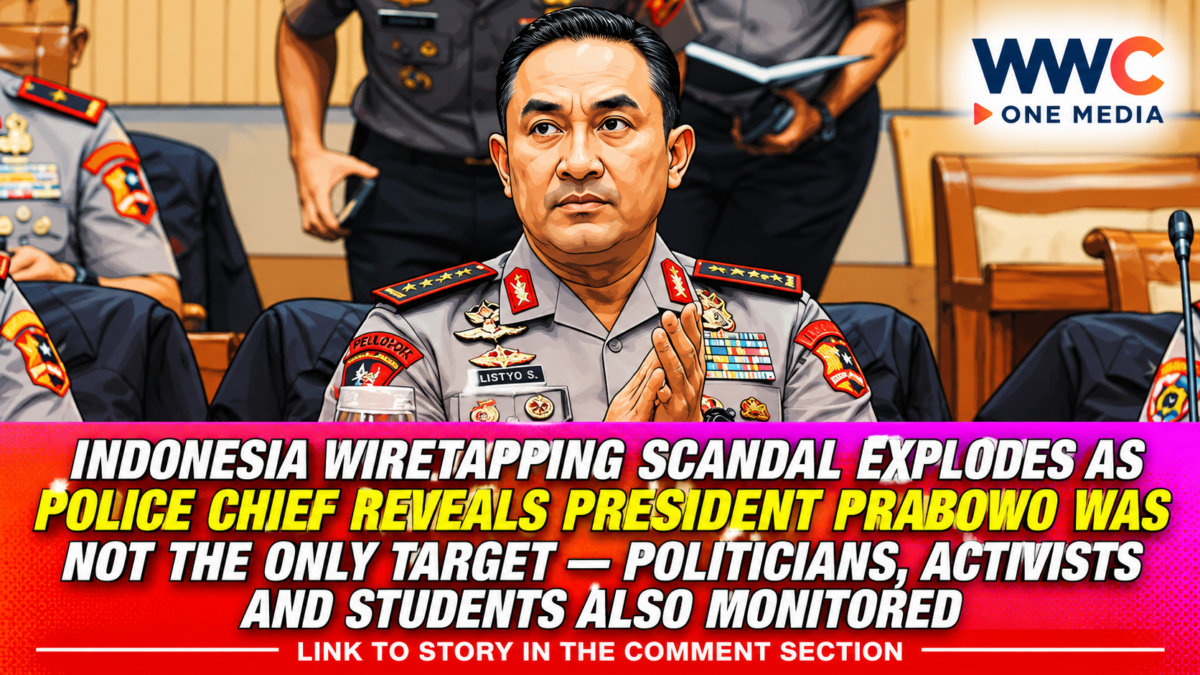
Indonesia’s growing illegal wiretapping scandal has taken a dramatic turn after the country’s police chief revealed that an alleged surveillance operation targeting President Prabowo Subianto also extended to government officials, lawmakers, governors, political figures, journalists, anti-corruption personnel, activists and students.
The disclosure has intensified pressure on Indonesia’s security establishment, with investigators now examining an alleged surveillance network involving four senior police officials, including former National Police chief General Listyo Sigit Prabowo.
National Police Chief General Suyudi Ario Seto made the revelations during a parliamentary hearing on November 12, as lawmakers demanded answers about who authorised the alleged monitoring, why the targets were selected and whether additional people were involved.
The controversy has become one of the most serious political and security scandals confronting Prabowo’s administration since he took office.
What makes the case particularly alarming is that the alleged surveillance was not limited to the president. According to the police chief, the operation involved a much wider range of people across Indonesia’s government, political institutions and civil society.
However, Seto stressed that appearing on a surveillance target list does not mean an individual is suspected of committing a crime.
Police Chief Reveals the Expanding List of Alleged Surveillance Targets
During his appearance before the Indonesian House of Representatives’ Commission III, which oversees legal and security matters, Seto outlined the reported scope of the alleged wiretapping operation.
The people whose telephone communications were allegedly monitored included:
- President Prabowo Subianto.
- Officials working within the presidential palace.
- Government ministers and personnel from state institutions.
- Members of parliament and political party figures.
- Provincial governors.
- Anti-corruption officials.
- Journalists and media figures.
- Activists and representatives of civil society organisations.
- University students.
- Businesspeople and community leaders.
The expanded list has raised serious concerns about whether police surveillance capabilities were allegedly used beyond their legitimate law-enforcement purposes.
Seto made an important distinction during the hearing: being identified as a surveillance target does not automatically make someone a suspect or establish that the person was involved in wrongdoing.
The investigation must still determine why the individuals were selected, what information was collected and how the intercepted communications were used.
For lawmakers, however, the revelation raises a much bigger question: How could an alleged surveillance operation involving the country’s president and so many influential figures have continued without proper authorisation?
Former Police Chief Listyo Sigit Allegedly Ordered the Surveillance
One of the most significant developments emerged from Seto’s explanation of the alleged roles played by the four suspects.
According to reporting by The Jakarta Post, the police chief told lawmakers that former National Police chief General Listyo Sigit Prabowo was allegedly the ultimate recipient, or end user, of the intercepted communications.
Seto alleged that Listyo selected surveillance targets and instructed three other senior officers to carry out the monitoring and report their findings to him.
The three other officials identified in the investigation are:
- General Ahrie Sonta Nasution, head of the National Police Legal Division.
- Inspector General Eko Hadi Santoso, a senior police officer associated with the National Police Education and Training Institute.
- Inspector General Slamet Uliandi, a former senior police technology and monitoring official.
Investigators are also examining allegations that Ahrie played a role in concealing the operation by removing electronic records and traces from the surveillance system.
These are allegations presented by investigators and reported during the parliamentary proceedings. They have not yet been established through final court judgments.
The development is particularly significant because Listyo previously led the National Police, one of Indonesia’s most powerful law-enforcement institutions.
How the Alleged Wiretapping Operation Was Carried Out
Investigators suspect that the operation exploited the National Police’s Lawful Interception Management System, known as LIMS.
The system is designed to facilitate authorised interception of communications as part of legitimate law-enforcement investigations.
Such surveillance is subject to procedures intended to prevent arbitrary monitoring and protect people’s privacy.
However, police allege that telephone numbers were entered into the system without the required verification and without being connected to legitimate criminal investigations.
The alleged activity reportedly occurred between 2025 and 2026, when Listyo was still serving as National Police chief.
Investigators are examining whether the system was improperly used to collect private communications belonging to the president and other individuals.
The case became public after officers reportedly discovered suspicious activity and raised concerns on October 30.
Police subsequently detained senior officials and began examining the electronic records associated with the alleged operation.
The case has exposed serious questions about the effectiveness of internal oversight within Indonesia’s police force.
Police Allege Intercepted Records Were Deleted to Conceal Evidence
Another disturbing element involves the alleged deletion of electronic records.
Investigators previously said that some files containing intercepted communications were removed from the LIMS system in October 2026.
According to police, the deletion was allegedly intended to conceal evidence and erase traces of the surveillance operation.
Authorities have also described allegations that Ahrie requested the deletion of records and that Slamet Uliandi approved the request.
The alleged destruction of electronic information is now a separate part of the investigation.
When the case was first announced, police said they had seized:
- 11 mobile phones.
- One iPad.
- Four USB flash drives.
These devices are being examined for information that could help investigators reconstruct communications, identify instructions and establish the extent of the alleged operation.
The investigation has since expanded. Reuters reported on November 12 that authorities had questioned 38 witnesses, including telecommunications workers and a vendor connected to the surveillance system.
The additional witness interviews suggest that investigators are examining not only the officers allegedly involved but also the technical and operational arrangements that may have enabled the monitoring.
Four Senior Police Officials Now Face a More Serious Investigation
The case initially involved three detained police officials, but investigators subsequently identified a fourth suspect.
The fourth official, Slamet Uliandi, was initially questioned in connection with the investigation before being named as a suspect.
The four individuals are now facing scrutiny over alleged unlawful interception, unauthorised access to electronic systems and the handling or deletion of electronic information.
The latest development is particularly significant because police have moved beyond the initial focus on illegal wiretapping.
Reuters reported on November 12 that investigators said they had sufficient preliminary evidence to pursue treason-related charges against the four suspects.
The Jakarta Post also reported that police had formally expanded the investigation to include allegations of treason.
This represents a major escalation from the initial criminal investigation.
However, the authorities still need to establish the necessary evidence to support those allegations in court. The suspects have not been convicted, and the legal process remains ongoing.
Treason Charges Could Carry the Death Penalty
The possibility of treason charges has raised the stakes considerably.
Reuters reported that treason under Indonesian law can carry the death penalty.
However, this does not mean the four suspects have been sentenced to death or that such a punishment has been established as the likely outcome.
Investigators must prove the relevant elements of the alleged offences, and courts must determine whether the evidence supports criminal liability.
Earlier in the investigation, Coordinating Minister for Law, Human Rights, Immigration and Corrections Yusril Ihza Mahendra said authorities had not found an indication of treason.
The latest statements from police indicate that the investigation has developed and that officials now believe there is preliminary evidence to pursue the more serious legal avenue.
The distinction between preliminary evidence, formal charges and a final conviction is important.
Indonesia’s authorities must establish what happened, who authorised the operation and whether the alleged surveillance was connected to conduct that meets the legal definition of treason.
Why Listyo’s Position Makes the Scandal Even More Explosive
Listyo’s involvement is especially sensitive because of his previous position and his close political connections.
He served as National Police chief from 2021 until October 2026, having originally been appointed by former President Joko Widodo.
During his tenure, he led the police force through both the Widodo and Prabowo administrations.
On October 1, 2026, Prabowo removed Listyo from the police chief position during a government reshuffle and appointed him as presidential chief of staff.
That appointment placed Listyo in a senior position within the president’s own administration.
His subsequent detention in the wiretapping investigation has therefore created an extraordinary situation: a former police chief who had recently been entrusted with a senior presidential role is now accused of being a central figure in an alleged operation targeting the president and other prominent people.
The development has also intensified questions about the administration’s internal security arrangements.
It is important to note that the shared surname does not mean Listyo is related to President Prabowo.
The Scandal Is Deepening Tensions Between Prabowo and Former President Jokowi
The investigation has also revived political tensions between Prabowo and former president Joko Widodo, popularly known as Jokowi.
Listyo was appointed police chief during Jokowi’s presidency and has long been viewed by political observers as an ally of the former president.
His alleged involvement has therefore become politically sensitive, particularly because Prabowo and Jokowi previously formed an influential political alliance.
Jokowi supported Prabowo during the 2024 presidential election, while his son, Gibran Rakabuming Raka, became vice-president.
However, analysts have increasingly questioned the durability of the political relationship between the two camps.
The Lowy Institute has described the wiretapping case as a development that could intensify the rivalry between Prabowo and the Widodo political network.
The Financial Times has also reported on the growing political confrontation surrounding the scandal.
Nevertheless, there is no established evidence that Jokowi ordered, approved or knew about the alleged surveillance operation.
Political connections and past appointments should not be treated as proof of criminal involvement.
The investigation must establish individual responsibility based on evidence.
Parliament Demands Answers About Who Ordered and Funded the Operation
The parliamentary hearing has become an important part of the effort to uncover the full extent of the alleged surveillance.
Commission III lawmakers want investigators to identify the people who authorised the operation, determine who financed it and establish whether the four suspects acted independently or on behalf of someone else.
Some lawmakers have also raised concerns that their own telephone communications may have been monitored.
Their questions reflect a wider fear that the alleged misuse of surveillance systems could extend beyond the individuals already identified.
Commission III chairman Habiburokhman has said the parliamentary inquiry will continue until the facts are established and anyone found responsible is held accountable.
The hearing also places pressure on the police leadership because Seto is now overseeing an investigation involving his predecessor and other senior figures within the institution.
His challenge is to demonstrate that the investigation will proceed independently and that no official will be protected because of rank or political connections.
Why Journalists, Activists and Students Are Particularly Concerned
The inclusion of journalists, activists and students among the alleged surveillance targets has raised concerns about privacy and civil liberties.
Journalists frequently communicate with confidential sources who provide information about government decisions, corruption, public spending and other sensitive matters.
If those communications were unlawfully intercepted, it could undermine the confidentiality needed for independent reporting.
Activists and nongovernmental organisations also rely on private communications to coordinate advocacy work, organise public activities and raise concerns about government policies.
Students may be particularly vulnerable when their communications are monitored without a legitimate legal basis.
Amnesty International has called for a comprehensive investigation, warning that unlawful surveillance could be used to intimidate critics and undermine civil liberties.
However, authorities have not publicly established that every person on the alleged target list was successfully monitored or that all intercepted information was used for political purposes.
The full scope of the operation remains under investigation.
Indonesia’s Surveillance System Faces a Major Credibility Test
The scandal has raised questions about how Indonesia controls its lawful interception infrastructure.
Electronic surveillance can be a legitimate tool for investigating organised crime, terrorism, corruption and other serious offences.
But such powers require clear authorisation procedures, independent oversight and reliable records of every operation.
If investigators establish that senior officers used the system without proper approval, the case could expose weaknesses in the safeguards designed to prevent abuse.
The government may also face pressure to strengthen the rules governing access to surveillance equipment, digital records and telecommunications data.
The alleged deletion of interception records makes the issue especially important.
An effective oversight system must ensure that sensitive records cannot be altered or destroyed without detection.
Restoring confidence will require more than arrests. It will require transparent legal proceedings and stronger institutional safeguards.
What Happens Next in Indonesia’s Wiretapping Investigation?
The next phase will focus on reconstructing the alleged surveillance operation and determining the responsibility of each suspect.
Investigators must establish:
- Who selected the people placed on the alleged surveillance list.
- Who authorised the interception of their communications.
- What information was actually collected.
- Who received and used the intercepted material.
- Whether records were deliberately deleted.
- Whether additional individuals helped organise or finance the operation.
- Whether the evidence supports the more serious treason allegations.
The answers could determine whether the case remains limited to the four named suspects or expands into a wider investigation involving additional officials.
For Prabowo, the scandal presents a major test of leadership and institutional accountability.
For Indonesia’s police force, it raises difficult questions about whether surveillance powers were allegedly abused by people who were supposed to enforce the law.
And for ordinary Indonesians, the case has brought a deeply unsettling issue into public debate: whether private communications can remain protected when the very institutions responsible for enforcing the law are accused of misusing their own surveillance systems.
With the police chief now revealing that the alleged wiretapping extended far beyond the president, Indonesia faces a defining question: Was this simply an illegal surveillance operation involving powerful officers, or will investigators uncover a much wider network with consequences reaching the highest levels of the country’s political establishment?
Related WWC ONE MEDIA Reports
- Indonesia’s Prabowo Wiretapping Scandal Explodes as Police Chief Faces Parliament — But Who Really Ordered the Secret Surveillance?
- Indonesia Arrests Former Police Chief and 2 Generals Over Alleged Spying on President Prabowo — But Who Ordered the Secret Wiretaps?
- Indonesia Considers Presidential Palace Bug Sweeps After Explosive Wiretapping Scandal — Police Generals Accused of Spying on Prabowo