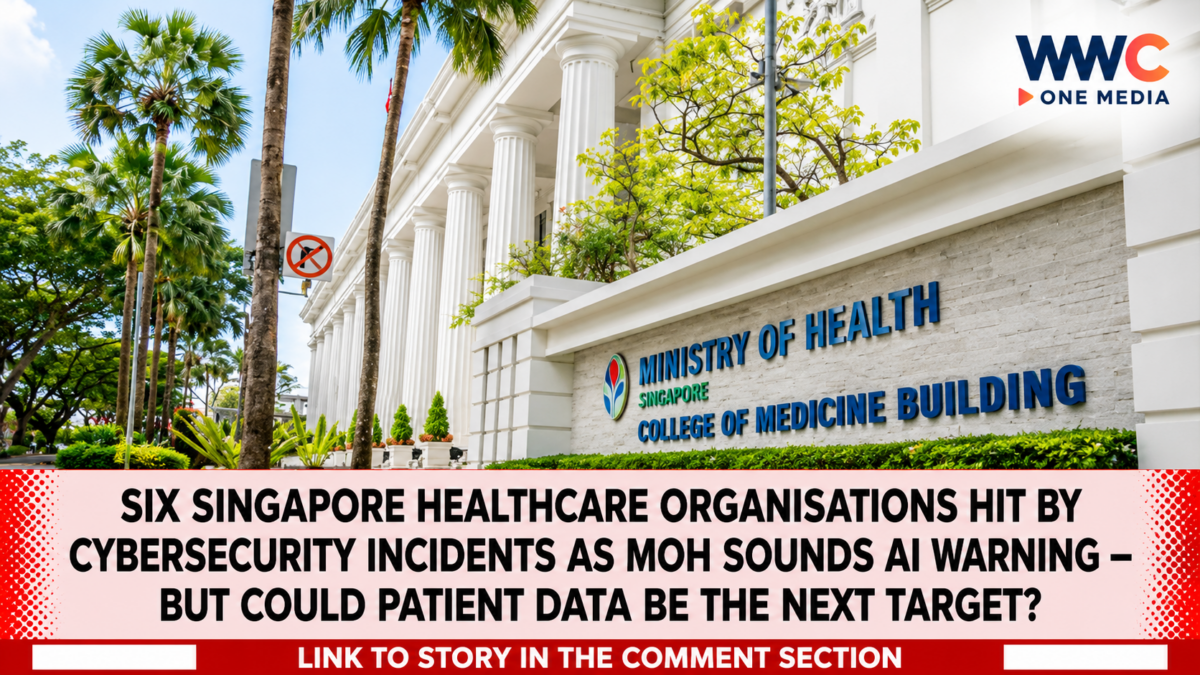
SINGAPORE — Singapore’s healthcare sector is facing growing cybersecurity concerns after six healthcare and healthcare-related organisations reported incidents involving unauthorised access to their IT systems, prompting the Ministry of Health (MOH) to order stronger security measures across the industry.
The incidents, disclosed over recent weeks, have affected the Agency for Integrated Care (AIC), Alliance Medinet, Doctor Anywhere Group, Fullerton Health Group, Minmed Group and Dementia Singapore’s CARA mobile application.
While the ministry stressed that patient care operations have not been disrupted and there is currently no evidence of unauthorised access to patient health records in these incidents, the growing number of cybersecurity disclosures has raised serious questions about the protection of personal information in Singapore’s increasingly digital healthcare ecosystem.
In its November 12, 2026 statement, MOH said it was taking the incidents very seriously and was working with the affected organisations to establish their full implications.
The ministry also issued a warning about the growing threat posed by artificial intelligence, saying technological advancements could make vulnerabilities easier to expose and cyberattacks more frequent, rapid and formidable.
The developments have placed healthcare providers, technology vendors and government agencies under increased pressure to strengthen their digital defences before further incidents occur.
Six Healthcare Organisations Affected by Cybersecurity Incidents
The six organisations identified by MOH operate across different parts of Singapore’s healthcare and community care ecosystem.
Although the incidents involved separate systems and organisations, their concentration within a relatively short period has heightened concerns about cybersecurity preparedness.
The affected organisations are:
- Alliance Medinet
- Doctor Anywhere Group
- Fullerton Health Group
- Minmed Group
- Dementia Singapore
- Agency for Integrated Care (AIC)
MOH confirmed that the incidents had not disrupted patient care operations.
It also said there was no evidence thus far that patient safety and care had been compromised. To the ministry’s knowledge, there had been no unauthorised access to patient health records in these breaches.
However, the distinction between clinical records and other personal information remains important. Even when medical records are not compromised, exposed identification numbers, contact details and other personal information can create opportunities for phishing, impersonation and identity-related scams.
Alliance Medinet Breach Affected Approximately 110,000 Members
Among the six incidents, the Alliance Medinet breach stands out because of the number of individuals potentially affected.
The healthcare administration provider disclosed in October that unauthorised access to its membership database had compromised personal information belonging to approximately 110,000 members.
The information potentially exposed included names, identification numbers and contact details.
More concerningly, bank account information belonging to seven members and a medical diagnosis belonging to one member may also have been affected.
Customers associated with HSBC Life, Singlife and Income Insurance were among those potentially affected.
Alliance Medinet subsequently engaged KPMG to validate security improvements following the incident.
The Personal Data Protection Commission was notified and began investigating the case.
The incident demonstrated the potential consequences of storing large volumes of sensitive information in systems operated by third-party healthcare administrators.
Importantly, the Alliance Medinet breach is separate from the other five incidents identified by MOH. There is no established evidence that all six organisations were targeted by the same attackers. CNA+1
Doctor Anywhere Confirms Personal Information Leak
Doctor Anywhere disclosed on November 6 that an unknown third party had gained unauthorised access to its systems.
The company became aware of the incident on October 29.
Subsequent reporting identified potentially exposed information including names, email addresses, NRIC or passport numbers, dates of birth, emergency contact details and bank account information.
The company said there was no evidence that passwords, login credentials, payment-card details or images of identity documents had been compromised.
It also confirmed that clinical records were unaffected.
Doctor Anywhere engaged Ensign InfoSecurity to conduct forensic investigations and strengthen its cybersecurity measures. It also notified the PDPC and filed a police report.
The company did not publicly establish the total number of affected users in the reports reviewed.
The incident highlights the risks associated with digital healthcare platforms that process large amounts of personal information. CNA+1
Fullerton Health Reports Possible Exposure of Migrant Workers’ Information
Fullerton Health disclosed another incident involving unauthorised access to a server supporting its Migrant Worker Primary Care Plan.
The company said it became aware of the incident on October 31.
Information that may have been affected included:
- Full names
- Foreign Identification Numbers (FIN)
- Dates of birth
- Mobile numbers
- Email addresses
- Residential addresses
Fullerton Health stressed that the affected information did not include health records, medical information or personal financial details.
The company said the incident appeared limited to a specific standalone system and that there was no evidence at the time that systems supporting its other programmes, clients or patients had been affected.
It notified the PDPC, filed a police report and contacted the Ministry of Manpower.
Healthcare services and facilities remained operational while investigations continued.
The incident is another example of how administrative systems can become targets even when the medical information held by a provider is not involved. Fullerton Health Singapore+1
Dementia Singapore’s CARA App Also Hit by Cybersecurity Incident
Dementia Singapore disclosed a separate cybersecurity incident involving its CARA SG mobile application.
The organisation reported that unauthorised notifications had been sent to some app users on November 1.
Subsequent checks indicated that certain members’ personal information may have been exposed.
The potentially affected information included names, email addresses, telephone numbers and membership identification numbers.
Dementia Singapore clarified that NRIC numbers were not compromised.
The organisation worked with its third-party mobile application service provider to contain the incident and secure the affected systems.
It also reported the matter to the PDPC.
The incident raised concerns about the security of digital platforms serving vulnerable communities, including people living with dementia and their caregivers.
CARA is designed to support people affected by dementia by providing access to resources, services and community support.
The incident reinforces the importance of ensuring that applications used by vulnerable populations receive adequate cybersecurity protection. CNA+1
Minmed Reports Malicious Cybersecurity Incident
Minmed Group disclosed its cybersecurity incident on November 11.
The healthcare provider said the incident affected a specific standalone system supporting its teleconsultation and health-screening services.
Minmed engaged Ensign InfoSecurity to investigate the incident and strengthen its security measures.
The company said clinical records were not affected and that its clinics and healthcare services continued operating.
It also confirmed that the identified system vulnerabilities had been secured following security fixes validated by the cybersecurity specialist.
Minmed notified the PDPC and filed a police report.
However, the company did not publicly provide a confirmed number of affected individuals or a complete breakdown of potentially accessed information in its initial announcement.
This is an important distinction: while the company has said clinical records were not compromised, the full extent of the incident should not be assumed until investigations are completed.
WWC ONE MEDIA previously examined this incident in its coverage of Minmed’s cybersecurity disclosure.
AIC Breach Raises Concern Over NRIC and Employee Information
The sixth organisation identified by MOH is the Agency for Integrated Care.
AIC disclosed that an unauthorised third party had accessed its Advance Care Planning IT system.
The incident was detected on November 10, with personal information belonging to up to 4,064 employees of public healthcare institutions and community care providers potentially affected.
The information included names, contact numbers, email addresses and NRIC numbers.
AIC took the affected system offline while investigations were conducted and restored access on November 12.
During the disruption, Advance Care Planning facilitators continued documenting individuals’ preferences through physical forms.
The agency also lodged a police report and notified CSA.
AIC said there were no indications that medical records or patient data had been compromised.
It committed to contacting potentially affected individuals and reviewing its systems to strengthen cybersecurity protections.
For employees whose NRIC numbers and contact details may have been accessed, the main immediate concern is the possibility of targeted impersonation and phishing attempts.
The agency advised potentially affected individuals to exercise caution when receiving unsolicited messages and calls.
The AIC incident is separate from the Alliance Medinet, Doctor Anywhere, Fullerton Health, Minmed and Dementia Singapore cases. AsiaOne+1
MOH Orders Stronger Cybersecurity Monitoring Across Public and Private Healthcare
In response to the incidents, MOH has directed Synapxe, Singapore’s national health technology agency, and public healthcare institutions to increase monitoring for potential cyber threats across public healthcare IT systems.
Private healthcare providers have also been urged to review and strengthen their cybersecurity measures.
The ministry specifically reminded licensed healthcare institutions and Healthcare Information Management System providers to strengthen their cybersecurity posture and protect the security and integrity of their IT assets, systems and patient information.
This is particularly important because healthcare organisations increasingly depend on digital systems to coordinate appointments, manage administrative operations and support medical services.
The incidents also highlight the importance of cybersecurity among third-party technology providers that manage information on behalf of healthcare institutions.
A provider may have strong internal security measures, but weaknesses in an external service or connected platform can still create additional risks.
MOH’s response therefore extends beyond the six affected organisations and calls for heightened vigilance across the healthcare industry. Ministry of Health+1
Artificial Intelligence Could Make Cyberattacks More Frequent and Sophisticated
One of the most significant warnings in MOH’s November 12 statement concerns the growing role of artificial intelligence in cybersecurity threats.
The ministry cautioned that technological advancements, particularly AI, could make system vulnerabilities easier to identify and cyberattacks more frequent, rapid and formidable.
AI can help legitimate organisations identify suspicious activities, analyse threats and strengthen their security systems.
However, the same technological advances may also provide malicious actors with tools to improve phishing campaigns, automate certain attack processes and identify weaknesses more efficiently.
This creates a difficult challenge for organisations that may already be struggling to keep their digital infrastructure secure.
The concern is not limited to healthcare.
Financial institutions, telecommunications companies, government agencies and businesses that process personal information must also prepare for increasingly sophisticated threats.
Singapore’s broader cybersecurity efforts have included investments in digital defence and specialist training.
WWC ONE MEDIA previously reported on the Singapore Armed Forces’ new Digital and Intelligence Service Training Command, which is designed to strengthen expertise in cybersecurity, artificial intelligence and intelligence operations.
Read: Singapore Military Launches New AI and Cyber Defence Command as Digital Threats Evolve.
The military initiative is separate from MOH’s healthcare cybersecurity response, but both reflect Singapore’s growing focus on developing the capabilities needed to confront evolving digital threats.
Singapore’s Cybersecurity Concerns Extend Beyond Healthcare
The recent healthcare incidents have also occurred alongside other cybersecurity disclosures involving Singapore-based organisations.
One notable case involved telecommunications operator M1, which disclosed a separate incident affecting customer information.
Doctor Anywhere and M1 reported their incidents on the same day, November 6, although there is no established evidence that the two breaches were connected.
WWC ONE MEDIA previously examined the incidents and their potential implications for identity-related scams.
Another important development involves third-party cybersecurity risks across Asia.
WWC ONE MEDIA also reported on a Reuters survey indicating that approximately one in three Japanese companies experienced cyberattacks involving their own systems or external service providers in 2026.
Read: One in Three Japanese Companies Hit by Cyberattacks in 2026 as Supplier Security Risks Grow.
Although these incidents are unrelated to the six Singapore healthcare cases, they demonstrate how cybersecurity risks are becoming a wider regional business concern.
The growing reliance on external technology providers means organisations must assess not only their own security systems but also the platforms and partners that handle their information.
What Singapore Residents Should Know About the Recent Healthcare Breaches
For members of the public, one important distinction must be understood: the six cybersecurity incidents do not mean that all Singapore patients’ medical records have been exposed.
MOH explicitly said that there was no evidence thus far of compromised patient safety and care, and that it was not aware of unauthorised access to patient health records in these breaches.
Nevertheless, personal information can still be misused.
People should remain alert to:
- Unexpected messages claiming to come from healthcare providers.
- Calls requesting NRIC numbers, banking details or passwords.
- Emails containing suspicious links or attachments.
- Fake medical appointment or insurance notifications.
- Requests for one-time passwords or online banking credentials.
Individuals who receive suspicious communications should independently verify the sender using official contact information.
They should never disclose passwords or one-time passwords to unsolicited callers.
Anyone who receives a notification from one of the affected organisations should follow the instructions provided and contact the organisation directly if clarification is needed.
The Bigger Question Is Whether Singapore’s Healthcare Sector Can Prevent Another Breach
The six cybersecurity incidents have placed Singapore’s healthcare industry under renewed scrutiny.
Although the incidents involved different organisations and systems, they collectively demonstrate the importance of protecting personal information throughout the healthcare ecosystem.
The absence of confirmed patient health-record exposure is reassuring, but it does not eliminate the need for stronger security measures.
For AIC, Alliance Medinet, Doctor Anywhere, Fullerton Health, Minmed and Dementia Singapore, the immediate priorities include completing investigations, containing vulnerabilities and providing accurate information to potentially affected individuals.
For MOH, the challenge is ensuring that public and private healthcare organisations maintain adequate cybersecurity protections as digital services continue expanding.
The growing use of artificial intelligence adds another layer of urgency.
As cybercriminals gain access to increasingly sophisticated tools, healthcare providers must improve their ability to identify threats before they become major incidents.
Singapore’s healthcare system has not reported a disruption to patient care from these six incidents, but the growing number of disclosures is a warning that digital security can no longer be treated as a secondary operational concern.
The ultimate test will be whether the latest incidents lead to meaningful improvements in cybersecurity across the industry.
And as authorities continue investigating the six cases, one critical question remains: If patient records were not compromised this time, how prepared is Singapore’s healthcare sector to defend against the next cyberattack—and what happens if the next breach reaches the medical records themselves?