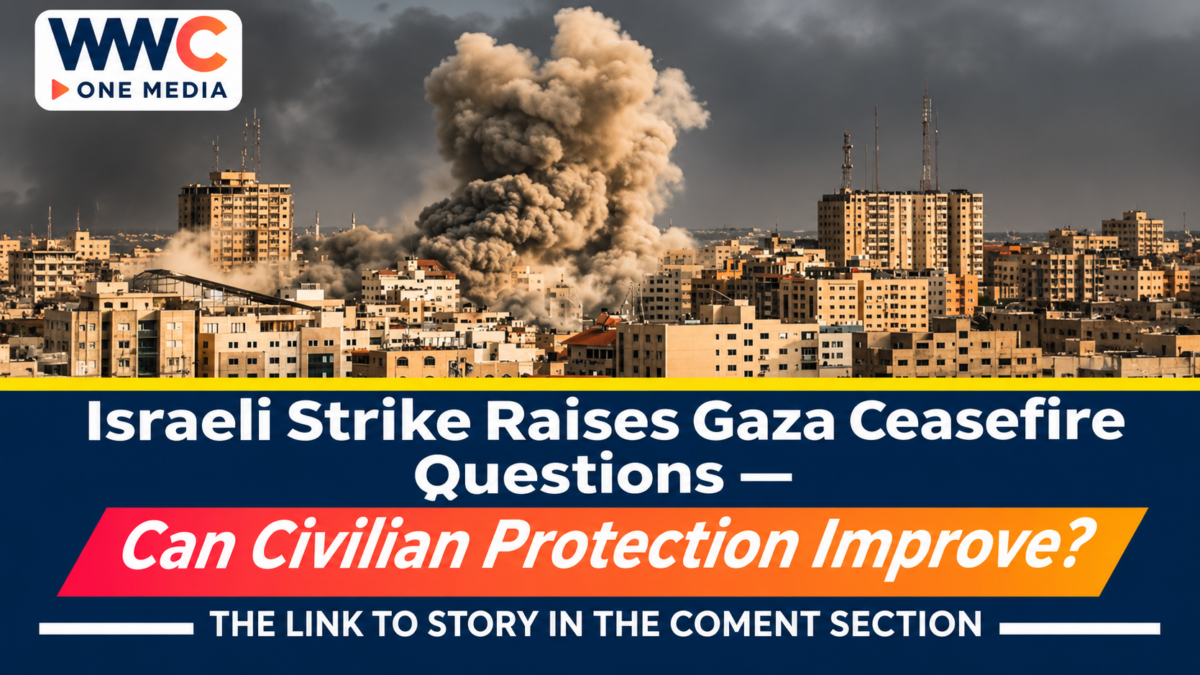
GAZA, Nov. 15, 2026 — Israel’s military has documented further operations around the Gaza Strip this week, while a new United Nations humanitarian report records continued casualties despite the ceasefire that began in October 2025. Reports of a strike against a senior Hamas military figure on Nov. 14–15 have added to scrutiny, although the specific target’s identity and death were not independently confirmed through an original statement opened for this article.
The distinction is important. A military announcement establishes what a party says its forces did, but does not by itself settle the identity of every person harmed or whether an operation complied with international law. The UN’s latest figures also show how repeated incidents and humanitarian restrictions affect civilians long after large-scale fighting subsided.
Gaza Ceasefire: What the Military Record Establishes
An official Israeli military record describes a Nov. 14 operation in southern Gaza against a person whom it said had crossed the designated “yellow line” and approached Israeli troops. It said the individual presented an immediate threat and was killed. This is the military’s account of that incident, not an independently adjudicated finding about the person’s identity or conduct.
The same official compilation describes separate operations on Nov. 12 near Khan Younis and Rafah. In the latter case, the military said troops identified four armed individuals and struck three, while its forces were dismantling underground infrastructure.
These entries establish that Israeli forces say they continue operations under the ceasefire’s security provisions. They do not establish that every reported strike on Nov. 14 or 15 refers to the same event. Combining separate military notices would risk creating an inaccurate account of casualties and targets.
An independently authenticated primary statement naming the senior commander reported killed in the latest strike was not obtained. That person’s identity, rank, precise location and alleged past actions therefore require a separate, direct verification before being included as established facts.
United Nations Records Show Continued Casualties
In its Nov. 13 humanitarian situation report, the UN Office for the Coordination of Humanitarian Affairs described continued airstrikes, shooting and shelling affecting populated areas from Nov. 3–9. The report records 22 Palestinians reported killed and 90 wounded during that period, using information supplied by Gaza’s Ministry of Health.
The report attributes those casualty figures to the local health ministry, which operates under the territory’s de facto authorities. They are reported figures, not an independently verified list of each casualty or a count solely attributable to one named operation.
For the period since the October 2025 ceasefire, the same UN report recorded a cumulative 1,613 reported fatalities and 5,833 injuries, together with a separate retrospective adjustment of 12 fatalities whose identification details were approved.
The temporal boundary matters: that report predates the latest weekend strike and should not be treated as its death toll. The broader history of continuing violence has also been addressed in WWC’s earlier reporting on Gaza strikes during the ceasefire.
The Ceasefire Has Not Ended Humanitarian Disruption
The October 2025 agreement sharply changed the scale of the conflict, but the UN’s November records show that insecurity and humanitarian needs remain. Its Nov. 13 assessment describes damaged shelters, interrupted health services and constraints affecting the delivery of supplies.
Between Nov. 2 and 8, the UN logistics figures recorded 262 humanitarian trucks manifested for entry, of which 228 were offloaded on the Israeli side of the Kerem Shalom crossing. The number offloaded was about 42% below the preceding week’s figure, with the report citing a suspended Egyptian corridor and lower volumes available to partners among the reasons.
A truck offloaded at a crossing is not automatically a household receiving food or medical supplies. The distinction between material arriving at a border, entering distribution networks and reaching intended beneficiaries should remain explicit in coverage of the emergency.
WWC has also examined the obstacles confronting Gaza reconstruction plans. Proposals for longer-term rebuilding are separate from verified deliveries of emergency supplies this week.
Flooding Has Added a Second Immediate Crisis
Heavy rainfall since Nov. 6 damaged displacement sites and essential services. The Nov. 13 UN assessment says site-management alerts indicated that more than 46,000 households, around 226,000 people, may have been affected, with reports of more than 40,000 shelters damaged. The agency explicitly describes portions of that damage as not yet confirmed.
Flooding also interrupted education. The UN counted 109 affected learning spaces and at least 5,500 children unable to access them as of Nov. 10. Floodwater mixed with sewage created additional public-health concerns in already damaged neighbourhoods.
Those conditions matter when evaluating any security operation. Civilian protection involves not only immediate precautions during an attack, but also the broader ability of people to obtain shelter, medical care, food and safe movement.
WWC’s recent coverage of Gaza’s flood emergency provides context on the winter response. The UN’s updated Nov. 13 estimates should not be confused with earlier provisional counts.
What the Available Evidence Cannot Decide
Analysis: Israel’s public military record supplies its stated security rationale for certain operations. Humanitarian reports document civilian harm and the obstacles faced by relief agencies. Neither record, standing alone, conclusively determines the legality of the latest reported targeted strike.
That assessment would require reliably establishing the target, location, expected civilian risk, precautions taken, and the rules applicable to that operation. An assertion that a person was a member of an armed organisation is not a substitute for examining those questions.
The same discipline applies to allegations of ceasefire violations. Both the specific commitment allegedly breached and the underlying events must be documented before assigning responsibility as an established legal conclusion.
What Happens Next
Further official military statements could clarify the identity and outcome of the reported strike. Fresh UN humanitarian updates can establish subsequent casualty and aid figures, while independent investigations may provide information unavailable in initial claims.
The immediate public-interest test is whether parties reduce harm to civilians and allow emergency assistance to reach displaced households. A ceasefire cannot be assessed only by the absence of a major ground offensive when people remain exposed to military incidents and severe humanitarian hardship.
Frequently Asked Questions
Has the Gaza ceasefire ended all military operations?
No. Israeli military notices describe continued operations, and UN reports record casualties from airstrikes, shooting and shelling after the October 2025 ceasefire agreement.
Was a named Hamas commander confirmed killed in the latest strike?
Several accounts identify a commander, but the complete original military or armed-group confirmation was not independently opened for this report. The identification remains outside its verified findings.
How many casualties did the UN report in early November?
For Nov. 3–9, the UN cited Gaza health authorities’ reports of 22 Palestinians killed and 90 injured. Those figures do not represent the casualty total for the later weekend strike.
Why is humanitarian access still a concern?
The UN describes funding and entry restrictions, damaged facilities and disruptions from heavy rains. Goods reaching a crossing do not necessarily reach families immediately.