MELAKA, Malaysia — Barisan Nasional (BN) secured 21 of 28 seats in Melaka’s 16th state election on Nov. 14, while its election partner Perikatan Nasional (PN) won three and Pakatan Harapan (PH) captured four, giving BN and PN a combined 24-seat majority in the state assembly. umno-online.my+1
The result gives BN a commanding position in Melaka, but it also creates a difficult political situation for Malaysia’s federal unity government, where BN and PH are partners even as they competed against each other in the state election.
The distinction is important: the Melaka result changes the balance of political influence inside the state assembly, but it does not automatically change the composition or parliamentary majority of Prime Minister Anwar Ibrahim’s federal government.
For BN, the victory strengthens its position ahead of the next general election. For PH, the four-seat outcome raises questions about its electoral standing in Melaka. For Anwar, the challenge is maintaining cooperation between political partners whose electoral interests do not always align.
Melaka Election Results Put BN in a Dominant Position
The final seat distribution gives BN the largest representation in the 28-member Melaka State Legislative Assembly.
| Political coalition | Seats |
|---|---|
| Barisan Nasional | 21 |
| Perikatan Nasional | 3 |
| Pakatan Harapan | 4 |
| Total | 28 |
The figures were recorded in UMNO’s official post-election announcement, which also identified the agreement between BN and PN on their preferred candidate for chief minister. umno-online.my
BN alone holds 21 seats, comfortably above the 15 needed for a simple majority. Its combined position with PN reaches 24 seats.
A two-thirds majority in a 28-seat assembly requires 19 seats. The BN–PN arrangement therefore exceeds that threshold by five seats.
This means BN does not need PN’s three assembly representatives to maintain a simple majority. However, their cooperation gives the incoming political bloc a much larger legislative presence.
The Election Commission’s pre-election statement recorded 28 constituencies and 79 candidates, establishing the size of the contest before polling day. spr.gov.my
Why BN and PH Competed in Melaka Despite Governing Together Federally
The election exposed an important feature of Malaysia’s political system: cooperation at federal level does not necessarily mean parties will stop competing in state elections.
BN and PH are both part of the federal unity government established after the 2022 general election.
The arrangement followed an election in which no party secured enough parliamentary seats to form the federal government independently. DAP’s official 2023 Central Executive Committee report documents PH’s role in the formation of the unity administration and the participation of BN and other parties. dapmalaysia.org
Ahead of the Melaka election, UMNO deputy president Datuk Seri Mohamad Hasan addressed concerns about the arrangement.
In an interview published on Nov. 6, he said BN’s cooperation with PN in the state election should not be interpreted as a decision to abandon the federal unity government.
He maintained that BN had no reason to withdraw from the national administration and explained that cooperation at state level did not necessarily require a change in its federal political position. Mohamad Hasan
The final result makes that distinction more politically significant.
BN has strengthened its independent electoral position in Melaka while PH has emerged with only four assembly seats. Yet the two coalitions still have reasons to maintain cooperation at the national level.
This creates a balancing act: parties must defend their own electoral interests without undermining the government they jointly support.
What the 24-Seat Bloc Means for Anwar Ibrahim
The result gives BN and PN considerable influence over Melaka’s state legislature.
However, it would be inaccurate to describe the outcome as an immediate defeat of Anwar’s federal government.
State assembly seats and parliamentary seats are separate mandates. The 28 seats contested in Melaka do not alter the number of representatives in Malaysia’s Dewan Rakyat.
The result therefore does not, by itself, remove Anwar’s parliamentary support or trigger a change in the federal administration.
The political implications are different.
BN can point to its 21-seat victory as evidence of its strength in the state. PN can highlight its three seats as a contribution to the combined governing position. PH, meanwhile, must assess why its candidates secured only four constituencies.
The result could also affect future discussions about electoral cooperation, candidate allocation and political messaging before the next general election.
WWC ONE MEDIA previously examined the tension between UMNO’s ambitions for the next national election and its commitment to remain in Anwar’s government in its report on UMNO’s GE16 strategy and its position in the unity administration.
PH Faces a Difficult Assessment After Winning Four Seats
PH’s four-seat result places the coalition behind both BN and PN in the new assembly.
The result creates an immediate challenge for the coalition’s state leadership: rebuilding its electoral position while continuing to participate in the federal government.
It also highlights the difference between holding national government responsibilities and maintaining local electoral support.
Voters in state elections choose representatives for local legislative responsibilities. Their decisions can reflect constituency-level concerns, candidate performance and local political preferences.
It would therefore be premature to conclude that the Melaka result represents a nationwide rejection of PH.
Nevertheless, four seats in a 28-member assembly leave the coalition with limited numerical influence compared with the BN–PN bloc.
Its representatives will need to demonstrate effective constituency work and scrutiny of the incoming administration.
For the federal coalition, the result also raises the question of how BN and PH will manage political disagreements without turning every state-level contest into a national government dispute.
BN’s Victory Comes as UMNO Looks Towards GE16
The result arrives amid wider political positioning ahead of Malaysia’s 16th General Election, commonly known as GE16.
UMNO has previously expressed interest in an earlier national election, while its leadership has also said the party intends to remain in the current federal administration.
That combination reflects a political reality: a coalition partner can support the current government while preparing to compete for greater influence in the next election.
WWC ONE MEDIA has also examined the tensions within Perikatan Nasional following its organisational dispute involving Bersatu.
The Melaka outcome now provides another factor for parties to consider when negotiating future electoral arrangements.
BN’s strong performance may strengthen its bargaining position. PN’s participation could encourage further discussions about cooperation, while PH will have to assess its performance in a state where it previously participated in a unity-government arrangement with BN.
However, one state election cannot establish how the national electorate will vote in GE16.
The parliamentary contest will involve different constituencies, candidates and national issues.
Ab Rauf Yusoh Is BN–PN’s Choice for Melaka Chief Minister
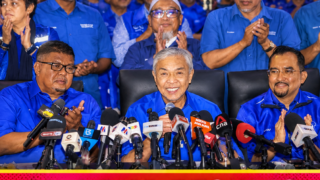
The leadership question was addressed on election night when BN chairman and UMNO president Datuk Seri Dr Ahmad Zahid Hamidi announced Datuk Seri Dr Ab Rauf Yusoh as the coalition’s candidate for Melaka chief minister.
The announcement followed an agreement between BN and PN on the leadership of the incoming state administration.
Zahid said an appointment letter would be sent to the Yang di-Pertua Negeri Melaka. umno-online.my
The announcement establishes the coalition’s preferred candidate, but it should not be confused with the formal constitutional appointment.
Ab Rauf’s proposed leadership also gives the incoming administration an opportunity to demonstrate whether its substantial assembly majority can translate into stable administration and effective delivery of state programmes.
For Melaka residents, the priorities will extend beyond political negotiations. Infrastructure, investment, employment, tourism and public services will remain important measures of the government’s performance.
What Happens Next?
The immediate task is to complete the formation of the new state administration and establish how BN and PN representatives will coordinate their work in the assembly.
Several political questions will remain relevant:
- Can BN and PH maintain their federal partnership despite competing in state elections?
- Will BN use its Melaka victory to seek a stronger negotiating position ahead of GE16?
- Can PH rebuild its state-level electoral support?
- Will PN’s participation in Melaka encourage broader cooperation with BN?
The relationship between BN and PH deserves particular attention. An earlier public explanation from UMNO leadership explicitly separated state-level cooperation with PN from BN’s commitment to the federal unity government.
That position will now face the practical test of governing relationships after an election in which the partners did not share the same electoral interests.
WWC ONE MEDIA has also examined the disagreements within Anwar’s administration over government coordination and public spending.
Ultimately, Melaka’s election has changed the political balance inside the state. Whether it produces a wider realignment in Kuala Lumpur will depend on decisions that have yet to be made.
Frequently Asked Questions
1. Who won the Melaka state election in November 2026?
Barisan Nasional won 21 of the 28 seats, followed by Perikatan Nasional with three and Pakatan Harapan with four.
2. Did BN and PN secure a two-thirds majority?
Yes. Their combined 24 seats exceed the 19 required for a two-thirds majority in the 28-seat assembly.
3. Does the result mean Anwar Ibrahim’s government has fallen?
No. The election determined representation in Melaka’s state assembly. It did not change the composition of Malaysia’s federal Parliament.
4. Why did BN cooperate with PN while remaining in Anwar’s federal government?
UMNO deputy president Mohamad Hasan explained before polling that state-level electoral cooperation with PN did not mean BN intended to leave the federal unity government.
5. Who was nominated as Melaka chief minister?
Datuk Seri Dr Ab Rauf Yusoh was announced as the BN–PN candidate by Ahmad Zahid Hamidi on Nov. 14, 2026. The announcement of a candidate is distinct from the formal appointment.