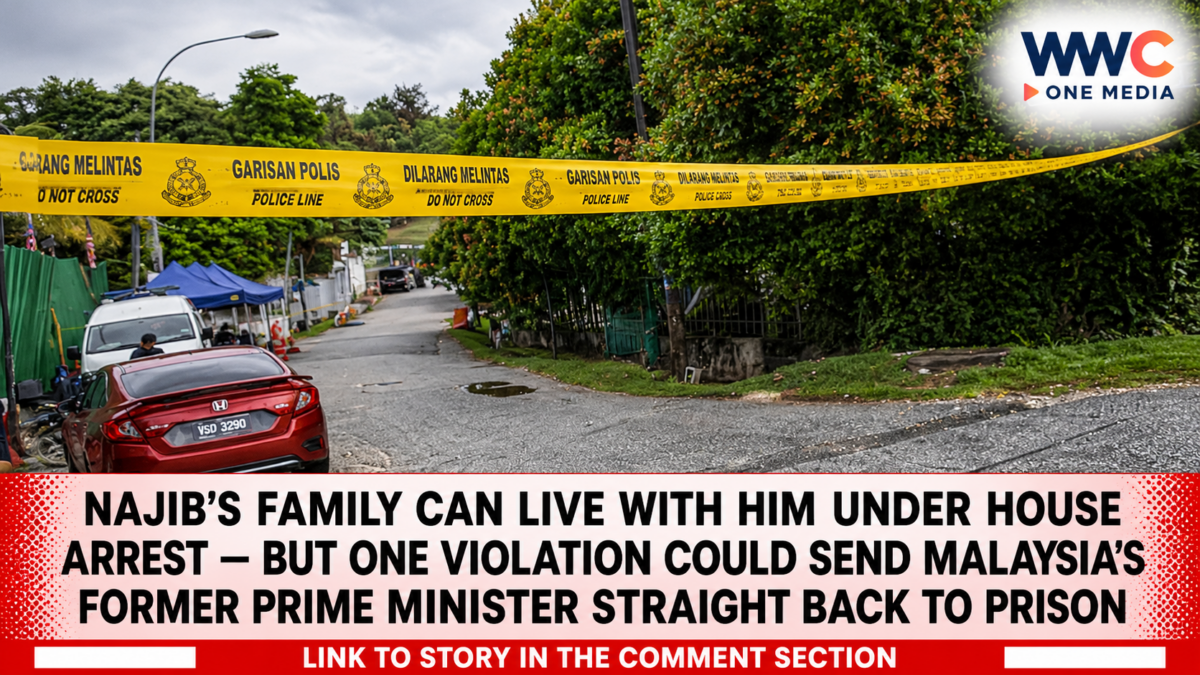
Former Malaysian prime minister Najib Razak may live with his immediate family while serving the remainder of his prison sentence under house arrest, but the arrangement comes with strict restrictions on his movements, communications and public activities.
Malaysia’s Home Minister Saifuddin Nasution Ismail revealed the conditions in Parliament on November 12, 2026, clarifying several details that had remained uncertain since Najib was transferred from Kajang Prison to his Kuala Lumpur residence earlier in the week.
Under the rules, Najib’s immediate family members—including his spouse, children, sons- and daughters-in-law, and grandchildren—are permitted to live with him at the designated property without obtaining additional approval.
Anyone outside those categories must secure prior written permission from the authorities before staying at the residence. Visitors are also subject to approval.
The announcement has drawn renewed attention to the former prime minister’s controversial house-arrest arrangement, which has already triggered legal disputes, political criticism and questions about whether the conditions will be applied consistently.
Najib Cannot Leave His Designated Home Without Permission
Saifuddin told Parliament that Najib must remain at his registered residence at No. 11, Jalan Langgak Duta, Kuala Lumpur.
He is not permitted to move to another house, building or property, and cannot leave the designated address without written authorisation.
The minister also disclosed that Najib had submitted a written request to include a second residence in his house-arrest arrangements. That request was rejected because the Pardons Board’s decision specified only one approved property.
There is a provision for Friday prayers. Saifuddin said prison authorities would arrange for Najib to be transported to attend them, although he did not identify the mosque or provide further operational details.
The restrictions mean that house arrest does not give Najib the freedom to travel between residences or carry out ordinary activities outside his home.
Personal Phones, Social Media and Media Statements Are Restricted
One of the most significant conditions concerns Najib’s access to communication devices.
Saifuddin said the former prime minister is prohibited from using mobile phones and other telecommunications equipment unless the devices are officially registered with the Prisons Department.
The registered equipment is intended to allow prison authorities to contact him and verify that he remains at the approved residence.
Najib is also prohibited from deliberately appearing in media coverage or on social media platforms. He cannot issue media statements, make public comments, attend public gatherings or participate in political activities.
These restrictions are particularly significant because Najib remains an influential figure in Malaysia’s political landscape, despite his convictions and imprisonment.
The rules also raise questions about how authorities will monitor indirect communication, including political messages that might be conveyed through other people. The minister’s announcement did not fully explain how every possible situation would be handled.
Breaking the Conditions Could Send Najib Back to Prison
Saifuddin warned that any breach of the house-arrest conditions could result in Najib being returned immediately to Kajang Prison or another prison designated by the Prisons Department’s commissioner-general.
The restrictions cover four broad areas: residence and personal associations, movement and visitors, telecommunications use, and participation in rehabilitation and intervention programmes.
The Home Ministry and Prisons Department are responsible for implementing and monitoring the arrangement.
According to the minister, three prison officers will be assigned to each shift at Najib’s residence, with three shifts operating daily. Police personnel are also involved in monitoring the property.
Saifuddin said the prison officers had been reassigned from Kajang Prison, rather than newly deployed, and that the arrangement would not create additional staffing costs.
The government has said the conditions are also intended to provide a framework for handling possible future house-arrest cases, rather than being designed exclusively for Najib.
Why Najib Was Allowed to Serve His Sentence at Home
Najib began serving his house-arrest arrangement on November 10, following a series of legal developments involving his conditional royal pardon.
The former prime minister was originally sentenced to 12 years in prison and fined RM210 million after being convicted in the SRC International case, involving RM42 million transferred from the former 1Malaysia Development Berhad subsidiary into his personal accounts.
Malaysia’s Pardons Board reduced his prison term to six years and lowered the fine to RM50 million in January 2024.
A further conditional pardon granted by King Sultan Ibrahim Sultan Iskandar in September 2026 allowed Najib to serve the remaining portion of that sentence under house arrest, subject to the specified requirements.
On November 6, the RM50 million fine was paid, fulfilling a major financial condition attached to the arrangement.
However, the transfer from prison was briefly delayed after the Attorney-General’s Chambers sought legal clarification concerning the effect of the relevant court orders and the conditional pardon.
The Kuala Lumpur High Court subsequently issued a fresh order on November 10, allowing the house-arrest arrangement to proceed.
WWC ONE MEDIA previously reported on this legal turning point in its coverage of Najib Razak’s return home as Malaysia prepared to implement his house arrest.
The Separate 15-Year 1MDB Sentence Still Hangs Over Najib
An important distinction remains: the house-arrest arrangement applies to Najib’s reduced six-year sentence in the SRC International case. It does not cancel his separate 15-year prison sentence imposed in another 1MDB-related corruption and money-laundering case.
Najib is appealing that separate conviction and sentence.
Unless the legal position changes through the appeal process or another court order, he could face a return to prison after the house-arrest period ends.
The separate sentence is one reason the latest developments remain closely watched in Malaysia.
The wider 1MDB scandal involved the alleged misappropriation of billions of dollars from Malaysia’s state investment fund and triggered investigations across several countries.
Najib has denied wrongdoing in the wider 1MDB case and is challenging the separate conviction through the courts.
WWC ONE MEDIA previously examined the dispute involving the royal pardon and the Attorney-General’s Chambers in its report, Malaysia’s King Rebukes Attorney-General as Najib’s RM50-Million House Arrest Deal Is Blocked.
Calls for Transparency Grow as House-Arrest Conditions Become Public
The announcement has also renewed debate about transparency and equal treatment under Malaysian law.
Some lawmakers and members of the public have questioned how the conditional pardon was approved, how the restrictions will be enforced and whether similar arrangements would be available to other convicted individuals.
Saifuddin said the right to seek a royal pardon under Article 42 of Malaysia’s Federal Constitution is available to all Malaysians, regardless of status.
He also indicated that he was prepared to bring a proposal to Cabinet to declassify the Pardons Board meeting minutes relating to Najib’s case.
The proposal could give the public a clearer understanding of the decision-making process, although any disclosure would depend on the government’s decision.
The Star reported on November 13 that the minister intended to raise the proposal at the Cabinet meeting.
The issue is especially sensitive because Najib was Malaysia’s prime minister from 2009 to 2018 and remains one of the most prominent figures associated with the 1MDB scandal.
WWC ONE MEDIA has also followed the earlier dispute over the financial requirement in its coverage of Najib’s reported difficulty paying the RM50 million fine required for house arrest.
A House Arrest Arrangement Under Close Scrutiny
Najib’s situation is now governed by a detailed set of restrictions that allow him to live with specified family members but sharply limit his freedom outside the home.
He cannot freely receive visitors, use personal communication devices, make public statements, participate in politics or leave his designated residence without approval.
The authorities have also warned that violating the conditions could result in his immediate return to prison.
While the latest parliamentary explanation answers several questions about who can live with Najib and what he is allowed to do, it is unlikely to end the wider debate surrounding his conditional pardon.
The next major test will be whether the government can demonstrate that the restrictions are being enforced consistently and transparently.
For a former prime minister whose criminal cases have shaken Malaysian politics, the distinction between serving a sentence at home and enjoying freedom remains at the centre of the controversy.