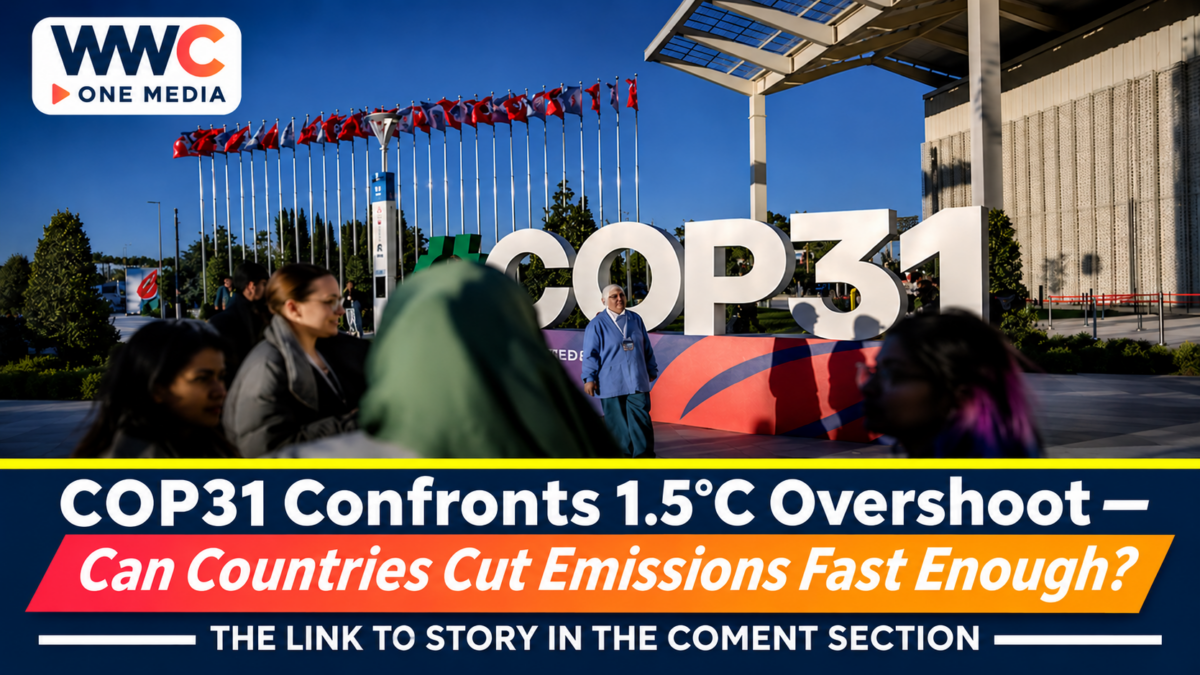
ANTALYA, Türkiye, Nov. 15, 2026 — Governments meeting at COP31 are confronting a possible 1.5°C overshoot of a climate target that is becoming harder to meet: the latest United Nations emissions assessment says global warming is set to exceed 1.5°C above pre-industrial levels. With talks continuing in Türkiye through Nov. 20, the scientific question is shifting towards how high temperatures could rise, how long they could stay above the threshold and what governments can still do to limit the damage.
The 1.5°C objective has not been cancelled or replaced by a new international target. But official assessments show a large difference between countries’ current pledges and the reductions needed to bring temperatures back down. That gap puts the credibility of implementation—not another declaration—at the centre of the summit.
1.5°C Overshoot: What the Climate Target Actually Means
The Paris Agreement commits countries to hold the increase in long-term global average temperature well below 2°C and pursue efforts to limit it to 1.5°C. These are temperature limits relative to the pre-industrial period, not forecasts for how much an individual city will warm on a particular day.
A single year exceeding 1.5°C does not automatically determine whether the Paris temperature goal has been reached or irretrievably lost.
The World Meteorological Organization reported on Nov. 9 that global temperature from January through September 2026 averaged approximately 1.47°C above its 1850–1900 reference period. It expects 2026 to rank among the four warmest years recorded and warned that a strengthening El Niño could add further heat.
Analysis: The distinction between one hot year and sustained warming matters, but it does not make the risk smaller.
A UN Report Quantifies the Emissions Gap
The UN Environment Programme’s 2026 Emissions Gap Report models a lower-overshoot pathway in which warming peaks around 1.7°C–1.8°C near mid-century and returns to or below 1.5°C by 2100, with about a 50% probability.
Reaching that pathway would require global greenhouse-gas emissions to decline by 18% by 2030, 45% by 2035 and 69% by 2040, each compared with 2025 levels.
By contrast, full delivery of countries’ existing nationally determined contributions would reduce emissions by only 5%–8% by 2030 and 11%–15% by 2035 against the same baseline. The report associates that pledge pathway with about 2.6°C of warming this century.
These are conditional model results, not a declaration that any precise future temperature is guaranteed.
WWC’s earlier COP31 opening-day coverage described the demand for implementation. The latest numerical evidence sharpens that challenge by distinguishing pledges on paper from emissions cuts of the necessary scale.
Negotiators Are Discussing Overshoot, Not Declaring a Settlement
COP31 opened in Antalya on Nov. 9 and is scheduled to conclude Nov. 20. Türkiye is hosting the conference, with Australia’s Chris Bowen serving as president of negotiations under the two-country partnership arrangements.
The official consultation schedule records discussions on a proposed overarching decision on Nov. 10, 11 and 13, and a further consultation on Friday, Nov. 13. A presidency summary of reflections notes views about responding to a possible overshoot, limiting its magnitude and duration and keeping the 1.5°C objective.
Crucially, that summary explicitly says it is not a statement of consensus. The fact that an idea appears in a consultation paper does not mean every government has accepted the wording or committed to a specific new emissions target.
Analysis: Governments may find it easier to acknowledge that overshoot is becoming likely than to agree on who must cut emissions faster, how implementation will be financed and what additional steps should follow.
Why Every Additional Fraction of Warming Matters
WMO’s 2026 update reports record-high global mean sea level in the satellite era and preliminary evidence pointing towards another year of record ocean heat content. It identifies the current El Niño as an additional factor that can raise the risk of extreme heat, drought and heavy rainfall into 2027.
An overshoot should not be described as a harmless temporary event. Greater warming can intensify risks during the period above 1.5°C, while some changes—particularly involving ice, oceans and ecosystems—may not reverse quickly when average temperatures eventually decline.
The difference between peaking around 1.7°C–1.8°C and allowing a substantially higher peak therefore has practical significance.
WWC’s report on the climate adaptation finance gap addresses the other half of the challenge: communities must prepare for risks already unfolding while countries work to limit future warming.
What the Findings Mean for the Philippines
The Philippines’ first nationally determined contribution, submitted in April 2021, sets a projected cumulative emissions reduction and avoidance of 75% against a business-as-usual scenario for 2020–2030. Its official breakdown is 2.71% unconditional and 72.29% conditional on international support.
That 75% target is not a promise to cut absolute annual emissions by three-quarters from today’s level.
For the Philippines, the issue therefore combines mitigation with access to resilience investment. A smaller global overshoot would reduce future climate pressures, while better preparation remains essential even if emissions fall.
WWC’s earlier account of Türkiye’s COP31 implementation agenda provides context for why international talks are now judged increasingly by practical outcomes rather than promises alone.
What Happens Next
Delegates have until the scheduled Nov. 20 close to negotiate decisions. No completed COP31 settlement should be inferred from draft consultations.
The scientific conclusion is clear enough: the world can still reduce the height and duration of an overshoot, but the cuts required are much deeper than those implied by current pledges. What remains uncertain is whether governments will enact them.
Frequently Asked Questions
Has the world permanently lost the 1.5°C climate target?
Not necessarily. A single year above 1.5°C is different from sustained long-term warming. UNEP’s 2026 report models a possible return to or below 1.5°C by 2100, but only under substantial emissions cuts and other conditions.
How warm was the world in 2026?
WMO estimates that January–September 2026 was about 1.47°C warmer than the 1850–1900 average. It had not yet issued a complete full-year 2026 figure as of Nov. 15.
What emissions cuts does UNEP say are needed?
For its lower-overshoot pathway, UNEP estimates cuts of 18% by 2030, 45% by 2035 and 69% by 2040 relative to 2025 global emissions.
Has COP31 agreed to abandon 1.5°C?
No such adopted agreement was established in the official records reviewed. Negotiators have discussed how to respond to overshoot, but consultation notes do not represent a final consensus.