World leaders and climate officials have been urged to accelerate action against globalCOP31 Opens in Turkey With Urgent Warning to World: Climate Action Is Falling Far Behind as Extreme Weather Intensifies
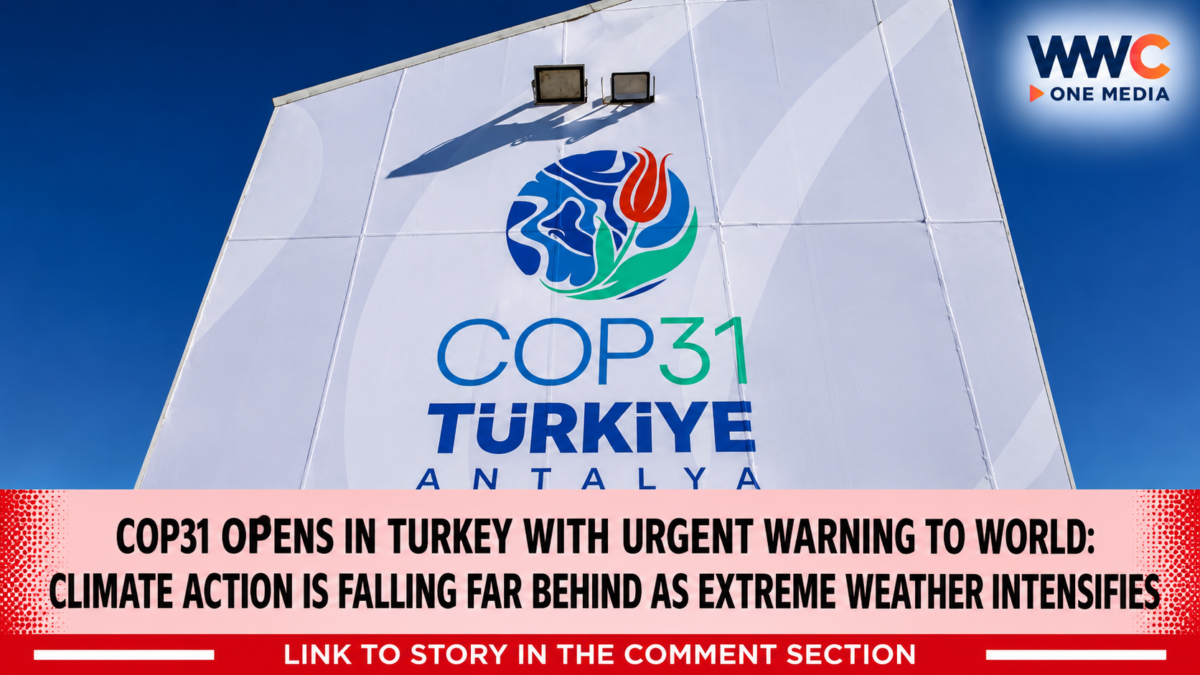
World leaders and climate officials have been urged to accelerate action against global warming as the COP31 climate summit opened in Antalya, Turkey, on November 9, 2026. The warning comes amid another year of destructive weather, rising temperatures, energy insecurity and growing pressure on governments to turn climate promises into measurable results.
The two-week United Nations climate conference, running from November 9 to 20, has brought representatives from nearly 200 countries together to address the worsening climate crisis. But the message from the opening day was blunt: the world’s response is still nowhere near fast enough.
UN Climate Change Executive Secretary Simon Stiell said the urgency of the moment must push governments to move faster, warning that existing progress remains insufficient to confront the scale of global warming.
The summit is taking place as climate-related disasters continue to threaten communities, infrastructure, food production and economic stability. Extreme heat has affected parts of Europe, while devastating flooding in Nepal following a glacier collapse has highlighted the dangers facing vulnerable mountain communities.
A powerful El Niño is also adding to concerns about global temperatures and extreme weather patterns. The United Nations has warned that 2026 is on track to rank among the four hottest years ever recorded.
The 1.5°C climate target is slipping further out of reach
One of the most serious issues confronting delegates is the growing likelihood that the world will exceed the 1.5°C warming threshold established under the 2015 Paris Agreement.
The target was designed to limit the most dangerous consequences of climate change. However, assessments by the United Nations Environment Programme indicate that current global policies and emissions-reduction commitments are not sufficient to keep warming within that limit.
Crossing 1.5°C does not mean every climate consequence will suddenly occur at once. Instead, every additional fraction of warming increases the risks of more intense heat, worsening droughts, heavier rainfall, rising sea levels and damage to ecosystems.
The challenge facing COP31 is therefore not simply to announce another set of climate ambitions. Governments must demonstrate how existing commitments can translate into lower emissions, stronger infrastructure and better protection for communities exposed to climate disasters.
Turkey pushes for a major global electrification target by 2035
Turkey’s COP31 presidency is promoting a major initiative to increase electricity’s share of the global economy from roughly one-fifth today to more than one-third by 2035.
The proposal aims to accelerate the replacement of equipment powered by fossil fuels, including vehicles, heating systems, industrial machinery and cooking appliances.
COP31 President Murat Kurum said the objective is to make climate progress visible in everyday life through more efficient buildings, cleaner public transportation, affordable energy and new employment opportunities.
However, the proposal has already drawn criticism from climate advocates. Electrification alone does not automatically reduce emissions if the electricity used to power homes, factories and transport systems still comes primarily from coal, oil or gas.
The environmental benefits will depend heavily on whether countries expand renewable energy and modernise electricity networks alongside the shift towards electric technologies.
That distinction could become one of the important debates during the negotiations.
Climate finance becomes an early battleground
Beyond emissions targets, one of the biggest challenges at COP31 is the question of who will pay for climate protection and recovery.
Developing countries are pressing wealthier nations to provide more reliable financial assistance for adaptation, disaster recovery and the transition to cleaner energy.
Many vulnerable countries argue that they are already experiencing severe climate impacts despite having contributed relatively little to the historical greenhouse gas emissions responsible for global warming.
The dispute surfaced even before the summit’s opening ceremony. Negotiators disagreed over demands from developing nations to include climate-finance discussions more prominently in the official agenda.
The issue is especially important for countries that need funding to strengthen flood defenses, protect agricultural production, improve early-warning systems and rebuild after climate-related disasters.
The Associated Press reported that negotiations will address financial support for poorer countries, while developing-country representatives are warning against forcing vulnerable nations to borrow heavily to deal with a crisis they did little to create.
The outcome could determine whether COP31 produces practical financial commitments or another round of promises without sufficient resources behind them.
Wars, energy insecurity and artificial intelligence complicate climate action
COP31 is also opening at a time when international conflicts, inflation and growing electricity demand are competing for governments’ attention.
Disruptions to global energy supplies have exposed the economic risks of relying heavily on imported fossil fuels. Higher oil and gas prices can encourage governments to reconsider their energy strategies, although some may respond by expanding fossil-fuel production rather than accelerating the transition.
Artificial intelligence is another emerging challenge.
The rapid expansion of data centres and AI infrastructure is increasing demand for electricity. Without sufficient investment in renewable generation and efficient power systems, that additional demand could increase emissions.
Reuters reported that Turkey is also seeking greater attention to sustainable artificial intelligence as part of the broader climate agenda.
The challenge is to ensure that technological progress does not undermine emissions-reduction commitments.
United States absence adds another complication
The United States, one of the world’s largest greenhouse gas emitters, is again absent from the official climate negotiations following President Donald Trump’s withdrawal from international climate commitments.
Its absence raises questions about how effectively global climate agreements can be implemented without participation from a major economy and a significant source of emissions.
China, meanwhile, remains central to the negotiations because of its enormous industrial emissions and its growing role in manufacturing solar panels, batteries and other clean-energy technologies.
The summit is therefore taking place against a complicated geopolitical backdrop: countries must cooperate on climate action even as they compete over energy security, industrial development and technological leadership.
Turkey and Australia share responsibility for COP31
This year’s conference also has an unusual leadership arrangement.
Turkey is hosting COP31 and holding the presidency, while Australia is leading the formal negotiations through its Climate Change and Energy Minister Chris Bowen.
The arrangement followed discussions between the two countries over hosting the summit.
Turkey is directing the Action Agenda, which focuses on voluntary initiatives and practical cooperation. Australia is responsible for leading the formal negotiations among participating countries.
That division places additional responsibility on both governments to maintain coordination and build consensus among nearly 200 participating countries.
The United Nations has confirmed that COP31 is scheduled to run until November 20 in Antalya.
Why COP31 matters to the Philippines
The negotiations carry particular importance for the Philippines, one of the countries highly exposed to typhoons, flooding, extreme heat, drought and rising sea levels.
The country’s climate vulnerabilities make international financing, disaster preparedness and adaptation major national priorities.
The Philippine government has also been working to strengthen its climate commitments under the Paris Agreement, including efforts to reduce emissions and improve resilience across vulnerable sectors.
For background, WWC ONE MEDIA has previously examined Turkey’s COP31 agenda and its push for clean energy, climate finance and implementation.
The Philippines’ domestic climate challenges are equally important. Up to 85 Philippine provinces face dry-spell or drought risks as El Niño strengthens, highlighting the potential consequences for agriculture, water supplies and household livelihoods.
The country must also address the growing danger of extreme rainfall and flooding. WWC ONE MEDIA has reported on the government’s renewed efforts to revisit its flood-control master plan, as well as the need to strengthen disaster-resilient infrastructure before emergencies strike.
These issues demonstrate why climate negotiations are not simply diplomatic discussions. Their outcomes can influence access to financing, technology and cooperation that vulnerable countries need to protect communities.
The real test is implementation, not another declaration
COP31 opened with an urgent warning, but the conference’s success will depend on what governments actually deliver before negotiations conclude.
Countries must address several difficult questions: how quickly can they reduce emissions, how much financial assistance will reach vulnerable nations, how will renewable electricity meet growing demand, and what practical measures will protect communities already experiencing climate-related damage?
Turkey’s proposed electrification target could become a significant step if it is supported by cleaner power generation and investment in electricity networks.
But climate advocates will be watching closely to see whether the final commitments include meaningful safeguards against continued reliance on fossil fuels.
Climate finance will also remain a major test. Developing nations need more than broad assurances; they need predictable support that can be translated into projects, infrastructure and protection for vulnerable populations.
The warning from COP31’s opening day is difficult to ignore: the world already has many of the technologies and policy tools needed to accelerate climate action, but implementation continues to fall behind the scale of the crisis.
With the summit running until November 20, governments have a limited window to show that international cooperation can produce measurable results.
For countries such as the Philippines, the stakes are immediate. Every delay in climate adaptation and disaster preparedness can leave more communities exposed to floods, droughts, extreme heat and economic losses.
The question hanging over COP31 is whether world leaders will finally move beyond speeches and ambitious targets—or allow another climate summit to end with commitments that arrive too late for the people who need protection now. warming as the COP31 climate summit opened in Antalya, Turkey, on November 9, 2026. The warning comes amid another year of destructive weather, rising temperatures, energy insecurity and growing pressure on governments to turn climate promises into measurable results.
The two-week United Nations climate conference, running from November 9 to 20, has brought representatives from nearly 200 countries together to address the worsening climate crisis. But the message from the opening day was blunt: the world’s response is still nowhere near fast enough.
UN Climate Change Executive Secretary Simon Stiell said the urgency of the moment must push governments to move faster, warning that existing progress remains insufficient to confront the scale of global warming.
The summit is taking place as climate-related disasters continue to threaten communities, infrastructure, food production and economic stability. Extreme heat has affected parts of Europe, while devastating flooding in Nepal following a glacier collapse has highlighted the dangers facing vulnerable mountain communities.
A powerful El Niño is also adding to concerns about global temperatures and extreme weather patterns. The United Nations has warned that 2026 is on track to rank among the four hottest years ever recorded.
The 1.5°C climate target is slipping further out of reach
One of the most serious issues confronting delegates is the growing likelihood that the world will exceed the 1.5°C warming threshold established under the 2015 Paris Agreement.
The target was designed to limit the most dangerous consequences of climate change. However, assessments by the United Nations Environment Programme indicate that current global policies and emissions-reduction commitments are not sufficient to keep warming within that limit.
Crossing 1.5°C does not mean every climate consequence will suddenly occur at once. Instead, every additional fraction of warming increases the risks of more intense heat, worsening droughts, heavier rainfall, rising sea levels and damage to ecosystems.
The challenge facing COP31 is therefore not simply to announce another set of climate ambitions. Governments must demonstrate how existing commitments can translate into lower emissions, stronger infrastructure and better protection for communities exposed to climate disasters.
Turkey pushes for a major global electrification target by 2035
Turkey’s COP31 presidency is promoting a major initiative to increase electricity’s share of the global economy from roughly one-fifth today to more than one-third by 2035.
The proposal aims to accelerate the replacement of equipment powered by fossil fuels, including vehicles, heating systems, industrial machinery and cooking appliances.
COP31 President Murat Kurum said the objective is to make climate progress visible in everyday life through more efficient buildings, cleaner public transportation, affordable energy and new employment opportunities.
However, the proposal has already drawn criticism from climate advocates. Electrification alone does not automatically reduce emissions if the electricity used to power homes, factories and transport systems still comes primarily from coal, oil or gas.
The environmental benefits will depend heavily on whether countries expand renewable energy and modernise electricity networks alongside the shift towards electric technologies.
That distinction could become one of the important debates during the negotiations.
Climate finance becomes an early battleground
Beyond emissions targets, one of the biggest challenges at COP31 is the question of who will pay for climate protection and recovery.
Developing countries are pressing wealthier nations to provide more reliable financial assistance for adaptation, disaster recovery and the transition to cleaner energy.
Many vulnerable countries argue that they are already experiencing severe climate impacts despite having contributed relatively little to the historical greenhouse gas emissions responsible for global warming.
The dispute surfaced even before the summit’s opening ceremony. Negotiators disagreed over demands from developing nations to include climate-finance discussions more prominently in the official agenda.
The issue is especially important for countries that need funding to strengthen flood defenses, protect agricultural production, improve early-warning systems and rebuild after climate-related disasters.
The Associated Press reported that negotiations will address financial support for poorer countries, while developing-country representatives are warning against forcing vulnerable nations to borrow heavily to deal with a crisis they did little to create.
The outcome could determine whether COP31 produces practical financial commitments or another round of promises without sufficient resources behind them.
Wars, energy insecurity and artificial intelligence complicate climate action
COP31 is also opening at a time when international conflicts, inflation and growing electricity demand are competing for governments’ attention.
Disruptions to global energy supplies have exposed the economic risks of relying heavily on imported fossil fuels. Higher oil and gas prices can encourage governments to reconsider their energy strategies, although some may respond by expanding fossil-fuel production rather than accelerating the transition.
Artificial intelligence is another emerging challenge.
The rapid expansion of data centres and AI infrastructure is increasing demand for electricity. Without sufficient investment in renewable generation and efficient power systems, that additional demand could increase emissions.
Reuters reported that Turkey is also seeking greater attention to sustainable artificial intelligence as part of the broader climate agenda.
The challenge is to ensure that technological progress does not undermine emissions-reduction commitments.
United States absence adds another complication
The United States, one of the world’s largest greenhouse gas emitters, is again absent from the official climate negotiations following President Donald Trump’s withdrawal from international climate commitments.
Its absence raises questions about how effectively global climate agreements can be implemented without participation from a major economy and a significant source of emissions.
China, meanwhile, remains central to the negotiations because of its enormous industrial emissions and its growing role in manufacturing solar panels, batteries and other clean-energy technologies.
The summit is therefore taking place against a complicated geopolitical backdrop: countries must cooperate on climate action even as they compete over energy security, industrial development and technological leadership.
Turkey and Australia share responsibility for COP31
This year’s conference also has an unusual leadership arrangement.
Turkey is hosting COP31 and holding the presidency, while Australia is leading the formal negotiations through its Climate Change and Energy Minister Chris Bowen.
The arrangement followed discussions between the two countries over hosting the summit.
Turkey is directing the Action Agenda, which focuses on voluntary initiatives and practical cooperation. Australia is responsible for leading the formal negotiations among participating countries.
That division places additional responsibility on both governments to maintain coordination and build consensus among nearly 200 participating countries.
The United Nations has confirmed that COP31 is scheduled to run until November 20 in Antalya.
Why COP31 matters to the Philippines
The negotiations carry particular importance for the Philippines, one of the countries highly exposed to typhoons, flooding, extreme heat, drought and rising sea levels.
The country’s climate vulnerabilities make international financing, disaster preparedness and adaptation major national priorities.
The Philippine government has also been working to strengthen its climate commitments under the Paris Agreement, including efforts to reduce emissions and improve resilience across vulnerable sectors.
For background, WWC ONE MEDIA has previously examined Turkey’s COP31 agenda and its push for clean energy, climate finance and implementation.
The Philippines’ domestic climate challenges are equally important. Up to 85 Philippine provinces face dry-spell or drought risks as El Niño strengthens, highlighting the potential consequences for agriculture, water supplies and household livelihoods.
The country must also address the growing danger of extreme rainfall and flooding. WWC ONE MEDIA has reported on the government’s renewed efforts to revisit its flood-control master plan, as well as the need to strengthen disaster-resilient infrastructure before emergencies strike.
These issues demonstrate why climate negotiations are not simply diplomatic discussions. Their outcomes can influence access to financing, technology and cooperation that vulnerable countries need to protect communities.
The real test is implementation, not another declaration
COP31 opened with an urgent warning, but the conference’s success will depend on what governments actually deliver before negotiations conclude.
Countries must address several difficult questions: how quickly can they reduce emissions, how much financial assistance will reach vulnerable nations, how will renewable electricity meet growing demand, and what practical measures will protect communities already experiencing climate-related damage?
Turkey’s proposed electrification target could become a significant step if it is supported by cleaner power generation and investment in electricity networks.
But climate advocates will be watching closely to see whether the final commitments include meaningful safeguards against continued reliance on fossil fuels.
Climate finance will also remain a major test. Developing nations need more than broad assurances; they need predictable support that can be translated into projects, infrastructure and protection for vulnerable populations.
The warning from COP31’s opening day is difficult to ignore: the world already has many of the technologies and policy tools needed to accelerate climate action, but implementation continues to fall behind the scale of the crisis.
With the summit running until November 20, governments have a limited window to show that international cooperation can produce measurable results.
For countries such as the Philippines, the stakes are immediate. Every delay in climate adaptation and disaster preparedness can leave more communities exposed to floods, droughts, extreme heat and economic losses.
The question hanging over COP31 is whether world leaders will finally move beyond speeches and ambitious targets—or allow another climate summit to end with commitments that arrive too late for the people who need protection now.