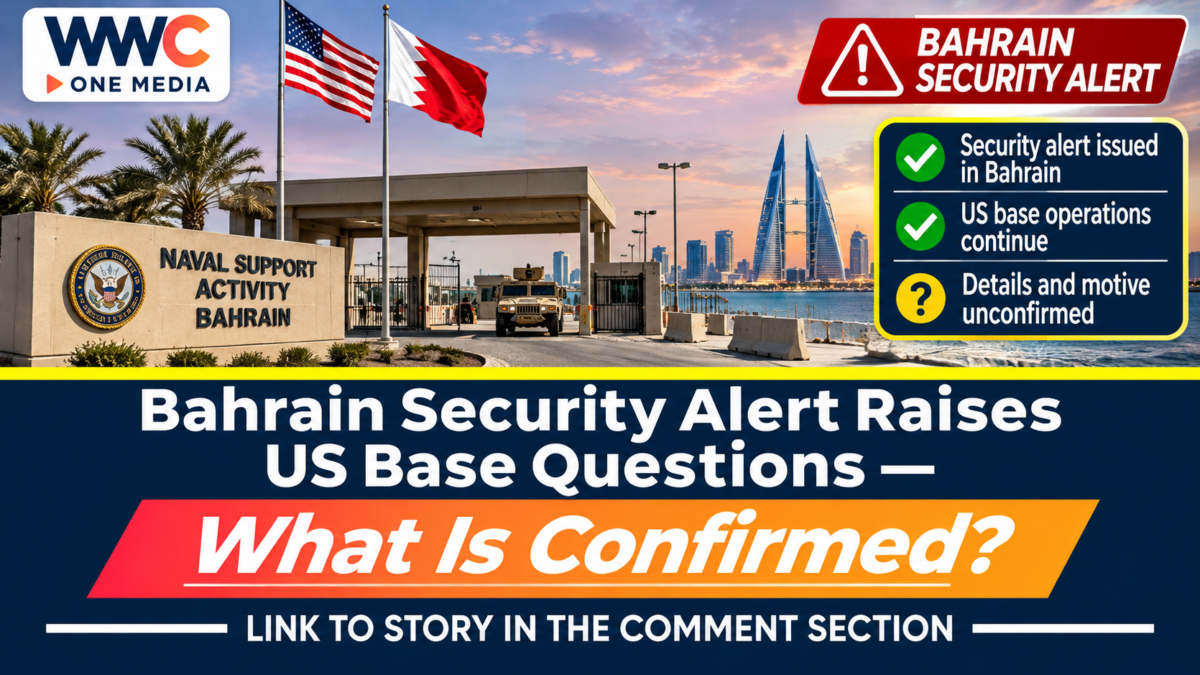
MANAMA, Bahrain — Nov. 15, 2026. Bahrain’s Ministry of Interior issued public warnings about a potential threat on Sunday, directing residents to seek safety and follow official information. The alerts came as security concerns remained elevated around American military facilities in the Gulf, but the warnings alone do not prove that a US base was struck.
The distinction matters to civilians, travellers and governments monitoring the region. An official safety warning tells the public to take precautions; it does not, by itself, identify an attacker, establish damage or verify a military claim circulating online.
Bahrain Security Alert: What Can Be Established?
A Nov. 15 message published from the Ministry of Interior’s official social-media account urged citizens and residents to remain calm, move to the nearest safe location and follow official channels. The alert was publicly embedded in contemporaneous reports, but direct retrieval of the original post was restricted at the time of this editorial review.
That means a final newsroom check of the original Ministry post or an archived government release is necessary before this incident-specific lede goes live. It would be misleading to suggest the Ministry publicly confirmed the precise origin of the threat in the safety alert itself.
The broader security environment is independently documented. The United Kingdom’s official Bahrain travel advice, current on Nov. 15, warns that conflict-related strikes have affected civilian and US military infrastructure in the region. It also notes that airspace closures and travel interruptions may arise with little notice.
The British guidance recommends following local instructions and avoiding the vicinity of military facilities.
Why American Facilities Matter to Bahrain
Bahrain hosts US Naval Forces Central Command and the US Fifth Fleet. A September 2026 report prepared by the Congressional Research Service identifies Naval Support Activity Bahrain as an important logistical hub for American maritime operations.
That relationship exposes Bahrain to risks from missiles, drones and infrastructure disruption.
The congressional report documents Iranian attacks against Bahrain during the conflict that began in February 2026. It discusses damage to critical infrastructure and military facilities, while making clear that some estimates and assessments remained preliminary when the report was prepared.
WWC’s earlier analysis of risks facing US military bases from the Gulf to the Pacific examines why dispersed facilities have become an important defence-planning question. The Nov. 15 warning is a separate development and should not be presented as proof of any particular vulnerability being exploited.
What the US Base Attack Claims Do Not Prove
Claims of a successful strike on American radar equipment circulated alongside the new warnings. However, the available official safety message did not name a targeted installation, identify drone numbers or supply a damage assessment.
A claim by a party to a conflict is evidence that the claim was made, not independent evidence that the claimed outcome occurred. Verifying damage would require an original military statement, technical assessment or another primary record establishing the result.
This is particularly important when reported incidents involve radar systems. A military installation could be targeted without being hit. An incoming object could also be intercepted without causing the damage claimed by the launching force.
The correct editorial distinction is between an alert, a claimed attack, a confirmed interception and a verified impact. Those are four different assertions requiring different evidence.
The government’s alert should not be expanded into a story about casualties, destroyed equipment or a newly launched offensive unless an official record supports those further conclusions.
How the Warning Could Affect Residents and Travellers
The UK’s travel guidance treats sudden disruption as a continuing risk, rather than assuming that routine transport operations remain available whenever no damage has been announced.
It advises travellers to keep documents and departure arrangements current, monitor airline and government notices and prepare for possible flight cancellations or airspace restrictions. It also warns against approaching fragments of drones or missiles.
For households, this creates an information problem as much as a physical security problem. People need clear instructions on when to shelter, where to obtain updates and how to identify an official all-clear, rather than relying on social-media videos whose place and date may be uncertain.
An alert does not establish that commercial flights were cancelled, the airport closed or the causeway to Saudi Arabia was shut. Those details require separate notices from the relevant transport or border authorities.
What This Could Mean for Gulf Diplomacy
Analysis: Bahrain’s position illustrates why limited military incidents can have consequences beyond an individual base. Even an unconfirmed claim may affect travel decisions, financial risk assessments and public confidence if it is accompanied by official safety warnings.
The region’s governments also face a difficult diplomatic balance. Stronger defensive precautions can reassure residents, while repeated alerts reinforce the urgency of preventing further escalation.
The broader debate appears in WWC’s examination of the United Arab Emirates’ concerns about the long road to a regional settlement. That earlier discussion provides diplomatic context, not evidence of what happened at a Bahrain installation on Nov. 15.
Separately, WWC has covered Iran’s public warnings about possible retaliation during the continuing conflict. Statements of future intent must still be separated from independently established military events.
What Happens Next
The first question is whether Bahrain’s authorities provide a detailed follow-up explaining the threat and confirming that any public warning has ended. A second is whether US military authorities issue an incident-specific statement identifying what their systems detected or intercepted.
Officials may also clarify whether civilian facilities, transport routes or infrastructure were affected. Until such records are available, the verified public-interest story is about precautionary alerts and longstanding exposure to regional security threats, not a proven successful strike on a named US base.
For WWC’s editors, the next step is to obtain the original government alert and any subsequent defence statement before releasing a definitive account of the event.
FAQ
Did Bahrain issue a security alert on Nov. 15, 2026?
A warning appeared on the Ministry of Interior’s official social-media account and was publicly embedded in reports. Its original post could not be directly retrieved in this review, so independent source verification remains pending.
Did Iran destroy a US radar installation in Bahrain?
That outcome is not established by the primary government records inspected for this article. A damage claim must not be reported as a verified result.
Why is Bahrain important to the US Navy?
Bahrain hosts the headquarters of US Naval Forces Central Command and the Fifth Fleet, which support American maritime operations in the region.
Should travellers expect disruption?
The UK’s current official guidance warns that flight cancellations, airspace closures and other transport changes are possible. Travellers should check relevant government and carrier notices for specific operations.
What should residents do during an official warning?
Follow Bahrain’s official safety instructions. UK travel guidance also recommends moving to shelter when advised, staying away from military facilities and avoiding suspicious debris.