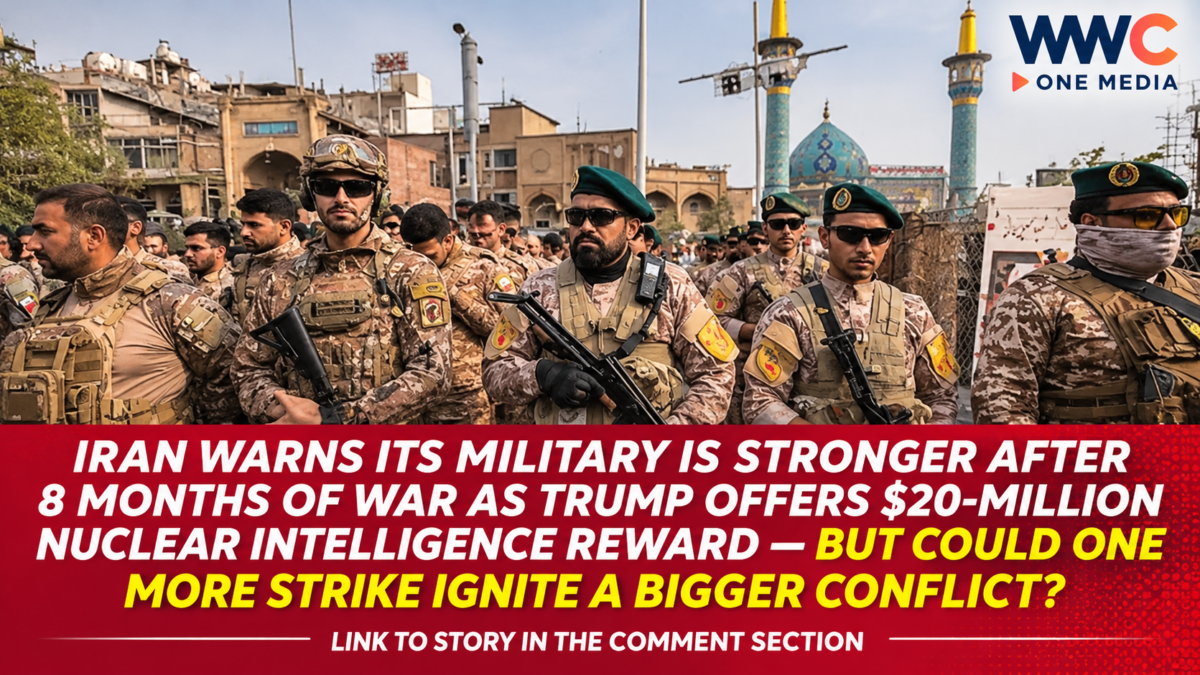
TEHRAN / WASHINGTON — Iran has issued a defiant warning to the United States, declaring that its armed forces are stronger, more experienced and better prepared to retaliate than when the Middle East war began eight months ago.
The statement comes as President Donald Trump’s administration intensifies pressure on Tehran, offering a reward of up to US$20 million for information about Iran’s nuclear programme, while international mediators race to prevent another major military confrontation.
On Saturday, November 7, Iranian army spokesman Mohammad Akraminia said the country’s armed forces had emerged from months of fighting with greater readiness and confidence.
He also warned that Iran could respond to future attacks without geographical restrictions.
The message came amid renewed tensions around the Strait of Hormuz, reports of explosions on Iran’s Qeshm Island and a growing disagreement over the conditions needed to end the conflict.
But the military rhetoric tells only part of the story.
Behind the threats, both Washington and Tehran are facing enormous pressure to find a way out of a war that has damaged Iran’s economy, disrupted global energy supplies and become an increasingly difficult political challenge for Trump.
Qatar is attempting to revive diplomacy.
Trump says Iran wants a deal.
Iran insists that its military remains capable of responding forcefully.
The danger is that both sides may believe they have enough leverage to refuse concessions.
And if that calculation proves wrong, another limited confrontation could trigger much wider consequences.
Iran Declares Its Military Stronger Than at the Start of the War
Akraminia’s November 7 statement was carried by Iran’s official IRNA news agency.
He argued that the country’s military had gained experience from confronting American and Israeli forces.
According to the spokesman, Iranian personnel now have greater motivation, commitment and operational confidence.
He also said the armed forces remain on heightened alert.
The message was intended to demonstrate that Iran has not been forced into submission despite months of military and economic pressure.
But there is an important distinction.
Iran’s claim of improved military strength has not been independently established.
Military capability depends on several factors, including available personnel, functioning equipment, ammunition supplies, logistics, communications and the ability to sustain operations.
An armed force can become more experienced while simultaneously losing equipment and infrastructure.
Washington maintains that US and Israeli operations have severely weakened Iran’s military capabilities.
Tehran disputes the suggestion that those losses have eliminated its ability to deter or retaliate against further attacks.
The competing claims form part of the wider struggle to influence perceptions of the conflict.
Iran Warns Its Next Response Could Extend Beyond Its Borders
Akraminia also issued a warning about how Iran would respond if hostilities intensified.
He said the armed forces were prepared to act rapidly and effectively under instructions from the country’s supreme leader.
His comments suggested that Iran would not necessarily restrict retaliation to the immediate location of an attack.
Such rhetoric increases concern across the Gulf, where American military facilities, shipping routes and critical energy infrastructure are located.
However, a threat of retaliation is not evidence that a new operation has already been ordered.
Nor does it establish which locations Iran might target.
The warning should be understood as a statement of military intent and deterrence rather than confirmation of an imminent attack.
Iran’s Revolutionary Guards have also emphasized the continued development of missile capabilities.
Spokesman Hossein Mohebbi told the Fars news agency that work to increase Iranian missile range was continuing.
No independently verified new missile range or capability was established in the November 7 reporting.
The statements nevertheless indicate that Iran wants Washington to believe further military action would carry significant risks.
Trump Says Iran Wants a Deal After Months of Fighting
While Tehran projected military confidence, Trump offered a sharply different assessment.
The US president said Iran had suffered severe damage to its economy and armed forces during the conflict.
He also suggested that Tehran was eager to negotiate an agreement.
Speaking on November 6, Trump said the two governments were communicating and that Iran wanted a deal.
Those comments suggest Washington believes military pressure and economic restrictions have strengthened its negotiating position.
But there is no confirmed peace agreement.
The two sides remain divided over major questions involving Iran’s nuclear programme, the US blockade, sanctions and shipping through the Strait of Hormuz.
Trump has previously raised the possibility of additional large-scale strikes.
More recently, he has emphasized diplomatic discussions while maintaining the possibility of military action.
This combination of pressure and negotiation has become a defining feature of the conflict.
The United States wants concessions without appearing to reward Iranian resistance.
Iran wants relief from military and economic pressure without appearing to surrender.
That leaves both governments facing difficult political choices.
US Offers $20 Million for Intelligence on Iran’s Nuclear Programme
The latest development also includes a major American intelligence initiative.
On November 6, US Central Command publicized an offer of up to US$20 million, along with possible relocation assistance, for information concerning Iran’s nuclear activities.
The initiative involves the US State Department’s Rewards for Justice programme.
The requested information includes details about facilities, equipment and personnel associated with Iran’s nuclear programme.
The offer is significant because Trump has repeatedly asserted that American strikes effectively destroyed Iran’s nuclear capabilities.
But claims that a nuclear programme has been destroyed require careful scrutiny.
Facilities and equipment can be damaged or eliminated without resolving every question about remaining materials, technical knowledge or future reconstruction.
The announcement of an intelligence reward does not independently prove that Iran possesses an operational nuclear weapon.
Nor does it establish precisely which nuclear facilities remain active.
Instead, it highlights Washington’s continuing interest in gathering information about Iran’s capabilities.
Any lasting nuclear agreement would likely require credible verification arrangements.
That issue remains one of the biggest obstacles to a negotiated settlement.
Qatar Steps In as Diplomacy Reaches Another Critical Moment
Qatar has emerged as an important mediator in the effort to prevent renewed large-scale fighting.
Trump spoke with Qatari Emir Sheikh Tamim bin Hamad Al Thani on November 6 about efforts to resolve the conflict.
Qatar’s prime minister, Sheikh Mohammed bin Abdulrahman Al Thani, also discussed the diplomatic situation during remarks in Oxford.
He credited officials in Washington and Tehran with helping prevent further escalation.
The Qatari leader emphasized that negotiators should not postpone practical progress while waiting for an ideal agreement.
He identified Iran’s nuclear programme, freedom of navigation and Gulf security as major priorities.
The comments reflect the difficulty of negotiating an agreement that satisfies every demand at once.
Washington wants verifiable nuclear restrictions and maritime security.
Tehran wants the US blockade and economic restrictions addressed.
Both sides also want assurances about future military action.
As previously reported by WWC ONE MEDIA in its coverage of Qatar’s efforts to broker a US-Iran peace agreement, mediation has focused on finding a sequence of concessions acceptable to both governments.
But an agreement has not been finalized.
The November 7 developments show that diplomacy remains active even as military tensions continue.
Why the Strait of Hormuz Remains the Biggest Global Risk
The Strait of Hormuz is one of the world’s most strategically important maritime routes.
The narrow waterway connects the Persian Gulf to the Gulf of Oman and the Arabian Sea.
Under normal conditions, oil passing through the strait amounts to approximately one-fifth of global petroleum consumption.
That makes freedom of navigation through Hormuz essential to international energy markets.
Iran has sought to restrict shipping through the waterway during the conflict.
Tehran argues that the restrictions will remain until its demands are addressed.
Washington has imposed its own pressure through a naval blockade and sanctions.
The disagreement creates a dangerous situation.
Oil producers rely on maritime access.
Shipping companies must evaluate security risks.
Importing nations face uncertainty over future energy supplies.
Even when individual tankers can navigate the region, the possibility of disruption can affect insurance premiums, transportation costs and market expectations.
The consequences extend far beyond the Middle East.
Asian economies, including China, Japan, South Korea and the Philippines, are sensitive to changes in international energy prices.
A prolonged disruption could increase costs for businesses and households around the world.
Tanker Incident Raises New Questions About Naval Mines
The risks intensified after Iranian authorities reported an incident involving a tanker in the Strait of Hormuz.
According to Iran’s military, the vessel struck a naval mine, caught fire and came to a halt.
The claim appeared in state television reporting on November 7.
The United States had previously said mines had been cleared from the waterway.
The conflicting accounts leave questions about the circumstances of the incident.
The reporting reviewed does not independently establish how the mine came to be present, who deployed it or whether it was part of a wider mining operation.
However, the allegation illustrates why mine threats remain dangerous to maritime traffic.
Commercial vessels require reliable information about navigational hazards.
Even uncertainty over whether a route is safe can discourage shipping companies from operating normally.
For global energy markets, that uncertainty can become economically significant.
Explosions Reported on Iran’s Qeshm Island
Tensions also rose around Qeshm Island, located near the Strait of Hormuz.
Iranian state media reported explosions on the island during November 7.
The Tasnim news agency reported that missiles had struck the area.
Iran’s military also claimed that its air-defence forces had shot down an American drone.
However, the available reporting did not independently confirm every detail of the alleged missile strikes or drone incident.
Nor did it establish a verified casualty toll.
Washington had conducted limited strikes in the area earlier in the week.
The latest reports therefore added to concerns about renewed exchanges between the opposing forces.
But individual explosions or isolated attacks should not automatically be described as the beginning of another full-scale offensive.
The scale, responsibility and consequences of each incident require verification.
For diplomats, the challenge is preventing limited military encounters from derailing negotiations.
The US Is Expanding Economic Pressure on Iran
Military strikes are only one part of Washington’s strategy.
The United States is also attempting to restrict Iran’s ability to import military-related equipment and generate revenue.
Reuters reported on November 7 that the US military had announced a new initiative called Task Force Iron Gate.
The task force is intended to coordinate efforts against the movement of sanctioned goods, sensitive technology and other materials through Iran’s land borders and the Caspian Sea.
The initiative expands pressure beyond the naval blockade.
US Central Command says the blockade has prevented more than US$25 billion in Iranian crude exports.
That figure is an American military assessment and should be attributed accordingly.
Reuters also reported that Iran has continued obtaining military-related equipment through international networks despite restrictions.
The developments illustrate why neither government can easily claim a decisive outcome.
Washington has imposed substantial economic pressure.
But Tehran continues attempting to sustain its military capabilities.
The economic confrontation could therefore continue even without a return to large-scale fighting.
Eight Months of War Have Created a Costly Stalemate
The conflict began in late February 2026 when the United States and Israel launched attacks on Iran.
Since then, the confrontation has involved military strikes, economic restrictions, maritime disruption and diplomatic efforts.
Reuters reported in August that the war had developed into an expensive stalemate.
American officials argued that Iran’s military and economy had been severely weakened.
Iranian leaders insisted that continued resistance would ultimately force Washington to reconsider its demands.
The result has been a prolonged confrontation without a comprehensive political settlement.
Iran has experienced severe economic pressure.
Regional governments have faced security concerns.
International energy markets have been exposed to shipping disruptions and the threat of further escalation.
As WWC ONE MEDIA previously examined in its report on Iranian threats against Gulf energy infrastructure, the possibility of attacks on energy facilities creates risks even before new damage occurs.
The consequences could include higher insurance premiums, changes in shipping schedules and increased price volatility.
These risks help explain why Gulf states are pushing for a negotiated outcome.
Iran Says Peace Contacts Are Still Alive Despite the Deadlock
The renewed military warnings do not mean Iran has abandoned diplomacy.
Iranian Foreign Minister Abbas Araghchi said he had conducted telephone discussions with ministers from 12 countries over a 48-hour period.
Those contacts suggest Tehran is continuing to explore diplomatic options.
Iran has previously proposed a phased arrangement involving changes to the US blockade, maritime access and economic restrictions.
However, important disagreements remain over the order in which concessions would take effect.
As WWC ONE MEDIA reported on November 3, Iranian officials have maintained diplomatic contacts despite the failure of earlier Qatar-mediated discussions to produce a breakthrough.
That distinction matters.
Talks can continue without producing an agreement.
Diplomatic engagement also does not eliminate the possibility of military escalation.
Both governments may continue negotiating while attempting to improve their bargaining positions.
Could Another US Strike Trigger a Wider Conflict?
The risk of escalation remains central to the crisis.
Washington has demonstrated its willingness to conduct limited military operations.
Iran has warned that further attacks could produce immediate and far-reaching retaliation.
The danger is that an individual incident could be interpreted as evidence that the other side intends to resume major hostilities.
A drone confrontation, missile strike or incident involving commercial shipping could increase pressure on military commanders and political leaders.
The consequences would depend on the severity of the event and how each government responds.
Another round of fighting is not inevitable.
But the combination of active military operations, unresolved diplomatic demands and threats against regional infrastructure creates a difficult security environment.
As WWC ONE MEDIA reported in its analysis of the continuing US-Iran peace deadlock, both sides continue presenting strong public positions while discussing possible diplomatic solutions.
Whether those negotiations succeed will depend on more than public statements.
They require agreements that can be implemented and verified.
Trump’s Midterm Setback Adds Another Political Complication
The diplomatic confrontation comes immediately after major political losses for Trump’s Republican Party in the November 3 US midterm elections.
The outcome has increased scrutiny of the administration’s handling of the war.
Ali Vaez, an analyst with the International Crisis Group, warned in comments to AFP that both Washington and Tehran may be misinterpreting the other’s weaknesses.
His assessment highlights an important risk.
Trump may face domestic pressure to demonstrate that the war has achieved meaningful results.
Iranian leaders may believe that political difficulties in Washington strengthen Tehran’s negotiating position.
If both governments interpret the other’s pressure as a reason to demand more concessions, negotiations could become even harder.
However, political pressure does not establish that either side has already decided to resume large-scale attacks.
It is one factor influencing a complicated diplomatic environment.
What Would a Lasting US-Iran Agreement Require?
The major obstacles are increasingly clear.
Washington wants assurances concerning Iran’s nuclear programme.
It also wants secure navigation through the Strait of Hormuz and limits on activities it considers threatening.
Iran wants relief from the US blockade, changes to economic restrictions and guarantees against renewed attacks.
The biggest difficulty may concern sequencing.
Which government must act first?
Would maritime access be restored before sanctions relief?
Would nuclear verification begin before the blockade was lifted?
Would either side accept an agreement implemented in stages?
These are difficult questions because each government fears losing leverage before the other fulfills its promises.
Qatar’s mediation may help bridge some of those differences.
But mediation alone cannot guarantee a settlement.
The final decision rests with Washington and Tehran.
What Happens Next?
Several developments will determine whether the crisis moves toward peace or escalation.
The first is whether Qatar and other mediators secure an agreement on immediate confidence-building measures.
The second is whether military incidents around Qeshm Island and the Strait of Hormuz continue.
The third is whether Washington and Tehran make progress on nuclear verification and economic restrictions.
The fourth is whether shipping through the Gulf becomes more predictable.
Finally, both governments must decide whether the benefits of compromise outweigh the political risks of making concessions.
No comprehensive peace agreement had been confirmed in the reporting reviewed as of November 8.
And no independent assessment had established that Iran’s armed forces were stronger overall than before the war.
The Bottom Line: Iran Is Projecting Strength, but the War Remains Unresolved
Iran has declared that its military is stronger and more prepared to retaliate than when the conflict with the United States began in February.
The November 7 statement came amid fresh tensions around the Strait of Hormuz and reports of explosions on Qeshm Island.
Washington, meanwhile, has announced a reward of up to US$20 million for information about Iran’s nuclear programme.
The United States is also expanding efforts to restrict Iran’s access to revenue and military-related supplies.
Qatar continues working to prevent renewed large-scale hostilities.
Trump says Iran wants a deal.
Tehran insists that its demands must be addressed.
The situation reveals a dangerous contradiction.
Both sides are discussing peace while continuing to demonstrate military and economic pressure.
For the Middle East, the outcome could determine whether the region moves toward greater stability or another period of violence.
For global energy markets, the Strait of Hormuz remains a critical vulnerability.
And as Iran warns that its armed forces are stronger than ever while Trump offers millions for nuclear intelligence and threatens further pressure, one question now hangs over the Middle East: Will diplomacy finally end eight months of confrontation—or could the next military incident ignite a wider crisis that neither Washington nor Tehran can easily control?