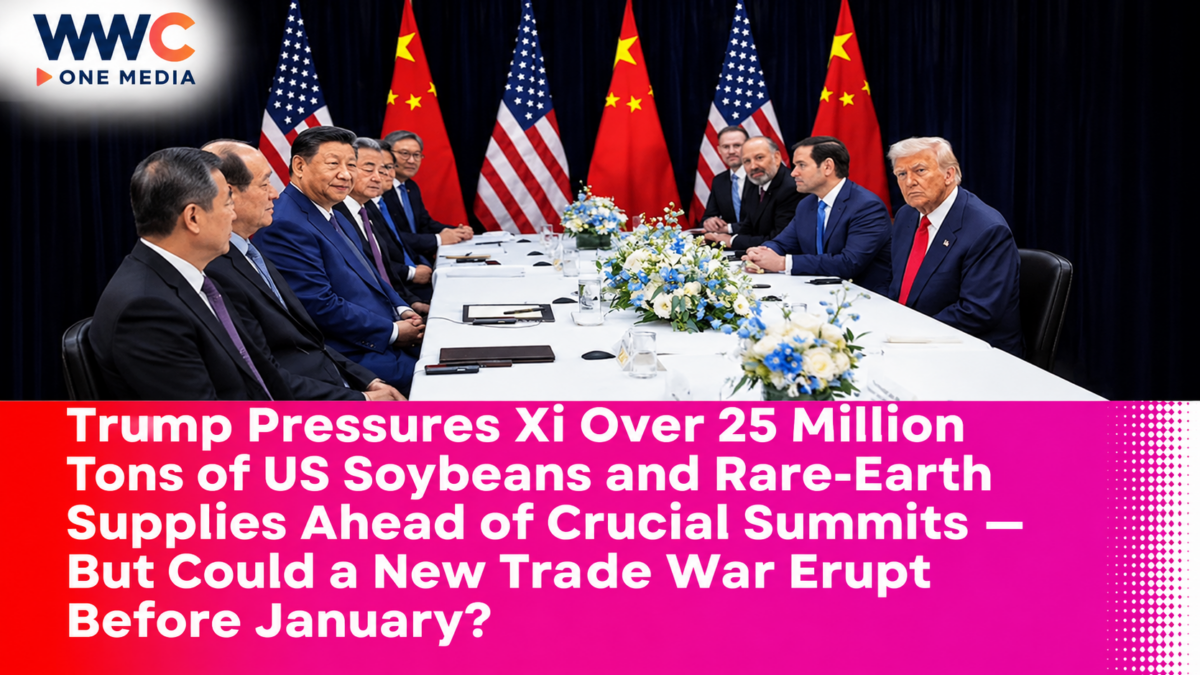
WASHINGTON / BEIJING — The fragile trade truce between the United States and China is facing another critical test after President Donald Trump’s administration demanded that Beijing deliver on its promises to purchase American agricultural products and improve access to rare-earth minerals.
With Trump and Chinese President Xi Jinping expected to meet twice before the end of 2026, Washington is signaling that diplomatic assurances will no longer be enough.
The United States wants concrete evidence that China is implementing commitments made under the trade agreement reached in Busan, South Korea, in October 2025.
On Friday, November 6, US Treasury Secretary Scott Bessent and US Trade Representative Jamieson Greer held a videoconference with Chinese Vice Premier He Lifeng.
The American officials raised concerns about China’s agricultural purchases and access to critical minerals essential to manufacturing, electronics and advanced technology.
Beijing responded by expressing serious concern about recent US trade restrictions.
Both sides nevertheless agreed to maintain consultations.
The diplomatic exchange has renewed uncertainty over an agreement scheduled to expire on January 10, 2027.
And with negotiations involving billions of dollars in agricultural purchases, strategically important minerals and possible tariff reductions, the stakes are extending well beyond Washington and Beijing.
Could the next Trump-Xi meetings deliver a lasting breakthrough—or is another confrontation between the world’s two largest economies approaching?
Trump Administration Demands Immediate Action From China
The latest negotiations took place during a November 6 call involving Bessent, Greer and He Lifeng.
According to an official statement from the Office of the United States Trade Representative, Washington emphasized the importance of China taking concrete steps to fulfill its earlier commitments.
The American government identified three priorities: agricultural purchases, rare earths and other critical minerals.
Bessent said he had urged China to honor its commitments fully and immediately.
The Treasury Department also indicated that American officials would closely evaluate Beijing’s implementation of the trade arrangement.
That language reflects Washington’s growing frustration.
The two countries have repeatedly announced agreements intended to stabilize economic relations.
But disagreements continue over whether those arrangements are being implemented as expected.
For Washington, the immediate focus is obtaining measurable results rather than additional promises.
For Beijing, the dispute involves reciprocal treatment and the removal of restrictions affecting Chinese businesses.
Why Rare Earths Have Become a Major Source of Tension
Rare-earth elements are essential to numerous advanced technologies.
They are used in permanent magnets, electric vehicles, wind turbines, industrial equipment and certain military systems.
China holds a dominant position in important stages of the global rare-earth supply chain, particularly processing and magnet manufacturing.
That gives Beijing considerable influence over supplies used by American and international companies.
US officials have complained that American manufacturers continue experiencing difficulty obtaining sufficient quantities of some Chinese rare earths and other critical minerals.
Washington says the Busan agreement was intended to ease restrictions introduced during the 2025 tariff confrontation.
But the Trump administration believes implementation has been inadequate.
The dispute highlights a broader concern about supply-chain security.
Even countries capable of producing advanced products may depend on foreign suppliers for essential materials.
A disruption involving rare-earth exports can affect manufacturers far beyond China and the United States.
Industries involving automotive components, industrial machinery and advanced electronics are particularly exposed.
For Washington, securing more reliable access to critical minerals has therefore become both an economic and national-security priority.
As previously reported by WWC ONE MEDIA in its analysis of how Trump and Xi moved from tariff confrontation toward a fragile trade truce, restrictions involving critical minerals have been among the most sensitive issues in the bilateral relationship.
American Farmers Are Waiting for China’s Promised Purchases
Agriculture is another major battleground.
The Busan arrangement includes a reported commitment for China to purchase 25 million metric tons of American soybeans over a three-year period.
It also includes commitments involving other US agricultural products.
Reuters reported that Washington expects expanded purchases worth billions of dollars.
The United States has also described plans involving approximately US$17 billion in additional agricultural trade.
However, the various soybean commitments, broader agricultural-purchase targets and proposed tariff arrangements should not be treated as one completed transaction.
They involve different negotiating commitments and implementation schedules.
For American farmers, China’s purchasing decisions have major financial consequences.
China is a significant importer of soybeans used in animal feed and food production.
American producers compete with suppliers from Brazil, Argentina and other agricultural exporters.
When Chinese demand weakens, US farmers can face pressure on prices and export revenues.
The Trump administration therefore wants China to demonstrate that its purchase commitments are translating into actual commercial orders and deliveries.
But Beijing has linked further agricultural purchases to reciprocal American tariff concessions.
That disagreement remains unresolved.
China’s Response: Trade Cooperation Must Work Both Ways
China did not simply accept Washington’s criticism.
According to the official Xinhua news agency, He Lifeng expressed serious concern about recent US trade restrictions.
Beijing maintains that additional commercial cooperation should be accompanied by implementation of reciprocal tariff reductions.
China’s Commerce Ministry said on November 5 that the country remained open to purchasing more American agricultural goods.
However, it emphasized the importance of both sides fulfilling their commitments.
The disagreement reveals the central weakness of the current trade relationship.
Washington wants Chinese market access and reliable export supplies.
Beijing wants relief from tariffs and restrictions affecting its own companies.
Neither government wants to appear to be making unilateral concessions.
That creates an environment where even previously announced agreements can become sources of renewed tension.
Nevertheless, Chinese and American officials agreed to continue consultations.
That suggests both governments still see value in preserving a functioning negotiating channel.
The January 10 Deadline Is Becoming a Major Risk
The existing Busan trade arrangement is scheduled to expire on January 10, 2027.
Under the agreement, US tariffs on Chinese goods introduced during Trump’s second term have been capped at approximately 20%.
The arrangement has helped prevent an immediate return to some of the more aggressive trade measures considered during earlier disputes.
But it remains temporary.
Unless the countries extend or replace the arrangement, uncertainty over tariff policy could increase.
Businesses need time to plan production, transportation and investment.
A sudden change in tariffs can alter the economics of importing materials or selling finished products.
For manufacturers with international supply chains, uncertainty itself can create costs.
Companies may delay investment decisions or diversify suppliers to reduce exposure.
As WWC ONE MEDIA previously reported when Washington and Beijing extended their trade truce into January, the extension created additional negotiating time without resolving every disagreement.
The November 6 exchange demonstrates that those unresolved issues remain significant.
Trump and Xi Prepare for Two Crucial Meetings
Diplomatic attention is now turning toward two major international summits.
Trump and Xi are expected to meet during the Asia-Pacific Economic Cooperation summit in Shenzhen on November 18 and 19.
They are also expected to hold discussions around the Group of 20 summit in Miami on December 14 and 15.
Those meetings could provide opportunities to address unresolved trade commitments.
The leaders may discuss agricultural purchases, critical minerals, tariffs and broader economic cooperation.
But the meetings are still expected events.
No new agreement can be treated as finalized before the governments announce its terms.
The September Trump-Xi summit in Washington demonstrated both the potential and limits of high-level diplomacy.
The two sides discussed a package of reciprocal tariff reductions estimated at approximately US$60 billion.
However, Reuters reported that the broader package had not been finalized.
Earlier discussions also produced proposals involving approximately US$30 billion in goods from each side that could qualify for improved tariff treatment.
Those proposals should not be confused with completed tariff reductions across the entire US-China trade relationship.
The challenge for the coming summits will be translating diplomatic understandings into enforceable and commercially meaningful arrangements.
Could the US$60-Billion Tariff Proposal Break the Deadlock?
The proposed tariff package is potentially important because it could provide benefits to both countries.
Lower tariffs can reduce certain costs for importers and improve market access for exporters.
American agricultural producers could benefit from stronger Chinese demand.
Chinese manufacturers could benefit from more favorable conditions for selected exports.
However, the economic effects would depend on which products are covered and when the changes take effect.
Not all tariffs are necessarily included.
Sensitive sectors may remain subject to restrictions.
And some measures may require additional domestic procedures before implementation.
As WWC ONE MEDIA reported on China’s decision to exclude whole American soybeans from an agricultural tariff-reduction list, individual product exclusions can undermine expectations that a broader trade agreement will benefit every agricultural exporter equally.
That example demonstrates why the details matter.
An agreement worth billions of dollars on paper may deliver uneven benefits across industries.
For farmers and manufacturers, the real measure of success will be improved market access and actual trade flows.
Why China Still Holds Important Leverage
Despite the pressure from Washington, Beijing retains substantial negotiating advantages.
China remains one of the world’s largest manufacturing centres.
Its processing capabilities in several critical minerals are difficult to replace quickly.
It also represents a major market for American agricultural exports.
These advantages give Beijing leverage in negotiations.
At the same time, China has vulnerabilities.
US tariffs can affect Chinese exporters.
Technology restrictions can complicate access to advanced semiconductors and other strategic equipment.
And global companies are increasingly seeking to diversify their supply chains.
Both governments therefore have economic reasons to avoid an uncontrolled escalation.
But neither side is willing to abandon its strategic priorities.
This combination creates a fragile balance: cooperation is commercially valuable, while competition remains politically important.
What Could Happen if the Trade Truce Breaks Down?
A failure to preserve the agreement could increase uncertainty across global supply chains.
Possible consequences include renewed tariff threats, additional export controls and delays in investment.
American agricultural producers could face weaker export demand if Chinese buyers shift purchases toward alternative suppliers.
Manufacturers could encounter higher costs or difficulties securing critical components.
Chinese exporters might face renewed pressure from US trade measures.
However, these are potential consequences rather than actions that have already been announced.
The latest November 6 call did not terminate the existing agreement.
Nor did it establish that either government has decided to launch another tariff war.
Both sides continue to negotiate.
The next important question is whether officials can agree on measurable implementation steps before the January deadline.
How the Dispute Could Affect Southeast Asia
The consequences of US-China trade tensions are especially important for Southeast Asian economies.
Countries including Vietnam, Malaysia, Thailand, Singapore and the Philippines participate in regional manufacturing and technology supply chains.
Some produce components used in electronics and automotive manufacturing.
Others provide logistics, financial services and industrial infrastructure.
A prolonged dispute between Washington and Beijing could encourage companies to diversify production across the region.
That may create investment opportunities for selected Southeast Asian markets.
But increased uncertainty can also disrupt trade and raise costs.
For the Philippines, the implications include potential changes in electronics demand, investment decisions and imported input prices.
Singapore’s role as a major trading and financial centre makes it sensitive to changes in international commercial flows.
Malaysia and Vietnam also have substantial exposure to technology and manufacturing supply chains.
The effects would vary by industry and country.
A trade dispute does not automatically benefit or damage every ASEAN economy in the same way.
The central issue is whether governments and businesses can adapt to changes in global sourcing and investment patterns.
APEC Could Become the Defining Test for US-China Relations
The upcoming APEC summit provides a diplomatic setting for Trump and Xi to address several difficult issues.
Unlike bilateral negotiations conducted exclusively by trade officials, a leaders’ meeting can help establish political priorities.
It may also allow the presidents to resolve disagreements that negotiators have struggled to settle.
But summit diplomacy has limits.
A public handshake or optimistic statement does not guarantee that commercial obligations will be fulfilled.
Implementation requires coordination among government agencies, businesses and regulators.
For the United States, success would mean more reliable Chinese agricultural purchases and critical-mineral supplies.
For China, success would involve meaningful progress on reciprocal tariffs and market restrictions.
For the wider world, success would mean reducing the risk of another sudden escalation between the two largest economies.
The stakes are high precisely because neither side has secured everything it wants.
What Investors and Businesses Should Watch Next
Several developments will help determine whether the negotiations are progressing.
The first is evidence of actual Chinese agricultural purchases, including soybean shipments and orders for other farm products.
The second is whether American manufacturers report improved access to rare-earth materials.
The third is progress on reciprocal tariff reductions.
The fourth is the outcome of the expected November and December presidential discussions.
Finally, businesses will monitor whether the January 10 deadline is extended or replaced by a more comprehensive arrangement.
Markets could react positively to credible progress.
But disappointment could also increase volatility.
Investors should distinguish between reported negotiating proposals and binding agreements.
Promises, draft arrangements and completed transactions are not interchangeable.
That distinction is particularly important in a trade relationship where implementation has repeatedly become a source of dispute.
The Bottom Line: Trump Wants Results, Xi Wants Reciprocity
The latest confrontation between Washington and Beijing is not about launching a completely new trade negotiation.
It is about whether the two countries are fulfilling commitments already made.
On November 6, Treasury Secretary Scott Bessent and Trade Representative Jamieson Greer pressed Vice Premier He Lifeng over agricultural purchases and access to critical minerals.
China responded by raising concerns about American trade restrictions.
Both sides agreed to continue talks.
The disagreement arrives before expected meetings between Trump and Xi at the APEC and G20 summits.
It also comes ahead of the January 10, 2027, expiry of their current trade arrangement.
The United States wants stronger evidence that China is meeting its commitments.
Beijing wants reciprocal concessions and more predictable trade conditions.
For businesses, the outcome could influence export demand, manufacturing costs and investment decisions.
For global financial markets, it could determine whether US-China economic relations stabilize or experience renewed turbulence.
And as Donald Trump prepares to face Xi Jinping with unresolved promises involving millions of tons of soybeans, billions of dollars in agricultural trade and strategically important rare-earth minerals, one question remains: Will the two leaders reach a deal that protects their fragile trade truce—or could their next disagreement ignite another costly confrontation across the global economy?