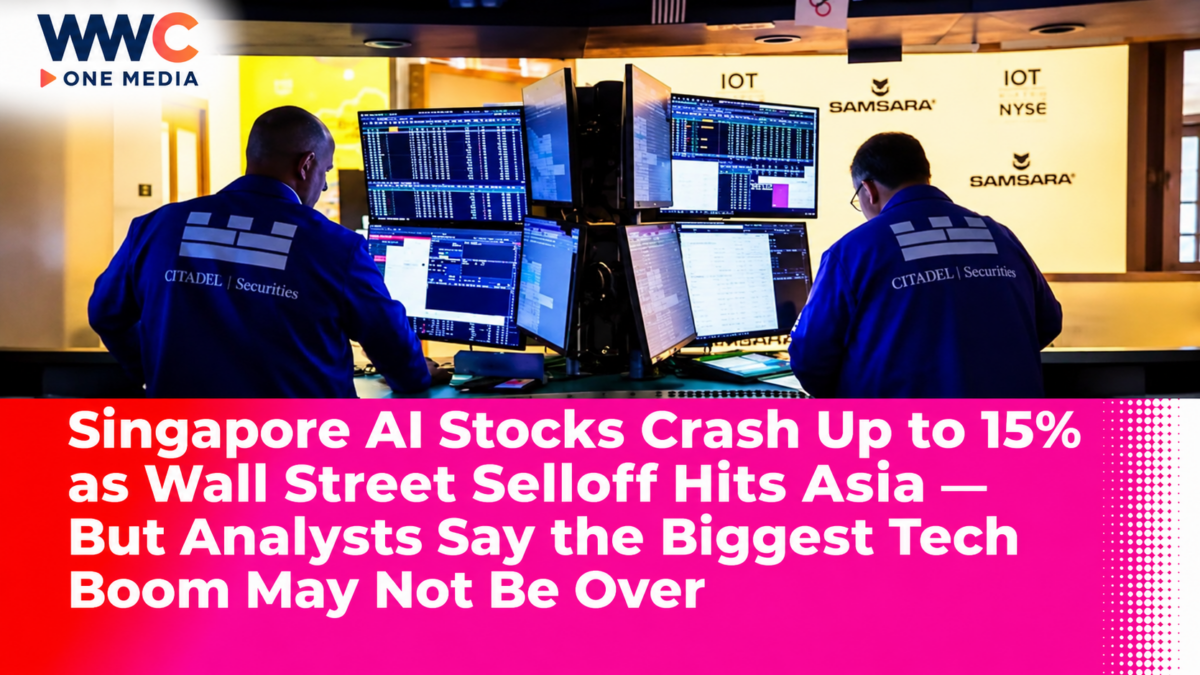
SINGAPORE — Singapore’s artificial intelligence investment boom has encountered a sudden reality check after a global technology-stock selloff triggered sharp declines in the city-state’s semiconductor and electronics companies, wiping out billions in regional market value and sending investors searching for answers.
On Friday, November 6, shares of semiconductor equipment supplier UMS Integration plunged 15.2% at the opening, while AEM Holdings dropped as much as 13%.
Frencken Group also fell more than 8% in early trading, as a wave of selling swept across companies connected to artificial intelligence, chip manufacturing and data-centre development.
The Straits Times Index ultimately closed 2.2% lower at 5,179.17 points.
But something unexpected happened during the session.
Buyers began returning to selected technology stocks, helping several companies recover a significant portion of their initial losses.
The recovery has prompted analysts to question whether the market is experiencing a temporary correction or the beginning of a more serious reversal in the global AI investment cycle.
While investors remain nervous about expensive valuations and possible tighter US regulations, industry experts say the underlying demand for advanced semiconductors and digital infrastructure has not disappeared.
For Singapore, the stakes are significant.
The country is home to major semiconductor manufacturers, specialized equipment suppliers and multinational technology investments.
And despite the latest market shock, long-term commitments—including Micron Technology’s planned US$24-billion expansion—suggest that the industry’s future may be more complicated than Friday’s falling share prices indicate.
UMS Integration Plunges 15.2% as Singapore Tech Shares Come Under Pressure
UMS Integration was among the hardest-hit technology companies during Friday’s opening session.
According to Channel News Asia, the semiconductor equipment supplier fell 15.2% at the market open.
The decline reflected investors’ concerns about global capital spending on semiconductor manufacturing equipment.
UMS supplies precision components used in semiconductor production systems, making it sensitive to expectations about future equipment orders.
But the shares subsequently recovered part of the decline and closed at S$1.69.
That recovery matters because a stock’s opening decline does not necessarily represent its final daily performance.
AEM Holdings experienced a similar pattern.
Its shares dropped as much as 13% during early trading before recovering to close at S$6.20.
Frencken Group fell more than 8% at the opening and finished approximately 6% lower.
Venture Corporation also came under pressure, closing around 3% down.
The developments suggest that investors were reducing exposure to companies associated with AI infrastructure.
However, the differences in each company’s performance indicate that the market was not treating every business identically.
Singapore’s STI Loses 117 Points as Global AI Panic Spreads
The technology selloff contributed to a broader decline in Singapore’s stock market.
The Straits Times Index fell 117.08 points, or 2.2%, on November 6.
It closed at 5,179.17.
According to The Business Times, nearly all of the benchmark’s constituent stocks finished lower.
The weakness extended beyond semiconductor companies.
DBS declined 2.1%, UOB fell 2.5%, and OCBC lost 0.7%.
Yangzijiang Shipbuilding led the index’s declines, while airport services company SATS was among the few stocks that ended higher.
That broad-based selling demonstrates how financial-market shocks can spread beyond the industries that initially trigger them.
Investors reassessing technology valuations may also reduce exposure to other equities as they adjust risk across their portfolios.
Singapore’s banks were additionally facing scrutiny following their third-quarter earnings announcements.
The result was a difficult session for the wider market.
But the decline did not establish that Singapore’s economy or technology industry had entered a recession.
It reflected a sharp repricing of shares amid global uncertainty.
Wall Street’s Nasdaq Collapse Triggers an Asian Technology Selloff
The turmoil began in the United States.
On Thursday, November 5, the Nasdaq Composite plunged 5.52%, entering correction territory after falling more than 10% from its October peak.
Investors sold shares in major technology companies amid concerns about the enormous amounts being spent on artificial intelligence.
The downturn followed the November 3 US midterm elections.
Democratic victories raised expectations of greater scrutiny of AI infrastructure, including data-centre construction and environmental regulation.
However, new federal restrictions are not automatic.
Any legislation would need to pass through the US political process and could face opposition from President Donald Trump, who retains veto powers.
The immediate market reaction therefore reflected fears about future policy, not a confirmed nationwide shutdown of AI development.
The selling nevertheless spread quickly across Asia.
South Korea’s technology-heavy market suffered a severe decline, and Japan’s Nikkei also experienced substantial losses.
As previously reported by WWC ONE MEDIA in its coverage of the Asian stock-market crash, the regional shock showed how closely Asian semiconductor companies are tied to expectations for US technology spending.
Singapore’s technology stocks were caught in the same reassessment.
Analysts Say the AI Boom Is Not Necessarily Over
Despite the heavy selling, market analysts interviewed by CNA offered a more measured interpretation.
Chez Anbu, OCBC’s head of wealth advisory, said Singapore’s technology sector has substantial but concentrated exposure to the global AI investment cycle.
The strongest connection comes through semiconductor manufacturing equipment and electronics supply chains.
That leaves certain Singapore-listed businesses particularly sensitive to changes in investor expectations.
But the selloff does not prove that the global expansion of AI infrastructure has ended.
Anbu noted that stocks enjoying the biggest earlier gains may remain vulnerable to further corrections.
Charu Chanana, chief investment strategist at Saxo, similarly explained that the recovery from the day’s lows suggested that buyers were still willing to return after steep declines.
However, she warned that market conditions remained uncertain.
Investors now need stronger evidence that AI spending can translate into durable earnings.
That is the central difference between a short-term market correction and a fundamental deterioration in business conditions.
Stock prices can fall because valuations become excessive, even when companies continue generating revenue.
The more serious warning would be actual reductions in customer orders, capital expenditure or earnings forecasts.
AEM and UMS Face Greater AI Exposure Than Diversified Electronics Companies
Not all Singapore technology businesses carry the same risks.
AEM Holdings provides advanced semiconductor testing solutions.
UMS Integration manufactures precision equipment components.
Their businesses are closely connected to semiconductor manufacturing investment.
If major chipmakers reduce equipment spending, these suppliers could face weaker orders.
Frencken and Nanofilm also have exposure to technology-related manufacturing.
Venture Corporation has a broader customer base spanning multiple electronics and industrial markets.
That diversification may provide some protection against weakness in a particular technology segment.
However, diversified companies are not immune to a global slowdown.
A widespread decline in electronics demand could affect businesses across multiple sectors.
The key distinction is how much each company’s future revenue depends on continued AI infrastructure investment.
For investors, understanding that exposure is more useful than assuming every Singapore technology stock will rise or fall together.
Micron’s US$24-Billion Singapore Investment Offers a Different Perspective
The longer-term industry outlook remains supported by major manufacturing commitments.
One of the most important is Micron Technology’s planned US$24-billion investment in Singapore.
In January 2026, the American semiconductor manufacturer announced a new advanced wafer fabrication facility within its existing NAND manufacturing complex.
The investment is planned over approximately 10 years.
Micron expects the facility to eventually provide around 700,000 square feet of cleanroom space.
Wafer production is scheduled to begin in the second half of 2028.
The project is intended to support demand for memory and storage technologies associated with AI and other data-intensive applications.
That long-term commitment illustrates why a short-term stock selloff should not automatically be interpreted as an end to investment.
Manufacturing projects of this scale are planned over many years.
However, Micron’s announcement is not a guarantee that every Singapore semiconductor supplier will benefit equally.
Contracts, customer relationships, technology requirements and future market conditions will determine which companies capture business from the expansion.
The project also remains subject to execution risks and potential changes in demand.
Applied Materials’ Expansion Strengthens Singapore’s Semiconductor Position
Applied Materials is another major technology company expanding its Singapore operations.
The company supplies equipment and services used in semiconductor manufacturing.
Its presence supports the country’s wider industrial ecosystem.
Singapore offers access to skilled workers, research capabilities, manufacturing infrastructure and international trade connections.
These advantages help attract multinational semiconductor companies.
For local precision manufacturers and engineering businesses, the presence of major equipment suppliers can create opportunities.
But the benefits are not automatic.
Local companies must meet demanding technical standards and compete for contracts.
The significance of Applied Materials’ expansion is that global semiconductor manufacturers continue to treat Singapore as an important operational location.
That supports the case for the country’s long-term industrial competitiveness even during periods of financial-market volatility.
Could Data-Centre Spending Grow 27% Annually Through 2029?
One of the more optimistic forecasts cited in CNA’s report concerns spending on data centres.
OCBC’s Chez Anbu pointed to projections suggesting global data-centre investment could grow by approximately 27% annually through 2029.
That would represent a substantial expansion of the physical infrastructure supporting artificial intelligence.
But it is a forecast, not a guaranteed outcome.
Future spending will depend on customer demand, financing conditions, electricity availability and government approvals.
The distinction matters because investors often price shares based on anticipated growth.
If companies expect spending to rise rapidly, they may expand capacity in advance.
But if customers delay projects, equipment suppliers can experience weaker orders.
That is why analysts are increasingly focused on actual spending plans rather than ambitious announcements alone.
As WWC ONE MEDIA previously examined in its coverage of Wall Street’s US$3.2-trillion AI stock rout, investors are questioning whether enormous infrastructure commitments can generate adequate returns.
For Singapore’s semiconductor companies, those questions matter because their customers are often investing in the equipment required to build that infrastructure.
The AI Revolution Is Entering a New Phase
Saxo’s Charu Chanana identified three broad stages of the AI investment cycle.
The first centres on semiconductor development and manufacturing.
Companies produce the advanced processors, memory systems and supporting components needed for AI.
The second involves infrastructure.
Businesses construct data centres, expand cloud computing and install networking systems.
The third stage is adoption.
Companies across the economy begin using AI to deliver measurable productivity improvements and generate revenue.
This third stage may become increasingly important.
The first two phases require large amounts of capital.
But continued investment depends partly on whether users of AI services can achieve meaningful financial benefits.
Singapore’s semiconductor manufacturers are more directly exposed to the first two stages.
That can make their earnings sensitive to changing infrastructure budgets.
By contrast, businesses successfully applying AI in sectors such as financial services, logistics and healthcare could potentially generate benefits even if the pace of data-centre construction slows.
The transition will not be smooth or identical across industries.
But it helps explain why a correction in semiconductor shares does not necessarily signal the end of artificial intelligence’s commercial development.
Independent Research Suggests Some Singapore Chip Stocks May Be Oversold
Not every analyst views the recent declines as a warning to avoid semiconductor shares.
Research published by FSM Global on November 6 highlighted a possible disconnect between falling Singapore technology-stock prices and the operating performance of some major semiconductor customers.
The research noted that AEM, UMS and Frencken had experienced substantial declines from mid-October to early November.
However, several important customers continued reporting strong results or maintaining substantial equipment-spending plans.
FSM Global upgraded UMS to a buy recommendation and maintained a buy rating on AEM.
It pointed to expectations of continued growth in semiconductor manufacturing equipment spending.
But its conclusion is an investment opinion rather than a guaranteed outcome.
Customer earnings may remain strong while individual suppliers face margin pressure, contract changes or weaker demand.
The independent research provides a counterpoint to the market panic.
It suggests investors should assess each company’s financial position rather than assume that a sector-wide selloff proves all businesses are deteriorating.
Why AI Data-Centre Regulation Could Become the Next Major Risk
Policy uncertainty remains a major concern.
Across several regions, proposed data centres have encountered opposition involving electricity consumption, water use and land development.
A tighter regulatory environment could delay certain projects or increase their costs.
That would affect companies selling equipment to data-centre operators.
As WWC ONE MEDIA reported in its investigation into opposition to AI data-centre construction, infrastructure developers increasingly face pressure to demonstrate that their facilities can operate without creating unacceptable burdens for surrounding communities.
However, regulation does not necessarily mean the industry will stop expanding.
Some projects may move to different locations.
Others may adopt new cooling systems or secure alternative electricity arrangements.
The effect on semiconductor demand would depend on whether those changes cause delays, cancellations or simply modifications to construction plans.
Investors therefore need to distinguish between political proposals and actual reductions in spending.
What Singapore Investors Should Watch Next
Several indicators could help determine whether the recent selloff becomes a deeper downturn.
The first is customer capital expenditure.
Spending announcements from major cloud providers such as Amazon, Microsoft and Alphabet can influence demand throughout the semiconductor supply chain.
The second is order visibility.
Companies with firm customer commitments may be better positioned than businesses relying heavily on projected future demand.
The third is balance-sheet strength.
Companies with manageable debt and adequate cash resources may have more flexibility during volatile markets.
The fourth is valuation.
A stock that has fallen significantly is not necessarily cheap if its price still assumes aggressive future earnings growth.
Finally, investors should monitor whether the market’s concerns lead to actual downward revisions in company guidance.
That would provide stronger evidence of deteriorating business conditions than share-price volatility alone.
Why Buying the Dip Could Still Be Risky
Sharp declines can tempt investors to buy shares immediately.
But analysts interviewed by CNA cautioned against rushing into the market without examining individual circumstances.
Anbu suggested that investors with a longer time horizon might consider spreading purchases over time rather than attempting to identify the exact bottom.
Chanana emphasized the importance of diversification, financial strength and realistic earnings expectations.
The advice reflects a basic investment principle.
A lower share price does not guarantee attractive value.
If a company was previously priced for years of exceptional growth, a 20% decline might still leave its shares expensive.
Investors also need to assess their existing exposure.
Someone already holding substantial investments in semiconductor and AI-related companies may increase concentration risk by buying more during a selloff.
Diversification can reduce some risks, but it does not eliminate the possibility of losses.
The appropriate approach depends on financial goals, risk tolerance and investment time horizon.
The Bigger Picture: Singapore’s Tech Industry Is Not the Same as Its Stock Market
Singapore’s technology industry and the share prices of its listed companies are related, but they are not identical.
A falling stock price can reflect changes in investor expectations.
It does not necessarily mean factories have stopped operating, existing investments have been cancelled or long-term demand has disappeared.
Likewise, announcements of new semiconductor projects do not guarantee rising share prices.
Markets evaluate expected future earnings, profitability, financing costs and risk.
The latest selloff illustrates that distinction.
UMS and AEM experienced steep early declines, while longer-term investments from companies such as Micron and Applied Materials continued to support Singapore’s industrial outlook.
For the government, the priority remains maintaining competitiveness in semiconductor manufacturing, research and digital infrastructure.
For companies, the challenge is winning sustainable orders and managing costs.
For investors, the challenge is determining which businesses can remain profitable if the global pace of AI infrastructure spending moderates.
The Bottom Line: Singapore’s AI Stocks Are Under Pressure, but the Boom Has Not Been Declared Dead
Singapore’s semiconductor and technology stocks suffered heavy selling on November 6 as the global AI investment selloff spread across Asian markets.
UMS Integration fell 15.2% at the opening.
AEM Holdings dropped as much as 13%.
Frencken and Venture Corporation also declined.
The Straits Times Index closed 2.2% lower at 5,179.17.
But several technology stocks recovered a significant portion of their early losses.
Analysts say the market is reassessing valuations, regulatory risks and future earnings expectations rather than confirming that artificial intelligence investment has permanently collapsed.
Singapore continues benefiting from long-term semiconductor manufacturing commitments, including Micron’s planned US$24-billion investment.
However, these projects do not remove the risks facing individual companies.
The crucial test will be whether major technology customers sustain their spending and whether AI adoption produces measurable economic returns.
And after one of Singapore’s sharpest recent technology-stock selloffs, one question remains: Are investors witnessing the painful correction of an overvalued AI market—or could Singapore’s semiconductor companies emerge stronger when the next phase of the artificial intelligence revolution begins?