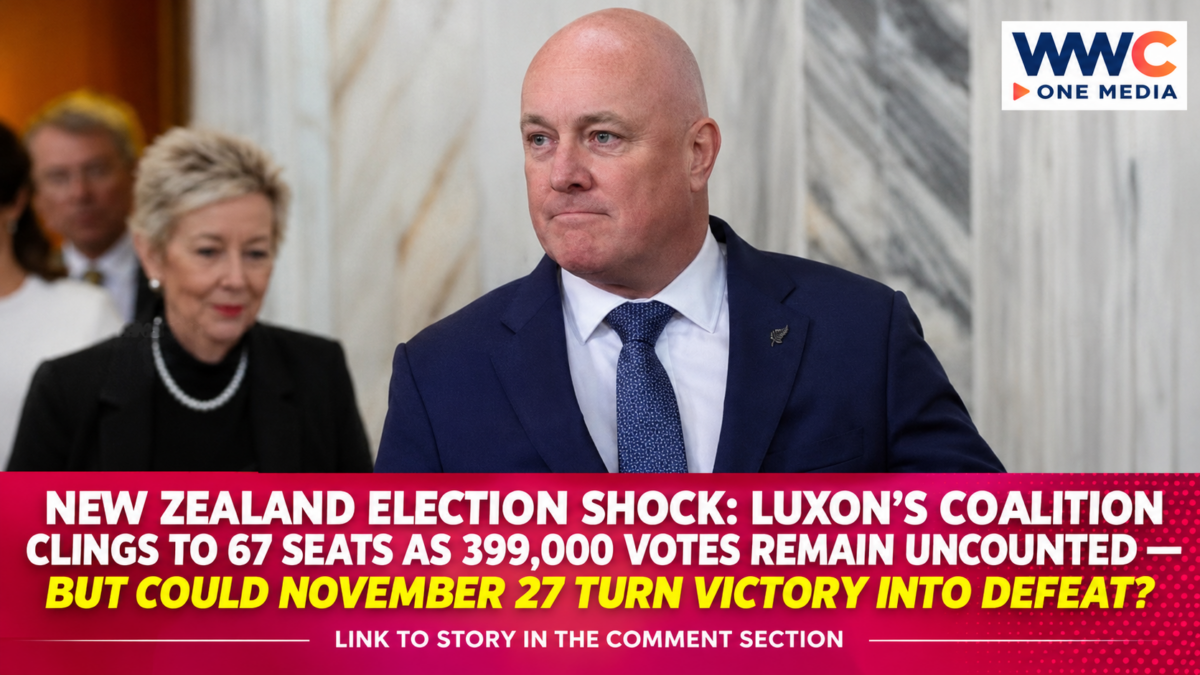
WELLINGTON, NEW ZEALAND — New Zealand has been plunged into political uncertainty after one of its closest general elections in years left Prime Minister Christopher Luxon fighting to retain power with the narrowest of parliamentary advantages.
Following Saturday’s November 7 election, preliminary results project that Luxon’s National Party and its coalition partners, ACT New Zealand and New Zealand First, will control 67 seats in a 131-seat Parliament.
That gives the governing bloc just one seat more than the 66 needed for a majority.
But the result is far from settled.
Approximately 399,365 special votes remain to be checked and counted, including ballots from overseas voters and New Zealanders who voted outside their home electorates.
Those votes have historically been more favourable to left-leaning parties.
With official results not expected until November 27, the outcome could still change.
And there is another remarkable twist.
Labour has received more preliminary party votes than Luxon’s National Party—even though National is projected to win six more parliamentary seats.
That unusual result has set the stage for weeks of coalition negotiations, political uncertainty and speculation about whether a seven-seat newcomer could determine the country’s next government.
Luxon Claims a Path to Government, but the Numbers Are Dangerous
Speaking to journalists on Sunday, November 8, Luxon argued that voters had given his party a route to forming the next government.
National is currently projected to hold 42 parliamentary seats.
Its existing partners, ACT and New Zealand First, are projected to secure 13 and 12 seats, respectively.
Together, the three parties would control 67 seats.
That would be enough to govern if the numbers survive the official count and the parties renew their governing agreement.
However, losing even a small number of seats could complicate the coalition’s position.
Luxon acknowledged that the result remains uncertain.
The prime minister also urged New Zealanders to take a break from political speculation while the remaining votes are counted.
His message was designed to project confidence without claiming an outright victory that the preliminary results do not yet establish.
For a prime minister seeking a second term, the distinction is important.
National has a possible route to power, but it does not yet have a confirmed mandate to govern.
Labour Actually Leads the Nationwide Party Vote
The official Electoral Commission figures reveal just how unusual the election has become.
Labour received 710,330 preliminary party votes, equivalent to 29.36% of the total.
National received 706,680 votes, or 29.21%.
That gives Labour a lead of just 3,650 votes.
Despite this advantage, Labour is projected to win 36 parliamentary seats compared with National’s 42.
The difference reflects New Zealand’s electoral system, including electorate victories and the creation of additional parliamentary seats.
Under the mixed-member proportional system, the party receiving the largest nationwide vote does not automatically form the government.
Instead, the decisive question is which combination of parties can command a majority in Parliament.
For Labour leader Chris Hipkins, the result provides political encouragement but not a straightforward path back to the prime minister’s office.
His party may have won more party votes, but its potential coalition partners currently lack a majority.
That is why negotiations and the remaining special votes will be critical.
New Zealand Election Results: How the Parties Stand
According to the Electoral Commission’s official preliminary results, the projected distribution of seats is:
| Political Party | Party Vote | Projected Seats |
|---|---|---|
| National | 29.21% | 42 |
| Labour | 29.36% | 36 |
| Green Party | 13.30% | 16 |
| ACT New Zealand | 10.92% | 13 |
| New Zealand First | 9.78% | 12 |
| Opportunity Party | 5.96% | 7 |
| Te Pāti Māori | 0.57% | 5 |
| Total projected Parliament | 131 |
The parliamentary total is larger than New Zealand’s usual 120 seats because of overhang seats, which arise when electorate results give parties more seats than their proportional party-vote allocation would otherwise provide.
The current numbers favour Luxon’s existing coalition.
But they remain provisional.
The Electoral Commission will recount ordinary votes, verify special ballots and finalize electorate results before declaring the official outcome.
The 399,365 Votes That Could Decide New Zealand’s Future
One of the most consequential parts of the election is the large number of special votes still to be processed.
The Electoral Commission estimates that approximately 399,365 special votes are outstanding.
These include overseas ballots and votes cast outside a voter’s home electorate.
The figure represents roughly 14% of the estimated total votes cast.
Special votes have historically helped Labour, the Greens and other left-leaning parties.
That does not guarantee the same pattern in 2026.
But it explains why political leaders are reluctant to declare victory.
A change of one or two seats could affect whether the current National-led coalition retains a parliamentary majority.
The official result is scheduled for Friday, November 27.
Until then, the political balance remains uncertain.
Chris Hipkins Refuses to Concede
Labour leader Chris Hipkins has also declined to declare the election over.
His centre-left party campaigned on restoring economic confidence, improving public services and easing household financial pressure.
The former prime minister, who succeeded Jacinda Ardern in 2023 before losing that year’s election, has spent the past three years attempting to rebuild Labour’s support.
The preliminary results suggest the party has recovered enough ground to challenge National closely.
But the parliamentary arithmetic remains difficult.
Labour’s 36 seats, combined with the Greens’ 16 and Te Pāti Māori’s five, would provide 57 seats.
That is nine short of the 66 required for a majority.
Even if the seven-seat Opportunity Party supported that grouping, the combined total would reach only 64 seats on the current projections.
Therefore, a Labour-led government would require changes in the final seat distribution or a different combination of parliamentary support.
The possibility remains open, but it cannot be presented as a confirmed outcome.
The Opportunity Party Could Become the Election’s Biggest Surprise
The emergence of the centrist Opportunity Party has added another layer of uncertainty.
Led by Qiulae Wong, the party received approximately 5.96% of the preliminary nationwide vote.
That places it above the 5% threshold generally required to enter Parliament through the party vote.
Opportunity is projected to secure seven seats.
For a party entering Parliament for the first time, that is a potentially significant achievement.
Its support could become decisive if the final count changes the balance between the major blocs.
The party’s rise was already attracting attention before election day.
As WWC ONE MEDIA reported on November 5 in its analysis of New Zealand’s election cliffhanger, Wong’s party was positioned to influence coalition negotiations if neither major political alliance secured enough seats.
That possibility now appears more relevant than ever.
However, Opportunity is not yet guaranteed to hold the balance of power.
On the current projected numbers, Luxon’s existing coalition can govern without it.
Its influence will depend on the final results.
Luxon Softens His Position Toward Opportunity
Before the election, Luxon had strongly resisted the possibility of cooperating with Opportunity.
One major disagreement involved the party’s proposed land-value tax.
National has opposed introducing such a tax.
But on November 8, Luxon adopted a more flexible tone.
He suggested that while his existing partners provided a route to government, he was willing to cooperate with Wong on issues where their parties could find common ground.
That does not amount to a coalition agreement.
Nor does it mean National has accepted Opportunity’s tax proposals.
The shift nevertheless demonstrates how a close election can change political calculations.
A party previously dismissed as an unlikely governing partner may become important if the final seat totals change.
For Wong, the situation offers an opportunity to influence policy.
But it also creates risks.
Supporting either major bloc could alienate voters who backed Opportunity as an alternative to New Zealand’s established political parties.
Why New Zealand Could Face Weeks of Political Negotiations
New Zealand uses a mixed-member proportional electoral system, commonly known as MMP.
Voters cast two ballots: one for their preferred political party and another for their local electorate representative.
The party vote largely determines proportional parliamentary representation.
However, electorate results can affect the total number of seats.
This system makes coalition governments common.
It also means election-night results do not always reveal who will become prime minister.
Following the official count, political parties may negotiate coalition agreements or confidence-and-supply arrangements.
Such agreements can include commitments involving taxation, government spending, ministerial portfolios and legislative priorities.
The process may take weeks.
The current government will continue operating under caretaker conventions while the outcome is finalized and a new government is formed.
That provides continuity in government administration.
However, major or controversial decisions may require additional consultation.
Why New Zealand’s Economy Became the Biggest Election Battleground
The exceptionally close result reflects widespread concern about the country’s economic conditions.
Households have been dealing with elevated living costs, weak economic growth and rising unemployment.
Housing affordability remains difficult for many families.
Businesses have also faced uncertainty involving borrowing costs, energy prices and consumer demand.
Luxon’s government campaigned on economic management, fiscal discipline and improving the business environment.
Labour argued that households needed stronger support, more affordable essential services and investment in infrastructure.
The competing approaches formed a central part of the campaign.
For many voters, the immediate concern was not which party could dominate political headlines.
It was which government could make everyday life more affordable.
That economic frustration appears to have contributed to stronger support for smaller parties.
Unemployment and Inflation Put Luxon’s Record Under Pressure
New Zealand’s unemployment rate rose to 5.7% in the September 2026 quarter, reaching its highest level in more than a decade.
Approximately 174,000 people were unemployed.
Inflation also remained above the Reserve Bank of New Zealand’s target range.
Annual consumer price inflation was 3.7% in the September quarter.
Those figures contributed to the pressure facing Luxon’s government before the election.
High living costs can reduce household purchasing power.
Rising unemployment can weaken confidence.
Together, they can make voters less willing to support an incumbent administration.
The opposition argued that government policies had not delivered sufficient relief.
National maintained that its economic approach would support recovery over time.
The election result suggests neither party secured overwhelming public confidence in its economic programme.
Interest Rates Could Become a Major Challenge for the Next Government
The election also comes during an important period for New Zealand’s monetary policy.
On October 28, the Reserve Bank of New Zealand held its Official Cash Rate at 2.75%.
As WWC ONE MEDIA reported in its analysis of possible interest-rate increases after the central bank’s surprise pause, economists were debating whether persistent inflation would require renewed monetary tightening.
Higher interest rates could help control inflation.
But they could also increase borrowing costs for households and businesses.
That would complicate the economic recovery promised by the eventual government.
The next prime minister will therefore inherit significant financial challenges regardless of which coalition takes power.
Political negotiations may determine the government’s economic policies, but central-bank decisions will continue to influence borrowing costs and investment conditions.
Australia’s Inflation Battle Highlights the Regional Economic Pressure
New Zealand is not alone in facing difficult economic conditions.
Australia has also been confronting persistent inflation and elevated borrowing costs.
As WWC ONE MEDIA reported on Australia’s November 3 interest-rate increase, the Reserve Bank of Australia raised its cash rate to 4.85% as policymakers sought to contain price pressures.
Australia’s monetary policy is separate from New Zealand’s election and central-bank decisions.
However, the regional comparison highlights the economic environment facing both countries.
Higher energy prices, housing costs and uncertain consumer demand can place pressure on households and businesses.
For New Zealand’s next government, restoring confidence will require more than securing parliamentary votes.
It will also require policies capable of responding to persistent economic challenges.
National Could Lose Several Senior Ministers
The election has also created uncertainty for prominent members of Luxon’s government.
Reuters and Australian ABC reporting indicated that Finance Minister Nicola Willis and other senior National figures were at risk of losing their parliamentary seats.
The situation is partly linked to the unusual seat allocation produced by the election.
National’s strong electorate performance, combined with a relatively low nationwide party vote, has affected how its parliamentary seats are distributed.
If senior ministers lose their seats, Luxon could face difficult decisions about Cabinet appointments and the continuity of important government portfolios.
That would add another challenge to coalition negotiations.
However, the final status of individual candidates must be determined through the official count.
Possible losses should not be described as confirmed departures until the election results are finalized.
Could New Zealand Experience a Major Political Realignment?
One of the most striking features of the election is the weakness of the two largest parties’ nationwide vote shares.
National and Labour each secured less than 30%.
Meanwhile, the Greens, ACT, New Zealand First and Opportunity collectively attracted substantial support.
This suggests that voters are becoming increasingly willing to consider alternatives to the country’s traditional major parties.
The result does not necessarily mean National or Labour will lose their long-term dominance.
But it could make future coalition negotiations more complicated.
Smaller parties may demand stronger policy concessions.
Major parties may find it more difficult to govern without substantial compromises.
And the balance of parliamentary power could become more sensitive to minor changes in electoral support.
For New Zealand, the election may represent more than a temporary political deadlock.
It could signal a changing relationship between voters and the parties that have historically dominated national politics.
What Happens on November 27?
The Electoral Commission is scheduled to release the official election results on Friday, November 27.
Before then, election officials will recount ordinary ballots, process special votes, verify eligibility and finalize electorate results.
The results could confirm the current National-led majority.
They could also alter the number of seats allocated to individual parties.
If Luxon’s coalition retains enough seats, negotiations may focus on renewing the existing governing agreement.
If the coalition loses its majority, other political combinations could become necessary.
That may increase Opportunity’s influence.
It could also create additional opportunities for Labour and its potential partners.
The final parliamentary composition will determine which arrangements are mathematically possible.
But the political willingness of individual parties to work together will determine whether those arrangements become a functioning government.
The Bottom Line: New Zealand Has Voted, but Its Next Government Is Still Uncertain
New Zealand’s November 7 general election has delivered an unusually close result.
Prime Minister Christopher Luxon’s National-led coalition is projected to hold 67 of 131 seats.
That is just one seat above the majority threshold.
Labour, led by Chris Hipkins, received more preliminary party votes than National but is projected to hold fewer seats.
The Greens, ACT, New Zealand First and the emerging Opportunity Party have secured substantial representation.
Approximately 399,365 special votes remain to be processed.
The official count will not be released until November 27.
Until then, Luxon will remain prime minister under caretaker conventions.
The election has also revealed broader public frustration with living costs, unemployment and the performance of major political parties.
The next government will face difficult decisions involving the economy, taxation, housing and public services.
But those policy debates cannot be resolved until the parliamentary balance becomes clear.
And as New Zealand waits for hundreds of thousands of remaining votes to be counted, one extraordinary question hangs over the country’s political future: Will Christopher Luxon’s one-seat majority survive November 27—or could a last-minute shift hand the balance of power to an unexpected coalition and end his government after just one term?