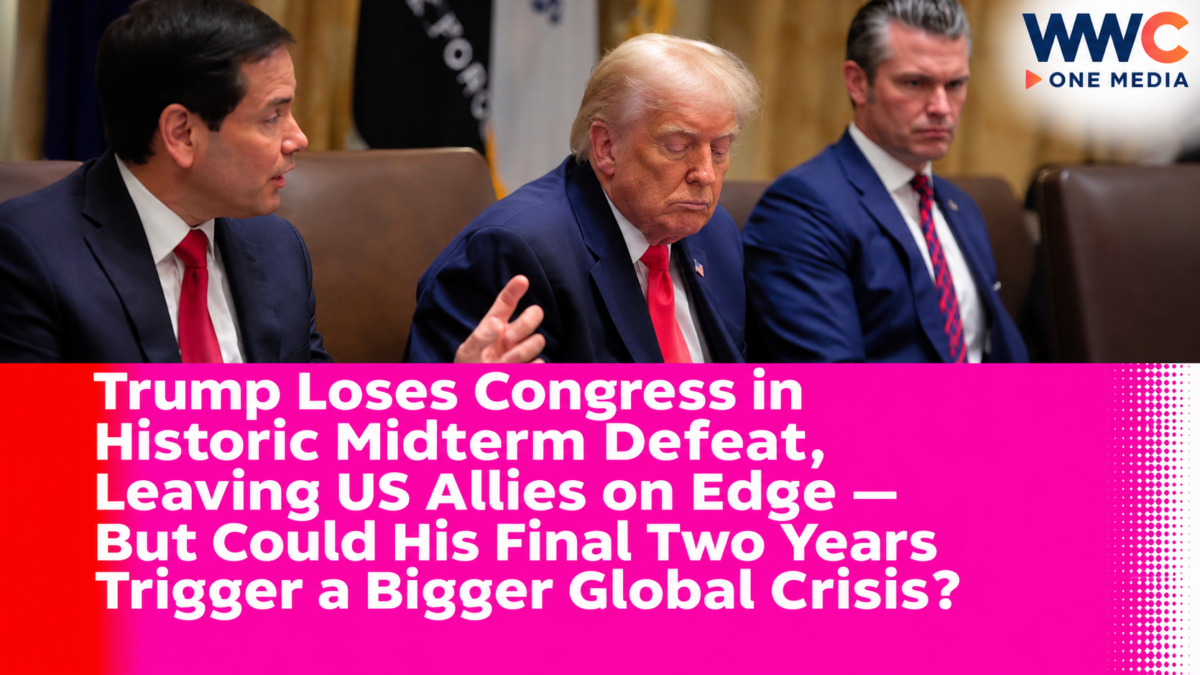
WASHINGTON / LONDON / MANILA — Donald Trump has suffered a devastating political defeat at home, but some of America’s closest allies are now confronting an uncomfortable possibility: a president weakened by voters could still wield enormous power over the rest of the world.
Following the November 3 US midterm elections, Democrats have captured both chambers of Congress, dealing Trump’s Republican Party a major setback and threatening to cripple much of his domestic legislative agenda.
But the president’s constitutional powers over diplomacy, military command and national security remain substantial.
That reality is raising difficult questions in capitals from Kyiv and Brussels to Tehran, Jerusalem and Beijing.
Could Trump respond to his domestic political humiliation by escalating international confrontations?
Or might he pursue diplomatic breakthroughs to rebuild his reputation and secure a favorable historical legacy?
A November 8 Bloomberg Opinion commentary by Marc Champion, republished by Channel News Asia, argues that foreign governments should prepare for both possibilities.
The central concern is not simply whether Trump has become a politically weakened president.
It is how he may choose to exercise the considerable authority he retains.
For America’s allies and rivals, the danger lies in mistaking domestic political weakness for reduced international influence.
Democrats Capture Congress, Delivering Trump’s Biggest Political Setback of 2026
The November 3 midterm elections dramatically changed the balance of power in Washington.
Democrats won control of both the House of Representatives and Senate, ending Republican domination of Congress.
The results were driven partly by dissatisfaction with rising living costs, energy prices and the administration’s handling of the Iran war.
The Associated Press reported that Democratic candidates made major gains in traditionally Republican states, demonstrating the breadth of voter frustration.
CBS News also projected substantial Democratic majorities, including at least 54 Senate seats as election results continued to develop.
The victories place Democrats in a stronger position to challenge Trump when the new Congress convenes in January 2027.
As previously reported by WWC ONE MEDIA in its coverage of the Democrats’ sweeping congressional victory, the election will significantly complicate the president’s efforts to advance major domestic legislation.
Democratic lawmakers will also gain committee leadership positions, giving them greater influence over congressional investigations, federal spending and executive-branch oversight.
However, losing congressional control does not remove Trump from office.
He remains president until January 2029.
And that distinction could prove crucial for international security.
Why a Lame-Duck President Could Still Be Powerful Abroad
The term “lame duck” generally describes an elected leader whose political influence has weakened, particularly as their time in office approaches its end.
But in the American presidential system, diminished congressional support does not automatically eliminate executive authority.
Trump retains the ability to conduct diplomacy, direct executive agencies and exercise commander-in-chief responsibilities.
Congress possesses substantial powers of its own, including authority over appropriations, legislation, oversight and declarations of war.
The president’s military powers are also subject to constitutional and statutory limits.
Nevertheless, presidents have historically exercised considerable discretion in international affairs, particularly during crises requiring immediate decisions.
Reuters reported on November 5 that Trump’s foreign-policy powers remain a major source of uncertainty despite the Democratic midterm victory.
Analysts identified several possible responses.
Trump could become more cautious after voters rejected policies associated with the Iran conflict.
He could seek major diplomatic agreements to improve his legacy.
Alternatively, he could pursue more confrontational actions abroad while facing legislative obstacles at home.
None of those outcomes is inevitable.
But they illustrate why foreign governments cannot assume that Trump’s election defeat means US foreign policy will become more predictable.
Iran: Could Trump’s Political Defeat Reduce the Risk of Another War?
One of the most consequential questions concerns the conflict involving Iran.
The war has become a major political liability for the administration.
Its economic consequences, particularly pressure on energy markets, contributed to voter dissatisfaction ahead of the midterms.
In his Bloomberg Opinion commentary, Marc Champion argues that renewed large-scale hostilities could be politically counterproductive for Trump.
The reasoning is straightforward.
If Americans have already expressed frustration over the economic consequences of military conflict, escalating that conflict could deepen the president’s domestic problems.
Champion points to Vice President JD Vance’s assessment that the Iran war and its economic repercussions played an important role in the Republican defeat.
That could give Trump a powerful incentive to avoid renewed high-intensity warfare.
In an interview with the Financial Times, Trump appeared to suggest that the current arrangement was delivering important benefits for Washington, particularly in relation to Gulf oil flows.
But this does not mean the risk of escalation has disappeared.
Iran’s leaders also have strategic interests and political pressures of their own.
If Tehran determines that the current situation is unacceptable, it could take actions that increase the risk of renewed confrontation.
That could force Washington to choose between military escalation, diplomatic concessions or continued instability.
Reuters similarly identified the Iran conflict as one of the most immediate tests of Trump’s post-election foreign policy.
For global markets, the stakes are especially high.
Renewed disruptions to Middle Eastern energy supplies could increase oil prices, create inflationary pressures and complicate economic recovery.
For countries such as the Philippines, which depend heavily on imported petroleum, sustained increases in international oil prices could affect transportation costs, electricity expenses and consumer prices.
The critical uncertainty is whether both Washington and Tehran see greater value in maintaining the current fragile situation or negotiating a more durable settlement.
Ukraine Faces a Dangerous Diplomatic Calculation
Ukraine may be confronting an even more difficult strategic dilemma.
President Volodymyr Zelenskyy’s government continues to depend on Western security assistance as Russia’s invasion remains unresolved.
Trump has repeatedly expressed interest in negotiating an end to the war.
However, the terms of any settlement remain deeply contested.
Ukraine has resisted arrangements that would undermine its sovereignty or leave it vulnerable to future Russian attacks.
Moscow continues pressing demands that Kyiv and its European partners consider unacceptable.
Champion argues that Trump’s political setback could create uncertainty over whether Washington will increase pressure on Ukraine or seek a different negotiating strategy.
One possibility is that Trump might push Kyiv toward territorial concessions in pursuit of a diplomatic agreement.
Another is that the incoming Democratic Congress could encourage Washington to take a firmer stance toward Russian President Vladimir Putin.
Democratic lawmakers have generally been more supportive of continued military assistance to Ukraine, although positions vary across Congress.
The new majority could use legislative and spending powers to advocate stronger support for Kyiv.
But the president would retain considerable influence over diplomatic negotiations and implementation of foreign policy.
As previously examined by WWC ONE MEDIA in its analysis of Trump’s remaining international powers, the new congressional balance may complicate the administration’s foreign-policy decisions without removing presidential authority.
For Ukraine, the challenge is determining whether Trump’s weakened position at home creates an opportunity for stronger Western support or increases pressure to accept a settlement unfavorable to Kyiv.
Both remain possible.
Putin Watches Washington’s Political Turmoil
Russia is also closely monitoring the consequences of Trump’s defeat.
Following the midterm election results, Kremlin spokesman Dmitry Peskov expressed hope that Trump would continue his efforts to negotiate a resolution to the Ukraine conflict.
That statement reflected Moscow’s interest in preserving diplomatic engagement with Washington.
But it does not prove that Russia and the United States have agreed on a peace settlement.
Major disagreements remain over territory, security guarantees and Ukraine’s future relationship with Western institutions.
Russian state-controlled media have also speculated about whether Trump’s political defeat could make him more confrontational internationally.
Such commentary should be understood as political interpretation, not evidence of a confirmed White House strategy.
The more important issue is whether Moscow believes the next two years offer an opportunity to secure favorable terms before another American administration takes office.
Trump cannot seek another elected presidential term under the US Constitution’s Twenty-Second Amendment.
His current term therefore creates a limited window in which he may pursue major diplomatic initiatives.
For Putin, that time horizon may influence negotiations.
For European governments, it creates urgency to establish security arrangements that can survive changes in Washington.
NATO and Europe: Could America’s Security Guarantees Become Less Predictable?
European leaders are facing a difficult balancing act.
They want to preserve America’s military commitment to NATO while preparing for the possibility of a less dependable Washington.
Trump has repeatedly argued that European countries should assume greater responsibility for their defense.
He has also questioned aspects of the transatlantic security relationship.
The incoming Democratic majority may favor stronger cooperation with European allies.
However, congressional support does not automatically guarantee that Trump will adopt the same approach.
The president continues to represent the United States in high-level diplomatic negotiations and directs much of the executive branch’s foreign-policy activity.
Congress can influence defense spending, impose legal restrictions and conduct oversight.
But major changes often require legislation capable of surviving a presidential veto.
That is a significant obstacle because Democrats do not hold the two-thirds majorities needed to override vetoes without Republican support.
Champion’s commentary emphasizes that European governments should prepare for uncertainty rather than assuming the election result will restore predictable US leadership.
The implications extend beyond military spending.
NATO countries must consider long-term weapons procurement, defense-industrial capacity, intelligence cooperation and the protection of critical infrastructure.
They must also determine how to support Ukraine if Washington’s priorities change.
The central challenge is building greater European resilience without unnecessarily damaging the alliance.
Israel Faces a Political Shock as US Support Comes Under Pressure
Israel is another country confronting potentially significant consequences from America’s midterm elections.
The country held an inconclusive election on October 27, leaving its political future unsettled.
Trump had supported Prime Minister Benjamin Netanyahu, but shifting political sentiment in the United States has complicated Israel’s relationship with Washington.
Champion argues that growing criticism of Israel among American voters could influence future US policy.
The issue is particularly sensitive because American military assistance and diplomatic support remain important to Israel’s national security.
According to the CNA-published commentary, Trump said on November 3 that he intended to halt nearly US$4 billion in annual American military assistance to Israel by the end of the year.
That statement represents a significant proposed policy shift.
However, a presidential declaration should not be confused with confirmation that all assistance has already ended.
Existing aid arrangements, funding laws and implementation procedures may affect what changes can take place.
Israel’s opposition leader Gadi Eisenkot has argued that restoring bipartisan American support should be a central national priority.
His argument reflects concern that Israel’s traditionally strong position in Washington may become more politically contested.
The outcome of Israel’s government-formation process could influence how the country responds.
For Netanyahu and his opponents, the American midterm results have added another complication to an already difficult domestic political environment.
Why US Support for Israel Could Change After 2026
American policy toward Israel has historically enjoyed considerable bipartisan support.
However, differences have emerged within both major political parties over military assistance, civilian casualties and US policy in the Middle East.
The 2026 midterm elections may intensify that debate.
A Democratic-controlled Congress could seek closer scrutiny of arms transfers, assistance programs and the administration’s regional strategy.
At the same time, Trump retains meaningful executive authority over diplomacy and certain security decisions, subject to applicable law.
Any major change in American assistance could have consequences beyond Israel.
It might affect regional military balances, diplomatic relations with Arab governments and negotiations involving Iran.
But it is important to distinguish among three separate developments: political statements, proposed policy changes and measures that have actually taken legal effect.
Those are not interchangeable.
The central question is whether Washington and Jerusalem can maintain a stable security relationship despite growing political disagreements.
China and Asia: America’s Allies Face a Different Kind of Uncertainty
The consequences of Trump’s weakened domestic position extend across Asia.
China, Japan, South Korea, Taiwan and the Philippines all have significant interests in Washington’s decisions.
For Beijing, the priority includes trade, technology restrictions and US security commitments in the Indo-Pacific.
For Japan and South Korea, American military partnerships remain central to national defense planning.
For Taiwan, uncertainty surrounding Washington’s willingness to respond to a regional crisis remains a major strategic concern.
For the Philippines, US policy has direct implications for maritime security, defense cooperation and regional stability.
Another CNA analysis by Kevin Chen of Singapore’s S. Rajaratnam School of International Studies suggests that Trump’s midterm setback could encourage renewed attention to foreign-policy initiatives, including potential diplomatic engagement with North Korea.
Such efforts could create opportunities for dialogue.
But they might also concern regional allies if negotiations occur without sufficient consultation.
The broader lesson is that Asia cannot judge Washington’s future behavior solely through the balance of power in Congress.
Presidential decisions, existing security commitments and diplomatic negotiations will remain influential.
The Philippines in particular must continue monitoring developments involving the South China Sea and the US-Philippines defense relationship.
A change in American political leadership or priorities could affect regional calculations even without an immediate change in treaty commitments.
Trump Could Face Aggressive Congressional Investigations
While foreign governments assess the implications of Trump’s remaining powers, Democrats are preparing to challenge the president at home.
The incoming majority is expected to focus congressional oversight on several controversial areas of the administration.
These include the Iran war, defense spending, immigration enforcement, government contracts and possible conflicts of interest.
As detailed in WWC ONE MEDIA’s report on the Democrats’ five-front congressional offensive, lawmakers are preparing to use committee hearings, document requests and investigations to scrutinize executive-branch decisions.
Such investigations can impose political costs and reveal information relevant to public accountability.
But they do not automatically result in criminal charges or overturn executive decisions.
Congress must operate within constitutional and statutory limits.
Disputes over executive privilege, subpoenas and oversight authority may also result in litigation.
For Trump’s administration, the combination of domestic investigations and international crises could create a complicated governing environment.
The president may need to respond simultaneously to congressional scrutiny, military developments and diplomatic negotiations.
That does not make foreign-policy escalation inevitable.
It does increase the importance of careful decision-making.
Stephen Miller’s Promotion Signals Continued Political Confrontation
Trump has already begun reshaping his administration following the midterm losses.
On November 6, he announced that Stephen Miller would replace Susie Wiles as White House chief of staff.
Miller, a longtime adviser and prominent advocate of strict immigration policies, is scheduled to take office on November 9.
The appointment suggests that Trump is maintaining a confrontational political approach rather than immediately seeking a broad compromise with Democrats.
As WWC ONE MEDIA reported in its analysis of Miller’s appointment, the leadership change places one of the president’s most ideologically committed advisers in a central coordinating role.
Miller’s appointment does not establish what decisions Trump will make about Iran, Ukraine or China.
The chief of staff helps manage White House operations and coordinate policy.
The president remains responsible for final executive decisions.
Still, personnel choices can offer insight into an administration’s priorities.
Trump’s decision to elevate Miller after a major election defeat suggests that the White House is not abandoning its willingness to confront political opponents.
Whether that approach extends to major changes in foreign policy remains uncertain.
Could Trump Pursue a Major Foreign-Policy Breakthrough Instead?
Not every consequence of Trump’s political defeat would necessarily increase international tensions.
There is another possible outcome.
A president facing legislative gridlock may seek diplomatic achievements that do not require the same level of congressional cooperation as domestic reforms.
Historical precedent supports the possibility.
Presidents have often pursued significant foreign-policy initiatives during periods of divided government.
Trump might attempt to negotiate a settlement involving Iran.
He could seek progress in Ukraine-Russia peace talks.
He might pursue a trade agreement with China or open additional diplomatic channels in Asia.
Such efforts could allow him to claim major achievements before leaving office.
But diplomacy carries its own risks.
A poorly constructed agreement might leave allies feeling excluded.
Concessions designed to secure a quick announcement could create long-term security problems.
And negotiations could collapse if the parties involved refuse to compromise.
For that reason, foreign governments must examine the substance of any proposed agreement rather than focusing solely on whether Trump announces a diplomatic breakthrough.
Why Global Markets Should Watch Trump’s Next Moves
Political uncertainty in Washington can influence financial markets, particularly when it intersects with military conflict and international trade.
A renewed confrontation involving Iran could affect oil prices and shipping costs.
Changes in US policy toward Russia could influence energy markets, sanctions and European defense spending.
New trade restrictions involving China could disrupt supply chains and increase costs for businesses.
Uncertainty surrounding American security commitments could also affect investment decisions in Europe and Asia.
Reuters reported that investors were already preparing for greater legislative gridlock and regulatory scrutiny following the midterm results.
However, market reactions to political events are not always straightforward.
Some investors may welcome limits on domestic policy changes.
Others may worry about unpredictable executive action.
A congressional defeat does not automatically produce higher oil prices, falling stock markets or currency volatility.
Those outcomes depend on actual policy decisions, economic conditions and investor expectations.
For Philippine businesses, developments involving energy prices, exchange rates and US trade policy deserve particular attention.
But predictions should remain conditional until concrete decisions emerge.
What America’s Allies Should Do During Trump’s Final Two Years
The central recommendation emerging from Champion’s Bloomberg Opinion commentary is that foreign governments should prepare for uncertainty.
That means avoiding overdependence on any single expectation about Trump’s future decisions.
European governments may need to strengthen defense capabilities and coordinate more closely on Ukraine.
Middle Eastern leaders may need to prepare for both renewed diplomacy and possible military escalation.
Asian governments should maintain communication with Washington while strengthening regional relationships and crisis-management arrangements.
Israel faces the additional challenge of maintaining support from American political leaders across party lines.
These are policy considerations rather than evidence that a particular crisis is about to occur.
The most effective response to uncertainty is not necessarily confrontation.
It is building diplomatic flexibility and maintaining options.
Governments that can adapt to changes in Washington may be better positioned than those that assume Trump’s political weakness guarantees a particular outcome.
The Bigger Picture: Trump Is Weaker at Home, but the World Cannot Ignore Him
The November 3 elections marked a major political reversal for Donald Trump.
Democrats captured Congress, creating significant obstacles for the domestic agenda of his second administration.
But his defeat does not mean that America will retreat from international affairs or that the president has lost control of foreign policy.
Trump continues to wield substantial executive authority.
The United States remains a central military, diplomatic and economic power.
And decisions made in Washington can still influence conflicts, alliances and markets around the world.
Marc Champion’s central argument is that world leaders must assess what Trump considers politically advantageous rather than assuming his loss of Congress will automatically make him either more aggressive or more restrained.
That remains an interpretation, not a proven prediction of presidential behavior.
Trump could attempt to rebuild his political standing through diplomacy.
He could intensify confrontation with adversaries.
Or he could pursue a mixture of both approaches, depending on the circumstances.
The incoming Democratic Congress will have meaningful opportunities to scrutinize his decisions, influence funding and challenge some policies.
But its ability to dictate foreign-policy outcomes will remain limited by constitutional divisions of authority, existing laws and the president’s veto powers.
For America’s allies, preparing for multiple scenarios may be more important than attempting to predict one.
The Bottom Line: A Lame-Duck President Could Still Reshape the World
Donald Trump’s historic midterm defeat has changed the political balance in Washington.
It has not eliminated his ability to shape international events.
From Iran and Ukraine to Israel, Europe and the Indo-Pacific, governments must now consider how the president will respond to a divided political system during his final two years.
The possibilities include both diplomatic breakthroughs and dangerous escalation.
Congressional investigations may constrain parts of his administration, but the president will continue exercising significant powers over foreign affairs.
That creates a period of uncertainty with potentially far-reaching consequences.
For the Philippines and other American partners, the challenge is to remain prepared for changing US priorities while protecting their own security and economic interests.
And as Trump enters the final two years of his presidency with a hostile Congress and an increasingly uncertain international environment, one question could determine the future of global stability: Will America’s weakened president pursue peace to secure his legacy—or could the world’s next major crisis emerge from his determination to prove that he is still in control?