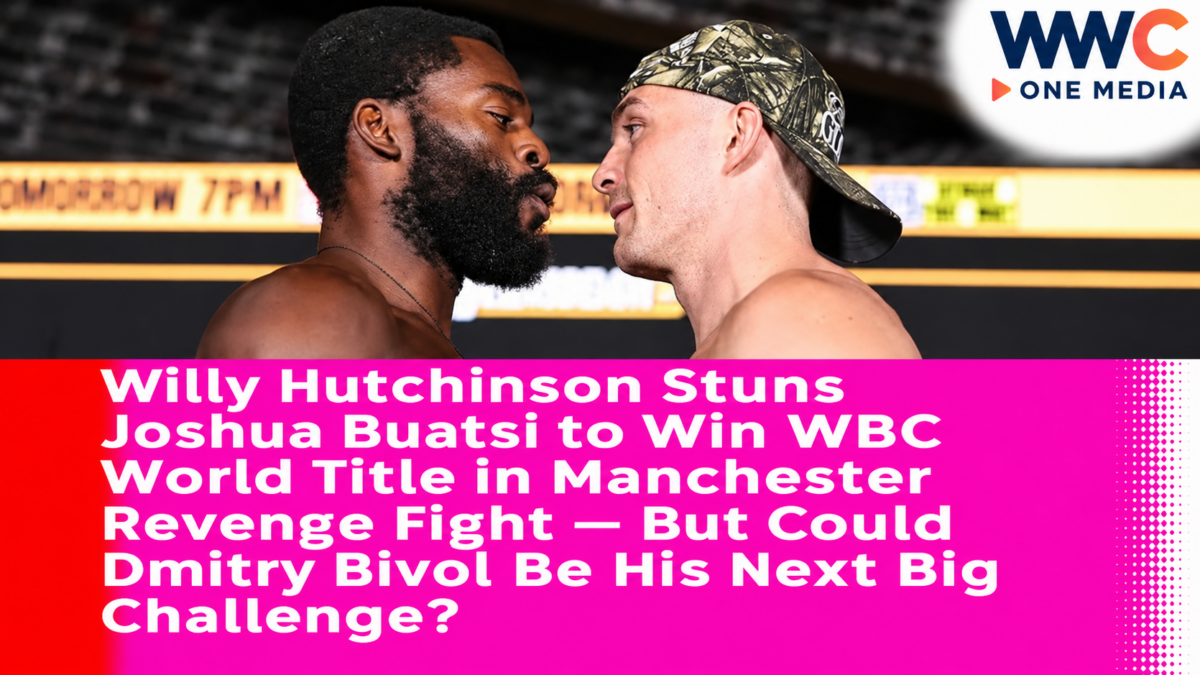
MANCHESTER, UNITED KINGDOM / MANILA, PHILIPPINES — November 8, 2026 | WWC ONE MEDIA | Global Sports, Boxing and World Championships
Scottish boxer Willy Hutchinson has completed a remarkable comeback, defeating former Olympic medalist Joshua Buatsi by unanimous decision to capture the vacant World Boxing Council (WBC) light-heavyweight championship.
In a fiercely contested 12-round rematch at Manchester’s AO Arena on Saturday, November 7, Hutchinson used superior movement, quick combinations and disciplined counterpunching to overcome the opponent who had handed him a painful defeat two years earlier.
The three judges awarded the contest to Hutchinson by scores of 117–112, 115–113 and 115–113, confirming one of the biggest victories of the 28-year-old’s professional career.
For Hutchinson, the triumph was particularly satisfying.
In September 2024, he had been knocked down twice by Buatsi before suffering a split-decision defeat at Wembley Stadium.
This time, the result was reversed.
Hutchinson survived Buatsi’s late pressure, controlled crucial stages of the contest and secured the championship belt vacated by unbeaten American star David Benavidez.
The victory improved his professional record to 21 wins and two defeats, including 14 knockouts.
Buatsi, meanwhile, fell to 20 wins and two losses.
According to Reuters, the result also reshapes the WBC light-heavyweight championship picture as rival titleholder Dmitry Bivol prepares for a December defense against Callum Smith.
But Hutchinson’s long-awaited success now raises a more difficult question.
Can the newly crowned Scottish champion establish himself among the world’s elite light-heavyweights—or will the division’s biggest names prove an even tougher challenge than the opponent he finally defeated?
Hutchinson Finally Gets Revenge Against Buatsi
The November 7 contest was more than an ordinary world championship fight.
It was a rematch loaded with unfinished business.
Hutchinson had wanted another opportunity to face Buatsi since their first meeting at Wembley Stadium on September 21, 2024.
That night, Buatsi won a split decision following a dramatic battle on the undercard of Daniel Dubois’ heavyweight championship defense against Anthony Joshua.
Buatsi knocked Hutchinson down in the sixth and ninth rounds.
Those two knockdowns proved crucial to the result.
Although Hutchinson recovered and continued fighting, the judges awarded Buatsi the victory.
The official scorecards read 117–108 and 115–110 for Buatsi, with the third judge scoring the contest 113–112 for Hutchinson.
That narrow split reflected the competitiveness of the encounter despite the two knockdowns.
For Hutchinson, the defeat became motivation.
He believed he could perform better in a rematch.
More than two years later, he finally got his opportunity.
And this time, the result went his way.
Hutchinson’s Speed and Movement Make the Difference
Sky Sports reported that Hutchinson established an early advantage through his hand speed and elusive movement.
The Scottish fighter repeatedly used quick combinations before moving away from Buatsi’s attacks.
That approach prevented Buatsi from consistently establishing the same pressure that had helped him win their first encounter.
Hutchinson also demonstrated greater discipline.
Rather than remaining stationary and inviting exchanges, he used movement to control distance.
His counterpunching proved particularly effective during the opening stages.
Buatsi struggled to land the damaging shots that had produced two knockdowns in 2024.
The tactical contrast was significant.
Hutchinson’s performance showed that revenge did not require him to overpower his rival.
He could win by changing his approach.
The result was a more controlled performance built around timing, positioning and punch selection.
Buatsi Fights Back but Cannot Reverse the Result
Buatsi did not surrender easily.
The former Olympic bronze medalist increased his aggression during the second half of the contest.
He closed the distance more frequently and attempted to attack both Hutchinson’s head and body.
His increased activity created a more competitive finish.
Two judges eventually scored the fight by only two points, showing how closely contested several rounds remained.
But Hutchinson maintained enough control to preserve his advantage.
During the final round, the Scotsman avoided unnecessary exchanges and relied on movement to protect his lead.
When the final bell sounded, both fighters had completed the scheduled 12 rounds.
The judges agreed on the winner.
Hutchinson had avenged his previous defeat and captured one of boxing’s most prestigious championship belts.
Why This Was a Full WBC World Championship Fight
There was some confusion surrounding the title at stake.
Earlier announcements described Hutchinson versus Buatsi as a contest for the interim WBC light-heavyweight championship.
An interim championship can be awarded when circumstances prevent the recognized titleholder from making a regular defense.
But the status of this contest changed before fight night.
David Benavidez, previously the WBC light-heavyweight champion, relinquished the title as he pursued opportunities in the cruiserweight division.
That left the full WBC world championship vacant.
The WBC subsequently promoted Hutchinson versus Buatsi into a contest for the vacant championship.
This is why Reuters, BBC Sport and Sky Sports correctly identified Hutchinson as the new WBC light-heavyweight world champion after his victory.
The distinction matters.
Hutchinson did not merely win an interim belt while another fighter remained the recognized WBC titleholder.
He captured the vacant full championship.
That achievement significantly strengthens his position in the division.
David Benavidez’s Decision Created the Championship Opportunity
Benavidez’s departure from light-heavyweight opened the path for Hutchinson and Buatsi to compete for the title.
The American had established himself as one of the division’s leading fighters.
However, he decided to pursue new opportunities in the heavier cruiserweight category.
The WBC confirmed that the title was vacant following his decision.
For Hutchinson, the development created the biggest opportunity of his career.
Instead of simply settling a personal score with Buatsi, he had the chance to become a world champion.
That added enormous stakes to the rematch.
It also meant the winner would enter a championship landscape containing several other major titleholders.
The WBC belt gives Hutchinson recognition as a champion.
But it does not make him the undisputed champion of the entire light-heavyweight division.
That distinction remains important when considering what could come next.
Who Is Willy Hutchinson?
Hutchinson is a Scottish professional boxer who had already built a strong reputation before his world championship breakthrough.
Known as “The Hutch Train,” he entered the rematch with a professional record of 20 victories and two defeats.
Fourteen of his victories had come by knockout.
His previous achievements included winning the WBC International light-heavyweight title in 2023.
In June 2024, he also defeated Craig Richards in Saudi Arabia to secure the WBC Silver championship.
Those victories demonstrated his ability to compete against experienced opposition.
But Buatsi represented a particularly difficult challenge.
Their first fight exposed vulnerabilities in Hutchinson’s defense and ability to handle pressure.
The rematch showed evidence of improvement.
By relying more effectively on speed and movement, Hutchinson was able to avoid the damaging exchanges that had cost him the original encounter.
His victory adds another major achievement to British boxing.
For Scottish fans, it also creates a new world champion to follow as the division enters its next championship cycle.
Joshua Buatsi’s Olympic Background Makes the Victory Significant
Buatsi arrived in Manchester with an impressive résumé.
Born in Ghana, he represents Great Britain and won a bronze medal at the 2016 Olympic Games in Rio de Janeiro.
He entered the rematch with 20 professional wins and only one defeat.
His accomplishments had established him as one of Britain’s leading light-heavyweight contenders.
Buatsi’s powerful punching and experience made him a dangerous opponent.
In their previous meeting, he had demonstrated the ability to hurt Hutchinson and recover from difficult moments.
But the second encounter produced a different result.
Despite his late pressure, Buatsi could not overcome Hutchinson’s technical performance.
The defeat raises questions about his next move.
At 33, Buatsi remains an experienced contender, but losing a world championship opportunity makes his path back to the top more difficult.
He may need another high-profile victory before securing a further title shot.
However, no next opponent or immediate retirement decision has been confirmed.
His future remains open.
Boxing’s Greatest Comebacks Are Built on Second Chances
Hutchinson’s victory adds to a long tradition of fighters recovering from difficult defeats to capture major championships.
A loss can expose weaknesses.
For some boxers, it also becomes the motivation to rebuild their style and approach.
Hutchinson demonstrated that development by changing how he fought Buatsi.
Instead of attempting to win the same kind of battle that had cost him the first contest, he adopted a more disciplined strategy.
Other high-profile boxing rivalries have similarly shown how rematches can change a fighter’s career.
As WWC ONE MEDIA reported on Fabio Wardley’s highly anticipated revenge fight against Daniel Dubois, second encounters often become major tests of a boxer’s ability to adapt.
That heavyweight rivalry is separate from Hutchinson’s title victory.
But both illustrate the importance of tactical adjustments and mental resilience.
For Hutchinson, the lesson is clear.
The boxer who lost in 2024 was not the same fighter who returned in 2026.
And the difference was enough to make him a world champion.
Dmitry Bivol’s December Fight Could Influence Hutchinson’s Future
The WBC light-heavyweight championship is only one piece of a highly competitive division.
Russian fighter Dmitry Bivol holds the WBA, WBO, IBF and Ring Magazine light-heavyweight titles.
He is scheduled to defend those championships against Britain’s Callum Smith on December 12 in Yekaterinburg, Russia.
That upcoming contest could influence the championship landscape.
If Bivol retains his titles, he would remain a central figure in any discussion about future unification fights.
If Smith wins, the division could undergo another significant change.
For Hutchinson, holding the WBC belt creates the possibility of pursuing other champions.
But a unification fight is not automatic.
Potential opponents, promoters, broadcasters and sanctioning organizations would all need to agree on the relevant arrangements.
As of November 8, no confirmed Hutchinson-Bivol or Hutchinson-Smith title unification bout has been announced.
The possibility is intriguing, but it should not be reported as an agreed future fight.
What Would an Undisputed Light-Heavyweight Championship Require?
Professional boxing recognizes several major world championship organizations.
The four principal sanctioning bodies are the WBC, WBA, WBO and IBF.
A fighter generally becomes undisputed champion in the modern four-belt era by holding the titles of all four organizations simultaneously.
Hutchinson now possesses the WBC light-heavyweight championship.
Bivol holds the other three major sanctioning-body titles.
That means a potential meeting between them could carry enormous championship significance if both retain their respective belts.
However, the timing and feasibility would depend on future results and negotiations.
The distinction between a single world title and undisputed status has become especially important as more fighters pursue opportunities to unify divisions.
As WWC ONE MEDIA reported on Katie Taylor’s final championship performance in Dublin, holding all four major titles represents a particularly rare accomplishment.
Taylor’s achievement took place in a different weight division and competitive category.
But it demonstrates why unification fights are so important to boxing history.
For Hutchinson, capturing the WBC title is already a major breakthrough.
Any future attempt to become undisputed would be an even bigger challenge.
The WBC Title Remains One of Boxing’s Most Recognizable Prizes
The World Boxing Council is one of the sport’s leading sanctioning organizations.
Its green-and-gold championship belt has been held by many famous fighters.
For athletes, securing a WBC world championship can transform a career.
It may increase a boxer’s international recognition and create opportunities for higher-profile fights.
But becoming a champion also brings new responsibilities.
Titleholders may be required to face mandatory challengers under the sanctioning body’s rules.
They must also maintain their physical condition while negotiating future bouts.
The commercial benefits of a championship can vary widely depending on the fighter’s popularity, television appeal and opponents.
Hutchinson’s victory could improve his bargaining position.
But no specific purse amount or future guaranteed earnings have been independently confirmed for this fight.
It would therefore be premature to describe the victory as securing a particular multimillion-dollar contract.
Why the Victory Matters to British Boxing
British boxing has produced numerous world champions across different weight divisions.
The Hutchinson-Buatsi rematch continued the country’s tradition of staging major domestic rivalries.
Both fighters represented Great Britain, although Hutchinson is Scottish and Buatsi was born in Ghana.
Their fight attracted additional attention because of their previous encounter at Wembley Stadium.
The rematch provided an opportunity to settle the rivalry on a major stage.
This time, the stakes included the vacant WBC world championship.
For fans, the result created a compelling storyline.
Hutchinson had been knocked down twice and defeated in their first meeting.
He returned with a more effective strategy and captured the title.
That makes the victory particularly memorable.
It also demonstrates the depth of the British light-heavyweight division.
However, winning a domestic rivalry does not automatically establish dominance over the division’s best international fighters.
Hutchinson will still need to prove himself against future challengers.
The Philippines Continues Pursuing Its Own World Boxing Champions
Hutchinson’s success is also relevant to Filipino boxing fans, who have long followed the careers of world champions and international contenders.
The Philippines has produced celebrated fighters across numerous divisions.
Among them is Mark Magsayo, who previously held the WBC featherweight world championship.
As WWC ONE MEDIA reported on Magsayo’s September appearance against unbeaten Andres Cortes, the Filipino fighter has continued pursuing major opportunities in the lightweight division.
Magsayo’s career illustrates how difficult it can be to remain among boxing’s leading contenders after reaching world championship level.
Winning a title creates new expectations.
Defending it and continuing to challenge elite opposition can be even harder.
Hutchinson is now entering that stage of his career.
The challenge will be transforming one major victory into a sustained championship run.
Filipino Contenders Are Also Seeking International Title Opportunities
The global boxing scene remains highly competitive, with Filipino fighters continuing to pursue regional and world titles abroad.
As WWC ONE MEDIA reported on Gabriel Santisima’s scheduled WBO Asia-Pacific championship defense in Japan, the Cebuano boxer is preparing to defend his title against Kaito Yamasaki on December 6.
That contest involves a regional championship rather than one of the four principal world titles.
Nevertheless, regional belts can help fighters gain rankings, experience and greater international exposure.
Hutchinson’s career demonstrates the possible progression.
He previously held WBC International and Silver titles before securing the full world championship.
The path is never guaranteed.
But consistent performances against increasingly strong opponents can create opportunities for major title fights.
For emerging Filipino boxers, the lesson is the importance of development, preparation and perseverance.
Could Hutchinson Become a Long-Term Champion?
The biggest challenge begins after winning the belt.
Hutchinson has proven that he can defeat Buatsi.
Now he must demonstrate that he can consistently compete against other elite light-heavyweights.
The division contains highly skilled fighters with different strengths.
Some possess exceptional punching power.
Others rely on technical ability, movement or physical pressure.
The Scottish champion will need to adapt his style depending on the opponent.
His performance in Manchester suggests improvement in defensive discipline and ring movement.
But a single victory cannot establish how he will perform against every leading contender.
The next opponent will be important.
A successful title defense could strengthen his credibility.
A major unification contest would offer an opportunity to elevate his status further.
However, no official next fight has been announced.
For now, Hutchinson has earned the right to celebrate his achievement.
His future will be shaped by the choices made after that victory.
Three Possible Outcomes for the New WBC Champion
Scenario 1: Hutchinson successfully defends his championship.
He could strengthen his reputation by defeating a leading contender in his first title defense.
Scenario 2: A unification opportunity emerges.
Future results involving Dmitry Bivol and Callum Smith could create the conditions for a major title fight.
Scenario 3: The division’s depth creates an immediate challenge.
A difficult mandatory challenger or unfavorable matchup could put Hutchinson’s reign under pressure.
These are possible outcomes, not confirmed plans or scheduled fights.
The Bigger Question: Is Hutchinson Ready to Rule the Division?
Willy Hutchinson has achieved something that appeared much more difficult after his first meeting with Joshua Buatsi.
In 2024, he was knocked down twice and lost a hard-fought decision.
On November 7, 2026, he returned to the same rivalry with a different strategy.
His movement, hand speed and counterpunching helped him control important stages of the rematch.
The judges unanimously awarded him victory.
And the vacant WBC light-heavyweight world championship became his.
For Buatsi, the defeat is a major setback.
For Hutchinson, it is the biggest achievement of his professional career.
But the landscape ahead is far more demanding.
Dmitry Bivol remains a major force in the division.
Callum Smith is preparing for his own championship opportunity.
And new challengers will want a chance to take Hutchinson’s belt.
The confirmed result is that Hutchinson defeated Buatsi by unanimous decision and became the WBC light-heavyweight world champion. His next defense and any possible unification fight remain unannounced.
The Scotsman has already proven that he can learn from defeat and overcome a dangerous rival.
Now he must prove that he can defend his place at the top.
And as boxing’s newest world champion begins his reign, one question may define the next chapter of his career:
Will Willy Hutchinson’s dramatic revenge victory become the beginning of a long world championship reign—or could the light-heavyweight division’s biggest stars turn his dream comeback into an even more difficult fight for survival at the top?