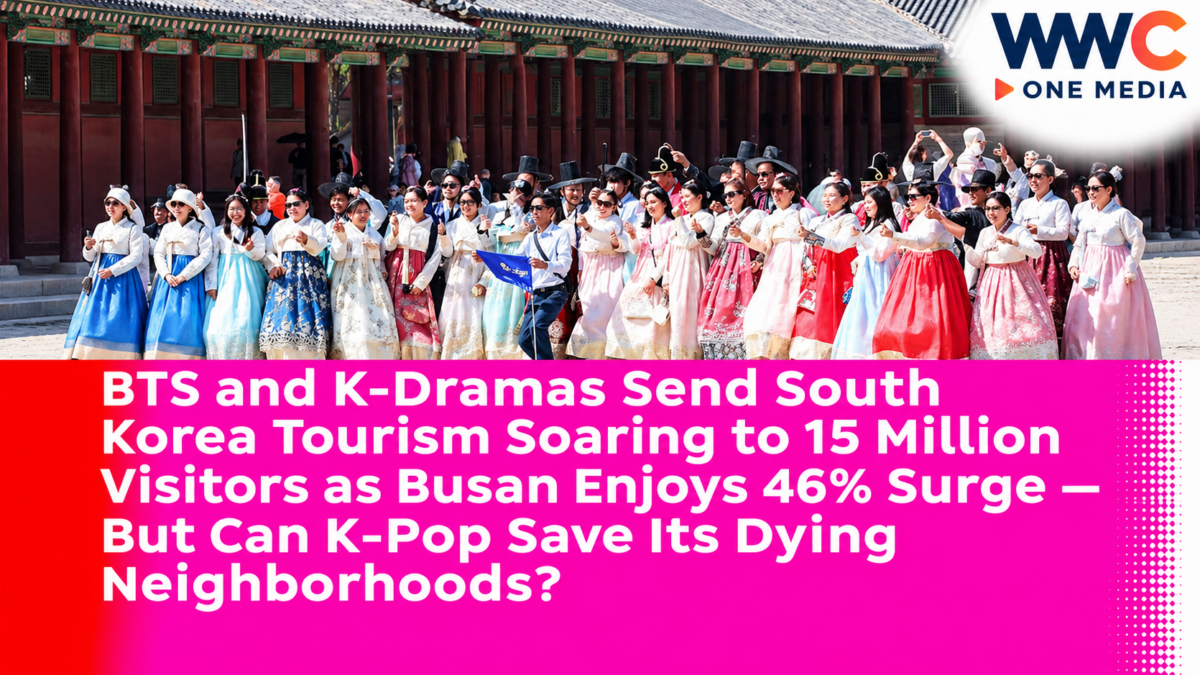
SEOUL, SOUTH KOREA — The global obsession with BTS and Korean dramas is turning into a powerful tourism opportunity, with millions of international travelers arriving in South Korea to experience the places, traditions and communities made famous by Korean entertainment.
From Seoul’s historic palaces to Busan’s hillside neighborhoods, the Korean Wave is no longer confined to television screens, streaming platforms and concert venues.
It is bringing visitors into local businesses, hotels, restaurants and cultural attractions.
According to South Korea’s Ministry of Culture, Sports and Tourism, the country welcomed 15.05 million international visitors between January and August 2026, a 21.6% increase from the same period a year earlier.
Tourism-related foreign card spending reached approximately 14.02 trillion won, up 48.5%.
Meanwhile, Busan, the hometown of BTS members Jimin and Jungkook, welcomed more than 3.4 million foreign visitors during the first eight months of 2026, a 46% year-on-year increase, according to figures cited by Channel News Asia.
The numbers illustrate the extraordinary appeal of Korean culture.
But behind the statistics lies an even more important story.
Some communities facing aging populations and declining local businesses are trying to turn K-pop fandom into an economic lifeline.
Could BTS and K-dramas do more than attract tourists—and actually help save South Korea’s disappearing neighborhoods?
South Korea’s Tourism Boom Reaches 15 Million Visitors
South Korea’s tourism industry is experiencing one of its strongest periods of international growth.
Government figures show that 15.05 million foreign visitors arrived between January and August, compared with approximately 12.38 million during the corresponding period in 2025.
August alone brought approximately 2.25 million visitors.
The tourism boom is being supported by several factors, including international entertainment, improved travel access, airline promotions and government campaigns.
K-pop, television dramas, movies and Korean food have helped create worldwide interest in the country.
But entertainment is only one part of the explanation.
The government has also been simplifying travel procedures and encouraging international airlines to expand access to destinations outside Seoul.
As WWC ONE MEDIA reported on South Korea’s plan to expand international routes through regional airports, officials are developing tourism strategies around Gimhae, Daegu, Cheongju, Yangyang and Muan.
The objective is to spread visitor spending beyond the capital and help regional economies.
South Korea’s government has confirmed strong tourism growth, but it has not established that every visitor was motivated by BTS or Korean dramas.
That distinction matters when assessing the economic contribution of entertainment.
K-Drama Fans Are Turning Filming Locations Into Real-Life Adventures
Channel News Asia’s November 8 report describes a growing number of international visitors traveling to destinations they first encountered in Korean television dramas.
For Norwegian tourist Annette Giwlebo, walking through historic Korean landmarks created a sense of familiarity because she had already seen similar locations on screen.
At Seoul’s Gyeongbokgung Palace, tourists dress in traditional Korean clothing known as hanbok while exploring the palace grounds.
Rental shops have benefited from visitors hoping to recreate the atmosphere of historical dramas.
Some customers even bring screenshots showing the costumes worn by their favorite actors.
Popular series such as <Entity category=”tv_show” value=”Love in the Moonlight”/> have helped bring attention to traditional Korean clothing and historic settings.
This illustrates an important change in tourism.
For some travelers, watching a television series becomes the first stage of planning an overseas trip.
They are not simply searching for landmarks.
They want to experience the atmosphere, clothing, food and cultural traditions they encountered through entertainment.
That creates opportunities for businesses offering guided tours, photography services, traditional clothing rentals and cultural experiences.
Park Bo-gum Shows How Korean Stars Can Promote Cultural Tourism
South Korea has increasingly used popular entertainment personalities to promote attractions beyond conventional sightseeing.
Actor <Entity category=”people” value=”Park Bo-gum” disambig=”South Korean television and film actor”/> recently participated in a cultural tourism initiative built around the sounds and atmosphere of historic Seoul.
As WWC ONE MEDIA reported on Park Bo-gum’s Korea Sound Journey, approximately 100 international participants and influencers from more than 20 countries joined an October experience at Changgyeonggung Palace and nearby cultural sites.
The event combined celebrity appeal with Korea’s historical and cultural attractions.
Its significance extends beyond one tourism promotion.
A familiar celebrity can attract attention, but the lasting value comes when visitors discover additional places, traditions and experiences.
That is the opportunity South Korea is pursuing as it converts global entertainment popularity into broader tourism spending.
BTS Concerts Turn Busan Into a Global Fan Destination
BTS has become one of the strongest examples of the connection between entertainment and international travel.
The group’s June 2026 concerts attracted fans from different countries to Busan.
Local authorities organized welcome activities, themed food offerings and attractions designed to encourage concertgoers to explore the city.
Busan also has personal significance for fans because members Jimin and Jungkook grew up there.
For international members of BTS’s fan community, known as ARMY, visiting the city can provide a deeper connection to the group’s history.
The economic effect is measurable.
According to CNA, Busan welcomed more than 3.4 million international visitors from January through August, an increase of 46%.
Paradise Hotel Busan reported that international visitors accounted for approximately 70% of its guests during the BTS concert dates in June, compared with about 30% under its usual guest mix.
The hotel also reported occupancy of approximately 95% during that period.
These figures indicate substantial demand around the concerts.
However, they do not establish that BTS alone caused Busan’s entire 46% tourism increase.
The city also benefits from broader tourism growth and other travel activities.
Government Study Reveals BTS Fans Stay Longer and Spend More
South Korea’s Ministry of Culture, Sports and Tourism has independently examined the spending behavior of international BTS concertgoers.
Its research found that foreign visitors attending BTS’s March 21 comeback concert in Seoul stayed an average of 8.7 days and spent approximately 3.53 million won per person.
By comparison, general inbound tourists during the first quarter stayed an average of 6.1 days and spent approximately 2.45 million won.
That means the surveyed concertgoers stayed 2.6 days longer and spent approximately 1.08 million won more per person.
The government’s analysis also examined BTS concerts in Goyang.
During those performances, international visitor numbers near the venue increased approximately 35-fold compared with the corresponding period a year earlier.
Foreign visitor spending increased approximately 38-fold.
These are location-specific observations during concert dates, not national tourism growth rates.
Nevertheless, the results provide evidence that major entertainment events can generate spending beyond ticket sales.
Fans may also pay for hotels, restaurants, shopping, transportation and other tourism services.
A Popular BTS Café Is Becoming a Destination of Its Own
Busan’s fan tourism economy extends beyond concert venues.
Businesses associated with BTS members or their families can become attractions for international visitors.
As WWC ONE MEDIA reported on the planned 2027 closure of ZM-illennial, the café operated by Jimin’s father has attracted fans who travel to Busan to visit a place connected to the singer.
The business announced a one-year countdown toward closure in November 2026.
Its announcement reflects how ordinary commercial spaces can acquire cultural significance through their association with well-known entertainers.
For fans, the experience may be about sharing memories and meeting others with similar interests.
For nearby businesses, visitor traffic can create commercial opportunities.
But celebrity-linked attractions may also face changes in ownership, operations and popularity.
Their long-term economic contribution cannot be guaranteed.
Can BTS Save Busan’s Aging Ami-dong Neighborhood?
Perhaps the most compelling example in CNA’s reporting comes from Ami-dong, a historic hillside neighborhood in Busan.
The area is known as the gravestone village.
During the Korean War, refugees built homes on land that had previously served as a Japanese cemetery.
Some houses were constructed directly over former grave sites.
The community is now facing a very different challenge: depopulation.
Younger residents have moved away, leaving aging residents and vacant homes.
But local advocates believe the global popularity of BTS could bring new attention to the neighborhood.
The connection is unusually simple.
The Korean pronunciation of BTS’s fandom name, ARMY, resembles the name Ami.
Former city councillor Kim Byeng-geun has been promoting that association.
Purple murals and decorations associated with BTS now appear around parts of the hillside.
The hope is that international fans will visit, explore local history and spend money in nearby businesses.
If tourism demand becomes sustained, it could encourage cafés, souvenir shops and other enterprises to open.
But that outcome remains uncertain.
Tourism cannot automatically reverse decades of population decline.
For Ami-dong, the challenge is converting temporary curiosity into an enduring local economy.
Not Every Local Business Is Benefiting Equally
The tourism boom also has limitations.
CNA interviewed a longtime market vendor in Busan’s Haeundae area who said she had seen fewer BTS fans than during the group’s 2022 concerts.
She questioned whether visitors were staying long enough or spending enough to significantly benefit local traders.
Her experience provides an important counterpoint to the strong hotel and tourism statistics.
Large events can generate substantial demand while leaving some small businesses with limited gains.
Visitors may concentrate around concert venues, major hotels and recognizable attractions.
Smaller shops located away from those routes may receive less traffic.
Tourism revenue can also be uneven across different industries.
For local authorities, attracting visitors is only the first challenge.
Ensuring that spending reaches neighborhood businesses is another.
Busan’s tourism officials have emphasized the importance of encouraging concertgoers to return for future visits.
That would help reduce dependence on occasional large entertainment events.
Korean Temple Stays Attract a Record Number of Foreigners
Korean entertainment is also introducing international audiences to traditions beyond music and television.
CNA reported that 55,515 foreigners participated in Buddhist temple stays in South Korea during 2025, according to the Cultural Corps of Korean Buddhism.
That was a record.
Interestingly, only approximately one in 10 foreign participants identified as Buddhist.
Some visitors discovered temple-stay experiences through television programs and online content.
Singaporean tourist Ellie Yeo said she became interested after watching a temple stay featured on the Korean variety program <Entity category=”tv_show” value=”I Live Alone” disambig=”South Korean television variety series”/>.
Temple stays can include meditation, traditional meals and opportunities to learn about Buddhist cultural practices.
The popularity of these experiences demonstrates how entertainment can introduce travelers to activities they might not otherwise consider.
But the appeal is not necessarily religious.
Some visitors are seeking relaxation, reflection or a deeper understanding of Korean traditions.
That helps tourism authorities diversify the experiences available to international visitors.
More Than 500,000 Foreigners Entered Korea for Study and Training
Korean culture is influencing more than short-term travel.
As WWC ONE MEDIA reported on South Korea’s growing international study market, official data show that approximately 505,410 foreign nationals entered South Korea for study or training in 2025.
That represented about 2.7% of the country’s total foreign arrivals during the year.
The figure illustrates the scale of international interest in Korean education and language learning.
K-pop and Korean dramas may encourage some people to study the language or seek longer-term cultural experiences.
But the study-arrival total should not be attributed entirely to entertainment.
Academic institutions, career opportunities, scholarships and personal circumstances also influence education-related travel.
The broader significance is that South Korea’s cultural influence can create interest in activities beyond a short holiday.
Filipino Visitors Are Part of Korea’s Growing Tourism Market
The South Korean tourism boom is also relevant to the Philippines.
According to the Korean Ministry of Culture, Sports and Tourism, approximately 454,000 visitors from the Philippines entered South Korea between January and August 2026, an increase of 16.1% from the same period a year earlier.
Filipino travelers are among the Southeast Asian audiences targeted by Korean tourism campaigns.
K-pop concerts, Korean dramas, shopping and food experiences are popular travel interests.
But tourism growth also depends on practical considerations such as airfare, travel documentation and the affordability of accommodation.
South Korea’s government has worked with airlines and tourism partners to increase accessibility and promote regional destinations.
For Philippine travel agencies, the growing demand may create opportunities for specialized itineraries involving entertainment, cultural activities and locations outside Seoul.
However, an increase in arrivals does not mean every traveler is visiting primarily because of Korean entertainment.
The Philippines Faces a Different Tourism Challenge
There is also an interesting contrast between the two countries.
South Korea is seeing strong growth in inbound tourism, including from the Philippines.
Meanwhile, the Philippines has experienced a decline in arrivals from South Korea, historically one of its most important tourism markets.
As WWC ONE MEDIA reported on Philippine tourism figures through August 2026, the Philippines welcomed approximately 4.11 million international visitors during the first eight months of the year.
South Korean arrivals were down more than 17% year over year.
These figures describe different tourism markets and should not be interpreted as proof that Korean travelers are choosing domestic destinations instead of the Philippines.
But the comparison raises an important question about tourism competitiveness.
South Korea has successfully developed global recognition around entertainment, food, fashion and culture.
For the Philippines, creating memorable destination experiences and strengthening international visitor confidence could help attract new markets.
Could South Korea’s Cultural Tourism Boom Last?
The strongest argument for long-term growth is that Korean entertainment continues reaching international audiences.
New television series, music releases and tours can introduce additional visitors to the country.
But entertainment-driven tourism faces limitations.
Concert schedules are temporary.
Popular filming locations can change.
Hotels may experience intense demand during major events and quieter periods afterward.
Some neighborhoods may struggle to convert occasional tourism into stable employment.
There are also practical concerns about congestion, rising costs and protecting historical communities from inappropriate commercial development.
For South Korea, the long-term challenge is to ensure that growth benefits more than major hotels, airlines and entertainment companies.
Small businesses and local residents need opportunities to participate.
Three Possible Outcomes for Korea’s Tourism Economy
Scenario 1: K-pop tourism drives continued growth beyond Seoul.
Cities such as Busan could benefit from more international visitors who combine concerts with sightseeing, shopping and cultural experiences.
Scenario 2: Local neighborhoods develop sustainable tourism businesses.
Communities such as Ami-dong could attract repeat visitors and encourage new enterprises, provided growth respects residents and local heritage.
Scenario 3: Entertainment tourism produces uneven benefits.
Large hotels and major attractions could gain more than smaller businesses if visitors remain concentrated in a few locations.
These outcomes are possible scenarios, not guaranteed projections.
The Bigger Question: Can K-Pop Revive Communities Facing Population Decline?
South Korea’s tourism transformation is becoming difficult to ignore.
The country welcomed 15.05 million international visitors in eight months.
Busan recorded more than 3.4 million foreign visitors.
BTS concerts attracted fans who stayed longer and spent more than typical international tourists in the government’s sample.
And Korean dramas are encouraging visitors to explore palaces, traditional clothing, temples and regional destinations.
The economic opportunity extends far beyond entertainment itself.
Hotels, restaurants, transport operators and small businesses may benefit from the spending generated by international fans.
But the experience of Busan’s aging neighborhoods reveals the limits of the boom.
Tourism can bring people into a community.
It cannot automatically guarantee long-term jobs, affordable housing or population recovery.
The verified story is that Korean pop culture is helping attract international visitors and generate measurable economic activity. Whether that growth can reverse regional decline remains uncertain.
For South Korea, the next challenge is transforming worldwide cultural popularity into lasting benefits for local communities.
And as BTS fans explore Busan’s historic streets while K-drama enthusiasts discover the country beyond the screen, one question may define the future of Korea’s tourism industry:
Will the Korean Wave become powerful enough to revive aging towns and create lasting opportunities for local businesses—or could the tourism boom fade from struggling neighborhoods once the concerts end and the next viral destination takes over?