SAN FRANCISCO / MENLO PARK / MANILA — November 8, 2026 | WWC ONE MEDIA | Artificial Intelligence, Global Business and Technology
One of Meta’s most experienced executives is leaving Mark Zuckerberg’s technology empire to join a rapidly expanding artificial intelligence startup, highlighting how the battle for AI talent is moving beyond engineers and researchers into the highest levels of corporate leadership.
Dave Wehner, Meta Platforms’ chief strategy officer and former chief financial officer, is joining Fireworks AI as its new CFO, according to reporting published by CNBC on November 7.
The move is particularly significant because Wehner has spent approximately 14 years at Meta, helping guide the company through major periods of expansion, financial restructuring and strategic investment.
Now he is leaving a technology giant valued at approximately $1.56 trillion in the stock market to join a privately held AI company that began operations only four years ago.
Fireworks was valued at $17.5 billion during its July 2026 funding round.
But the startup is already attracting attention for a potentially much larger financing deal.
Business Insider and The Information have reported that Fireworks is considering raising additional capital at a valuation that could reach $30 billion to $40 billion.
That would represent a substantial increase in its estimated market value within months.
However, no completed financing at that higher valuation has been confirmed.
The development raises a fascinating question about Silicon Valley’s fast-changing power structure.
Why would an executive who helped manage one of the world’s biggest technology companies leave for a much smaller startup—and could Fireworks become one of the next major winners of the AI revolution?
Dave Wehner Leaves Meta After 14 Years
Wehner joined Facebook, now known as Meta Platforms, in 2012 as vice president of corporate finance and business planning.
He became chief financial officer in 2014.
He held that position until 2022, when he transitioned to the role of chief strategy officer.
During his time at Meta, the company expanded its global advertising business, invested heavily in infrastructure and navigated significant changes in its products and corporate strategy.
As CFO, Wehner helped oversee financial planning and investor communications during a period when Facebook transformed into one of the world’s most valuable technology companies.
His experience included managing large capital expenditures and explaining investment decisions to shareholders.
In 2022, Meta reorganized its senior leadership, with Susan Li succeeding him as CFO.
Wehner continued serving in a senior strategic role.
Now he is leaving to take direct responsibility for finance at Fireworks.
The Information separately confirmed his decision on November 6, citing Wehner’s public announcement.
Meta’s chief operating officer, Javier Olivan, praised Wehner’s contributions and experience navigating complex company-level decisions.
The departure does not establish a dispute between Wehner and Meta’s leadership.
Nor has credible reporting indicated that Meta is abandoning its artificial intelligence strategy.
Instead, the move appears to reflect Wehner’s interest in helping build a smaller, rapidly growing business.
Fireworks CEO Lin Qiao Welcomes the Former Meta Executive
Fireworks CEO Lin Qiao welcomed Wehner’s appointment, emphasizing his experience in helping build and scale a major technology company.
In a public statement, Qiao said Wehner was interested in returning to an environment where he could help create a large business from an earlier stage.
The appointment gives Fireworks an executive with extensive experience in corporate finance, capital allocation and strategic planning.
These skills are especially important for AI infrastructure companies.
Unlike software businesses that can expand with relatively modest physical infrastructure, AI computing providers frequently need substantial investment in servers, processors, networking equipment and data centers.
They must also manage customer contracts, operating costs and the financing needed for future expansion.
For Fireworks, appointing a former Meta CFO may strengthen its ability to manage that complexity.
It could also improve the company’s credibility with investors evaluating its next fundraising round.
However, the appointment alone does not guarantee that the company will obtain more financing or achieve profitability.
What Exactly Is Fireworks AI?
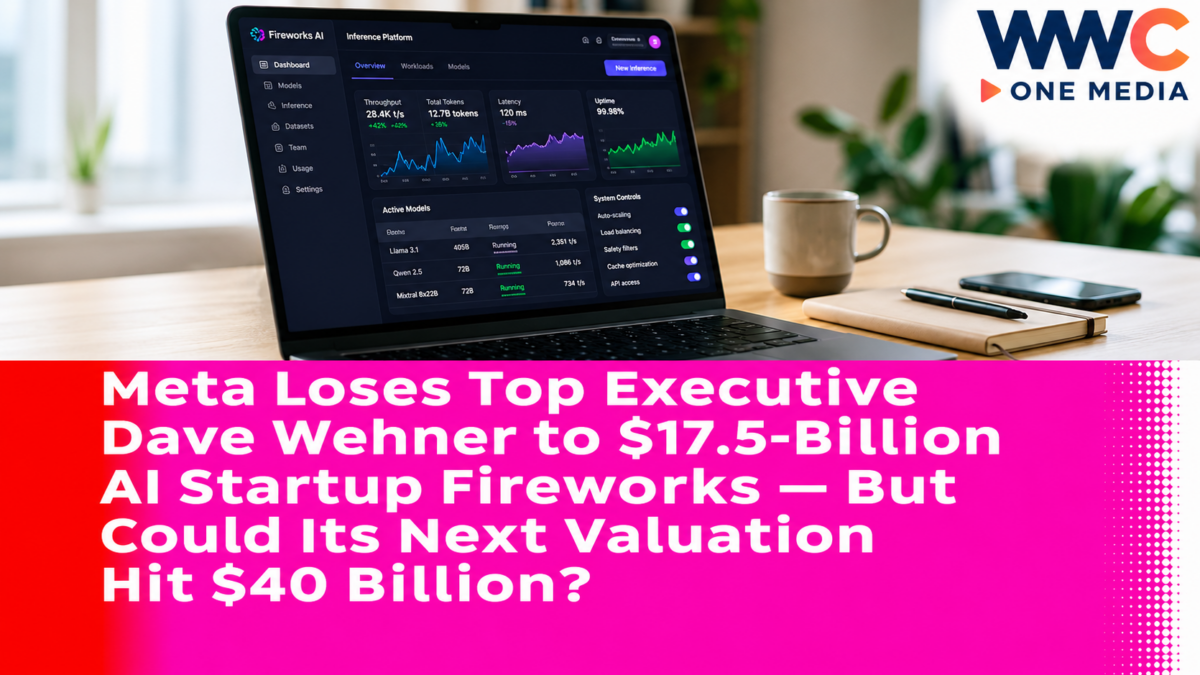
Fireworks is an artificial intelligence infrastructure company founded in 2022.
Its platform allows businesses and developers to customize, deploy and run AI models.
The company focuses particularly on open models and specialized AI applications.
Rather than concentrating primarily on a consumer chatbot, Fireworks helps other businesses operate the models powering their own products and services.
Its offerings include model inference and training-related tools.
Inference is the process of using a trained AI model to generate answers, produce content or perform tasks.
For example, a retailer might use an AI model to answer customer questions.
A financial-services company might use a specialized model to analyze documents.
A software developer might deploy AI features inside a business application.
Fireworks provides infrastructure intended to help those applications operate efficiently at scale.
Its strategy is based on the idea that companies will increasingly want models tailored to their own data, industries and workflows.
That creates a potentially large market beyond general-purpose AI applications.
But competition is intense.
Fireworks faces rivals among specialized AI infrastructure providers and major cloud-computing companies.
Fireworks Raises $1.505 Billion at a $17.5-Billion Valuation
One of the clearest indications of investor interest came on July 16, 2026.
Fireworks announced that it had completed a $1.505-billion Series D financing round at a $17.5-billion valuation.
The financing was led by Atreides Management, Index Ventures and TCV.
Other investors included Nvidia, Bessemer Venture Partners and Lightspeed Venture Partners.
The company’s legal adviser, Orrick, independently confirmed the transaction and valuation.
The financing provided capital for continued infrastructure development, engineering and commercial expansion.
The size of the round illustrates the substantial financial resources being committed to companies supporting AI applications.
But investors should distinguish fundraising proceeds from operating revenue.
The $1.505 billion represents money raised through financing.
It does not mean the company earned that amount from customers.
Likewise, the $17.5-billion valuation represents the value established in the funding transaction, not audited net assets or annual profit.
The valuation reflects investors’ expectations about the company’s future commercial prospects.
Fireworks Reports More Than $1 Billion in Annualized Revenue
Fireworks also announced an important commercial milestone in July.
The company said its annualized revenue had exceeded $1 billion.
This is particularly significant for a startup founded only four years earlier.
However, annualized revenue requires careful interpretation.
It generally describes a current revenue run rate projected across a 12-month period.
It is not necessarily the same as revenue actually earned over the preceding full year.
Fireworks also reported processing approximately 40 trillion AI tokens daily around the time of its July financing.
Investor Bessemer Venture Partners subsequently described the company’s processing activity as approximately 43 trillion tokens per day.
These figures indicate substantial usage of the platform.
But token volume is not equivalent to revenue or profit.
The amount a company earns depends on customer pricing, model requirements, computing costs and other contractual arrangements.
The company has not publicly released comprehensive audited financial statements establishing its net income or free cash flow.
For investors evaluating its valuation, that distinction remains important.
Fireworks Could Seek a $40-Billion Valuation
The next potential milestone is another fundraising round.
Business Insider reported in late October that Fireworks was in early discussions about raising additional capital at a possible valuation between $30 billion and $40 billion.
The Information separately reported that the company was preparing to pursue new financing, with a valuation target of at least $30 billion.
If a transaction eventually closed at $40 billion, the implied valuation would be approximately 129% higher than July’s $17.5-billion figure.
But that comparison remains hypothetical.
Fundraising discussions can change.
Investors may negotiate a different valuation, adjust the size of the round or decline to participate.
There is no verified announcement that Fireworks has completed a financing transaction at $30 billion or $40 billion.
The higher figures should therefore be described as possible targets.
Wehner’s arrival could be relevant to those discussions because institutional investors typically scrutinize a company’s financial controls, operating performance and expansion plans.
But his appointment does not establish that the fundraising will succeed.
Why Nvidia’s Involvement Matters
Nvidia is one of the investors in Fireworks.
That relationship places the startup within a broader AI infrastructure ecosystem supported by the semiconductor company.
Nvidia processors are extensively used in AI training and inference.
Demand for those processors has increased as businesses expand their use of advanced models.
However, developing a successful AI computing platform requires more than purchasing powerful chips.
Companies need software that efficiently manages computing resources.
They must also offer reliable services, competitive pricing and tools that developers can integrate into their applications.
Fireworks focuses on helping customers run and customize models for specific applications.
As WWC ONE MEDIA reported on Nvidia-backed Groq’s pursuit of an $8-billion valuation, investors are closely watching specialized AI computing businesses as inference becomes an increasingly important part of the industry.
Groq and Fireworks are separate companies with different technology and financing arrangements.
Their valuations should not be treated as directly interchangeable.
But both illustrate investor interest in businesses that provide infrastructure for running artificial intelligence models.
Fireworks’ Rapid Growth Comes as Big Tech Faces an AI Spending Reckoning
The appointment also comes during a period of heightened scrutiny of AI infrastructure spending.
Major technology companies are committing enormous sums to data centers, chips and networking systems.
Amazon, Alphabet, Microsoft, Meta and Oracle have become central participants in the expansion.
Yet investors are questioning how quickly those investments can generate sustainable financial returns.
As WWC ONE MEDIA examined in its coverage of Big Tech’s $750-billion AI spending gamble, the industry faces growing pressure to connect capital expenditure with measurable revenue growth.
Fireworks operates in a different part of that ecosystem.
Rather than developing a consumer social network, the company sells infrastructure and software services to organizations building AI-powered products.
Its growth suggests that demand for inference services is expanding.
But that does not make it immune to the wider industry’s risks.
Computing prices may change.
New chips could improve efficiency and reduce the cost of particular workloads.
Rivals may offer competing services.
And customers could move workloads between providers if technology or pricing changes.
Fireworks must therefore demonstrate that its revenue growth can translate into durable financial performance.
What Wehner’s Departure Means for Meta
Meta continues pursuing its own aggressive AI strategy.
The company is investing heavily in computing infrastructure, AI research and products across its social media and messaging platforms.
Wehner’s departure is a leadership change, not evidence that these initiatives have been canceled.
Nevertheless, his exit is noteworthy because he played an important role in Meta’s financial and strategic development.
The company must continue managing substantial capital spending while convincing investors that those investments are justified.
As WWC ONE MEDIA reported on Meta’s negative credit-outlook revision amid its $145-billion AI spending plans, the cost of AI infrastructure has become an increasingly important issue for investors and credit analysts.
That gives Wehner’s move an additional dimension.
An executive experienced in overseeing a global technology company’s finances is now joining a startup attempting to build an infrastructure business in the same highly competitive industry.
For Fireworks, his experience could be valuable.
For Meta, the departure means losing a longtime member of its senior leadership team.
But no financial impact from Wehner’s exit has been publicly quantified.
Microsoft and Oracle Show How Quickly AI Infrastructure Requirements Can Change
The risks facing Fireworks are illustrated by recent developments involving Microsoft and Oracle.
Microsoft is reportedly winding down a rental agreement for Oracle AI computing capacity because the older hardware no longer meets its requirements.
As WWC ONE MEDIA reported on Microsoft’s decision to pull back from the Oracle arrangement, technology companies are reassessing the suitability and economics of some external computing commitments.
The Microsoft–Oracle arrangement is unrelated to Wehner’s appointment at Fireworks.
But it highlights a challenge faced by all AI infrastructure providers.
Customer needs change rapidly.
Hardware can become less suitable for certain applications.
New models may require different technical capabilities.
And businesses increasingly expect high performance at competitive prices.
For Fireworks, sustainable growth will depend on adapting its technology and pricing as those requirements evolve.
An October Security Incident Adds Another Challenge
Fireworks’ rapid expansion has also brought security responsibilities.
On October 6, the company identified a security incident involving unauthorized use of internal credentials.
According to its official security bulletin, an unauthorized third party accessed environment variables used in evaluation jobs within a limited number of customer accounts.
Some of those variables contained credentials or other secrets.
Fireworks said it had not detected evidence of unauthorized access to customer models, training data, datasets, personal information or inference traffic within the systems it examined.
However, it continued investigating the scope of the incident.
The company revoked affected credentials, notified identified customers and worked on additional security measures.
The distinction is important.
The incident involved unauthorized access to certain sensitive environment variables.
It should not be described as confirmed theft of all customer data or AI models.
For an AI infrastructure provider, security is a critical commercial issue.
Enterprise customers need confidence that their data, credentials and workloads are appropriately protected.
Wehner’s financial responsibilities will be distinct from those of technical security teams, but managing organizational risk will be important as the company grows.
Why AI Infrastructure Startups Are Attracting Big Tech Executives
The move from Meta to Fireworks reflects an important trend in technology leadership.
Fast-growing AI companies increasingly need executives who can manage complex operations, fundraising and large-scale investment.
Technical innovation may attract customers and early-stage investors.
But sustained expansion requires strong financial management.
A company raising billions of dollars may need to coordinate infrastructure purchases, long-term contracts, workforce expansion and relationships with financial institutions.
Experienced executives can help establish the systems required to manage those activities.
Fireworks is also expanding into markets that require significant computing capacity.
Its future growth may depend on entering new regions and serving customers with different regulatory and technical requirements.
That increases the importance of financial planning and operational discipline.
Wehner’s experience at Meta gives him a background in many of these areas.
Whether that experience translates into success at Fireworks remains to be seen.
What This Means for the Philippines and Asian Technology Businesses
The development matters beyond Silicon Valley.
Businesses across Asia, including the Philippines, are exploring AI applications in customer service, software development, finance, logistics and other industries.
Many organizations may prefer to use existing AI infrastructure platforms rather than build their own computing clusters.
Providers such as Fireworks offer tools intended to make model deployment and customization more accessible.
That could lower technical barriers for some businesses.
However, actual costs, security requirements, data handling and service reliability must still be evaluated.
No specific Philippine investment, customer agreement or local expansion resulting from Wehner’s appointment has been confirmed.
The more immediate relevance is that competition among AI infrastructure companies could eventually influence the services and prices available to businesses internationally.
Three Possible Outcomes for Fireworks
Scenario 1: Fireworks completes another major funding round.
Strong investor demand could support additional financing and provide capital for infrastructure expansion.
However, the final valuation and transaction terms would still need to be confirmed.
Scenario 2: Revenue grows, but investors demand stronger financial evidence.
The company could continue attracting customers while facing increased scrutiny over operating margins, infrastructure expenses and cash flow.
Scenario 3: Competition and security concerns slow expansion.
Pressure from rival providers, changing customer requirements or operational challenges could complicate the company’s growth plans.
These are possible outcomes, not announced results.
The Bigger Question: Could Fireworks Become the Next AI Infrastructure Giant?
Dave Wehner’s decision to leave Meta for Fireworks represents more than a routine executive appointment.
It brings an experienced former chief financial officer from one of the world’s largest technology companies into a startup pursuing ambitious growth.
Fireworks has already raised $1.505 billion at a $17.5-billion valuation.
It reports more than $1 billion in annualized revenue.
And it is considering another financing round that could potentially value the business at $30 billion to $40 billion.
Those figures demonstrate significant investor interest and commercial momentum.
But major questions remain.
Can Fireworks expand efficiently?
Will its customers continue increasing their use of specialized AI models?
Can the company maintain strong security and operational reliability?
And will future earnings justify the valuation investors may be asked to accept?
The confirmed development is Wehner’s move to Fireworks. The possible $40-billion valuation remains an ambition under discussion—not a completed financial milestone.
For Meta, the departure closes a long chapter in its senior leadership.
For Fireworks, it marks a new stage in its attempt to become a major AI infrastructure company.
And as Silicon Valley’s battle for artificial intelligence leadership accelerates, one question could define the startup’s future:
Will Dave Wehner help turn Fireworks into a $40-billion AI powerhouse—or could soaring valuations, expensive infrastructure and fierce competition expose the risks behind Silicon Valley’s next big technology bet?