
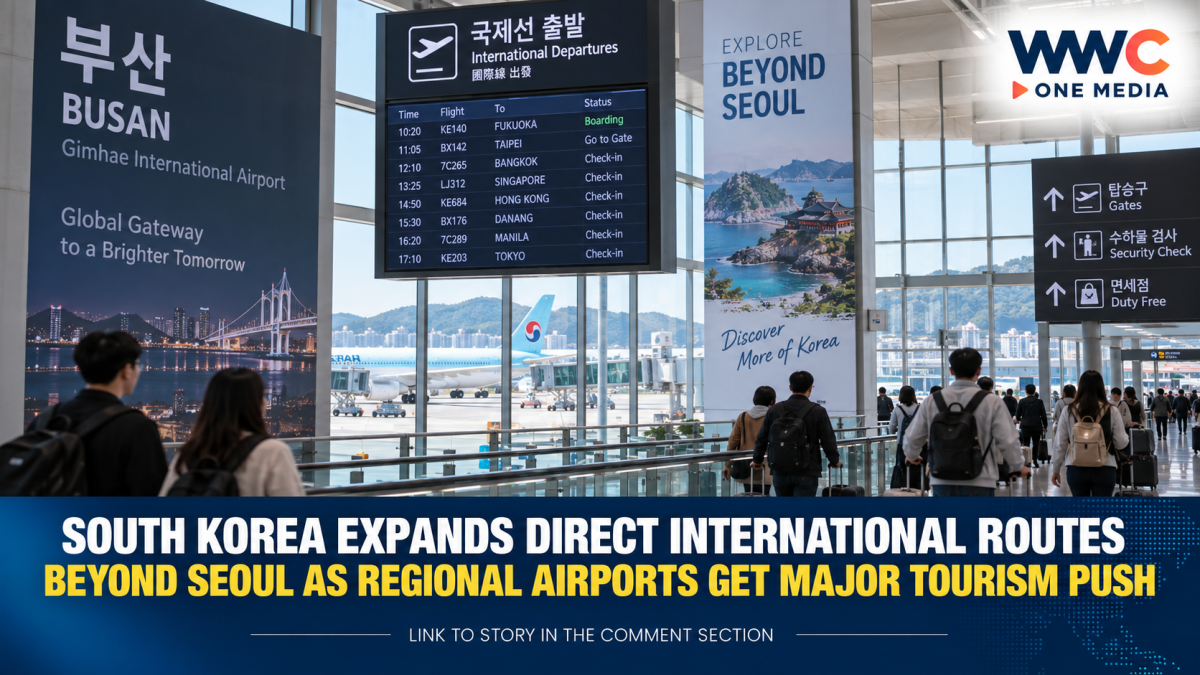
South Korea is accelerating efforts to make regional airports direct gateways for international travelers, giving visitors more ways to reach destinations outside Seoul without first passing through the capital’s main airports.
The strategy is part of a broader government campaign to spread tourism spending beyond Seoul and Jeju and encourage international visitors to explore cities and provinces across the country.
The Ministry of Culture, Sports and Tourism recently announced plans to develop five regional tourism zones centered on international airports in Gimhae, Daegu, Cheongju, Yangyang and Muan. Beginning in 2027, the government plans to invest 93.5 billion won in transportation links, integrated travel services and overseas marketing around these airport hubs.
More Travelers Can Fly Straight Into Regional Korea
The shift is already underway.
According to VisitKorea, international flights from regional airports are operating on 98 routes across 13 regions during the 2026 summer schedule, with services connecting parts of Korea directly with destinations in China, Japan, Taiwan, the Philippines, Vietnam and Singapore.
Gimhae International Airport in Busan has added or resumed services involving destinations including Miyakojima, Shizuoka, Takamatsu, Taichung, Phu Quoc, Almaty and Kuala Lumpur.
Cheongju International Airport has also expanded its international network, including a new Shanghai service.
That means travelers heading to Busan, the central regions or other parts of Korea increasingly have alternatives to flying into Incheon and then making a separate domestic journey.
Busan and Cheongju Lead the Regional Push
South Korean tourism authorities have been using Cheongju and Daegu as pilot examples for developing regional airports as independent international entry points.
The Korea Tourism Organization reported that more than 50,000 international travelers entered through Cheongju Airport during the first five months of 2026, an increase of more than 114 percent from the same period a year earlier.
Daegu recorded around 46,000 foreign arrivals over the same period.
Chartered services have also contributed to the increase, with hundreds of nonscheduled flights to Cheongju and Daegu confirmed through the first half of 2026.
The objective is not simply to get passengers off airplanes.
Authorities want those visitors to continue traveling through surrounding regions, spending money at local hotels, restaurants, attractions and businesses.
New Routes Could Open the Door to Korea Beyond Seoul
The regional-airport strategy connects air travel with broader tourism circuits.
From Gimhae and Daegu, travelers can reach destinations associated with Gyeongju, Andong and Busan.
Cheongju can serve as an entry point for travelers visiting central Korean destinations including Gongju, Buyeo and Jeonju.
Yangyang is positioned to connect visitors with the eastern coast, including Seoraksan, Gangneung and Sokcho.
Meanwhile, Muan is intended to support tourism circuits connecting Mokpo, Gwangju and Yeosu.
The government is also looking at transportation connections, integrated passes and digital services to make it easier for international visitors to continue their journeys after landing.
Why Seoul Is No Longer the Only Focus
South Korea has been successful in attracting international attention through K-pop, Korean dramas, food and other cultural exports.
But tourism authorities have identified a major challenge: international visitors remain heavily concentrated in Seoul and a relatively small number of major destinations.
The new regional strategy is designed to turn airports into starting points for wider travel rather than simply alternative places to land.
The government has set a long-term goal of attracting 30 million international visitors annually, while aiming to increase regional airport arrivals to 5 million a year by 2029.
What This Means for International Travelers
For visitors planning a Korea trip, the expanding network could mean fewer transfers and more direct itineraries.
Someone interested in Busan, for example, may be able to fly directly into Gimhae rather than arriving at Incheon and continuing south.
Likewise, travelers interested in central Korea can increasingly consider Cheongju as an entry point.
The expansion also creates opportunities for travelers to build itineraries around regional destinations rather than treating them as day trips from Seoul.
Still, flight schedules remain subject to airline and airport conditions, so travelers need to check the latest service information before booking.
Korea’s Tourism Map Is Starting to Change
South Korea’s latest strategy represents a shift from a Seoul-centered tourism model toward a network of regional gateways.
With more direct international flights, better connections and dedicated tourism circuits being developed around regional airports, visitors may soon have substantially more choices about where their Korean journey begins.
And as the government pushes toward its 30-million-visitor target, the biggest change may not simply be the number of tourists arriving in Korea — but where they land once they get there.




Leave a Reply