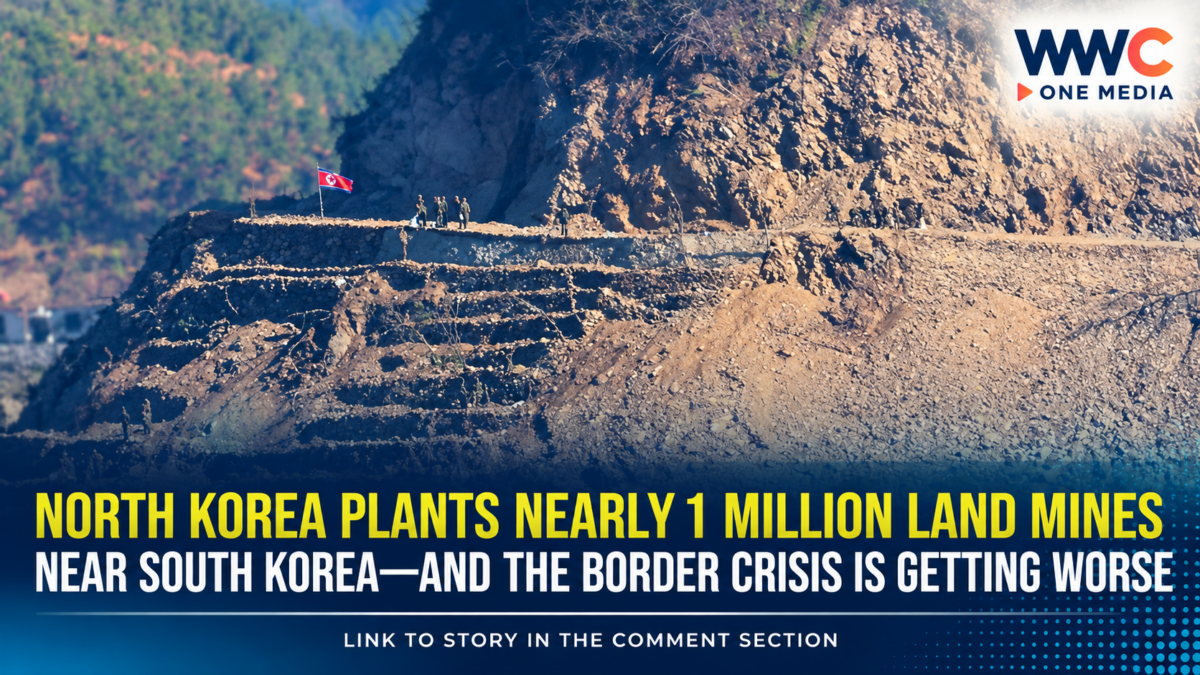
North Korea is believed to have planted approximately 960,000 land mines along the inter-Korean border since 2024, according to information from South Korea’s military disclosed to lawmakers, intensifying concerns over security along one of the world’s most heavily militarized frontiers.
The estimate, reported by Yonhap News Agency, The Korea Herald and KBS World on October 23, comes as Pyongyang continues reinforcing its border with fences, barriers and military roads. The buildup has coincided with deteriorating relations between North Korea and South Korea and renewed warnings from both sides.
The scale of the reported mine-laying operation is particularly alarming because experts estimate that approximately 2 million land mines may be buried throughout the Demilitarized Zone (DMZ), including those planted by South Korean forces over the decades. The 960,000 figure refers to North Korea’s estimated mine-laying activity since 2024—not a verified count of every mine currently buried in the area.
A border being transformed into a fortified military zone
North Korea intensified its border reinforcement campaign in April 2024, following leader Kim Jong Un’s declaration that relations with South Korea should be treated as those between two hostile states.
Since then, North Korean troops have reportedly laid mines, installed barbed-wire fences, built anti-tank barriers and constructed tactical roads. They have also cleared vegetation in border areas and severed key road and railway connections between the two Koreas.
The developments reflect Pyongyang’s increasingly hard-line approach toward Seoul and its efforts to strengthen physical defenses along the Military Demarcation Line, which separates the two sides within the DMZ.
Mine explosions leave South Korean soldiers injured
The growing mine threat became more immediate after two explosions on September 21, 2026, injured three South Korean soldiers operating near the Military Demarcation Line.
According to the Associated Press and Yonhap, South Korea’s military investigated the incident and concluded that North Korean land mines were highly likely responsible. On October 5, the Joint Chiefs of Staff said the investigation had determined that North Korean mines had been deliberately planted at the site. The military also reported that additional mines were removed during a joint operation with the United Nations Command.
The incident highlights the dangers posed by land mines in a region where military personnel operate close to the border. Mines can remain hazardous long after they are planted, and some may be displaced by flooding, making their locations difficult to predict.
North Korea has denied responsibility for the incident, according to reporting on the dispute. The accusations have further strained relations between the two countries.
Why the DMZ remains one of the world’s most dangerous borders
Despite its name, the Korean Demilitarized Zone is not an ordinary peaceful buffer zone. Established under the 1953 Korean War armistice, it separates the two Koreas and is heavily fortified on both sides.
The armistice stopped the fighting but did not produce a formal peace treaty, meaning the Korean Peninsula remains technically in a state of war.
Land mines, fences, military installations and armed personnel have made the border exceptionally dangerous. Decades of military activity have also complicated efforts to determine the precise number and locations of mines still buried in the area.
The estimated 960,000 mines planted by North Korea since 2024 therefore represent a significant new development in a border region already burdened by the legacy of the Korean War.
Fresh threats add to the growing tensions
The mine controversy is unfolding alongside renewed confrontations over military activity near the border.
Reuters reported on October 21 that Kim Yo Jong, the influential sister of North Korean leader Kim Jong Un, warned that North Korean loudspeakers directed toward South Korea could be placed on standby, alongside other unspecified countermeasures. The warning followed disputes over South Korean warning shots fired in response to North Korean troops crossing the Military Demarcation Line, according to Seoul.
South Korea has described its military responses as defensive measures, while Pyongyang has criticized them as provocations. These competing positions have increased the risk that a border incident could trigger another round of retaliation.
The latest developments also complicate efforts to improve relations between the two countries, as military activity continues despite calls for dialogue.
What happens next?
The reported mine buildup raises urgent questions about the future of security along the Korean Peninsula. The full extent of North Korea’s mine-laying campaign remains difficult to independently verify, and the precise locations of the reported mines have not been publicly established.
What is clear from the reporting is that the border fortification campaign has continued alongside deteriorating relations and incidents that have already injured South Korean soldiers.
With both sides maintaining military readiness and exchanging warnings, the situation remains volatile. Whether the latest escalation leads to renewed confrontation or creates pressure for diplomatic engagement will depend on what Pyongyang and Seoul do next.
For now, the reported mine buildup serves as another warning that the Korean Peninsula’s long-standing conflict remains unresolved—and that even a limited border incident could carry serious consequences.