Rumors claiming North Korean leader Kim Jong Un has died have once again spread across social media, reviving questions about his health, the secrecy surrounding his government, and what could happen if the country’s longtime ruler suddenly disappeared from power.
The latest claims alleged that Kim suffered a severe brain hemorrhage, fell into a coma, and died after receiving medical treatment in Beijing. However, no verifiable evidence has emerged to substantiate those allegations.
South Korea’s National Intelligence Service reportedly assessed the latest death rumors as false during a briefing to lawmakers on October 23, according to Yonhap News Agency. South Korean officials had also said earlier that they had received no information supporting the claims.
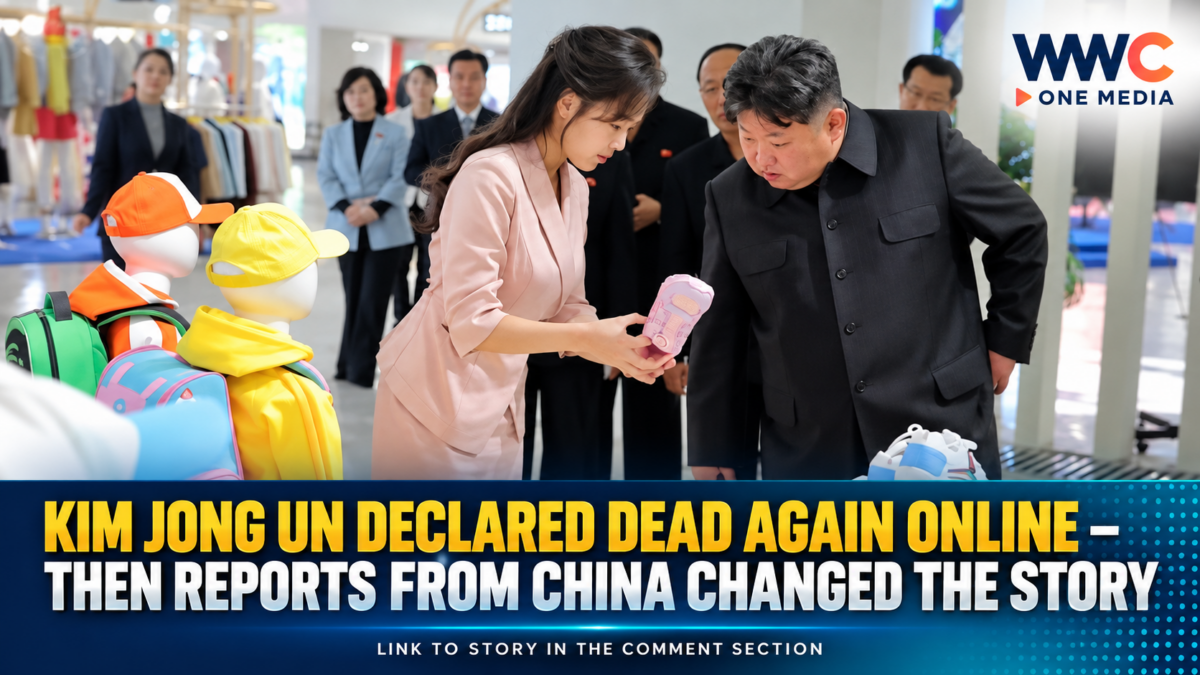
The rumors have since been contradicted by fresh developments. North Korean state media reported that Kim attended a clothing and footwear exhibition in Pyongyang on October 19. More significantly, Reuters reported on October 25 that Kim had returned to North Korea after visiting China’s border city of Dandong, where he toured a Korean War memorial and inspected a bus factory.
These reports provide a compelling reason to reject the viral death claims, although information about North Korea’s leadership remains difficult to verify independently.
Where Did the Latest Death Rumors Come From?
According to Yonhap, the latest wave of speculation reportedly originated from social media posts by Wanjun Xie, a Chinese dissident based in the United States.
The posts alleged that Kim suffered a serious brain hemorrhage, lost consciousness, and was transferred to Beijing for treatment because of limitations in North Korea’s medical facilities. They further claimed that he died and that his body was secretly returned to North Korea.
However, the claims were not accompanied by independently verifiable medical records, eyewitness accounts, or other credible evidence.
The speculation was subsequently picked up by several overseas media outlets, demonstrating how an unverified social media claim can gain international attention before the underlying facts are established.
North Korean authorities did not directly address the rumors. Instead, state media published photographs reportedly showing Kim visiting the exhibition with his daughter, Kim Ju-ae.
The photographs challenged the narrative that he was incapacitated or dead, although outside observers could not independently establish the precise timing of the images.
Sources: Yonhap News Agency, October 20 and 23, 2026; NK News, October 20, 2026.
Latest Reports Place Kim Jong Un in China
A significant development emerged on October 25, when Reuters reported that Kim had returned home after a one-day visit to Dandong, a Chinese border city.
During the visit, Kim toured a memorial commemorating China’s involvement in the Korean War and inspected a bus factory. His delegation included his sister, Kim Yo-jong, and Foreign Minister Choe Son Hui.
The trip also highlighted the continuing relationship between Pyongyang and Beijing. Kim crossed a newly opened bridge connecting the two countries, underscoring efforts to strengthen economic and diplomatic ties.
North Korea has also expanded its cooperation with Russia, making its relationships with both neighboring powers an important element of its foreign policy.
The reported China visit is especially relevant to the death rumors because it represents a major diplomatic development involving Kim after the speculation began.
Reuters and North Korean state media reported the trip and his return. As with other information emerging from Pyongyang, the details should be assessed with awareness of the limits of independent verification.
Source: Reuters, October 25, 2026.
Why Kim Jong Un’s Health Keeps Becoming an International Mystery
The recurring rumors reflect a longstanding problem: North Korea tightly controls information about its leadership.
Unlike political leaders in more transparent systems, Kim does not routinely disclose his medical condition or undergo public scrutiny of his health. His public appearances therefore become important indicators for foreign governments, intelligence agencies, and international observers.
Questions about his health have persisted for years because of reports concerning his weight, smoking habits, and potential cardiovascular risks.
South Korea’s National Intelligence Service previously assessed that Kim faced elevated cardiovascular risks but showed no notable signs of serious health problems during the period covered by its assessment.
That distinction matters. A potential health risk does not establish that a person is critically ill, incapacitated, or dead.
The lack of reliable information makes North Korea particularly vulnerable to speculation. When Kim disappears from public view, even temporarily, the absence of official information can create an opening for dramatic but unsupported claims.
The 2020 Episode That Exposed the Dangers of Speculation
The latest controversy recalls a major episode in April 2020, when Kim disappeared from public view for nearly three weeks and missed an important event marking the birthday of his grandfather, North Korea’s founder Kim Il-sung.
His absence triggered international speculation that he had undergone cardiovascular surgery and was either seriously ill or dead.
Some public figures and commentators made confident predictions despite the absence of independently verified information.
The speculation collapsed when North Korean state media published photographs and footage showing Kim attending the opening ceremony of a fertilizer factory on May 1, 2020, with the material released the following day.
His reappearance demonstrated how quickly an apparently convincing narrative can unravel when new evidence emerges.
Other rumors have circulated during periods when Kim or his father, Kim Jong-il, were absent from public events. Some episodes coincided with genuine health concerns, but speculation about death repeatedly went beyond what the available evidence could establish.
The lesson is clear: An absence from public view is not proof of death.
What Happens If North Korea’s Leader Suddenly Dies?
The rumors also attract attention because of the potential consequences of an unexpected leadership transition.
North Korea possesses nuclear weapons and maintains a heavily militarized relationship with South Korea and the United States. Any sudden change at the top could raise questions about political stability, military command, and the country’s future diplomatic direction.
Kim’s daughter, Kim Ju-ae, has appeared alongside him at several high-profile public events, prompting speculation about the future of the ruling family. However, public appearances alone do not establish that a formal succession decision has been made.
Kim’s sister, Kim Yo-jong, is another influential figure in the country’s political system. Her prominence has led analysts to consider possible roles she could play during a future transition, but speculation about possible scenarios should not be confused with confirmed succession plans.
A genuine leadership crisis would be closely watched by South Korea, China, Japan, the United States, and other countries concerned about regional security.
Nevertheless, there is no verified evidence that the latest death rumors have triggered such a crisis.
Why These Rumors Keep Returning
The cycle is driven by several overlapping factors: North Korea’s secrecy, public interest in the Kim family, uncertainty about succession, and the speed at which sensational claims travel online.
When official information is scarce, dramatic stories can spread before journalists and investigators have time to verify them. Repetition across social media and news websites can also make a claim appear more credible than its original evidence warrants.
That is why independent corroboration is essential, particularly when reporting on the health or death of a world leader.
For this latest episode, South Korean intelligence officials reportedly rejected the rumors, North Korean state media released images of Kim at a public event, and Reuters subsequently reported his visit to China and return home.
Together, these developments undermine the claim that Kim had died in the manner described in the viral posts.
For now, the evidence does not support the claim that Kim Jong Un is dead. The more revealing story is how a lack of transparency can repeatedly turn uncertainty about North Korea’s leader into an international rumor — and why credible reporting must separate verified developments from speculation.