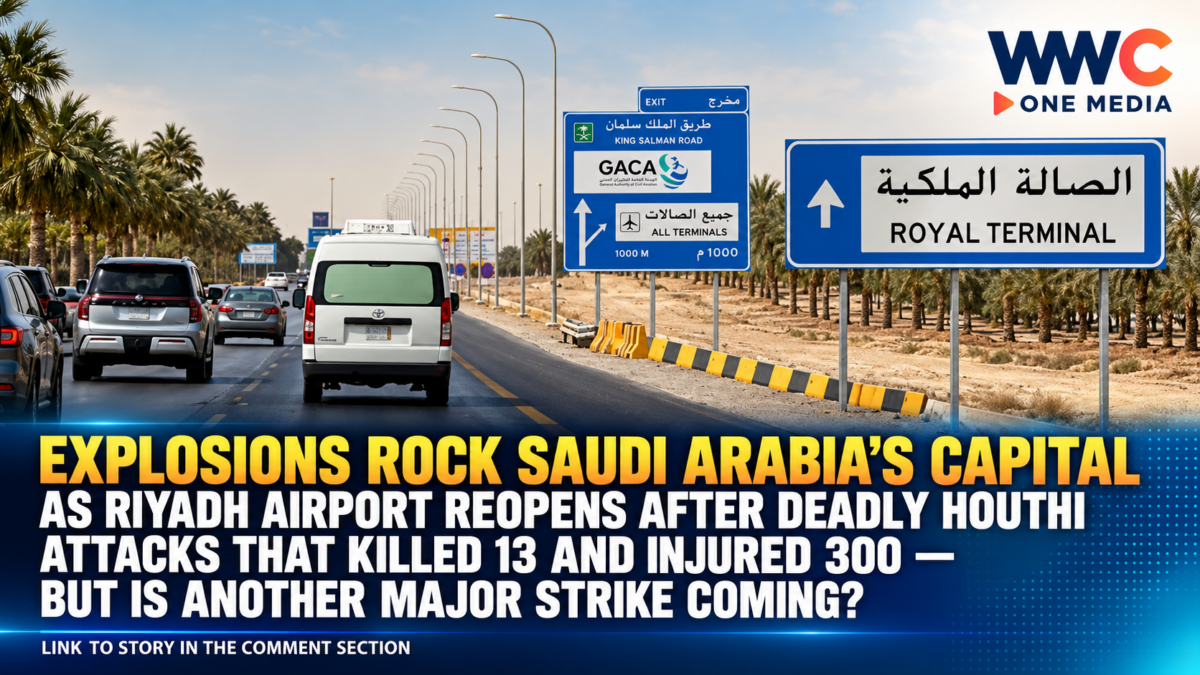
RIYADH, SAUDI ARABIA | October 25, 2026 — Saudi Arabia faced another frightening security alert on Sunday after explosions echoed across its capital, Riyadh, just as authorities prepared to resume operations at King Khalid International Airport following two weeks of disruption caused by attacks from Yemen’s Houthi movement.
The developments have raised fresh concerns about passenger safety, regional aviation, international oil supplies and the possibility of a wider military confrontation in the Middle East.
According to reports from Agence France-Presse (AFP) and Channel NewsAsia, three explosions were heard in Riyadh during the early hours of Sunday. Residents received emergency alerts warning of an incoming aerial threat and instructing them to seek shelter.
The Saudi-led military coalition subsequently announced that its air defence systems had intercepted and destroyed a ballistic missile directed toward Riyadh, along with two drones in the capital region.
The explosions came at a particularly sensitive moment, with Saudi authorities attempting to restore international air travel while confronting renewed attacks from the Iran-aligned Houthis.
Riyadh Airport Reopens After Attack That Killed 13 and Injured More Than 300
King Khalid International Airport, one of Saudi Arabia’s major international aviation gateways, had announced plans to resume flight operations on Sunday after approximately two weeks of closure.
The shutdown followed repeated Houthi attacks, including a devastating strike earlier in October that killed at least 13 people and injured more than 300 others.
The attack was among the deadliest to hit Saudi Arabia in more than a decade.
Flight-tracking information indicated that at least one aircraft departed early Sunday, suggesting that some flight activity had resumed despite the continuing threat.
Gulf News separately reported that operations were scheduled to restart at Terminals 1 and 2, with airport authorities advising passengers to check directly with their airlines before travelling.
However, the reopening has not eliminated the risk of further disruption.
Houthis Warn Airlines: Riyadh Airport Remains a Military Target
The Houthi movement issued an explicit warning against using King Khalid International Airport.
Houthi military spokesman Yahya Saree described the airport as unsafe and claimed that it remained a legitimate target for the group’s military operations.
The movement warned international, regional and domestic airlines, airport personnel and travellers against using the facility.
The threat comes as the Houthis continue their confrontation with Saudi Arabia following the collapse of a years-long truce in Yemen.
The group has also claimed attacks against other Saudi airports, energy installations, an oil pipeline and a military airbase within a 24-hour period.
While the latest Saudi interceptions were officially announced, the precise circumstances surrounding the explosions and any resulting damage had not been fully established in the initial reports.
Mecca and Medina Also Report Missile Debris Incidents
The security situation extends beyond the Saudi capital.
Saudi Arabia’s civil defence authorities reported responding to falling missile debris in the Mecca and Medina regions on Saturday following reported interceptions.
The two cities are Islam’s holiest locations, making any threat near them especially sensitive for the kingdom and Muslims worldwide.
The Houthis rejected accusations that they deliberately targeted the holy cities, describing Saudi allegations as false.
These conflicting claims highlight the difficulty of independently verifying battlefield statements as the conflict intensifies.
Reuters: Saudi Aramco Evacuation Highlights Growing Energy Threat
The military escalation is increasingly affecting Saudi Arabia’s energy industry.
Reuters reported on October 21 that Saudi Aramco had instructed personnel to evacuate its headquarters in Dhahran and work remotely as attacks on the kingdom intensified.
The report, citing six sources, followed repeated attacks on Saudi energy and aviation infrastructure.
Reuters also reported that an attack on King Fahd International Airport near Dhahran killed two people and injured eight others.
The latest developments have intensified concerns about the security of Saudi Arabia’s energy infrastructure and the potential impact on global petroleum supplies.
Saudi Arabia is the world’s largest crude oil exporter, and prolonged disruptions could place additional pressure on international fuel prices, airline costs and inflation-sensitive economies.
Why the Yemen Conflict Has Escalated Again
The renewed fighting follows the breakdown of a United Nations-brokered truce that had significantly reduced cross-border attacks after 2022.
The Houthis, also known as Ansar Allah, have expanded their military activities while Saudi Arabia continues supporting Yemen’s internationally recognised government.
Reuters reported on October 14 that the Houthis’ advances along Yemen’s Red Sea coastline, including their control of the strategically important Bab el-Mandeb Strait area, have created additional security concerns for international shipping.
The narrow maritime passage connects the Red Sea to the Gulf of Aden and forms part of a vital shipping corridor linking Asia, Europe and the Middle East.
Any sustained instability could affect vessel movements, freight insurance, shipping costs and global trade routes.
The confrontation is also unfolding against the backdrop of the wider US-Iran conflict, adding another layer of geopolitical uncertainty.
Could Saudi Arabia’s Vision 2030 Be Threatened?
The intensifying security crisis presents another challenge to Saudi Arabia’s ambitious Vision 2030 economic transformation.
The kingdom has invested heavily in tourism, aviation, entertainment, infrastructure and international business as part of its efforts to diversify beyond oil.
However, continued attacks on major airports and energy facilities could complicate these ambitions.
Reuters has highlighted the risks that renewed conflict poses to foreign investment, Saudi Arabia’s economic transformation and confidence in the kingdom’s security.
Airport shutdowns, military alerts and threats against essential infrastructure may also influence business travel and international investment decisions.
The challenge facing Riyadh is increasingly complex: maintaining national security while convincing investors, tourists and airlines that the country remains safe for business.
What Does This Mean for Filipino Workers and Travellers?
The developments are particularly relevant to Filipinos living and working in Saudi Arabia and elsewhere in the Gulf.
Further attacks or airspace restrictions could potentially affect international flights, connecting journeys and travel plans for overseas Filipino workers.
Passengers travelling through Riyadh should confirm flight status directly with their airlines and follow airport and local government advisories.
Filipinos in affected areas should also monitor official Philippine diplomatic announcements and avoid circulating unverified social media reports about explosions or attacks.
There was no confirmed information in the reports reviewed establishing Filipino casualties from Sunday’s Riyadh incident.
What Happens Next?
Saudi Arabia’s effort to reopen King Khalid International Airport could become an important test of its ability to restore normal civilian operations amid an increasingly unpredictable military confrontation.
The kingdom’s air defence systems have reported successfully intercepting incoming threats, but renewed warnings from the Houthis indicate that the danger has not disappeared.
Three questions now dominate the situation: Can Riyadh maintain safe commercial flights? Will the Houthis continue targeting Saudi aviation and energy infrastructure? And could the latest escalation push the region toward an even more destructive conflict?
For now, the airport reopening represents a cautious move toward normality — but the explosions heard across Riyadh underscore how fragile that normality remains.